
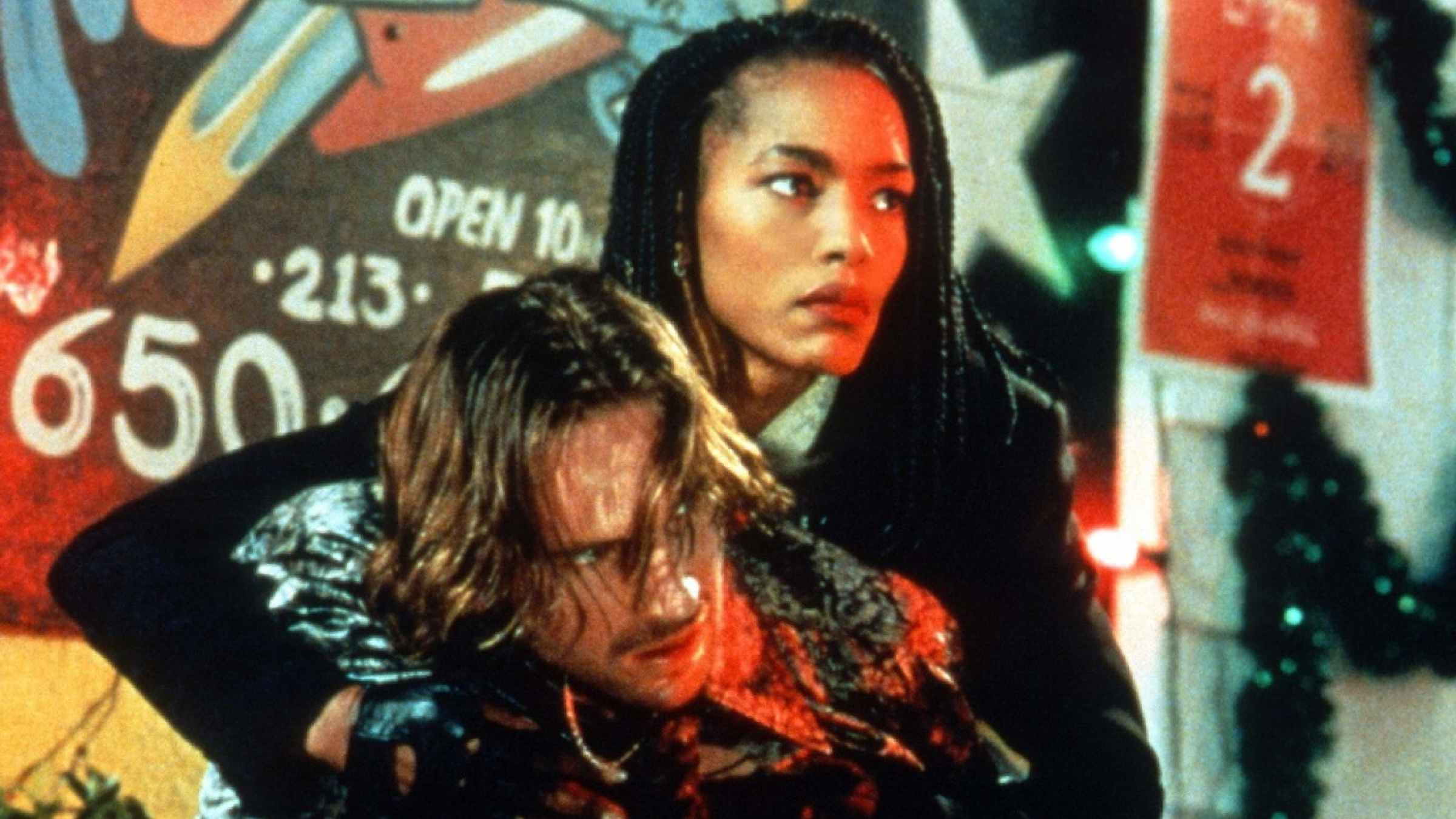
Strange Days opens with a remarkable moment of cinematic voyeurism, a morbid act of willful complicity disguised as sheer kinetic pleasure. In first person, we watch as a would-be robber is frantically chased out by the police, ultimately falling to his death. Soon enough, we’ll learn that we’ve been watching a virtual memory, one that can be felt and experienced through a proto-VR headset, and one that is sold by nebulous street urchin and creature of the night Lenny Nero (Ralph Fiennes). We will also learn that Nero is tormented by his own memories of ex-flame Faith Justin (Juliette Lewis), who now runs with bigger fish crime lord Philo Gant (Michael Wincott, so you know it’s a mid-‘90s film). He, like the film’s opening, is willing to run head-first into a violent world, and he is only held back from his darker impulses by a platonic but ambiguous relationship with extraordinarily competent bodyguard and driver Lornette “Mace” Mason (Angela Bassett). These relationships will expand and knot and inflame and fold in on themselves over almost 150 minutes of screen-time, but, for the first few minutes, we are in a blissfully neurotic and disturbingly ecstatic cinematic present-tense, a scene which impels us to look and to look away in equal measure, and during which we can think of nothing else.
Here, in the first minute, director Kathryn Bigelow updates her breathtakingly fluid-frenetic chase sequences from her prior apex Point Break, itself a story about how an audience-surrogate is tempted by the anti-social thrills the promise of escape offers, into a deliciously disturbing treatise on the uncanny thrill of cinema itself. Demanding that we participate in the act only to have the violence turned on us as we fall to our doom, the film opens with a self-implicating gesture that serves as Bigelow’s fullest statement of art not as a beautiful getaway but an elegant trap that invites and disfigures us in all its grueling and emotionally invigorating but disturbing and self-assaulting complications.
While this isn’t without its tensions and difficulties, even what we might call failures, and arguably the film’s overall interest in technological voyeurism is more notable for its vigorousness than its originality (given that the theme received such a consistent showcase in Hitchcock’s films, among many others), Strange Days is a pretty nervous, pulsing stylistic and conceptual workout that remains far more legitimately troubled about more serious topics than most films of its budget would even know what to do with. A pungent fulfillment of what her ex-husband James Cameron more than a decade before called “Tech Noir,” Strange Days explores themes of voyeuristic addiction and self-flagellation by playing around the boundary between filmmaking, fetishism, and observation in a way that borders on cinematic autoerotic asphyxia. It feels like the film is trying to destroy itself, dazzlingly so at times, but never loosely nor arbitrarily. This is throat-knot political popular cinema of the finest variety.
Continue reading




 The Long Take