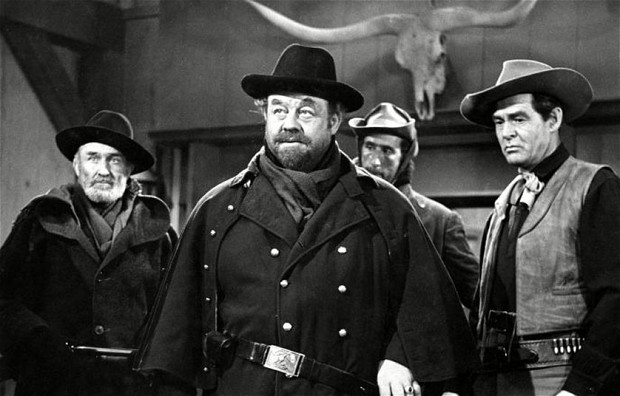
Category Archives: Fragile Frontiers

Fragile Frontiers: The Searchers

While the received wisdom about the Western genre presents it as an assured space of spiritual solitude or a canvas for self-betterment through restorative strenuousness, you’d be hard-pressed to find a Western more worried about its own beliefs than John Ford’s The Searchers. The only thing really working against the film is how thoroughly its reputation precedes it. Its self-critical nervousness has paradoxically been suppressed and composed over decades into a vision of the solemn, self-assured object imperially judging its forebears. This is a supposed masterfulness that the film itself may not need, nor ask for. But, of course, that is the difficulty, and the paradox, of John Ford. The Searchers is entirely aware of the cultural baggage it carries. Far more than era-concurrent works like Anthony Mann’s Winchester ’73, it self-consciously courts, and creates, the mythopoetics of the frontier space as a moral battleground –  rather than Mann’s amoral void – on which the fate of the proverbial nation is to be staked. Its screenplay by Frank S. Nugent, based on the novel of the same name by Alan Le May, is transparently freighted with the heavenly wisdom of the noble stranger archetype, the paradigmatic American: isolated in their heroic, if tragic, dignity while being able to fluidly move into and out of various social milieus without being “of them.” This is a film that seems to have recognized how important it was before it was released, something that usually spells death for a living, breathing work of art. Yet rather than solidifying itself into a work of serene self-criticism, the interesting thing about Ford’s film is how worried it seems to be that it hasn’t actually figured out what to say about the genre laid out before it. The genre, in Ford’s vision, is not a passive resource to be either churned into self-conscious mastery nor to be dismissed or depleted into a ruse, which of course would only be another way for the film to celebrate its own assurance that the genre was morally repugnant. The West, in The Searchers, is neither a landscape to excoriate nor to celebrate. It is a vast store of uncertainty, a wellspring of consternation.

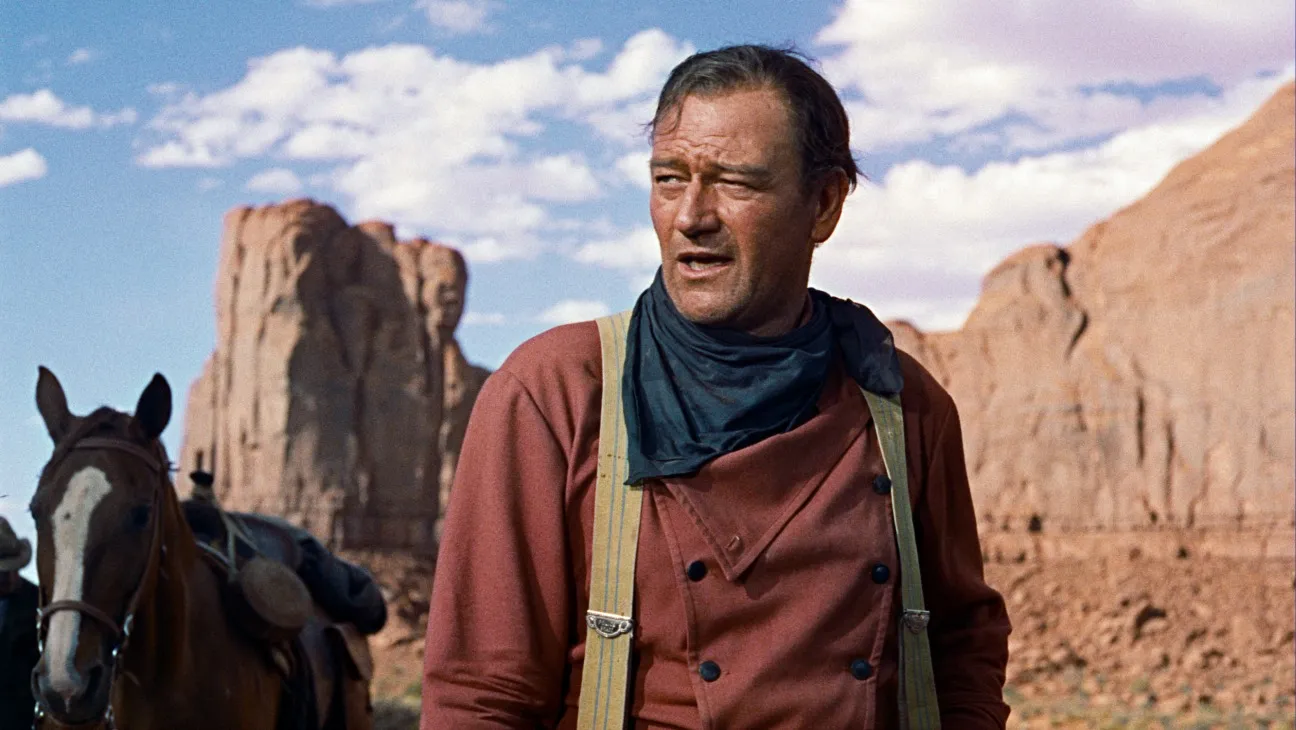
That doesn’t mean The Searchers doesn’t court the favor of its genre. The film’s interest, unlike so many heroes of the classic West, is that it transparently can’t escape its history, which means it must draw on the very mythos it can’t figure out. Wayne’s Edwards, the Western wanderer, is clearly the most capable man in the film, but he is also the most dangerous. He remains the film’s icon figure, like any good Western, but he is also the vortex around which the film distorts itself and the precipice it must confront but cannot fully peer into. While Wayne’s famous character introduction in 1939’s Stagecoach projects an imposing, all-consuming monolith overcoming a figurative landscape which he himself apexes and dwarfs, here he enters the film strolling in from a landscape that still seems to consume him, into a door that cannot fully protect him. While Stagecoach literally enacts the triumph of human over landscape in that moment of charged, almost phallic agency, The Searchers is a world in which humans seem essentially trapped in a tide of violence and vengeance that defrays the teleological, progressive structure that Manifest Destiny was predicated on. This is a not a man erected as a savior and defiler of a material, almost anthropomorphized abundance, but a lonely fellow who has come in from the cold, only to find that he imperils the very domesticity that he claims to protect.

Continue reading

Fragile Frontiers: The Lusty Men

Watching a Nicholas Ray film, it’s hard to feel good about the state of mainstream cinema in the 2020s. Ray never shows off. He doesn’t arrogate the full force of his talent to specific, privileged scenes. His films don’t explode off the screen. Instead, they achieve a kind of surface tranquility through the many febrile currents teeming within. His films superficially comply with the accepted forms of mid-century Hollywood, drawing out their inner plasticity and complexity without ever trying to make a show of exceeding them. In an early scene, aging yet apparently accepting ex-rodeo star Jeff McLoud (Robert Mitchum) returns home to his Texas birthplace after 18 years of itinerant stardom. The old man who lives there now recognizes him as the child from long ago, and they comically commiserate about the vagaries of achievement and the limits of desire.

The problem with “books on success,” the older man intones, is that they are written by “successful” people rather than “written by a failure.” In a long-shot, Ray holds on the older man on the right, shuffling around in the background with his normal routine. On the left, in the foreground, is McLoud, Mitchum letting his eyes loose on the part of the room we can’t see, seemingly taking in a vision of his past that the film does not afford us, a corner of the room that remains invisible to everyone but McLoud who, we intuit, has simply never stopped hustling for long enough to recognize that he has a past. This is a phenomenally suggestive image, Ray looking on at the two men who are sharing a story (and a mental framework) while also surviving within two entirely different registers. For one man, the house is a question of existence, and for the other it is an existential question.

Yet Ray has to insist on nothing, exposing layers of emotional reality without the characters speaking a word. This, more than anything, is what Jean-Luc Godard meant when he famously said “cinema is Nicholas Ray.” Reader, this is such a simple scene, such an apparently basic visual composition, but when do we see movies that actually even think about character blocking anymore?

The Lusty Men, in this fashion, is a quietly desolate film, the kind of piece about wayward, astray people who are so caught-up in the moment that they don’t even really understand themselves as being unanchored. In this modern-set Western, people are trapped by the vortex of the past and unfulfilled anticipations of the future, lost in a present that cannot fulfill them, or that they cannot allow to fulfill them, lest they give up on their self-imposed narratives of future, forever-deferred success. A Ray film is caught up in itself this way, aware of its energy but unable to stop it for more than a second at a time. The Lusty Men, then, is a film that knows how to kick up dust and to acknowledge the dust in its eyes, that aspires to and cowers before its own hell-raising. It thrives on the vitality of its ragged men and women, but it understands this raggedness as both a friction and a premature death. Ray was what we might call a weirdly expressionist naturalist, his cinema too hot and heightened to hold onto a reality bucking underneath it and too cold and sober to not recognize how tenuous its grasp really is. His cinema projects the fantasies his characters survive on, and it has a drink for the detritus of their being.

Continue reading

Fragile Frontiers: Forty Guns

There’s a scene in Forty Guns where the protagonist Griff (Barry Sullivan), finding himself in the middle of an impromptu high noon standoff, chooses not to draw his gun but instead to walk straight up to his antagonist and paralyze him in his tracks. As filmed by renegade writer-director Samuel Fuller, it’s not a beautifying celebration, a poetic coalition between gunslinger and camera-wielder, but a sudden invasion by a force that is too big, too insoluble, for the film screen to contain. He is assaulting the distance between camera and audience, and turning us to stone. This is a man who, with just his eyes, visualized so menacingly and brutally in pulverizing Cinemascope that he achieves a kind of Leone-esque abstract menace, not only commands the screen but exceeds it, cannot be contained in it, tries to rupture it with the sheer charisma of his uncontainability.

Fuller directs the way Griff walks. His style is both brazenly minimalist and bracingly direct, willing to state everything it needs to and never desiring to say more. At one point, a trial is initiated and concluded all within a single shot, a tacit admission of the limitations of the judicial system on the frontier conveyed, a visual travesty of justice that the film needs no other scenes to explain. Fuller gets right to the point here, while also arguing, with withering, savage grace, that the point has very much been avoided.

Continue reading

Fragile Frontiers: Day of the Outlaw

You can feel Day of the Outlaw grappling with itself from the first, forlorn shot of a snow-struck limbo as two men silently wander from left to right. Unlike many classic oaters, they don’t seem to order the screen at their command as virile archetypes of stoic masculine reticence. Rather, they seem like they seem to ride less above the land, superior to it, as atop it, at odds with it.   The snowbound setting can’t but bring to mind McCabe & Ms. Miller, Robert Altman’s amazing, soul-shattering cosmic moan where the West is a demonic ground and a tragic, aching slow-motion catastrophe. In the intervening years, the self-critical version of the genre has increasingly felt like a parody of itself, an arbitrarily nihilistic approximation of depth rather than a genuinely exploratory attempt to inhabit the genre generously, from within its terms, to critique it.

While many of these subsequent Westerns self-consciously explore the genre’s violent origins out of a kind of kind of half-hearted expectation, Day of the Outlaw is a legitimate, forgotten premonition of McCabe:a Western that felt like it was earnestly exploring the American frontier not out of a forced expectation or a conscious desire to interrogate established rules but through the violent indecision of inhabiting the genre so thoroughly that it can’t but grapple with its contradictions and feel out the limits it may not actually want to trespass on. There’s no mission statement with Day of the Outlaw other than a general desire to give us more than we bargained for, to take a set of themes we expect the film to ease into and instead to malform them by recognizing their own potential for disruptive complexity. Day of the Outlaw is a film continually in the process of discovering a radical otherness within itself.

Continue reading

Fragile Frontiers: Four of the Apocalypse

Aficionados of Lucio Fulci, perhaps the most savagely lurid of the most savagely lurid of the Italian horror giallo maestros and the least willing to sanctify his violence in a beatifying aura poetic abstraction, might be surprised to know that he did not fully commit to being a horror specialist until his sixth decade on this earth. His genre classics, which dare to descend into the darkness of the human soul at its most unvarnished, are cruel conduits for seemingly arcane, voracious forces that seem to congeal out of an unclaimed past. Yet even when he eschewed the formal trappings of the horror genre, Fulci seemed to tap into devious currents nonetheless. His was a cinema charting the existential breakdown of enlightenment ideals, an intrepid explorer of the darkness of the light. His greatest films merely use horror as a canvas on which to the frayed boundaries of reason and the murkiness of faith in progress avail themselves before us. His films, sloppy and with awkward edits that seem to come from some frayed corner of the mind, are dark impastos that stare at what we’d rather look at with downcast eyes, portraits of human abjection as vicious and primordial as cinema has ever produced.

Case in point: his downright malevolent travesty of an Italian Western, Four of the Apocalypse. While Italian filmmakers like Sergio Leone had exalted the genre as a hallucinatory canvas for piety and blasphemy to battle it out, and plenty of other Westerns essentially understood the genre as a boundlessly open space of anarchic creativity, Fulci’s Western is a shadowy vision of disgruntled sociality captured with Fulci’s primeval immediacy and narrative inexplicability. It begins with four characters in search of an exit, condemned souls who are, in a ruthlessly wicked gesture, only saved from a vicious massacre by their imprisonment. It ends with one interloper who found and lost a family set adrift in the desert sea to probably repeat this story time and time again. In the intervening span, Fulci turns the inviting landscape of the West into an unforgiving, unfathomable vortex that is also a cosmic abyss, a landscape that seems to extend for eons and to coagulate into a portrait of celestial nothingness.

Continue reading