Writer-director Avery Crounse, who fittingly became lost between rustic New Hollywood authenticity and synthetic ‘80s artificiality, is not only a conjurer of darkness but a scion of America’s very liminality, an acolyte of the spaces between existing categories. His first major feature Eyes of Fire feels like it could as easily have come out in 1923 as 1983, like it could depict 1750 as easily as 2250. It’s a lost film, a cinematic netherworld where time stands still and folds in on itself, a text that seems to be going from somewhere to somewhere else but never to exist anywhere, or to arrive at anything. Visualizing America’s wilderness years, and produced within its own cinematic wilderness, Eyes of Fire is a road-weary, ramshackle merry-go-round of contraband people in search of opportunity and the underground operatives – the seemingly deceased but still very present histories – that turn this period of America not only into savage terrain but demonic ground.
Demonic, that is, to the characters who are apparently our protagonists, but not to those dormant but not domesticated pasts rumbling beneath them that have less interest in going gracefully into the good night. In Eyes of Fire, Crounse limns the crepuscular underbelly of a pre-revolutionary American landscape clearly on the verge of becoming something else, but not quite sure what yet, a non-nation that remains hesitant about what sets of ideas would shape and provide contours to its empirically unstable ground. These national values, the film suggests, would be binding fictions, ideas of togetherness that would attempt to overwrite an aching land with visions of harmony. This framework of national unity comes undone in Eyes of Fire, slowly unweaving and then, with frightening quickness, collapsing from relatively stately solidity to fractal, fissioning landscape.
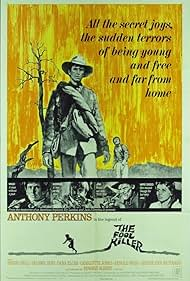
The titular not-quite protagonist of Servando Gonzalez’s The Fool Killer, played with curious intransigence by Anthony Perkins, embodies the American mantra of authenticity, a vision of self-reliance that is also self-delusion. His character wants to “eat when I’m hungry, talk to folks when I want to and not when I don’t, and see the world,” a mid-20th-century rebel without a cause in the garb of a mid-19th-century fugitive folk tale. He’s also a man “without history,” an aspiration to be pure momentary itinerancy, a paradoxical thing that is concept but also flesh and blood, a collection of bounded matter but also a free-floating spirit, something entirely unmoored from any kind of tangible relation with the world even as it floats all through it. He’s a dark Thoreauvian creature who resonates with that American prophet’s beautiful, redemptively spiritualized vision of matter and its unrestrained double, a self that is unaware of its debt to the world, that is all spirit and has no connection to the world’s matter at all. This is the self-isolation and feverish hunger for personal authenticity that would only turn the characteristic American craving for independence into a means of making men and women into appendages of the very mechanisms they nominally opposed.
This lode-bearing cinematic creature is also a mythological force, coalescing out of the very ether that marked 19th-century American dreams, galvanized here by the film camera. He doesn’t appear in the flesh for a long portion of the film, yet he seems to exercise real power over the text, asking the camera where it should position itself in relation to him, whether or not it can visualize him, and whether being visualized, taking on bodily form, separates him from himself, makes him become mere matter. Like art itself, he is menacingly passive, apart from the world but both reflecting and shaping that world, providing a vision of troubled American myths for us to reflect on. He is introduced with the camera taking his perspective, before a series of cuts inward onto his eyes, dominating the frame, suggest an invasive specter, a fragile phantom known as personal freedom that only occasionally corporealizes but exerts an inexorable pull on the nation’s conscience. He is a cinematic revenant, an illusory but impossibly-sticky harbinger of an America envisioned as a gathering darkness.
Rosewood’s most salient character is a figure who seems to recognize that he has walked into Rosewood out of an entirely different film and that he wears a century of American cinematic lore on his back. He is a cowboy, a disciple of the wandering lifestyle that has its roots in the nebulous core of American life. He is an opaque drifter as archetypal as Shane or The Man with no Name or McCabe. Indeed, he isn’t even a man with no name. He is named Mann (Ving Rhames), a self-consciously iconographic masculine drifter who wears his self-composure and cultivated distance from history on his sleeve. His icy competence, ably displayed throughout the film, is tethered to his dispassionate reserve, his displacement from the forces of history that have shaped him and his aspiration to act as though he is beyond those forces even as he fully embodies an icon that itself constellates and coagulates the forces of American lore. He can help save the town of Rosewood, an African American oasis in the middle of Jim Crow Florida that he wanders into, for the same reason that he doesn’t want to. He has seen history weighted against his, and their, Blackness, and he has decided to abscond from history. Rosewood is the story of that man recognizing his own complicity with those historical forces. It is his attempt to redirect them in an insurgent, counter-historical assault.
This film’s obvious interest in Mann’s predicament, and its concern about that interest, is felt in every frame, not only because it is the film’s story but because it is its ontology, which is to say, its own being. That’s because Mann is also a cipher for writer-director John Singleton’s own combative, conflictual relationship to the Hollywood machine, to a force he both wants to claim as his and a fear that it neither wants him nor he it. In hoping to wrangle forces of history and structures around him like an itinerant, independent maverick, a man who is inside and outside the world, he weaponizes the forces of his oppression against them. Just as Mann tries to embody the American cowboy figure against itself and emerges unsure about its final value, Singleton plunders the American picture-book both to invest in the cultural markers of resistant Americanism and to imply that they may not actually be worth saving.
Singleton’s neo-Western style, reinterpreted and strip-mined for a radical poetics, finds a cipher in Mann, an ex-soldier who, like many other African Americans after the Great War, aspired to “close ranks” with white Americans, a showcase of American piety that quickly became a reckoning with the limits of sacrifice. For many returning African Americans, an aspirational hope of national togetherness quickly exposed feelings that their faith had been misplaced. Displays of support for the American spirit, they realized, had severe limits as a basis for a progressive politics or the facilitation of a joint racial venture of national development.
The war, then, was also a frontier of a kind, a space in which many African Americans reported experiencing the loosening of social structures and the inherited assumptions from their life in the U.S., seeing equal treatment for people of multiple races for the first time not in the U.S. armed forces, which were segregated, but in European society. W.E.B. Du Bois wrote that African Americans “returned from fighting” and they “returned fighting,” and the renewed vigor to fight oppression felt by many African Americans reflected a sensibility girded against forces of oppression at home and abroad.
Mann begins the film reflecting this ambivalence. He is certainly unqualified in his agency. He has no qualms about displaying his frustration with racism. But his solution is a retreat into a decidedly individual life, a turn to a world apart, one within the confines of himself. His frontier horizon is not to change the system, but to escape it. Yet Rosewood, the town he discovers, is also a frontier in another sense. Rather than easing us into the acceptable pathways of liberal American multiculturalism, as most Hollywood history films of its vintage did (and still do), Rosewood makes a claim on a region of Black history outside the harmonies of what Gunnar Myrdal called the “American creed.” The African American town of Rosewood is one in which the Black residents have fashioned a collective rejection of America. They’ve accepted the Faustian bargain of segregation as a slantwise path to possibility, if not progress.
Indeed, Rosewood travels in one of history’s forgotten trenches here, an unexpected, seemingly oxymoronic frontier not in the Wild West but in the Deep South, where the seeming fixity and entrenchment of history can belie odd occurrences and improbable freedoms born out of the trickster god that is history, a space in which people do not act according to code. It was in the backwoods of Florida that the first independent Black town in what would be the U.S. was founded near St. Augustine, when the area was still controlled by the Spanish. It was in Florida where Mary McLeod Bethune led an African American school for girls. Authors like Zora Neale Hurston would go on to parlay their life within modern independent Black communities in the South (Florida, in her case, as well) into inspired cultural commentary on the beauty and complexity of communal Blackness uncoupled from any claims on white society. The independent African American town of Rosewood, much like Mann’s recalcitrant refusal, suggests a renewed commitment not to invest all of one’s faith in the gradual evolution of American civic-national opportunity. Instead, the people of Rosewood look to make freedom and progress on their own terms, not by kindling with America’s hopes but by tracing America’s shadows. Focusing on their own space, the people of Rosewood suggest, might actually attack discrimination from a different front, wielding the admittedly back-stabbing weapon of segregation in a way that carves out some opportunity, however dubious, within it.
As with Mann’s masculine individualism and Singleton’s Hollywood filmmaking, this path is also an attempt to wield structures of inequality as best they could, to survive and work with the devil, to hold one’s own in the belly of the beast. History has been ambivalent about these paths, as, importantly, have Black radicals, many of whom, even in the 1920s and 1930s, felt that interracial class-based solidarity was the only viable way to pursue real, lasting change in a world of increasingly interconnected capital. A Black town would never escape the structures of racial inequality. It could only, much like Mann’s projected vision of cowboy charisma, hold them at bay.
Rosewood recognizes this problem. While it is distinctly a film about a Black community’s hard-won, albeit incomplete, security, Singleton’s text is also unusually attentive to the dynamics of white attitudes toward Jim Crow, attitudes that inevitably limit the possibilities afforded the Black characters when a lie stokes the simmering racial tensions into a full-blown holocaust. When the white residents of a nearby town run riot over the residents of Rosewood, raising it to the ground, they show little remorse for their actions. Those who did, Rosewood suggests, may be no better. In a grave, gravitational shot, one that seems at once to center the film, to hold it close to the ground, and to force it to confront its demons, Sheriff Walker (Michael Rooker), who has been nominally trying to hold the white mob at bay, raises up in the foreground, center-frame, suddenly blocking the massacre’s first black body being hung directly behind him. This isn’t the film’s plea to empathize with this white man, a wounded expression of the white man’s soul asserting moral and epistemic precedence over the Black man’s body. The film will not shy away from raw confrontation with the desecration of Black flesh throughout, but, in this image, the point is precisely that this white man’s feelings of guilt are taking up time and literal screen space over the actual story of the dead Black person. Walker constantly adopts a masquerade of unearned beneficence in the interest of making the story about him rather than acknowledging the grotesque brutality he has condoned and legitimized. He looks forward in the frame, apparently certain yet actually lost amidst the contradictions of history he wants to have move forward and stand still, whereas someone like Mann effaces himself and relies on reticence and ambivalence to radiate a quiet dignity and, when need be, a brutal charisma. It is Walker who cannot see the myopia of his missionary self-image, and the limits of his self-aggrandizing brand of brittle liberalism, not Singleton. He is, as it were, an allegory for a white Hollywood happy to array itself against white racism when it is played with a country accent and knotted into a rope but not when it is wielded by apparently more enlightened forces.
Singleton’s investment in and ambivalence about Hollywood cinema is apparent in nearly every frame of Rosewood, a film that sees him shun the position of a fervent acolyte of cultural inclusion to become, instead, an armored interpreter of America’s worth. He adopts the position of a volatile vagabond moving through Hollywood’s trenches, a renegade man wrestling with his own inner frustration, perhaps his own inner complicity, and turning those aspects of himself against the system that condones them. His film doesn’t fully escape this system. But that’s the point. This is tenuous stuff for a provisional history. Rosewood imagines no inexorable march of progress. It doesn’t lead us, Moses-like, into a better world. It submerges us into a conflictual netherworld in which the forces at play in the world are never stabilized, in which the niceties of civilizational advance are always potentially surface level masquerades for churning material tensions that have to be constantly maintained by implicit threats and by the possibility of more overt forms of violence.
Ever attentive to these knots of history, Singleton does exquisite compositional work throughout. His multi-sided, prismatic frames situate humans with and against each other, their surroundings, and the wider world. Unexpected truths are clarified to our eyes that are only dimly apparent to the characters themselves. Late in the film, for instance, John Wright (Jon Voight), a liberal white store owners and one of the few white residents of Rosewood, walks back home to his house, perhaps the only building left standing in town, when the camera attunes us, but not him, to the body of his Nlack employee in the foreground. She lies dead in the road because she couldn’t bear the thought of being harbored by the man who, although seemingly caring, nonetheless showed little compunction about asserting himself onto her sexually earlier.
The shot inverts the image of the sheriff rising above the dying black man. Here, an ambivalent, if finally more heroic, white man recedes into the distance, perhaps to a renewed conviction or perhaps to an unchanged moral compass, as the camera moves us to the position of displacing him with the body of a dead Black women who he has, metaphorically, turned his back on. This is a vastly more frustrated, frustrating, hesitant portrait of white liberalism than another Hollywood film, with its self-serving, artificially redemptive aura, would have managed. Wright is an essentially permissive man, open to the structures of liberal modernity, but he is also a capitalist who obviously feels good about himself for exhibiting a more enlightened disposition to the Black residents of the town. He is a vision of Janus-faced white American modernity, embodied most clearly in the film’s final climax, where he boards a confiscated train, a symbol of modernity, to Jacksonville, while the two Black men who are the film’s other heroes ride off together on horses, unable to participate in this story of modern progress and unwilling to forget the violence it was built on.
When Mann and Wright salute at the end of Rosewood, having worked together to save the Black children of the town, the film doesn’t necessarily understand this as a moment of commiserative honor. Their ex-military camaraderie, consummated in a shared salute, is as much a display of their confusion about their own commitment to any cause other than their own survival throughout the film. These are the two most liminal men in the film, neither with or apart from the Black town. Mann, for his part, has finally decided where he stands. Wright, conversely, seems to want to sit on the fence. He is a man who is theoretically likely to go back to his own ways, who disowns abject violence but is also accepting of structures of oppression insofar as it suits him. Rosewood is fully aware that his participation in the heroism of the climax may be pyrrhic, that Wright may go back to his old life, whereas Mann and Rosewood resident Sylvester (Don Cheadle) seem to be riding through a nation that has no safe place prepared for them.
It is Sylvester, then, who exhibits the film’s other revealing arc, the one which forces him neither to recognize his participation in a hopeful community nor to reckon with his complicity with an oppressive one but to acknowledge the decimation of his community and apprehend its continuance, albeit in a new form. A member of Rosewood, Sylvester is an embodiment of the educated Black landowning class who is emboldened and hesitant, who knows how to wield a veiled threat and stand up for his rights and to demur and mask his indiscretion without fully denying it. He is, with a piano or a gun, good with his hands. Yet he can only survive the film by hiding in his mother’s casket at a pivotal moment. He is nearly buried with the remains of the woman who reared him, played by Esther Rolle, whose most famous role, matriarch of a compassionate, fragile Black family for the modern urban world, reared many youths on intra-relationships in the Black community and the liminality of freedom even in the “progressive” North.That character, of course, was named Florida, an echo of the Black Southern past still alive in the North. Sylvester’s return at the end of the film is a metaphorical rebirth born out of a closeness to death, a near-demise that hammers a new man out of the currents of historical oppression and human agency. His is a life through which Singleton weighs the competing urges of staying and going, resisting and demurring, holding onto the possibilities etched out of an oppressive past and locating a new future.
With a fire and brimstone cinematic charge, Singleton creates a historical double-sided sword that exhumes the hellish currents of Jim Crow segregation as a lamentable, damned land that nonetheless radiates collective humane warmth and possibility forged in spite of the structures around it. While Mann has to relearn what it means to connect to a history and a community, Sylvester transmutes his inheritance into a new creation, not as something to myopically hold onto and curate but as material out of which something living might be created. This is perhaps Singleton’s vision for himself, as an interpreter of classic Hollywood luster and a griot harnessing cinema’s potential for coaxing out the collective, compositional relations tying humans and structures. He weaponizes the history of people in place, living and dying in a horrible world, bearing witness to an imperfect existence as they act with the feel for a better one insurgently pushing its way into the grime of the now.
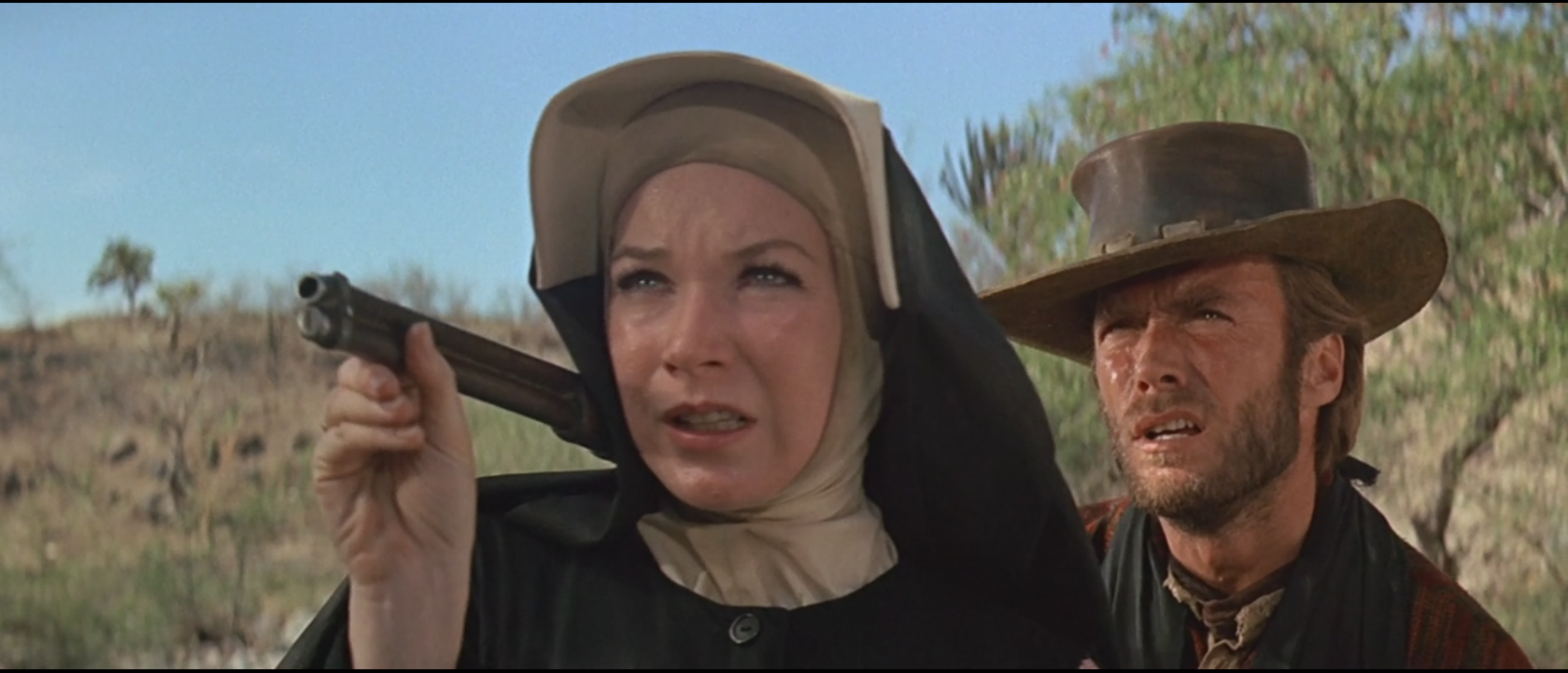
It is no secret that Clint Eastwood’s Hogan is very much the second “mule” in Two Mules for Sister Sara. For the most part, he’s a brute muscle whose soul is barely more tortured than a paper bag’s. If his taciturn efficiency and adaptable, survivable ethical relativism are treated with a tip of the hat by director Don Siegel, it is clearly Sister Sara’s unwavering moral vigilance that actually inspires the film. Without faith in a fundamental rightness, Hogan – and, implicitly, the archetypal wayward American with their hard, unmoving practicality – seems ready to drift in perpetuity, to suffer the fate of blind chance and mere circumstance that it mistakenly calls personal acumen. If Eastwood offers any contrapuntal critique of Sara’s spirited commitment and absolute belief in the first half of this film, a mid-film revelation that rounds out her character significantly implies that Sara is, finally, all that a human needs to be, and that Eastwood is just along for the ride. If, say, Robert Bresson sacralized the figure of the donkey in Au hasard Balthazar, creating an exalted mute witness lamenting humanity’s capacity for brutality, Siegel does the opposite. He profanes the human hero as little more than an ass.
This is an unusual thing for the signature Don Siegel-Clint-Eastwood pairing. Dirty Harry looms largest in their shared canon, and that film’s curdled vision of a thoroughly amoral world offers a backdrop for the film’s queasy call for a deregulated masculinity, unencumbered by government oversight, to personify that world’s awfulness, and, in doing so, hope to pacify it. But the men’s work together is far more slippery, and far more varied, than that epochal, and often grotesque, film suggests. The Beguiled, released between Dirty Harry and Two Mules, is a scorched-earth vision of American restlessness, implying that its rugged, creatively duplicitous loner protagonist is actually a cruel, conniving force, and that its coterie of Confederate women are really a menagerie of heated desires and malnourished souls in search of a pulse beneath their tenuous patina of harmony and ideology. And that’s not even mentioning Siegel’s earlier, non-Eastwood explorations like The Killers, which inverts the detective genre as two ruthless, reptilian assassins spend the entire film in search of an explanation for why their target was so willing to enter the wrong end of their gun.
Critical texts, certainly, but Siegel’s films are hairline fractures, not fissures. Little about his work announces itself as a critique of their zeitgeist, but in cutting into the world around him at odd angles, he can’t but fray its edges. Several of his key films take place in the modern-day West, and the most famous ones generally seem to affirm the Wild West’s mythology of ragged souls and recalcitrant spirits cleansing a tormented, unfinished land. The titular Dirty Harry, especially, clearly weaponizes anti-authoritarian dissidence and anarchic overflow as paradoxical tools of the state and harbingers of order, much like the Western cowboy beforehand. Yet Siegel and Eastwood’s actual Western is essentially a forgotten object, a self-consciously inconsequential text from a director and star working in a genre that, by any reasonable account, should have invited nothing less than a magnum opus. And, superficially at least, Two Mules leans fully into the signifiers of the baggage it carries, carting out Eastwood in his de rigueur poncho, scruff, cigar, and breathy husk, calling on the spirit of a man who had sacrificed his humanity to become an avatar of a set of ideas. How could this walking Western icon, working with his most important collaborator, not produce a masterpiece?
That’s the wrong question. A better one: why did they not seem to want to make a masterpiece? Siegel, in fact, was a journeyman by calling. He took his works as they came, and finishing one was an invitation to try on another, not an opening for an existential crisis. His vision of the West had little use for Sergio Leone’s abstract, metaphysical sense of bearing the weight of the genre’s accumulated trappings on his shoulders like an act of supreme penance. Two Mules for Sister Sara, comparatively, only initially seems like a brutal broadside of a Western, a film with a big idea about the genre that houses it. Within fifteen minutes, though, it seems like little more than a lark. An hour in, it has emerged as a wily, ornery, very ground-level thing, a merging of critique and nonsense, a film so seemingly superficial, and so obviously pretending to be serious, that we threaten to miss how serious it really is. It’s a veritable wolf in sheep’s clothing in wolf’s clothing.
The opening half-hour of Charley Varrick is a distillation of American ennui, a portrait of domestic pacification as percolating explosion. The first minute essays a romantic pastoralism, a post-Great Society Americana that could be the fruit of FDR’s Four Freedoms, a Norman Rockwell painting given motion and flesh. This is a Southwestern town that has adapted happily to mid-century modernity’s housekeeping. When a couple on the wrong side of middle age drive up to a bank, discussing an impending deposit, the West has been thoroughly commodified and expectedly tamed.
Until, that is, suddenly, within a swivel, two phantasms etherealize out of nowhere, joining the middle-aged man in a vitriolic bank robbery. The bucolic vision of America has been punctured, and we’ve been moved into an entirely different film, an imminently thunderous eruption of savage brutality that also reveals a brittle, banged-up America in search of an exit from itself.
A different film, I wrote, but Charley Varrick is also uniquely attentive to the continuum of the two worlds. The incendiary eruption will soon frost over into a slow, laconic crawl of an escape that raises the stakes by playing it cool. Varrick is a film about men whose capacity for violence has been formalized into the structure of a quotidian society, a remarkable film about the unremarkable. In three separate, interlocking stories that meticulously and suggestively interweave, director Don Siegel and co-writers Dean Riesner and Howard Rodman (adapting John H. Reese’s The Looters) craft three versions of post-‘60s masculinity that are circumstantially at odds with one another, but essentially overlapping in their mutual adriftness.
Walter Matthau’s titular Charley Varrick, ostensibly the subject of the film, is a casual criminal, a seemingly milquetoast crop-duster turned former stuntman turned criminal. In the passage from mid-century agrarian authenticity and sincerity to curious risk-taker in a world governed by confusion and subterfuge to outsider criminality weaponizing that chance-y chicanery, the film marks Varrick as a casualty of deindustrialization who is also a prophet of reinvention, able to mobilize his skills for illicit purposes to inhabit the cracks of a failing modernity. In a fallen world, he is a profane survivor.
Joe Don Baker’s Molly is a modern-day cowboy turned hitman, a laconic and self-amused individualist who wields the surface-features of Wild West authenticity like a corrupt and opaque moral code. He’s an old-school mercenary who fancies himself a mercenary whose only recourse to maintaining that vision of self is as an parasitic underling for the underbelly of legitimate business.
Most interesting of all, though, is John Vernon’s Maynard Boyle, a bank higher-up who uses his position to launder money for the mob, and who sicks Molly on Varrick when the bank they rob turns out to have an excess of mafia money lying in wait, undocumented, within it. In the film’s most inspired scene, a wonderful conversation near a cow field radiating with post-‘60s anxiety, both men doing the talking are speaking genuinely not about the waywardness of their souls but about the forces they find themselves prey to and their surprising comfort with their predators. Each man, in their way, seems essentially content with their place in the world, but they also recognize that this acceptance requires a myopia they have made peace with.
The inner-workings of these men, their capacity for violence and care, is genuine, and it only coexists in America with the placid doldrums of an only apparently comfortable existence because we’ve learned to accept this comfort in ours. Or to expect only the wrong kind of volcanic interruption. In an earlier moment, Vernon is making an inquiry with potentially deadly consequences while conversing with a young girl about her cat’s name. In another film, the girl’s presence would infuse the film with a superficial aura of suspense and dissonance. But there’s no guile here. It would be reducing the film to worry about this girl’s fate. Vernon’s managerial passivity has no interest in harming her. That’s not his style.
Nor is it late capitalism’s. While the frame seemingly binarizes the tranquil foreground with the girl and the dormant violence of the parents who know more of the man’s intentions in the background, the shot ultimately suggests a horrifying harmony. She will be fine, because the force of violence doesn’t suddenly interrupt anymore, but none of them will, because modernity’s bargain that allows her to be fine is an amicable agreement between domesticity and cruelty to suffuse the violence around them, at a much lower temperature, in the bones of the film itself. When startling violence does erupt, it is simply part of the tapestry of a world that relegates it to the margins, something the film evokes in one shot that depicts a suicide in a frame within a frame. A door closes on one man in a story that has moved beyond him, and which he doesn’t feel like continuing on in.
A not-so-different modernity, then, but it is, perhaps, a different Don Siegel. Most famous for Invasion of the Body Snatchers, apolitically political in a way that arguably evaporates its critique of conformity into a display of it, and, Dirty Harry, his quasi-fascist celebration of insular American individualism threatened by the forces of modernity, Charley Varrick is a vision of a different caliber. Rather than embattled, complacent suburbia pitifully susceptible to (potentially its own) insurgent bodies, or a modern-day resurgence of Wild West raggedness as a battleground for the fate of the American soul against nihilistic forces of social disintegration, Varrick exists in a post-apocalyptic West, an irradiated fallout zone of the late ‘60s in which the New Mexico landscape is a bleak backdrop for a narrative of social ennui. Like Dirty Harry, this film suggests a critique of progress’s potential arrogance, but unlike Harry, it doesn’t lionize untempered individualism as the privileged arbiter to put it back in its place.
If, like Dirty Harry, this is essentially a modern-day Western, it’s also a kind of film noir in that it depicts people getting involved in more than they wanted to bite off, entangling themselves and burrowing deeper and deeper into systems that extend beyond their mental horizons, and hoping that the most negligible of objects doesn’t act as a front for a more threatening one. Guns hide in purses, seemingly peering through objects, revealing a hidden world of pragmatic malevolence beneath the veneer of Americana. What interests Siegel is the minutiae of how this apparent subterfuge interacts with the everyday world, how the two are often one in the same. When Molly accepts his contract in the backrooms of a Chinese restaurant, Siegel takes note of the cans of food lined up like either day players in a more generous story of human survival or the bars of a prison, markers of the restaurant’s usual functioning not ready to be forgotten in the conflict that centers this film’s “narrative.” When Varrick has to evacuate his trailer-house suddenly, the tell-tale sign of his absconding is his dairy products laid out on his landlords doorstep in a similar array, not wanting it to go to waste because his act of sheer survival has gotten in the way of them being eaten, which is to say, of him surviving.
A simple, seemingly meaningless reference, unlocks so much about the fifteen year gulf between Varrick and the cool-cucumber ‘50s films it calls back to. When Varrick’s lover, apparently trying to have sex facing in every direction, says “you still owe me south by southwest,” Siegel’s film registers the amused itch of Hitch’s North by Northwest, a joke corroborated given Varrick’s previous life as a stunt pilot in a crop-dusting plane. This previous job of course nods to one of the classic cinematic suspense sequences in Hitch’s wry, deflationary study of mid-century masculinity and American cynicism. In that film, the advertising man is exposed as little more than a legitimized spy, a modern-day magician of shifting identity navigating tenuous surfaces above an empty center. The crop duster scene is magnificent, but the sequence’s sharpest moment involves the joke that a random person one meets in the middle of nowhere, on the side of the road, in the essentialized heartland of Americana, really could be a threatening revelation or a lackey of a secret conspiracy, that a stranger with no interest in you could be a missed connection to a more beautiful life or a vulture zeroing in on your throat. That film suggests that the only appropriate response to this quintessentially modernist situation is a kind of amoral ironism, a necessary distance held from the world that allows you to wear it lightly, and laugh it with gusto. Fifteen years later, in this more cynical film, one that wears the demise of “the American Century” on its sleeves, Varrick is the pilot, or rather, the ex-pilot, having gone straight by, paradoxically, turning to crime, by bending himself to the world of jagged edges and twisted irons to the point where the only way to maintain a space apart, a realm of private authenticity amidst fluctuating and devious surfaces, is not to glide with it but to sever oneself from it completely. This is a fallen world, and the only way to survive in this America is to seek transcendence through complete refutation of the social, to wander the drifter’s path of Emersonian self-exploration. This is an America in which a collective redemption has been deemed impossible.
This is, then, a work in which becoming something new is both as simple, and as impossible, as just getting by. The film’s finale affirms the American West’s historical promise of self-reinvention, as others have commented, but it is a decidedly melancholic reconsideration of selfhood, a deeply thin version of liberation. As Varrick leaves his old persona behind, his vehicle burns with a pathos as evocative as the lost childhood sled of Charles Foster Kane. Unlike Kane, though, Varrick is not deluding himself. He’s a post-modern ironist who knows that his survival is predicated on little more than recognizing how insignificant he is, or how insignificant he can appear. His final plan involves one last act of deceit that returns him to his stunt pilot days. He wins not by succeeding as a lone wolf but by pretending to be a failure, and pretending to be a friend, all from a distance.
The point is that he really is both of these things, a friend to capitalism because he is a failure at overcoming it, but he knows how to manipulate this status to his own gain. While Molly acts the part of an acolyte of old-school Hollywood renegades bucking the system and playing by their own rules, Varrick intuits that he is really in cahoots with the men who oppose him, that the only thing he can do is manipulate their rules, their perception, to his momentary benefit. He understands that they’re all basically fronts in the death drive of American capitalism. Tellingly, the film’s conclusion stages his resurgence by cashing in on his apparent nothingness, adding several more wrecks carted out from his past to a junkyard of American detritus. His cunning is appreciated, but it does not signal a moral victory. Rather, it unsettles the archetypes Siegel is more typically thought to celebrate. What sort of heroism is Varrick’s, and why does it both demand the resurrection of his former self and necessitate its immolation? Could heroism survive in a world where the difference between a fast and slow demise is knowing when to turn being upside down in a crashed plane into a means of self-effacement rather than self-delusion? In Varrick’s phenomenal, scorched-earth finale, the myth of the American bootstrapper-reinventor is turned, literally, upside down and saved, temporarily and tenuously, only because it recognizes how much figurative, and literal, weight is pressing down upon it.
A camera saunters into a lonely bar on the edge, and in the middle, of nowhere. It confronts its own face on a wanted poster, and then it rips the poster off the wall before solidifying as a shadow before it steps inside. This is a man, presumably, defacing his codified image, asserting himself as the real deal above and beyond the law’s version of him. But it also could be the wanted image – the weird, antagonistic mixture of legislated object and mythic subject, contained image and resistant force – enfleshing itself, giving itself the body of a human, enacting itself as a becoming. Here is a figure who knows he is a wanted thing and wants to both defile and endorse that wanted-ness in his act of defilement. The shadow seems to corporealize out of a mixture of nothing and everything, to make itself in the act of disregarding the law and embodying the law. The shadow becomes Judge Roy Bean by recognizing that its resistance to the law, in a nation that worships dissidence and rebellion if framed in terms that can be enfolded into the national narrative, is its way of becoming the law.
How could this film’s titular character sustain such a contradiction? We might instead ask: how has America? How have Americans lived within this contradiction for nearly a quarter millennium? The film’s opening is a vision of America’s founding writ large: a nation that wants to act as though it has always been there, always enshrined within some kind of law, and yet always incipient, always making itself new, always entangled in the act of defiling itself and critiquing itself. In disregarding the law, in ravaging it, America becomes the law. It founds itself on an act of anti-foundational behavior. It consecrates itself through a profaning gesture. It aggrandizes itself in the act of defiling itself. In escaping itself, in dismissing the rules by which it is supposed to live, it embodies its truest essence, returning to the primordial act of poetic imagination that has inspired and tortured, enrobed and denied, so many American writers and thinkers.
In this film, the figure is named, or rather names itself, Judge Roy Bean (enfleshed as Paul Newman), a man who becomes an allegory of American self-contradiction. Distilling a nation’s ability to overwrite its internal chaos with celebratory myths of inaugural innocence, he has no problem bequeathing himself with vagabond legitimacy wherein his sheer act of will becomes divine justification for violence. “I never killed a man before,” “I shot at some” but “I never hit anyone,” he remarks after a particularly unlikely showdown in which he vanquishes everyone. God himself must have left him off the hook before this – must have kept him pure – only to bestow him now with the gift of sacrosanct justice. He also, he claims, understands the law “since I live in flagrant disregard for it.” This is the ruffian as a dynasty, a vision of outsider frontiersmanship as Manifest Destiny. He is, in other words, an out-law, a man who will turn his perpetual errantry into a vision of redemptive self-authoring, who by being outside the law can be the law. Judge Roy Bean is like America, a self-legitimizing and finally self-insulating force that arrogates for itself the right to arbitrate justice, to lay down the rule of law, while also implying that it is simply enacting a higher one through its refusal of any other earthly tribunal. The Life and Times is nothing less than a travesty of America’s creation myth, a fire-and-brimstone desecration of the abiding faith that whatever the nation means can be traced back through to an initial act of originality.
Directors today almost entirely mobilize the wide-screen canvas to insist on the weight, purpose, and “big-ness” of their films (c.f. Christopher Nolan) or because it connotes cinematic acumen and anoints them as a filmmaker of legitimacy (c.f., most recently, Ryan Coogler). Rare is the Hollywood film that mobilizes wide-screen to articulate just how little it knows, and just how entangled its own relationship with American “big-ness” is. Robert Altman – maybe only Robert Altman – treats the elephantine canvas as a termite colony and a void, a busy, buzzing confusion of event and a supreme nothingness. His widest canvases are sloppy and wayward, fashioning confused, quasi-structureless saunters through the limits of American mythology, sideways ambles through America’s pretensions about itself. He fashions a frame that is both a critique of American egotism and a mode of diffusing it.
At the beginning of Buffalo Bill and the Indians, or Sitting Bull’s History Lesson, a narrator informs us that the Wild West was a celebration of “the anonymous,” promising a democratic affair of “these brave souls” and their unclaimed, but undaunted, effort to survive a harsh wasteland. As the frame lights up to view the outskirts of wild-man performer Buffalo Bill Cody’s traveling circus show, the narrator promises that Altman’s open canvas would be a democratic frame: one that incorporates the many, the liminal, the rogues, the outsiders, and allows them a moment to be counted, to be claimed in an image that doesn’t treat any of them as any more worthwhile than anyone else. This is America’s promise, and Altman’s most generous films ask what it would look like to fulfill that aspiration. Like an old-school Hollywood epic, Altman luxuriates in performative showmanship and grandiosity, yet he also smuggles in a neo-realist sense of multiplicity and ambivalence. His camera seems as though it could go anywhere, discover something new, as though it hasn’t figured itself out yet. His frame itself is a metaphor for America’s Phoenix-like belief in self-revising openness, in the capacity to find, in the margins of the frame, an undiscovered potential just begging to be catalyzed into kinesis.
Altman’s frame is also an expression of the nation’s delusory subscription to ideas about itself that doom that promise from the start, that mutate even openness and freedom into most pernicious modes of control. Yes, Altman’s camera looks and searches. It also seems like it might topple over at a moment’s notice, exploring the inner workings of a Wild West performance show that it neither understands nor celebrates. Paul Lohmann’s cinematography is sickly, jaundiced, and uncertain. The narration is spoken by a man who sounds like he’s about to drop dead. This is not an authentic America, but an incestuous tangle of ideas and iconographies, history and mythology, gazed at in a film that exposes inauthenticity as America’s core potential, and its final failing. In a nation where everyone is a momentary performer of the possible, where “the legend” is more important than the “fact,” as a famous man who made famous Westerns once famously said, Buffalo Bill (Paul Newman) is as American as apple pie with razor blades in it. He is like Andy Warhol, another American prophet of secular mysticism, who hides within the gap between freedom and oppression and exposes play itself as a particularly brutal mode of control.
Anthony Mann was one of the great chroniclers of American violence. His classic Winchester ’73 expresses that violence in an unholy object: a doomed gun that sidewinds through the hands of weary travelers of American life as it indexes a brutal cycle none of the men trapped in it could break from. Three years later, in The Naked Spur, he shifts from an object to a place, a cragged expanse that is a space of ostensible but illusory freedom that becomes an unexpected forum for the affectations of rugged masculine types and the afflictions of American society. The very raggedness that made the frontier a living thing was also a product of genocide and mass death and often spelled existential demise. The West in The Naked Spur is a fully three-dimensional hellscape, a place whose forbiddingly omnipresent physical nooks and crannies mirror the impossible ethical convolutions characters make within it. William C. Mellor’s cinematography is vivid but oddly neutered, intimating a vibrant geography concealing a festering moral sickness. It’s as though the spirit of the West no longer needs a corporeal object to attach to in order to unleash itself upon the world. When one character remarks that “it’s getting so I don’t know which way to point this thing anymore,” he’s talking about his gun, obviously, but he might as well be talking about the shared worldview its characters inhabit, one which invites them to join guns for a common cause just as easily as it coaxes them into turning their guns on one another.
In its cavalier, casual brutality, The Naked Spur feels like a definitive statement on the Wild West, but only because Mann’s film is so self-consciously un-definitive. That’s because everything is so double-sided. Take lead man Jimmy Stewart, the consummate Janus-faced Old Hollywood protagonist. There’s a reason Hitchcock famously quipped that he cast Stewart when he made movies about who he (Hitchcock) really was, a fundamentally ambivalent man capable of extreme nastiness when he summoned his darkest reserves of psychological frustration. In Stewart, Mann found a would-be scion of a moral American universe who was actually a cruelly domineering figure harboring unexpectedly violent urges. His character Howard Kemp begins the film an apparently noble man, but it isn’t long before we see how capable of using others he is, abusing their potential desires for his own momentary needs in a way that stops short of overt malevolence but certainly constitutes a kind of cruelty.
The Ballad of Cable Hogue opens with a hilariously deflationary inversion of the famous opening to director Sam Peckinpah’s previous film, The Wild Bunch. While that scabrous cosmic moan of a film famously begins with children maliciously treating nature’s brutality as entertainment, Cable Hogue saunters into a gentle, quiet conversation between a man and a lizard, coaxing it into a humane death that affirms their mutual value on this earth. The animal is to be food, certainly, and this is a no less brutal version of survival, but Peckinpah plays it not as a wicked triumph of nihilistic glee but an unfortunate reality of interspecies relations. The man is Cable Hogue (Jason Robards), and this is his compassionate desert pragmatism. Just as he is about to quietly kill the animal in an act of poetic, tragic necessity, a gunshot blows the lizard into pieces as bloodied as they are useless. When Hogue ponders the value of such an action, he seems to be proposing a counter-narrative to Sam Peckinpah’s whole oeuvre. This sort of murderous brutality is, the film suggests, just a tad bit gauche when all is said and done.
Hogue himself is a mystifying creature. His lizard conversation is a kind of cosmic communion, a natural respect for the sacrifice the lizard is making for his survival, and he continues the film with a similarly good-natured penitence to nature’s cosmic continuity. Talking to God, Hogue self-amusedly but very seriously notes “ain’t had any water since yesterday Lord, getting a little thirsty, just thought I’d mention it, amen,” not solemnly offering a prayer but suggesting a casual reminder to an old friend. He speaks in a spirit of warm-hearted minimalism, a kind of spartan humanism embodied in every moment of Peckinpah’s tough-minded but unexpectedly generous film. Hogue even gets his own credits sequence, a ballad-backed constellation of moving and stilled images that uses the similarly stop-start rhythms of TheWild Bunch to an antithetical purpose. While The Wild Bunch viciously metallizes and bleaches-out its Western archetypes, cutting into their motion, deconstructing it, and revealing the acid emptiness beneath, Cable Hogue playfully ricochets many simultaneous images of Hogue around the screen, serio-comically elevating his everyday trials and tribulations. The former is an image of heroes exposed as fraudulent brutes. The latter is an everyday man uplifted as an accidental poet of humanity. He has no pretensions to greatness, but the film treats his mundane ethos of workaday survival and epicurean pleasure as an undyingly human spirit of ramshackle beauty.
In its surprising, almost disarming generosity, The Ballad of Cable Hogue proposes a quiet rebuke to both the classical Western’s ethos of moral certainty and mythological majesty and the revisionist Western’s spirit of recalcitrant brutality and skeptical deconstruction. Both Hogue, unusually for Peckinpah, both are merely two sides of the same coin, seeking refuge in revelation of essential truths and the promise of moral certainty. Hogue neither celebrates nor excoriates but takes the arguably more difficult, less self-congratulatory perspective that the West cannot be summed up as any one thing. The film is an act of divine perplexity, a film that treats curiosity itself as a worthwhile mode of being. Much like Hogue himself, his titular film doesn’t seem to know where it’s going, and it finds pleasure it whatever comes its way.
It is the very fogginess of this vision that paradoxicallycasts such an unusually clear eye on the shadow of the West in the American imagination. The Ballad of Cable Hogue is set in 1905, twelve years after historian Frederick Jackson Turner lamented the demise of the American frontier. In his view, the land was a natural deposit at once energized and empty, pregnant with great potential and yet essentially available for human manipulation. This paradoxical vision of a landscape that was complex and value-laden yet essentially docile projected a canvas teeming with human futures, raw matter for fashioning new selves.
By Hogue’s release year of 1970, the ambivalence Turner felt was largely seen as passé. American media had mostly come to accept writer D. H. Lawrence’s view that “The essential American soul is hard, isolate, stoic, and a killer. It has never yet melted.” If men and women of the 19th century “lit out” for the territories, the revisionist Western line has typically been to expose the violence of this vision, to look to the shadows cast by America’s divine pretensions of Manifest Destiny. Responding to view of the West as a sublime potential of inert matter awaiting human mastery that not only invited but demanded “strenuous” activity, to use Theodore Roosevelt’s term, the newer, tougher breed of American cinema revealed the cruelty masking as energy and exposed the mental enervation dressed up as physical vigor.
Peckinpah’s films certainly participated. They cut down Western mythologies by the dozens, sparing no one in the process. But Hogue suggests that this tactic may risk reiterating the very “hard, isolate, stoic” soul it strives to unmask. After all, if Americans were supposed to be paradigmatically touch, taciturn, and realistic, what could embody that ethos more than revealing the grubby underbelly of the nation’s fantasies of idealism and grace?
It is thus ironic how un-ironic Hogue is. The plot, such as it is one, begins when Hogue finds water underground and sets up a desert spring. On the verge of dying, he digs in the dirt for water that is, essentially, mud. In any other Peckinpah film, this would be a self-consciously grotesque gesture, a cold-blooded reminder of the fundamental depravity of the human will. Here it’s a conversational engagement, a friendly opening-up to uncertainty and circumstance that is not quite a determined plea for survival. Asking “Lord … you call it” as he smiles, he receives the muddy water as both manna from Heaven and, simply, the vagaries of chance. His face drenched in muddy water in the ground, he coarsely laughs with a quietly boastful “Told You I was Gonna Live.” But his self-aggrandizement is humanistic, rooted in shared equality rather than hierarchized distinction. He is not an apex of humanity but a singularity of it, a fabled hero who embodies its foibles and frustrations and a stubborn determination that borders on grace. When he tries to get a deed to build a spring out of the water for parched passers-by, he can only gather a measly two and a half dollars. When asked if he has anything else to add to the value, he marshals, in a line tossed-off like an on-the-spot improvisation and a channeling of almost celestial wisdom, “Well, I’m worth something, ain’t I?”
Uncharacteristically, Peckinpah’s film believes he genuinely is. Or, perhaps, it might be more accurate to say that the film is interested in the proposition that he might be. This is an unusually generous portrait of human existence for Peckinpah, one in which a series of mostly well-meaning characters struggle to etch out their lives. It is also, atypically, not really asking much of these characters, other than that they exist, and keep going. What emerges is a kind of bildungsroman of an already formed man, a wanderer who never exactly learns anything, but always seems to be paying attention to new truths that might arise if he looks hard enough. Robards is wonderful, a prickly, protective man who confronts the world as an earthen poem. Speaking in simple, taciturn sentences – “I got to mark my boundaries, build me a claim monument.” – he nonetheless radiates humane warmth, celebrating, and embodying, a poesis of raw dirt.
And, indeed, a man willing to get his hands dirty, even though he is unusually hesitant to do so compared to the men he is confronted with. Throughout the film, he has been involved in a many-years-long engagement with two men who he, theoretically, seeks revenge on, not that he is trying especially hard. Near the end of the film, they inconvenience him again by putting him in a situation where he finds his gun uncomfortably necessary. The color of his soul, and the caliber of the Old West, seems to be on trial here. Just as he is about to shoot the man, however, a “horseless carriage” – car – arrives. The man on the bad end of the gun treats this beacon of modernity as his manna from heaven, but while the car momentarily stops the film’s climax, it just keeps on going. Laughing at the two men and their simultaneously monumental and pyrrhic conflict, this modernity treats the Old West and its elemental drama as a roadside attraction to mock rather than an enigma to wrestle with. In his cunning, curt demeanor, Hogue looks on just as bemusedly, remarking “that’ll be for the next guy to deal with” as he makes sure to set up his would-be victim with a fate worse than death: taking over his spring, sitting in wait for modernity to come to him while Cable can go live a new life as a perennial traveler on the road. The car, a dark emblem of an uncaring modernity, catalyzes a kind of epiphany for him, suggesting the pettiness of their grievances, even as it implies the littleness of the life of those moderns in the car, and the beauty and terror of Hogue’s.
Of course, Peckinpah’s point is that Hogue was probably always going to save the man on the other end of his gun, working to end a years-long retribution arc on the path to a more wholesome and full-hearted existence. The film, in the very nature of its ambulatory and discursive narrative structure, acknowledges this revenge is much less important than the characters make it out to be, more a pest than a pestilence. What really matters is the fact of the spring, the feel of the water, the sense of the space, and the time shared with local prostitute Hildy (Stella Stevens), who becomes a kind of displaced love interest who comes and goes, and itinerant preacher Joshua (David Warner), who has more interest in women than anything else but does not seem to oppose this to a genuine faith in the lord.
It is this spirit, Hogue’s welcoming ethos of taking life as it comes, not getting too wrapped up in pretensions of divinity or significance, that matters to a film that encroaches on a sense of grace that feels truly Thoreauvian in its willingness to appreciate the renewed physical and mental sensation of engaged receptivity with the earth around you. Of course, Peckinpah also mocks this deflationary ethos as itself a kind of American fetish for rugged, simple living. At one point, a preacher laments “The Devil seeks to destroy you, with machines,” for “inventions are the work of Satan,” and the film doesn’t exactly treat this rhetoric as a generous sensibility. The film doesn’t really agree with the man, but it understands Hogue’s adjacent version of it as a kind of everyday pragmatism that is also, essentially, mythical. That’s pretty American, admittedly, and The Ballad of Cable Hogue mostly appreciates the peculiar mixture of circumstance and effort that defines the belief in Western possibility that Peckinpah’s earlier The Wild Bunch so brutally excoriates and sets ablaze. It’s an aspirational ethos, but Hogue is not a celebratory or worshipful film so much as an intrigued one, a film that looks for beauty in unsuspecting places, even those that we have grown to dismiss. The film taps the Western landscape in the same exploratory spirit Hogue does when he sums up how he discovered and cultivated his water supply: “I found it where it wasn’t.”
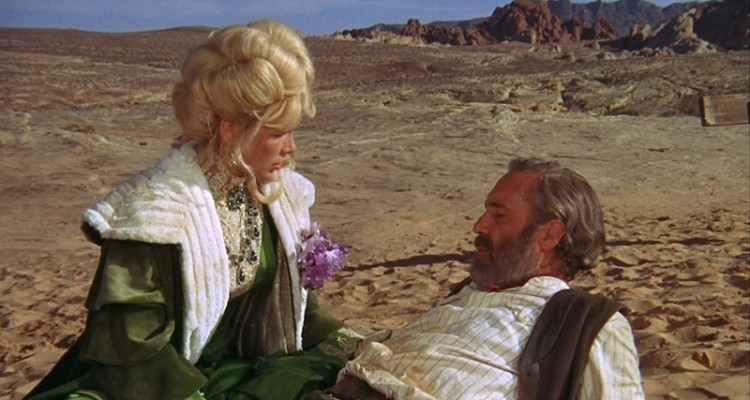
When he chooses to leave his water supply at the end of the film, to become someone else rather than be wedded to his personal property, Hogue recalls naturalist and everyday experimenter Henry David Thoreau’s own eulogy for his time living off the land: “I left the woods for as good a reason as I went there. Perhaps it seemed to me that I had several more lives to live, and could not spare more time for that one. It is remarkable how easily and insensibly we fall into a particular route, and make a beaten track for ourselves.” In a genuinely moving conclusion, Hildy returns, and just as she and Hogue are about to venture into another film, the car she rode in on runs him over. He lays out in bed, to die where he lived, in the desert. The preacher Joshua returns on his own gas-powered vehicle, and, at Hogue’s request to witness his own funeral, he delivers a meditation on the passing of the West played not as riposte or a lament or a eulogy but as a serio-comic inquiry. In its final moments, the film reflects on itself, on its own acts of self-mythologization. Hogue “came stumbling out of the wilderness like the prophets of old,” a figure who was God’s “dim reflection,” a man who might transfigure a spark of divinity but who himself wanders between Heaven and Hell.He might not be a hero, the film supposes, but he “lived and died here in the desert, and I’m sure hell will never be too hot for him.” He was, in the parlance of the Wild West, himself.
But also not himself. He only exists, the film suggests, in America’s bedtime stories about its own past, as a congealed archetype of a nation’s historical inheritance. The spring at the center of the film is an almost comically literal embodiment of the West’s promise of rejuvenation and Biblical redemption, its mantra of personal grit and hardship as the wellspring of a civic religion of self-creating, self-surpassing individualism of the type Hogue himself embodies to an extent that is both self-parodic and entirely sober.
Naturalist John Muir wrote four years prior to this film’s setting of the “Thousands of nerve-shaken, over-civilized people” who were “beginning to find out that going to the mountains is going home; that wildness is a necessity,” bespeaking a desire to conserve not only the land but the spirit that he and Turner both felt was rapidly petering out. In asking men and women to dive back into the water of natural replenishment, they implied not only a physical necessity but a moral imperative, an injunction that was, of course, paradoxical. The West celebrated escaping from civilization and it necessitated “civilizing” the region one escaped to. It worshipped natural primitivism and justified the very technological triumphalism that made the former impossible.
This is to say that “the West,” as an idea, roped together so many horses riding in so many directions and attempted to obfuscate the tensions in these paths through sheer force of will. The relatively easy thing for a film to do would be to dismiss these paradoxes. Hogue tries to inhabit them. Rather than mock or dynamite its genre’s central confusions, Ballad is usually immanent in its critique. Its hero is as pure an archetype of the Western hero as you could imagine, and the film’s most deconstructive maneuver is to expose how contingent and unclarifiable his core really was, how the archetype tenuously congealed around a core that was ultimately molten, able to mean many different things to many different people. It offers an entirely deflationary conclusion about Hogue, but also one that is essentially meaningful in its seeming meaninglessness: “he wasn’t really a good man, he wasn’t a bad man. He was a man.” The point is that the West was always working against itself, and it couldn’t not do that. How to appreciate its ethos of spartan self-making, Hogue’s everyday atmosphere of living on and living through, and to recognize the violence done in its name – to see that its sense of affable humanity was also the engine of impossible suffering and terror – remains the essential question of the most American film genre reckoning with the contradictions of its national past. Hogue’s ability to give a name to the essential in the inessential, to find beauty in the ambulatory and seemingly irrelevant life of one man while also suggesting that he may not really be worth saving anyway, answers that question with another question. How could it do anything else?
Near the beginning of Antonio Margheriti’s And God Said to Cain, a man is suddenly told that he is free from a decade-long sentence in a murderously oppressive prison camp. The camera zooms in, a blinding light taking over his face. Freedom comes like a gift from God, but also a profound opacity. His life has been restored, but we sense that he can’t determine what that even means. He can only see manna from Heaven as an excuse to become Biblical Wrath, or to enact his own.
The man is Klaus Kinski, whose face was like an Expressionistic abyss, a tormented canvas that resonated inner anguish better than any before or since. When the light blinds this face, it also binds it. This is freedom overtaking a human void, but it is also the creation of a darkness incarnate, one laminated in divine vengeance. Kinski, a man who would soon create his most famous roles with Werner Herzog as, among others, an inhuman hell-spawn (Nosferatu) and a pitiful human who fashioned himself as an arbiter of the divine (Aguirre, the Wrath of God), conjures one of his cruelest cinematic creatures here.
In Aguirre, Kinski’s titular character framed himself as a benevolent light for those he understood to be in darkness, but he was really just obfuscating his own blindness, unable to see his idiom of natural mastery as a fallacious Western construct born in an imperialist fantasy. Margheriti’s Western offers no such pretense: Kinski is an angel of darkness, a movie creation born within the contours of the film and set loose by the film to send others to hell, but there is very little sense that anyone in this world is or could be “correct,” or even think of themselves as such.
Kinski plays Gary Hamilton, arrested a decade ago for a robbery committed by his ex-partner Acombar (Peter Carsten), who intentionally framed Hamilton for the crime. When Hamilton arrives back in town, he self-consciously refashions himself as a “a ghost returning,” a specter who takes up a kind of residence in a cave system underneath the town Acombar has turned into a fiefdom. Acombar plays a different sort of blinding God, a false idol, and Hamilton has no interest in offering a different one. His interest is in doing the devil’s work: using cunning, contingency, and tricksterism, he blots everything out like a gathering darkness.
Italian Westerns were always among the most willing to treat the American West as a transparently metaphysical contrast, a poesis of raw imagination with little tangible historical reality. Their interest was not in replacing the myth with a construction of “the real” but in mutating the mythology in increasingly exploratory, and often self-critical, dimensions. If the Wild West in American mythology is a canvas on which to enact escape into the future, Margheriti infuses it with a Gothic texture, where figurations of freedom are haunted by a not-so-dormant past. In exacting his revenge, Hamilton turns himself into a wraith undoing the town from below, a phantasm hunting the present from the caverns of the past. He takes up residence in a literal underground cave system, and in a particularly pregnant maneuver, And God Said to Cain allows him to peer up through the house of God, mocking the pretension of heaven in such a hellish place, and the idea that anything he will do throughout the film could meaningfully be called “redemptive.”
Margheriti’s film also figures Hamilton as a distinctly cinematic revenant, though, a man-become-cinema. He seems able to appear anywhere, to evaporate at will and teleport wherever he needs to, to edit himself into any frame via a filmic underground to manipulate to his liking. When his antagonists demand to “stop him, once and for all,” Acombar is backed by a many-sided mirror, a perversion of the cinematic Western hero as a noble pillar of transparent certainty via a many-sided mirror that refracts him to himself, that makes him the victim of his own ego. When Acombar accidentally shoots his son Dick (Antonio Cantafora), who is sympathetic to Hamilton’s cause but not enough to turn on his father, and then willingly kills his wife Maria (Marcella Michelangeli), Hamilton has turned Acombar into a light so blind he can’t even see himself, molded his mirrored vision into an insular, paranoid prison. A prison that Hamilton, late in the film, will finally turn into a conduit for his own metastasizing body, more a force than a human. This is a vanity project turned into a horror hall of mirrors turned into a cinematic shattered glass.
When one character, then, jokingly tells another to be afraid of “raspberry syrup,” it actually becomes a clandestine cinematic mission statement: artifice has become a weapon. This congealed liquid, so easily a fake blood for a classic film, can hurt perhaps more-so than the real thing. Art, and Hamilton’s capacity to weaponize a chthonic art of subterfuge against Acombar’s pretensions of order, strategically mobilizes his artificial illusions – Hollywood’s illusions of grandeur and moral righteousness – to undo them. When a preacher, freshly shot for hiding Hamilton, decides with his last breath to play an organ from hell that resonates all over the extra-diegesis, echoing throughout the world of the cinema, he seems to be becoming-cinema himself, turning his moral vision into raw art. As Hamilton leaves at the film’s end, he says that there is enough gold beneath the wreckage he has wrought to “find more than enough to rebuild your town.” This is, of course, blood money, in every sense of the term. He leaves a cinematic gift and a moral void, the detritus of a cinematic ground-clearing. He leaves not as a force for good but as, simply, a force, an emanation from the desert designed to return unnatural edifices to the ashes from whence they came.






 The Long Take