
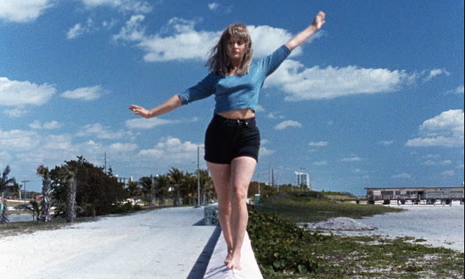
Writer-director Kelly Reichardt’s River of Grass captures Florida’s weirdness by presenting it as entirely mundane. It’s not a Florida noir, nor a Southern Western, nor a film that fetishizes the state’s purportedly alien qualities. It presents America’s tail as a humanist limbo, a space where joining the circus and joining the service are two paths out that are actually just circles to nowhere. She captures a state in which people hoping to cross eons, to get as far away as possible, who seem hopelessly apart from the world, may find a kindred spirit just one town over. In River of Grass, to be “not from around here” applies to all and none of us, embodying an exciting vertigo and a paralytic nothingness. Florida is a space that we can offshore the nation’s peculiar aloneness and strange camaraderie to, but that really is just America.
And River of Grass is a quintessential American text. Wandering with wooly abandon, carrying an imperfect idea about itself in its holster, it feels like a characteristic apostle of the American independent movement, a loose and amorphous thing more interested in momentary minutiae than eternity-chasing symbolic abstractions or dogmatic formulations. It was released at roughly the same time as Tony Scott’s True Romance and Oliver Stone’s Natural Born Killers, both of which would trouble the cinematic water in a way that Reichardt’s film , which didn’t make waves at the time, initially didn’t, but it joins them in telling a characteristically national tale of forlorn lovers on the run, looking for a conception of capital-M meaning to frame the rougher edges of their existence.
Stylistically, though, the three films couldn’t be further apart. Stone’s film was more the unholy progeny of European (or at least continental) neurosis and morbidly glorious excess. True Romance is the more obvious comparison to River. Both are not-so-quietly cribbing from Terrence Malick’s Badlands (itself an American variation of a European remix of an older American Depression narrative), drawing from Malick’s Emersonian openness to flux and skepticism about formalized institutions. But True Romance accents Emerson’s energy. It’s an American dynamo, a kinetic machine constantly inching toward torqued, fluorescent, Whitmanesque zeal.
Reichardt’s text is another thing entirely, not a motor revving the American id (like True Romance) or a fire-and-brimstone preacher castigating America’s unthinking viciousness (a la Natural Born Killers). Instead, it’s a gentle shift that touches the nation to slowly cast it in a new light. Malick’s Emersonian tension between immediacy and distance, his play between transcendental and empirical truth, is never not here, but the closer analogue might be Jim Jarmusch’s Stranger than Paradise (to name another quintessential early text from a master of American ennui), with its deflationary wryness. Jarmusch and Malick aren’t one another, and Reichardt could be the hypotenuse of the two. She has Jarmusch’s wonderful appreciation for the absurd immanence of reality, his desire to luxuriate in everyday detritus, but she laminates it in Malick’s eye for the sublime aspiration toward rapturous grace that seems to animate so many American texts, framing themselves as dousing rods for something they might call the American soul.
Continue reading
 The Long Take