Author Archives: jakewalters98

Film Favorites: Persona

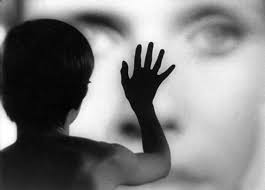
Not a document of but a discourse with reality, Ingmar Bergman’s Persona mirrors the fragility and disharmony of dual-protagonist Alma/Elisabet’s relationship in the film’s very struggle to represent itself, to marry images together into a smooth, harmonious, and stable whole. Like the characters in the quasi-narrative, the film’s images always retain their agency to disrupt, distort, and disturb the desire for holistic analysis, to produce a dominant meaning or theme argued to completion. Rather than an argument composed of images marshaled collectively toward one conclusive purpose, Persona instead explores how single images – and theoretically stable, singular characters – prismatically contain new meanings over time in polyvalent ways that cannot easily be lashed together into an overall thesis. While Persona treads on familiar ground in its reminders that film is, after all, a constructed and artificial art, the film transcends merely announcing this artifice; it does not merely produce “negative” meaning through renouncing the meaning of images. Rather, Bergman’s film finds purpose not merely in accepting that meaning is artificial but in using the film’s artificiality, its editing and framing dynamics, to suggest that images are capable of producing new, multiple, or alternate meanings precisely because they do not have any “innate” meaning. For Bergman, the fact that meaning is tentative, that the surface façade of an image can be fractured or stripped away, is not merely a nihilistic channel to self-destruction but a chance to open a door to reconsidering and recreating images in new contexts, reimagining the valence and purpose of images by introducing them into a temporal flow that reconfigures their purpose. Persona seems constantly on the verge of self-destruction and shuddering apart, but it is only for this reason that it infuses cinema with genuinely new life.

The film’s endlessly exploratory fluidity boasts critical implications for any psychological view of the main characters. In essence, the main characters are broadly treated in the film as collections of external perceptions/sensations/images that audiences (and the two characters themselves) may wish to understand by lashing together around a supposed internal psychology. Yet, the images of the women, like the more non-representational images in the film’s opening montage, ultimately defy “totalized” internal meaning. Many conventional films attempt to create the illusion of innate, fixed, internal meaning within the images and characters that are depicted externally; these films plaster over the temporal process of actually drawing, from images, meanings which don’t innately exist but rather come into existence when the viewer interacts with the images. Persona, however,not only calls attention to this meaning-making process explicitly (to disrupt an image’s fixed meaning) but uses its foregrounding of disruption and breakage to inflect its images with new meaning over time (to transcend fixed meaning). In a thoroughly modernistic sense, the film’s shredding of foundational, permanent meaning is not simply a catalyst for the endless nihilism of meaninglessness but a conduit for meaning excitably charged with impermanence and slippery intangibility.

In this light, Persona’s opening image is perhaps most telling: two abstract portals of light slowly reveal themselves, failing even to conform to a sense of symmetry as they occupy different regions of the screen and encompass disparate shapes (one a square, one an amorphous, oblong cone). The film thus begins with a non-representational gesture, a duo of images devoid of indexical relationship to the world, two shapes that do not even conform to each other and grow in brightness as the image unfolds. They exist in a state of constant becoming, only revealing themselves as representative of tangible shapes near the end of their fleeting existence. While films usually introduce themselves in a world-establishing gesture – a sequence to set the stage or establish ground rules or meanings for a mostly unchanging world – Persona’s opening images both devour any assumption of the “real” world and refuse to settle down. They are images to contemplate over time, not to compartmentalize and clarify.

Continue reading

Film Favorites: Sans Soleil

A great deal has been written about Sans Soleil’s meditation on, and mediation of, the link between memory, imagery, and time, much of which frames Chris Marker’s cinema as an attempt to navigate the impasse between self and society, as well as past and present, and to ponder the relationship between the external world and the internal, culturally contingent meanings divined by the viewer from external imagery. To this extent, an obvious reading of the film would be that it vandalizes cinema’s hope to accurately represent the world and corrodes memory’s potential to interrogate the past without bias. Yet, while a highly subjective film – one entirely unsure of its subjectivity – that dissolves linear continuity and causal image relationships to mourn the loss of stable, coherent mental structures, Sans Soleil also enlivens itself with the possibility of imagery unshackled from cause-effect confines, gifted flight to connect with and comment on other images that nominally – diegetically – boast origins in warring time periods and differing geographic locations. Sans Soleil reflects the mortality of the classical conception of cinema as a thread on which a singular “reality” is mounted from beginning to end, a cinema comparatively assured of its own truism. Yet Marker’s film also discovers in this demise a sense of renewed possibility, even refreshed reality, in a more subjective world caught up in the ephemerality of its own meanings, alive to a multiplicity of readings because each meaning, by itself, is ultimately far from completely sustainable. Marker’s cinema embodies Thoreau’s sense of the “I” as a personal and vibrant resonance with the world, one that is closer and more in touch with the world because it knows that it cannot access it completely or without the entanglements of the social.

Largely, Sans Soleil achieves this dialectic through editing with an eye for connection rather than causality, allowing images to echo and remake or inflect each other associatively rather than to “accumulate” over time toward one definitive “answer.” The film also routinely meditates on its own fallible representation by incorporating images of various artistic representations that both fail to encapsulate humanity and somehow exceed or re-interpret human life. Much as death in the film often animates creativity or life, even contact with the unknown or the intangibles of existence, the death/deconstruction of cinema’s classical structure is ultimately a conduit for imaginative revitalization and connection between images, cultures, and ideas. Decrementing artistic manipulation or modernism as an escape from reality and into the castle of the mind may risk implying that external reality is an objective state that can be grasped non-subjectively in the first place. Thinking about how one sees the world is interacting with the world. Sans Soleil thus refuses recourse either to an impenetrably singular will or an ungraspable material multiplicity, offering instead a plurality of sensate connections weaving a constellation of possibility out of the modern maelstrom of images, senses, and feelings confronting us at every turn. Moving across time and space like a ghostly wanderer through the cosmos, it is a cinema of interstellar communion.

Continue reading

Midnight Screamings: Nosferatu: Phantom der Nacht

With the release of Robert Eggers’ apparently very good remake of the most seminal of horror films, let’s look at the last time they also, somehow, managed to do it right.

Remaking one of the seminal films of the 20th century isn’t likely to win you any critical favors. However, for Werner Herzog, a filmmaker of unnatural receptivity to the world and general skepticism to the people who inhabit it, the film seems to have called to him nonetheless. Faced with the unenviable task of divining the original Nosferatu’s spirit rather than merely upholstering it for a new era, of being a necromancer rather than a cryptkeeper, Herzog seems to have done neither. Beckoned not by the surface or the soul of the original film itself but an unclarified possibility latent within it, his film is neither a remake nor even really a re-envisioning but, rather, a malevolent force that vibrates to an entirely different frequency, a tone poem that stalks the corridors of the unknown only to finally implore us to recognize our very selves.

Herzog is no stranger to films about men on strange journeys, impelled by the delusional hopes of a soul haunted by the belief that they can test the mettle of the cosmos and emerge unscathed. In his most famous, and best, film, Aguirre the Wrath of God,Klaus Kinski’s impenetrable and monomaniacal explorer believed he heard the siren song of a divine, heavenly order that was, finally, merely his own desire for control. Here, this film’s version of Jonathan Harker (Bruno Ganz) is not an impossible id but a bourgeois bastion of modernity attempting to colonize the world, to partition it into parcels of private property that attempt to compartmentalize the cosmos. In doing so, Herzog fears, the world invites its own destruction in the process.

Yet it is not the bland Harker, finally, who captures the film’s soul, but, rather, its melancholy, banal Dracula. If Herzog worried, with Melville-esque apprehension about the fate of modernity, Klaus Kinski was, of course, his Ahab, a once-in-a-lifetime conduit for Herzog’s divine and demonic sorcery, his own doomed attempts to channel and best the world with monomaniacal monstrousness. Casting Kinski, an actor who seemed to barely be able to bear the weight of the cosmic flux around him, as the creature would seem to finally set him up as the very force of nature he so desperately wanted to be, to become a literal embodiment of the quest for containing the universe that tortured him. When he sets off for the East to sell a home to Dracula, we are immediately cast into the realm of Herzog’s “ecstatic truth,” a portal of exquisite otherness that the man-creature is, nominally, the corporealization of. It’d be as though he had finally broken open his mortal shell and achieved an ecstatic sublimity of sheer resonance. The physical instability of the world, the very thing that had exposed Kinski’s cavernous ego in the stiflingly humid air of his own excessively imperialistic self-importance in Aguirre, now seems to warp around him as he wields the darkness of a world where reason long ago failed to extend to the depths and explore the breadth it promised to.

Continue reading

Film Favorites: Night and Fog

A right-ward track across the now-abandoned remnants of a concentration camp simultaneously models and critiques the encounter between the roving detective-camera, searching for the trace of history, and the trauma of the past that exposes itself, lying in wait to the perceptually attentive. Just as the film’s narrator remarks that there are “no images of the past,” seemingly resigning us to a doomed present sequestered off from a past stranded in history, the camera is suddenly intercepted, even assaulted, by the sudden shock of the black-and-white “documentary” image. History, the film suggests, insists on being heard.

Yet if the images we see construct a contrast between the moving color present and the grayscale truth dormant beneath, and thus rely on and seem to affirm the journalistic equation of black-and-white with both the past and the “real,” these sights also trouble the very argument they seem to be founding. Shots of marching Nazis intervene in and fulfill the camera’s search for a “real past” only to, in turn, question that very fulfillment, insofar as these images are themselves mediated by their presence in another film. Our first introduction to “the past” is actually an image from Leni Riefenstahl’s infamous 1933 propaganda film Triumph of the Will presented, by this film, as a document of history. Our engagement with the past, the film seems to remark, is already shot-through with its own slipperiness.

It is thus that director Alain Resnais’ seemingly straightforward documentary about the necessity of memory reveals itself as a meditation on the difficulty of history. In these opening moments, 1955’s epochal Night and Fog cuts together three exploratory images, “stitching” various rightward tracks (from different concentration camps) into both an existential demand for engaging the remnants of the past and a reminder of the difficulty of parsing that past and piecing it together. The film suggests the need to capture an ephemeral totality more substantial, and more impossible, than any one camp’s empirical reality. It asks what image – if any – truly indexes the gravity of the Holocaust. The film’s deepest and thorniest conundrum is how to treat the past as at once a necessary shock of light for the audience and an ambiguous shadow stalking that very light.

Continue reading

Midnight Screamings: Curse of the Undead

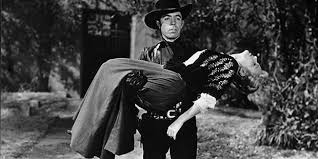
The Weird Western was born out of the very myth of the West itself. In American lore, the frontier of the Southwest was never not an invitation to mythologize and a call to speculate. Its material reality was both shot through with and held up by an imaginative topography that cast its expansive eye on to the nation’s iridescent understanding of itself. Already in the 1860s, Edward S. Ellis’s The Steam Man of the Prairies’ suggested the paradox of mystical machinery in the West: frontier living was a nominal revolt against civilizational order that was, finally, a harbinger of it. By the release of Curse of the Undead in 1959, nearly a century later, the Western frontier had thoroughly suffused the American mindscape, and the Weird Western understood the West as a mental canvas on which America’s vision of itself could be shot through a dark carnival mirror.

But the Weird Western signaled no default orientation. Its logic was a poetics of amplitude. The sacred frontier of untampered moral, spiritual, and economic progress could become a bastion of interstellar possibility in the Space Western. On the other hand, America’s history of genocide and material extraction could malevolently rematerialize as a cruel and unforgiving terrain wracked by violence and spectral presences of uncertain origin in the Gothic Western.

The latter, as a subset of the Weird Western, was still a rare breed in 1959 though, an  uncommon wraith haunting the cinematic scenery, so much so that Universal Studios, near-monopolistic purveyor of horror cinema in the U.S. during the Old Hollywood era, nearly waited until their own demise to cast their shadowy eye on the American West. One ought not be surprised. While Westerns were perennial features of the Old Hollywood landscape, even the most sober, critically-minded work in the Old Hollywood genre seldom exposed the metaphysical terrors that doubled as the negative side of the desert’s eternal strangeness. If the Wild West promised an otherworldly poetics of dreamy becoming, it was also haunted by a netherworld of settler brutality.

Continue reading

Midnight Screamings: Children of the Corn III: Urban Harvest

The original cinematic adaptation of Children of the Corn was one of the early casualties of the early Stephen King explosion. Like a good many of the man’s early texts, the story is a crazy-quilt of different fabrics and textures, an uncanny divorce from reality tethering together themes and questions without always trying to develop them. King’s story is a vision of corruptible children and generational trauma that also examines a wheezing, necrotic marriage and triples as an early exploration into a genuinely cosmic horror. In its short span, though, you mostly get the sense that King himself simply wasn’t sure about settling down into the pleasantly banal domestic sphere that, the story suggests, was at once a conduit for unholy forces and a way of denying them.

The presence of so many themes does not, as it would in another author, suggest a truly deliberate mind exploring the interweaving truths of many seemingly separate terrors. Rather, if they remind us that King could turn almost anything into horror, they also suggests that horror, somehow, wasn’t what he was most interested in after all. King was not a man tormented by suggestions of otherworldly forces, as say, H.P. Lovecraft was, or terrified by humanity’s capacity to channel them, as was, say, Mary Shelley. This was a man deeply bruised by alcohol and unsure of his relationship with the people who ostensibly loved him most. “Horror” could, for all the man’s reputation as a hell-raiser, often simply be window dressing for essentially sentimental stories that happened to channel emotions that slipped into the darker side of the world and didn’t pay too much attention to the reality principle. What, precisely, was horrifying is whatever happened to enter King’s mind that day. If parts of Children of the Corn could be filed next to Cujo as among King’s most quotidian horrors, its abutment of the inexplicable and the mundane are also indication enough that the author was willing to treat the genre more as a playground, or a toolkit, than a mission statement. His horror was, finally, an act of bare survival, not an existential vision.

Continue reading

Midnight Screenings: Incubus

“Alleged horror,” remarks a youtube description of the long-forgotten, once-lost Incubus. The poster seems to intend this as a criticism, but the film itself begs to differ. Incubus seems to delight in not being very upfront about the horror it wishes to unleash, including, quite literally, having to convince a Church that they were not making one in order to get the film made. It’s as though the film itself is afraid to call itself horror, or perhaps doesn’t want to be, all the more potent for a text feeling itself out in the moment, and that doesn’t want to stick around to let us figure it out. It’s a subterranean film, so much so that the actor playing the titular demon awakened late on, and who seems none too pleased about being back on this earth, would be back in the grave before the film’s release.

Incubus is a work that makes a virtue, or demon, out of necessity. It stalks our pretensions of perfect cinema. Written on the fly so that Leslie Stevens could keep up the momentum of the recently cancelled television masterpiece The Outer Limits, the brilliantly exploratory show that he unleashed upon the world and that, more importantly, conjured cinematographer Conrad Hall right out of nowhere and on a path to redefining color cinematography. To thin the membrane between cult American television and European art house cinema, it was filmed entirely in Esperanto, an entirely artificial language with no organic connection to any lived community, and it was framed as a folk horror film despite the “folk,” in this case, not existing. While other critics have pointed out this paradox as a simple curiosity, it’s really more of a thesis statement. While the “folk horror” genre purports to channel a group’s fears, Incubus almost – if you squint right – investigates the very idea of the genre: it implies an organic effusion of a single culture’s growth, but it, in fact, reminds us that “single culture” itself is entirely constructed object.

Continue reading

Midnight Screamings: The Bird with the Crystal Plumage

In announcing his status as a young director to be reckoned with, Dario Argento couldn’t have picked a more provocative opening gambit, one that unapologetically, if surreptitiously, seeds his future career into one scene. Witnessing a silent murder attempt in an art museum, protagonist Sam Dalmas (Tony Muante) runs to the aid of the wounded woman, only for the would-be murderer’s ghostly-gloved hand to push a button, trapping him in between the two glass panes in the museum entrance. Neither in the museum nor outside, all he can do is hopelessly watch an imminent demise he cannot even hear. Both of these people do leave the scene of the crime alive, but for the moment, Argento lets us linger in a liminal zone between reality and art, life and death, sound and silence, helpless and unwitting voyeurs to a killing that appears to be posed for him – and painted like an art object for us – but which he can only tenuously interfere in.

Positioned between Mario Bava’s earlier Hitchcock riffs and Lucio Fulci’s (and Argento’s own) later, lurid arias of psychedelic blood, The Bird with the Crystal Plumage also feels like a liminal realm for Italian horror in general. In 1970, Argento was clearly a director poised to move the genre from hell to purgatory, from brutally experimenting with society’s sins to exploring the very limits of narrative consciousness in a miasmic middle-ground. But Bird is not as demonic, nor as speculative, as his imminent, genre-transforming works. He’s still the lizard cleverly stalking his prey, not the shape-shifting chameleon daring us to join him in the abyss of cinematic solidity itself. The opening’s portrait of embroiled masculinity and helpless passivity obviously recalls Hitchcock’s Rear Window, and The Bird with the Crustal Plumage never quite escapes the Hitchcock obsession of the earliest giallos (and the likes of Brian De Palma), nor achieves the infectiously fractal vision of a completely broken world that Mario Bava unleashed with Bay of Blood one year later.

Yet Bird, like many great horror films, is already marvelously holding a knife to its own throat, achieving a kind of perverse self-awareness about its own debt to cinema history and the limits of its moral imagination. This is a film that knows how troubled it is, that senses its own participation in modernity’s foibles all too well. It opens with a man witnessing a helpless woman about to be murdered, framed as an art object worthy of the classics, and it closes with a reminder of just how blind he truly is. If the film, too, is myopic in many ways, it also exhibits the genre’s gleefully cruel ability to remind us that we, after all, are the ones who clicked play. The film, like most giallos, seems like a sledgehammer or a machete. We don’t notice it sneaking up on us with a scalpel, hellbent on disfiguring both its genre and our viewing habits, reminding us of the consequences of our inattention.

Continue reading

Midnight Screamings: Night Train to Terror

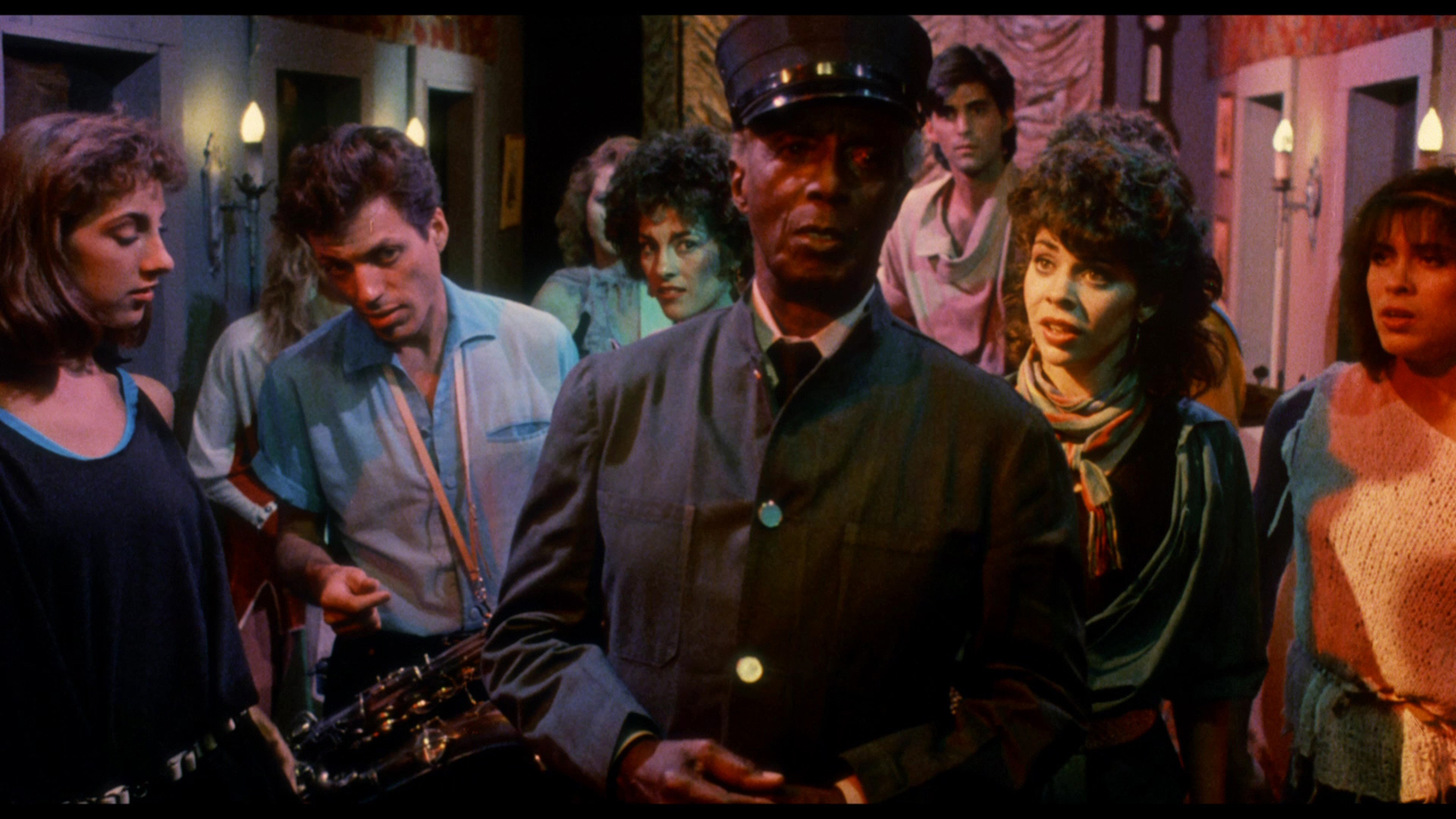
Night Train to Terror is undeniably trash, but its pleasures, paradoxically, are entirely intellectual. In its own unintentional, mercenary way, it severs the tension cord linking high and low art. It is, finally, only really valuable as a theoretical exercise, a strange cinematic mad science experiment (a connection that runs deep in cinematic history) in which several unfinished older films have been sliced and diced to pieces and reassembled into walking corpses of their ostensibly living selves. Born out of the forgotten remainders of unfinished horror pictures, this is an avowedly monstrous exercise in revivifying films that, as Frankenstein’s Monster himself once said, “belong dead.” That the film itself admits that this undertaking may itself be an immoral act – “bodies for money,” one character remarks in the first short film – is simply part of the fun. Night Train to Terror is a strange kind of cinematic meta-archive that salvages films while also working as proof for both the argument that this very salvaging is a heroic act and, conversely, that the films should have never been salvaged in the first place. It is, in the most literal possible sense, hack work.

All of this is to say: Night Train is probably an un-reviewable cinematic object. It feels like outsider art, so anything like a conventional standard of textual coherence or roundness seems essentially meaningless for parsing it or accessing its soul. Make no mistake, though: this is no labor of love. Its only investment is ensuring that scraps of lost and found footage might make a few dollars when unleashed on the unsuspecting, or on those who have deluded themselves into thinking this is a real movie, or on people like me who, apparently, hate themselves. For director Jay Schlossberg-Cohen, this is self-evidently an attempt to salvage a collection of films that couldn’t, or wouldn’t, cohere the first time around, footage that, as if by some demonic force, simply would not coagulate into a stable form.

Continue reading

Review: Once Upon a Time … in Hollywood

Once Upon a Time … in Hollywood opens with consecutive images of its two villains. Neither are Charles Manson, despite what the marketing claimed. The first is wanted poster of a Wild West outlaw. The second, in a whip zoom back, is Jake Cahill, Wild West lawman extraordinaire, a nasty renegade backed by Manifest Destiny who knowingly nods at the camera and who dishes out justice with an unforgiving grimace and little interest in the formalities of legality or the niceties of compassion. A marker of a time in the American imagination when retribution required little justification and morality was Manichean and measurable rather than mysterious and muddy, it is no wonder, we’re soon told, that Rick Dalton, the actor who once played Cahill in the early ‘60s TV boon as an unbending arbiter of goodness, has been reduced to momentary turns as a weekly walk-on heavy on budget Westerns and other TV shows dedicated to newer, younger, more ambiguous stars worthy of the murky waters of the late 1960s. The kind of justice he represents, a mixture of unbridled individualism and cosmic force, casts a dubious presence in a world where pretensions of moral purity backed by national predestination are increasingly threatened by recalcitrant forces of social unrest laying bare previously concealed realities and shrouded conflicts.

Two villains I wrote, but although Dalton is now reduced to playing villains on television, Quentin Tarantino’s Once Upon a Time … in Hollywood interrogates the possibility of giving him the fantasy of hero-dom he so desperately craves. When we cut back to a scene from Bounty Law, the show on which Dalton made his career playing Cahill, it’s to the shadow of a man, who falls dead into the frame, before Cahill covers him in the shot with his own image on a bounty poster. The shadow becomes flesh becomes print, illusion into reality into the legend. By the end of Once Upon a Time, Tarantino’s film will have helped Dalton fill out his shadow by giving him the chance of becoming a real-life Cahill, to embody a cowboy in the flesh. But the cost for turning dream into reality is a reminder that reality is a game of smoke and mirrors. Whatever else it is, Once Upon a Time … in Hollywood is a love letter to a time that, the film acknowledges, never really existed on the terms Tarantino wanted it to. Tarantino’s most recent film is a critical paean, and a wistful eulogy, for a hope that the film seems to recognize, but cannot fully admit, is a delusion. Which is to say: in aspiring to salvage the late 1960s, Tarantino also realizes he can only really be a pallbearer at its funeral.

Continue reading