Author Archives: jakewalters98

Midnight Screamings: A Bay of Blood

At the dawn of the 1960s, a number of Italian directors came to prominence with the rise of world cinema (or, rather, the construction of “world cinema” as an idea). Among the most famous, and certainly the most invested in dissecting the tensions of modernity, was Michelangelo Antonioni, whose 1960 film L’Avventura spreads outward in search of an exit from the present rather than following its line. Following two people who lose interest in searching for their suddenly-evaporated friend, the film suggests the limits of the detective’s epistemology, the hunt for the smoking gun. As we expect it to hone in, the film’s narrative seems to diffuse into the ether, as though something in the air and atmosphere was sucking dry the capacity to link cause to effect. Antonioni’s film suggests a search for an answer that, before long, blinds the protagonists to what question they were originally searching for. The need to reclaim a past, to resolve a conundrum, soon enough, unloosens into a wayward, wandering space where we can search around and within but not move toward.

At the same time, while Antonioni was exploring the limits of cinema’s capacity to follow narratives, prove conclusions, or answer problems, another Italian director was taking the old-school cinematic detective’s epistemology in another direction that, ultimately leads to a similar and similarly cruel meditation on the birth pains of the late 20th century. While no one would mistake Italian horror maestro Mario Bava’s 1964 Blood and Black Lace for Antonioni – it is a loving Hitchcock tribute rather than Antonioni’s tribute to all that was inadequate about Hitchcock – Bava’s films also explored the inadequacy of their own governing principles, also investigated themselves. But they did so less out of Antonioni’s deconstructionist intellect, his interest in perusing the world’s death throes, than a desire to playfully push the living to their limits. Bava’s early films nominally replicate Alfred Hitchcock’s style, but like the master, you can see him breaching unasked questions, testing and contesting their own frameworks. Bava’s bold, primary-hued splotches of color and narrative looseness, where the trajectory of the character’s arcs and the flow of the narrative become increasingly difficult to parse, suggest a touch of the surreal, a  dream logic taking Hitchcock’s parts and recombining them for their own purposes just as surely as Godard did with old Hollywood gangster pictures.

Continue reading

Midnight Screamings: The Blob (1988)

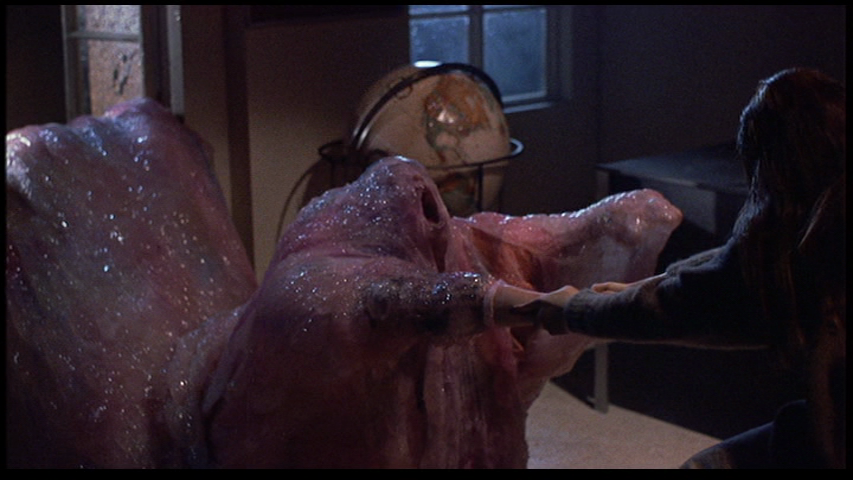
Released at the tail end of a number of remakes of mid-century horror pictures, Chuck Russell’s The Blob often gets the short end of the remake stick. If the remake trend was the fruit of the decade’s fixation with recovering, or rather creating, a mid-century optimism, the 1988 The Blob was released at the end of the trend, on the cusp of Bush-era cynicism, and is usually considered an also-ran amongst the heavy hitters of the era’s remakes. Philip Kaufman’s 1978 remake of Don Siegel’s 1956 Invasion of the Body Snatchers started the trend with a new version that updated that ultimate meditation on Eisenhower-era conformism into a critique of the failures of ‘70s individualism, the exsanguinating of the possibility of ‘60s liberation into a cult of mere personal difference. John Carpenter’s brutally poetic 1982 film The Thing recognizes and laments the fact that a group of men stranded and with even a little reason to worry are fundamentally willing to destroy one another. (His Christine one year later also turns mid-century iconography and masculinity into an auto-erotic death-drive and a failure to genuinely progress, but it is not a remake). David Cronenberg’s The Fly (1986) refigures Frankenstein as a post-industrial blues for the neoliberal era and a striking meditation on the human mind overtaking and corrupting the human body.

The Blob is, arguably, the least essential of these films (I wouldn’t quibble with the claim), and the comparisons arguably invite expectations The Blob itself doesn’t have much interest in validating. Plus, it only slightly precedes the end of this remake cycle and the birth of a second round of remakes: Savini’s Night of the Living Dead (1990) and a third version of Invasion, simply titled Body Snatchers, anticipating a decade of ‘70s nostalgia. Nonetheless, The Blob does feel of a piece with these earlier films. It lacks Carpenter’s meditative sangfroid and Cronenberg’s psychosexual energies and exploratory fixation on the limits of the human body, but it is, in its own way, a terse and cunning quasi-satire of ‘80s-era cultural conformity. When the film begins, a phenomenally moody, empty town suggests a derelict, post-apocalyptic hellscape for several minutes before the film cannily reveals seemingly the town’s entire population at the local football game. The titular mass of metastacizing pink extraterrestrial goo, it seems, hardly needs to get to work. Small town life has already eaten itself alive.  

Continue reading

Midnight Screamings: The Exorcist III

Lord save The Exorcist III. While never succumbing to the dark depths that suffered John Boorman’s delirious 1977 The Exorcist II: The Heretic, writer-director William Peter Blatty’s 1990 attempt to salvage his beloved franchise from the mismanagement of other voices fared little better among critics when it is released. While William Friedkin’s adaptation of Blatty’s original book The Exorcist was a truly epochal zeitgeist hit in 1973, a refraction of social backlash to the free-wheeling ‘60s, Blatty was always uncomfortable with Friedkin’s quintessentially ‘70s quasi-nihilistic hopelessness. Following Stephen King’s own famous critique of Stanley Kubrick’s demonically beautiful adaptation of The Shining, Blatty took it upon himself to reframe the film franchise that was surely his greatest claim to fame, turning it into what he’d always intended it to be: a beacon of light in the face of unmitigated evil in the world. Suffice it to say, the resulting film wasn’t what audiences or critics, deeply enmeshed in post-Reagan era cynicism, wanted.

Friedkin’s original The Exorcist, despite barely resembling his other films, is unmistakably the work of a man who was fascinated with psychic, social, and cosmic forces assaulting porous bureaucracies and systems in crisis. The deeply disturbed Exorcist II: The Heretic, a cosmic fracas of late ‘70s entropy as the decade tried to figure out what it was up to, was simply a psychic force all itself, not a film with something to say but an energy with designs on our consciousnesses. While Friedkin was a skeptic and Boorman a crank, Blatty was a zealot. Gone from The Exorcist III are Friedkin’s muscular mercuriality and Boorman’s psychedelic maelstrom. Instead, Blatty creates a comparatively unambiguous, deeply sober examination of the potential for evil in the world, a film that could for all intents and purposes be called simplistic, even “square.” But this is certainly not for lack of trying. The Exorcist III was released during a remarkably unimpressive few years for the horror genre, and, whatever else it does or does not do, it is certainly the work of someone seething to unleash something upon the world.

Continue reading

Midnight Screamings: Christmas Evil

I am making a New Year’s Resolution to return to blogging during the year 2024, starting with a slew of horror films in January to start the new year off on the dark side. But I had one or two holiday lumps of coal that just couldn’t wait until the calendar year switches over. Happy Holidays.

Christmas, an ostensible apotheosis of human togetherness, is also the apex of modernity’s hypocrisy and self-contradiction. While Christmas offers possibilities, it also implies assumptions and standards, and smuggles in judgement and failure. In addition to exacerbating consumerism, it metastasizes potentially possessive orientations toward compassion doled out in objects rather than genuine empathy. It is, as many have remarked, the loneliest time of year. While this isn’t a new observation, few films dissect these paradoxes as viciously and unapologetically as Lewis Jackson’s Christmas Evil. In the guise of an exploitation film – or because it is an exploitation film – it exploits the gap in our stated and performed values, scratching at it until it bleeds.

You know you’re in for something special almost immediately: Christmas Evil joins the wonderful club of films whose on-screen titles are different from their marketed titles. Christmas Evil’s in-credit title is You Better Watch Out, whose declarative claim suggests a moralistic missive which can’t quite match the blunt vagueness of Christmas Evil, perhaps the most straightforward title one could conjure for the narrative presented, but also the opaquest. “Christmas Evil” is almost totally unrevealing – it tells us next to nothing – yet it really tells us everything we need to know. It evokes the real feel of this film, a kind of brute poetry that puts in very little ostensible effort but radiates a kind of demonic sorrow. The vicious simplicity of the title anticipates a film that is both, minutely observed and deeply abstract, extremely simple and deceptively complex, a film that reveals more with every viewing, a gift that keeps on giving.

Continue reading

Midnight Screenings: The House of the Devil

With Ti West’s new film X both returning him to the horror genre for the first time in almost a decade and turning him to the backroads of America’s past, I thought I might return to the film that made his name all those year ago, a film that then felt like a genuine conjuration from cinema’s dark and demonic history.

One of the first films in the horror “mumblecore” genre of the late ‘00s and early ‘10s,  Ti West’s The House of the Devil explores the nexus point between American independent cinema in the ‘00s – scruffy DIY filmmaking, investment in human minutiae, openness to momentary fluctuations of emotion, relatively indeterminate and non-tendentious scripting designed to invite receptivity to human complexity – with horror’s emphasis on the ultimate unclarifiability and uncanniness of human experience. There’s a poetry to the thinking: both mumblecoreand horror feel around in the strangeness of experience, the odd excesses, the unexpected aporias, the potentialized gaps, the wounds within the surface that, when picked at (or even just noticed in passing), open up spaces for reconsideration, exploration, and even possibility. The House of the Devil was released in an era where horror was increasingly nasty-minded and vicious, emphasizing a certain kind of Grand Guignol precision and vicious craft. While West’s film alternately emphasizes ethereal ambience, slow-building atmosphere, and morbid curiosity, it still feels authentically disturbing and psychically dismembering. Through quotidian dread and an almost astonishing reduction of narrative and character matter to a brute, experiential portrait of human uncertainty, it manages to open a portal onto the world and into the mind that we cannot easily close.

Continue reading

Film Favorites: Apocalypse Now

“My film is not a movie. My film is not about Vietnam. It is Vietnam”: even director Francis Ford Coppola’s (in)famous reflection on the making of Apocalypse Now reeks of American egotism. Nonetheless, the film really does feel like Coppola’s accidental-intentional replay of the Vietnam War, a psychedelic maelstrom of American excess searching for an answer to a problem it invented, a solution to mask the film’s own complicity in problems it refuses to acknowledge. A literal theater of war, Coppola’s film is cinematic maximalism at its most perverse, an enormous, egotistical portrait of egocentrism that doubles back to a stunning sort of critique via self-immolation. Fully criticizing and even more fully replicating the imperialistic gigantism of the Vietnam War, Apocalypse Now becomes that which it critiques, and it devours itself in the process.

Opposites though they might be in their attitudes toward minimalism and maximalism, Coppola’s Godfather films and The Conversation are remarkably perfect objects: precise, manicured, and controlled machines which are, of course, about the precise and all-controlling machinery of American capitalism. Apocalypse Now, comparatively, is a mess. The film hits so hard and with such ferocity that it collapses from exhaustion, so much so that it took all of three editors (Lisa Fruchtman, Walter Murch, and Gerald Greenberg) and three years to release a finalized version that was, even then, only tenuously legible as a self-contained, discreet object. The film’s edits are war wounds and battle scars, lesions that are also stitches connecting and breaking disparate material and threatening to re-open the film even as they try desperately to close it up into an analyzable text. It opens itself to the ghosts in its (and capitalism’s) machine-work, etherealizing itself and diffusing us into a non-space that is troublingly divorced from empirical context. It echoes the myopic access endemic to American imperialism, indexing its subjects’ hubris and its creators’ maddened attempts to replicate it. All these years later, Apocalypse Now still feels unfinished, hovering around a center it cannot find, slowly expanding and moving on screen like magma.

Continue reading

Midnight Screenings: Creepshow

In 1982, the world received a horror holy grail: George A. Romero and Stephen King got to work together. The gruesome twosome, one perhaps the largest cultural force in horror over the last 45 years and the other the director who changed the path of horror filmmaking forever in 1968, were already namesake figures in 1982. Neither had anything to prove, and both are clearly having a ball here. The film they made, Creepshow, cheerfully casts off the weight of expectations in every way but one: it’s supremely well made. It wasn’t going to redefine horror, although one could make a case for its cinematography: it features some breathtaking high-contrast color that absolutely nails Italian giallo cinema’s particular mixture of fluorescent energy and subzero chilliness, which has no real precedent in Romero’s preference for grimy allegorical realism. But, outside that, Creepshow is largely content to amuse its creators and itself. All that really matters is that it lets us in on the fun.

Rekindling the classic horror omnibus anthology films, then most recently popular as a series of British films by Amicus Productions, Creepshow follows the Amicus style by compiling five shorts into one feature length film. While the Amicus productions literally adapted stories from mid-century pulp horror comic books, King and Romero conjure their own out of thin air, pulling a couple of King short stories and adding three new King screenplays to the mixture. Each story is fairly slight, even vague, functioning somewhere between a half-remembered dream and a fable that comically, ruefully enjoys punishing its protagonists for their obvious, caricatured flaws. More accurately, each story feels like a Saturday morning cartoon version of horror, almost like King and Romero woke up and jotted down the outline of a dream they had about writing a short story instead of actually thinking the story through. In general, I mean this in a positive way.

Continue reading

Midnight Screenings: Lifeforce

Given the new Texas Chain Saw Massacre film, the latest in a long line of misbegotten diminishments and perplexing variations on director Tobe Hooper’s seminal, genre-defining destruction of American mythologies, I’ve decided to look at one of Hooper’s stranger and more bedeviling films, one of the many that has contributed to his unfortunate reputation as a one-hit-wonder, even a cinematic accident whose career-long death slowly trickled out film after film. Like most of them, 1985’s well-budgeted Lifeforce reveals a director who was less in full command of his talents than one who was willing and receptive to asking how little in control any of us are.

For perhaps the only time in his life, Lifeforce found director Tobe Hooper playing with a leg-up. Having just directed Poltergeist for producer Steven Spielberg, he was for once and only once in Hollywood’s good graces. Even with Hooper’s name somewhat besmirched by critics who simply can’t recognize images, allowing themselves to believe that Poltergeist was, in fact, the result of Steven Spielberg’s directorial eye, producers were still willing to back him to the hilt for another film, before abandoning him yet again when Lifeforce flopped. A far cry from his grotty off-road Americana The Texas Chain Saw Massacre, Lifeforce was, fully, a major cinematic production, an attempt to cash-in on the science fiction craze of the 1980s. And this ostensible Alien rip-off had Alien’s screenwriter Dan O’Bannon as a co-writer, to boot!

But Hooper just wasn’t going to play ball. Perhaps expectantly giving Hooper’s chaotic and ununified cinematic history, Lifeforce is almost remarkably fugitive to itself, going out of its way to not be a self-same object. Instead of tonal or generic coherence, Hooper’s film invests in its own self-destruction. It feels not only like four movies in one but a film that is defiantly proud of the fact that it shuttles us across often-competing thematic registers and follows strange, alluring tonal energies to its heart’s content. It’s hard to say whether Hooper was a principled self-saboteur who felt that every film needed to travel the path of most resistance, to intervene in its own existence, or whether Hooper was just unlucky and really wanted to make mainstream motion pictures. But, warts and all, Lifeforce feels like it could only have been directed by Hooper.

Continue reading

Midnight Screenings: The Dead Zone

Compared to director David Cronenberg’s Videodrome from the same year (or any film he had previously made), The Dead Zone initially feels like a populist slab of straightforward, uncerebral, hip-fired entertainment, an attempt to make his name by getting on the Stephen King bandwagon. Unsurprisingly, then, Dead Zone feels ever so slightly alienated, as though itcan’t quite commit to its themes, can’t fully enter into its own world and explore it, as though it always exists at an imaginative remove from its content compared to Cronenberg’s earlier works, so obviously passion projects he was fully invested in. Something about the work seems to exist at a remove from its narrative, as though it is hovering slightly above or looking at it through a tear in the fabric of the universe it can see through but cannot quite invest itself in.

Yet, this is also a perversely well fit for the film’s themes, adapting King’s book about a Maine schoolteacher who awakes from a five-year coma with a form of second-sight, suddenly able to see beyond his present world into the future, and who has to find his way back to a present that has seemingly abandoned him and which he can no longer cope with. The Dead Zone is all about alienation, about falling below society’s threshold for engagement and perception, about fumbling, half-hearted attempts to rhyme with the rhythms of a society that you feel you are ever-so-slightly askew from. Much like the film’s protagonist Johnny, there is a clear sense that Cronenberg’s film feels, sees, and experiences in ways that are more receptive to strangeness than those around him will allow themselves to, and the mis-match between theme and director paradoxically becomes a match. The Dead Zone’s odd gambles and lurching half-steps come to suggest the difficulties of marrying personal sensibilities with the flow of everyday social life clearly resonate with Cronenberg’s own attempt to make a Hollywood product, to engage in the kind of personal self-sabotage necessary to produce a film that was almost certainly lorded over by producers. More philosophically, The Dead Zone seems to be reaching for ideas that it cannot express in clear terms, glimpsing fragments of a world that it does not have complete access to.

Continue reading

Film Favorites: Uptight

With Judas and the Black Messiah one year in the rearview mirror, I decided to look back on a much more full-throated critique of American modernity, a vicious screed and an acidic reminder of how far we haven’t come.

Uptight wears its frustration right on its sleeve, palpitating and sweating and threatening to tear apart the screen. Indeed, it might have been torn apart before release. Focusing on government attempts to internally dismantle black radical organizations, seeding them with informants, following the assassination of Martin Luther King Jr. on April 4, 1968, the film crew itself included at least one unknown FBI informant in a case of life imitating art imitating life. Uptight thus justified its existence in the act of its very production. For African American writer-actors Ruby Dee and Julian Mayfield and white writer-director Jules Dassin, the film resonated with their own experiences as leftist organizers, especially Dee’s work with the SCLC and CORE. Mayfield and Dassin’s own respective exiles to France (for Dassin’s membership in the Communist Party) and the recently liberated Ghana (for Mayfield’s work with NAACP local leader Robert F. Williams, who famously resisted the NAACP’s non-violent philosophy and provided a crucial link between liberal integrationism and Black Power) also haunt the film, potentializing it with awareness of how much is at stake in resisting the status quo. Uptight was the product of organic intellectuals who invested their personal energy into a film that kindles and threatens to overflow. It feels electric, like it could explode at any minute, but also weary and anxious, encroaching on exhaustion, like it knows that it might not be able to sustain itself, looking both over its shoulder and into a foggy future, worried about what comes in the hazy oncoming 1970s.

Set in Cleveland, Ohio, Uptight nonetheless begins with Dassin’s own guerilla-shot footage at Ebenezer Baptist Church in Atlanta following the murder of Martin Luther King Jr. As diegetic images ostensibly placing us in Atlanta reveal groups of Cleveland radicals observing the funeral on television, Uptight immediately foregrounds viewing and perception as key fulcrums of collective engagement with a national consciousness. Concerning increasing friction in black organizing after King’s assassination, Uptight nonetheless makes clear the shared bonds of frustration that resonate with every character on-screen. The narrative through-line concerns Tank (Julian Mayfield), asked by his brother Johnny (Max Julien), leader of a local organization chapter (implicitly a chapter of the Black Panthers but not named as such), to accompany them on a night raid to steal guns. Shook by the death of King, he initially refuses. Although he gestures, perhaps disingenuously, toward joining at the last minute, Johnny doesn’t hear, ultimately killing a guard in the raid. The rest of the film concerns the police’s attempts, largely through black informer Clarence (Roscoe Lee Browne), to convince Tank to inform on Johnny, and, once Tank gives Johnny up, the organization’s attempts to track him down and resolve their problem.

Based on John Ford and Dudley Nichols’ 1935 classic The Informer, itself adapted from Liam O’Flaherty’s novel about an IRA member who defected, Uptight retains the same narrative spine but alters both the thematic focus and the style. Ford’s film is an early American gloss on German Expressionism and a noir progenitor, resonating with Depression-era works like You Only Live Once in depicting social renegades lost in a quagmire of confusion and uncertainty. Dassin inherited those sensibilities in his early classic 1948 film The Naked City, which thoughtfully combined neorealist and film noir styles and, in doing so, suggested that shambolic non-structured realism and shadowy expressionism were, despite being ostensible antitheses, both expressions of post-war malaise and rampant social oppression. Uptight finds an analog for these anxieties in Dassin’s grimy hyperbole for Ford’s astonishingly misty chiaroscuro. Formally, Uptight most closely resonates with Dassin’s astonishing London-set Night and the City, a similar story about a fumbling, sweaty mass of nerves being pulverized by the film’s very ontology, throwing him down circles of stairs and spinning in circles around his head. Dassin turns the dial way back to these earlier days in Uptight, before he spent much of the ‘60s sprucing up some truly phenomenal but more collected works like the glistening Topkapi, films that were generally more elegant and anointed than Dassin’s hungrier, earlier works. Uptight, conversely, feels like a cinematic raw nerve, a clammy, live-wire film, flexing wiry muscles in nearly every scene, all the more brazenly direct in light of the fifty-three-years-later Judas and the Black Messiah, a fine film about similar themes that is not as politically astute and not nearly as formally accomplished or thornily textured.

At times, Uptight feels like it’s at its own throat, being torn apart by competing impulses. Perspiring and grubby, a New Hollywood hot-house of a film rejecting the niceties of Classical Hollywood, it is also nonetheless very much in the tradition of mid-century theater of morals. Drawing from Dee’s and Mayfield’s own theatrical backgrounds, everything is stylized and tilted toward a layer of heightened abstraction, from the stage-like streets to the somewhat manicured acting. Yet the contrast produces sparks, threading the needle between characters as people and figures as ideas, staged with a heavy, just-barely-invisible Proscenium that emphasizes the performativity of radicalism, the way in which being seen and not being seen can inform the fate of any situation, or, as the Panthers themselves put it, the “shadow” of the gun, the threat of violence and the pressured, organized capacity to resist, means as much as the gun itself. This tension, between grimy workaday reality and mannered unreality, lends Uptight an almost dialectical tension, the film pitting internal and external selves, realities and desires, off of each other.

Of course, the film’s focus on Tank, a wayward, excommunicated soul who sells out a community, has enough history in U.S. cinema, with the likes of On the Waterfront and High Noon obviously dueling it out with subliminal HUAC themes, conduits for their creators’ frustrations with telling or being told on. But Uptight poses difficult questions that twist the knot of depoliticized individualism that many of those films rely on. Rather than a nearly metaphysical question about individual purity and goodness, Uptight is thickly enmeshed in the social status quo, beginning with black Clevelanders mourning Dr. King’s death in the streets and several film characters reacting in a slurry of mixed emotions. Self-aware about the layers of interrelation that inform the radical activity, Uptight threads multiple intermeshing levels of conspiratorial activity and perception around Mayfield’s character, his long night of the soul resonating with multiple layers of social reality as the film pushes us to empathize with multiple perspectives without sympathizing with Tank’s tragic willingness to sell out his comrades.

Many of Dassin’s classic mid-century noirs explore the lonely individual just barely eeking by in the maelstrom of a modernity where city spaces are increasingly populated but all the more anonymous, where every site is a potential crowd for disguising oneself or being discovered, where new forms of collectivity are generated that nonetheless lack conventional or a priori group identities or similarities around which to congeal themselves. Uptight latches onto this implicit theme in many noirs, more often tackled in classic works like The Killing by focusing on teams gathered together to commit crimes, and explores what it means for politicization and organized revolt. Communities seem always in motion between connecting and diffusing, every presence soon a potential absence just as much as every absence holds the space for a potential presence. Uptight never loses this friction, but it does catalyze sparks. Johnny’s death is staged as a social theater affecting the entire neighborhoods, metaphorically (and literally) tilting the film off its axis, a more-than-360-degree camera turn unraveling the film’s tightly coiled energy as Tank’s collapsing star is subsumed into a metaphorical carnivalesque. Dassin’s work as a crime and noir director turns the film in on itself, the city becoming a distorted and confused space that breaks, mid-film, into a fun-house mirror. Slightly later, Tank visits his old job at a steel mill and has a nearly incandescent mental communion with it, industry figured in its mid-century guise as a sublime and world-altering radiant power. At the film’s end, Tank’s fate recalls another noir classic, 1948’s White Heat, mentally prefiguring the ‘70s and ‘80s as a desperate tumble. The same sublime power Tank wished to return to mid-film now drowns him out. Coal and soot and industrial malaise blanket the screen in a toxic fugue of post-industrial confusion, a dark harbinger of neoliberal notions of unregulated free-market capitalism and self-help soon to displace revolutionary urges that, as Uptight reminds us, were less failed than consciously corrupted and distorted by the powers that be.

Score: 10/10