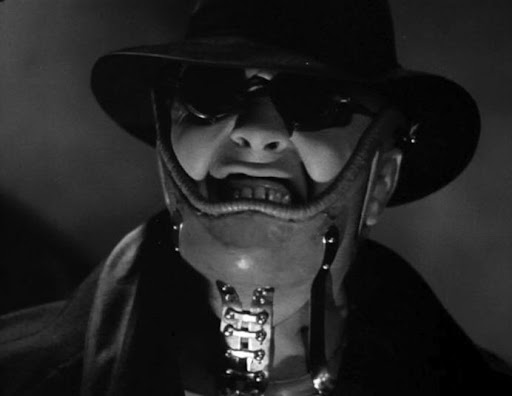
Historian W. Scott Poole makes a potent case for the 1924 film The Hands of Orlac as an aftershock of World War I. Reflecting the psychic tremors of a battle where bodies and minds were warped and destroyed, humans reduced to automatons and warped into psychological and physical pieces, the 1924 film severed a pianist’s hands and depicted the terror of the body seemingly working at odds from the mind that was supposed to control them. The 1924 film was directed by Robert Wiene and starred Conrad Veidt (both of The Cabinet of Dr. Caligari a few years beforehand), perhaps the first burst of Hollywood engagement with German Expressionist shadowplay, the surest throughline between Weimar horrors and the rise of the Universal Horror Monsters that would cast a long pall on horror cinema. Perhaps aware that it could all-too easily be seen as an also-ran, 1935’s Mad Love is a nominal remake thatreframes the story entirely. If The Hands of Orlac laments the violence of returning soldiers, Mad Love is very much about those who never went to war, for whom the war was a theater to watch and, perhaps, violently obsess over.
While the original story focuses on the plight of talented pianist Stephen Orlac (played, in this 1935 version, by Colin Clive), who loses his hands in a train accident and has them replaced with a murderer’s (Rollo, here played by Edward Brophy), this version shifts to Peter Lorre’s Dr. Gogol (Peter Lorre), the doctor who performs the operation and is infatuated with the pianist’s wife Yvonne Orlac (Frances Drake). Gogol, who houses a mannequin of Yvonne, fancies her Galatea to his Pygmalion, borrowing from the Greek play about an artist that conjures their sculpture to life via sheer artistic ability infused with the incantatory potency of desire. This last dynamic marks Mad Love as a deeply tormented meditation on the relation between creation and control. Rather than a performer-soldier, Gogol is a tragic mastermind-director, longing for something he can only domineer from behind the scenes.
In Larry Cohen’s Q: The Winged Serpent, Midtown Manhattan is being menaced by a giant bird-like dinosaur creature. That, incidentally, is not a good description of it, but it’s better than the verbal description given by the characters in the film. It also has something to do with a string of cult-like murders being investigated by Detective Shepard (David Carradine) and Sgt Powell (Richard Roundtree). It also crosses paths with Jimmy Quinn (Michael Moriarty), a failed pianist turned small time crook (now there’s a career path for you) who also seems to double as a bundle of raw nerves. None of these various menacings really cohere into anything actually menacing as a horror film, but Q’s strangenessmakes it exceedingly difficult to care about superficial things like a film’s genre or the temper it is supposed to have.
Much of that strangeness comes courtesy of the thing really menacing Midtown Manhattan in Q: Michael Moriarty, who seems to unravel the film as he passes through it. A walking psychic tremor of a man, Moriarty’s Jimmy is a human paradox who seems both deeply self-congratulatory and egotistical and essentially lost. He feels like a walking open wound of Method tics, a man feeling out his way through the world. The narrative itself – about a man who feels he has had no shot in the world and needs to command the momentary opportunity he has stumbled into, but doesn’t really know how to – reflects the performative style, which seems obsessed with controlling the space and the audience even as it is barely registering any effort. It’s a truly unmanicured performance, blistering with raw nervous energy and chaotic inner expressiveness. The most unsettling scene has nothing to do with the titular serpent but, rather, the camera’s own serpentine moves around Moriarty as he sidles up sinisterly to a piano less to tickle than prick the ivories on a frankly demented little ditty. It’s a remarkable scene, one in which the narrative content is essentially trivial but the form of the scene and its placement in the film evoke a much darker story.
After the baroque excess of Inferno, it is difficult not to figure Dario Argento’s Tenebrae as a retreat of sorts, a re-entrenchment in the (admittedly twisty) narrative form of the giallos that Argento cut his teeth on after the florid excess of Suspiria and the delirious nightmare Inferno so boldly and provocatively cast themselves in other directions entirely. If Suspiria was narratively curious and Inferno openly narrative hostile, Tenebrae is, comparatively, a relatively straightforward murder mystery rather than a cosmic exploration of worlds beyond our very capacity to perceive them, a curiosity beyond which the word “mystery” is adequate for.
It is, however, Argento, so it’s a sterling murder mystery as far as it goes, one with more than a few tricks up its sleeve. A series of straight razor murders by a prototypically giallo-esque black-gloved killer express familiarity with, even affinity for, the work of mystery author Peter Neal (Anthony Franciosa), visiting Rome with his agent Bullmer (John Saxon) and assistant Anna (Daria Nicolodi). Confronted by the avid fan Detective Germani (Giuliano Gemma), Peter also witnesses brief flickers of his wife Jane McKerrow (Veonica Lario), who has apparently followed him, despite him having little interest in her, nor her in him. This is very much unlike TV interviewer Cristiano Berti (John Steiner), who seems deeply invested in the sexual rage, subliminal neuroticism, and fervent moralism he reads into the Neal’s books.
The latter is the easiest codex for the film’s interests. Tenebrae is a deeply metatextual giallo, the most obviously Hitchcockian of Argento’s films, the most adroitly focused on the dangers and demeanors of filmmaking and filmmakers. Characters repeatedly allude to or outright discuss art and its relation to reality, the murderers are shot with typically fetishistic allure, an interviewer remarks that the novels only treat women as objects. Argento seems to cheerily affirm much of this, although the film quietly complicates and dissents as it coils its way into the back half and exhibits a genuine fright about its own complicity with the killings it depicts. Hardly an unexpected move for a horror film in that era or now, but Tenebrae is slithering and slimy enough to justify the autocritique.
I find myself strangely hesitant with Tenebrae, ultimately, given its relative hesitance with itself. I wish it was more earnestly detestable or more thoroughly improbable, rather than merely reasonably detestable and remotely improbable. But it’s hard to argue with this film’s nastiest cuts. Early on, the film all but announces its murderer, and rather than turning this into a red herring, it seems to have its cake and eat it too, both giving us the obvious murderer and rendering that fact essentially irrelevant, a narrative en route to more interesting terrain rather than the film’s raison d’ etre. Tenebrae, unable to throw itself head-first into the abyss, is always ultimately merely en route to something more interesting, but it’s amusing enough to experience the search.
I haven’t fully gotten these horror movies out of my system, so to get me through the frigid month of February, we’ll continue exploring the depths of hell.
Fresh off his monumental, genre-redefining Suspiria, director Dario Argento certainly didn’t take his success as a cause to rest. If the former film was a cosmic tear, Argento creates a pure void with Inferno, which conjures a breathtakingly demonic and disturbed view of a universe governed by clandestine orders and subterranean truths we can only cower before and never really comprehend. If anything, Inferno is even more devious in that it doesn’t even grant us the typical horror film’s descent from the normal to the uncanny. Rather than wayward rationalists suddenly confronted with the limits of their mental frameworks, Inferno’s characterssimply resonate with the film’s delirious rhythms from the start, hardly questioning any of its narrative contrivances. There is no audience surrogate, no questioning soul, in Inferno, unless we’re all as mad as Argento thinks we are.
Even more so than Argento’s earlier films, Inferno is decidedly ambivalent when it comes to its narrative center, and deeply promiscuous as an exercise in narrative flow. Consider the following. Mark Elliot (Leigh McCloskey) receives a letter from his sister Rose Elliot (Irene Miracle) informing him that she has purchased an occult text from an antique book store operated by a Mr. Kanzanian (Sasha Pitoeff). When Mark realizes she may be in danger, he rushes to New York, but not before the film disorientingly spends an entire act with Mark’s student friend Sara (Eleonora Giorgi), who happens to read the letter as well, before the film remembers that Mark exists and that, now, more than half way through the film, he will be our protagonist. The film’s entire first act follows Rose as she delves into the subject matter of the book, or rather, as we assume she is doing this from her actions, which are presented without editorial comment or even supporting dialogue. What, precisely, she is thinking is entirely opaque. Her face is an abyss as unrevealing as the film itself.
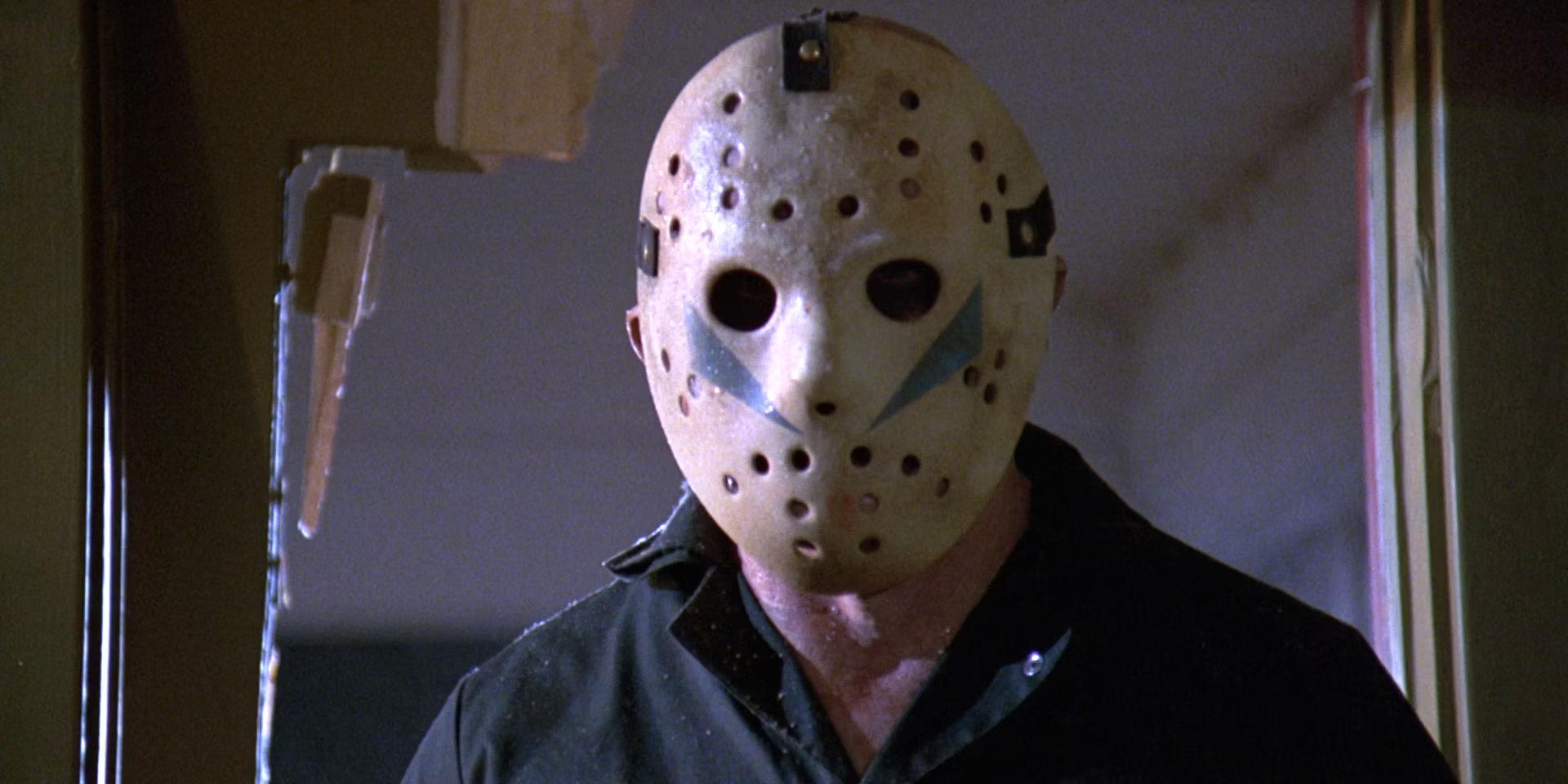
Having formally killed its Hockey-mask-clad central protagonist, Friday the 13th Part V: A New Beginning had nowhere to go but sideways. With the nominal franchise tetralogy concluded, but without the courage to shift away from the machete-wielding killer, the producers of Friday the 13th Part V took the cheapest possible route they could find. Rather than shifting to an entirely different story, a la Halloween III, or evolving the killer to include new emotional registers and shades of hate, a la Nightmare II, Friday Part V simply puts a new guy in a new hockey mask. His identity is technically a mystery but also entirely irrelevant and, famously, barely revealed in the moment of his ostensible, blink-and-you’ll-miss-it revelation. That may seem like a failure on the film’s part, but it also, oddly, recalls the spirit of a famous Edmund Wilson article called “Who Cares Who Killed Roger Ackroyd?” Focusing on an arbitrary narrative mystery asks the film to reduce itself to our conventional standards for judging cinematic quality. Does the identity of this killer matter? Could it? What does it say about us that we would want it to in such an empty film to begin with? Those conventional standards are fine if the film in question wants them, but Friday the 13th Part V is up to something, hacking its narrative to such tatters with Jason’s machete that it barely even registers as a film at all. Why can’t we search elsewhere for meaning?
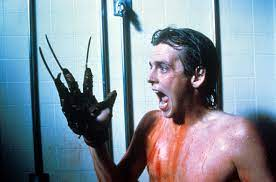
A Nightmare on Elm Street II: Freddy’s Revenge is a strange film to watch retroactively. It clearly isn’t yet fully aware of the expected texture of a Nightmare on Elm Street film because the weight of expectations hadn’t yet fully set in. But it’s also more liberated to follow its own energies, to treat the first film as a possibility to explore rather than a canvas to recreate on a larger, more absurdist scale, as the later films in this franchise did for better or worse. While Nightmare was a blinding light of cosmic terror, and the successive films would double-down on this formula to terribly successful (III) and just plain terrible (Freddy’s Dead) ends, the first sequel is a different creature all together. Queer in more ways than one, the film’s self-evident sexual subtext is all the more extraordinarily disarming because of how lurid and tortured it all is, like a film that hasn’t so much theorized its subject as felt it in its loins. Like its subject, this film is so unsure of itself and its structure that it seems to unleash energies it cannot quite explain or control. It is inverting formulas that it didn’t even yet know existed, partially lashing out at its forebears with a desire to be different and partially, simply, just not caring.
To its credit, if sex is typically associated with moral judgement or parental anxiety in slasher cinema, Jack Sholder’s film clearly fames the problem as a lack of climax. This film in no way believes, even as a product of unthinking corporate osmosis, that teenagers should not have sex, nor that they should be subjected to immediate death if they wish to. This Nightmare self-evidently believes that sexual frustration of all stripes is the culprit, and that identifying and being true to one’s even unrecognized sexual desires is an unambiguous good. “Subtext” is the word that is often brandied about in discussions on this Nightmare, but this is really only because the film is generally more interested in disturbing and trespassing on its own territory than making sense of anything in particular, and because it plays by the ruleset of its own id rather than developing any particular argument. There isn’t a “text” here to work with, just many stray feelings and sensations vying to be made manifest, repressed and latent urges in need of being rendered on the surface. For a mid-‘80s horror film, this is no simple thing. This is the feel of a film either not quite sure what it wants to say or so sure that it starts to drip off the screen. That, of course, makes it a more worthwhile film in more ways than one. That the film achieves this through a mostly nonsensical metaphor is either a feature or a bug, and no reviewer can determine that for you.
It’s hard being Halloween III. To its detractors’ credit, the film barely makes a case for itself. It hardly even feels like a film. So much happens, all of which feels like it was hashed-out the day after it was filmed. You have to give John Carpenter and Debra Hill credit for patently wanting to reach out in new directions, to thoroughly divest from what made the first Halloween such a cultural and commercial touchstone. Their desire, it seems, was so palpable that they allowed such a thinly-sketched, hardly-convincing story to tell the tale. If Michael Myers was a demonic moan of horror minimalism as a descent into suburban abjection, this one is a positively demented howl of absurdist maximalism, high concept and even higher in its demand that we don’t question it. This is an unhinged film, one that goes way out on a limb with its conspiratorial vision of corporate control and capitalist satanism.
Yet Tommy Lee Wallace, who directs with much more control and precision than he writes, doesn’t really seem to commit to the bit. Ironically, this is the film’s saving grace. In treating all the material with a kind of nondescript superficiality, in not trying very hard, it gives the film an air of offhand, blasé malevolence that is hard to dismiss, even if it is easily mistaken for mere uncaring banality. And it is entirely befitting the subject matter, which examines a decidedly more strait-laced and corporate wickedness than the prior films in the franchise. Evil, Hannah Arendt famously wrote, is banal after all, and Season of the Witch is a delirious mix of the thoroughly evil and the positively banal.
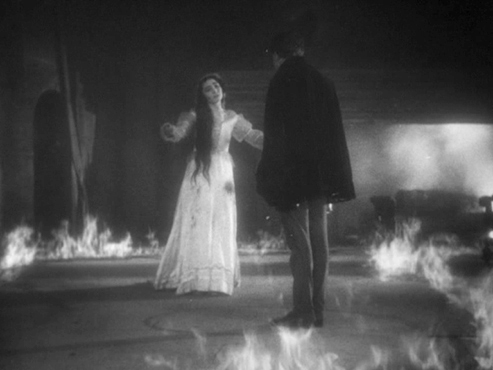
Jean Epstein and Luis Buñuel’s adaptation of Edgar Allen Poe’s short story The Fall of the House of Usher, in no uncertain terms, does not meaningfully understand the themes of the Poe story at all. Yet, at the same time, it absolutely nails the texture of it, even as it mutates that texture to alternative ends. Eschewing the story’s haunting, morbid diagnosis of humanity’s capacity for obsessive monomania, Epstein’s film evokes a romantic mood of sepulchral loss and lonely frustration, of wounded togetherness longing for fulfilled desire. Nonetheless, while it veers heavily from Poe’s intentions, it does resonate with Poe’s spirit, weaving a dense shroud of despondency and bitter regret that suggests Poe’s lovelorn, troubled life and the desolation that so frequently found their way into his pen. It’s more of gothic romance than gothic horror, but the way in which the world itself seems to lament the miscommunications of the characters is vintage Poe.
More a situation than a story proper, Epstein unchains cinema from reality and explores its expressive potential as a channeler of desire. Epstein’s film retains only the barest bones of Poe’s story, as an unnamed guest (Charles Lamy) visits his friend Roderick Usher (Jean Debucourt), who is painting an abnormally lifelike portrait of his wife Madeline Usher (Marguerite Gance), who, we are told, is dying. But this is more a pretext for the camera to resonate with currents of emotion lying underneath. When Usher plays a sonic lament for his wife on guitar, Epstein intercuts undulating waves that makes it seem like he is making the heavens move, or that they are weeping for him. An aria of billowing drapes suggest that the house too howls, as though cinema itself is reverberating with his consciousness. Nature, via cinema, seems to test architecture’s capacity to withstand.
Demons is clearly up to no good right from the log-line: a group of movie theater attendees invited to an advance screening of a new horror film become demons, consumed by the film-within-a-film’s sheer vitality. Metaphoric subtlety is not this film’s strong suit. By the time we’re 15 minutes in, there’s precious little mystery about what is afoot. Then again, restraint isn’t everything when a director knows how to channel obviousness into a kind of cinematic blunt force trauma. Demons is a cinematic demiurge, a fearless force of a film that opens with a gambit so idiotically overbaked that it can’t but sell you at the cost of its, and your, own soul. For the first third or so of the film, we watch the characters watch the film, cutting, with almost equal screen time, between the film and the film-within-a-film, as the two oddly resonate and rhyme with one another. Metaphysical events on screen mimic metaphysical events on the screen within a screen. The dead come back to life in both. It’s so obvious and inane that it becomes subtle. Almost entirely at a formal level, the film posits that the cinema theater is itself a centuries old crypt, and that film watching is an act of necromancy, a portal to the past but also to the unholy regions of the soul.
Without much metanarrative shenanigans – with no Scream-like characters discussing films within the film, with only one brief speech about the dark art of cinema, and even then one that doesn’t even seem to believe itself – Demons justifies its existence by asking one simple question: are you actually seeing the film you are watching? What does watching do, and how does how you watch this film reflect something broader about the act of watching itself? I don’t mean simply that it meditates on the act of watching at the level of the screenplay; I mean that it actually asks us to assemble the connections between the film and the film-within-a-film, which are purely visual and associative, never remarked on in dialogue.
Now, the film itself hardly earns the lofty comparisons, and more than any high-minded philosophical gambits, it’s just as easy to see Demons as a demented bit of autocritique in which cinema has fun excoriating itself, enjoying its own act of assaulting us just for the hell of it. But perhaps the superficial spirit of pure play is the point. Sometimes, you try to make a masterpiece. Sometimes you try too hard and fail. Sometimes your film works in spite of itself. Rarest of all is the film that tries and fails, and doesn’t even really make its point with a lot of sophistication, and still somehow justifies its existence through sheer gusto, as though channeling some cinematic otherwise entirely. Which, of course, places this film right in the heart of giallo, the sub-genre of Italian horror that always managed to strand lone, happy-go-lucky Americans in European cities tormented by the undigested weight of history and the centuries of violence lying in weight beneath the surface. The genre, most famously shepherded by Mario Bava and Dario Argento, turned the film space into a veritable vortex of phantasmic energies and stray forces with designs on our nerves, an attempt to render visible those currents typically operating below the perceptual threshold. Demons is the calling card of Bava’s son Lamberto, and there’s a sense in which turning the film’s assault back on cinema itself is its way not of answering the genre’s questions but extending its energies. It’s as though the younger Bava needs to exorcise the demons of the genre his dad created.
The film itself fashions a thoroughly cosmic vortex of impressions and sensations, signs and wonders, beyond any realistic or geographic space. A portentous crimson seeps up from the shadows only to dance with an azure aura of crystal menace. And the elder Bava’s favored yellow seems to emanate from some putrescent sickliness caking the screen, including in a putrescent looking bathroom that seems to have been coated in puss. We submerge in a thoroughly undomesticated space.
The film has no real interest in domesticating it. When one character hears of the 16th century prophet and remarks “Nostradamus, sounds like a rock group to me,” the comment obviously satirizes her inelegance, her inability to wrestle with genuine history and the sort of predictive capacity it portends. She can’t see the ability of history to prophecize the future because she is too stuck in her own present, too entombed in ‘80s corporate culture, to notice. At one point, a cut of a downward knife in the film-within-a-film transitions to a woman moving in the same downward direction to look away from the violence on screen, unknowingly repeating it with her body. We, the film suggests, are possessed long before we start hunting for flesh.
But what is the film’s own suggestion other than that modern art itself constitutes its own divining rod, that it allows us to see better than we otherwise could, that pop cinema is part of a prophetic lineage? Art has haunted us, has us in its grasp, and that is a many-centuries-old pull, not a mere modern phenomenon. Early in the film, a key transition equates the projector in the film theater with the two headlights of a motorcycle in the film-within-a-film, which soon enough finds an echo in the flashlight of a movie theater usher. All of these seem to tease us with a direction, the hope of being guided somewhere, to something, but amidst all the light and shadow, just what we are meant to see, and how anyone could see it, is really the film’s thorniest conundrum. Bava shoves knife after knife (literally) into the assumption of cinematic sanity, into our ability to properly separate art from reality, to ground our viewing experience in prefigured ideas about the nature of the reality the film is conjuring. Demons is doing some fearless business chasing a metaphor it can’t quite earn, but bless it for trying.
There’s a lot of mud around slung in Monkey Shines, and a lot of mess to survive if you want to appreciate it. It’s a sloppy film, in too many ways, in too many directions, but it genuinely tries to burrow into humanity’s bowels in search of a rich vein of terror. It was writer-director George A. Romero’s first studio picture, and his last for quite a while, the obvious fruits of his successes with his genre-defining Dead trilogy. It also reflects a kind of conceptual challenge to himself. While his most famous films redefined the zombie genre, clarifying one kind of fear rooted in mobile bodies unable to be controlled by unthinking brains, Monkey Shines inverts the dynamic. Focusing on Allan (Jason Beghe), a man who is rendered a quadriplegic after a running accident but retains full control of his “civilized” brain, Monkey Shines turns the loss of physical motion into a carnal meditation on the nature of masculinity, into whether a functioning brain is enough man for a man to accept when he doesn’t feel at home in his own body anymore.
Ironically enough, it’s a bit like John Carpenter’s studio horror picture Christine in that regard, but rather than a turning to man’s inner machine, Romero tries to dissect an inner beast. When Allan’s friend Geoffrey (John Pankow) recommends a trained chimpanzee to provide companionship and perform small tasks around the house, he neglects to mention that Ella has been injected with an experimental drug designed to boost her intelligence, and that companionship with Allan may be what she needs to excite the mind. While things initially work out for the better, Allan’s rage issues seem to metastasize almost instantly, and he is also receiving visions of something running outside with an oddly simian gait, despite Ella ostensibly being locked in a cage. More than a scientific symbiosis, the relationship is a kind of mental merge between the two, with Ella coaxing out the rage in Allan and Allan galvanizing Ella to act.
There’s a lot packed in here, and Monkey Shines is an odd beast, one that mixes metaphors and both over and underexplains itself. The film’s narrative makes a kind of hash of its themes. Is Allan’s anger metastacized by the psychic attachment to Ella, or is Ella simply acting on an already violent personality, which we aren’t given any clues of beforehand? Are the outburst latent manifestations of his frustration or is it restoring something that was always there? Poignantly comparing himself to a machine in an early moment, the film doesn’t need the underscore of the scene’s on-the-nose final line to clarify the point that his masculine self-possession has been underwritten by his organic nature, his physical and bodily masculinity, and that he feels threatened without it. More poignant is a brief, unremarked comment by Melanie (Kate McNeil), Ella’s trainer: “she’s your slave,” implying that mastery over an animal is his way of feeling whole again.






 The Long Take