
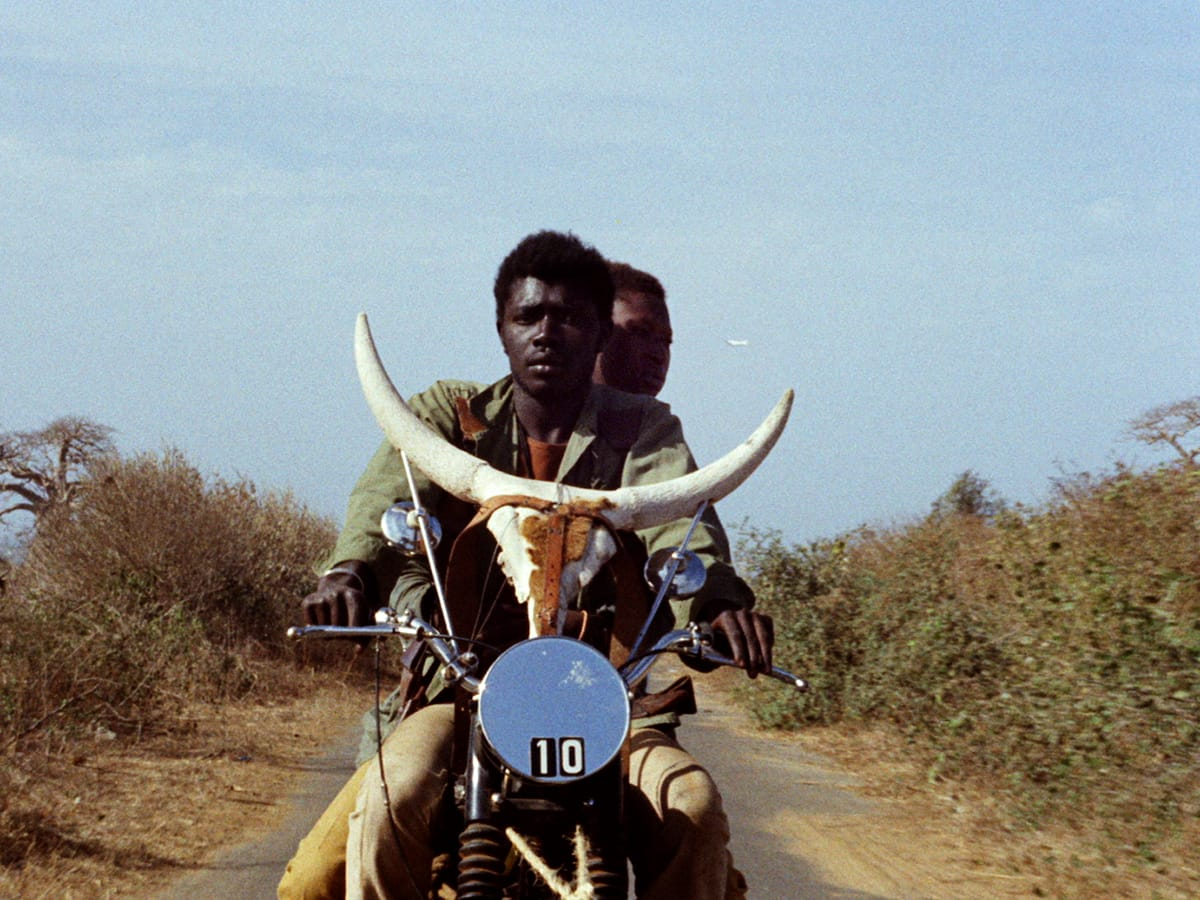
Djibril Diop Mambéty’s Touki Bouki is a vicious humanist of a film. It vandalizes its inherited cinematic styles, but it does so out of affection as much as frustration, care as much as critique. It trades classical cinematic storytelling for a French New Wave-inflected openness to disorientation and disarray, importing violent cuts, repeated imagery, and anachronistic sound cues from the French cinema of the 1960s. Stylistically, these techniques come from a Senegalese dream-time of integration with the metropole, embodying formally the inheritance of French thinking and culture on Senegal while meditating on the desire to smooth these connections, to render them natural rather than constructed through histories of violence and subjugation. These techniques destabilize the viewer, forcing us to confront the artificiality of both cinematic form – very much in the spirit of the New Wave’s critique of its own inherited and borrowed cinematic tropes – and the constructed nature of the colonial fantasies this cinema often sustains. If Touki Bouki utilizes its inspirations, it does so because it recognizes that it cannot escape them, and that engagement is the precondition for critique. While the techniques are in part borrowed from French New Wave cinema, Mambéty’s film makes them self-conscious of their own mimicry and, perhaps only in this capacity, able to escape it. There’s a self-conscious recognition of un-originality here, the brutal and curious intermixtures and impurities of colonial lineages, and an attentiveness to the fact that only in diving into these contradictions, rather than overlooking them, can African cinema become truly original. In the act of becoming itself through its interrogation of French cinematic norms, in appreciating those norms through its questioning of them, Touki Bouki may ultimately save them, and affirm itself.
The French New Wave was certainly self-conscious of its unoriginal originality in its own way. There was no long-term liberation in Godard’s image of French youth infatuated with American gangsters. Nonetheless, Breathless is infused with a romantic image of vagabond individualism as dissent, a rebellious rhythm in which youthful spontaneity could preserve a residuum of resistance, even if it took the form of a libertine death-drive, in spite of its limits as a form of collective challenge. The two lovers on the run in Godard’s first film were doomed, but there was poetry in the film’s exuberant vision of demise, a weak refusal of the status quo that retains the pure potency of its own energy. The protagonists were not long for this world, but their chosen idiom made their shortness amazing while it lasted.
Touki Bouki takes the same narrative structure – young people in search of a framework to hang their inchoate dreams on – but dislocates the joints beyond the point where it might read as even superficially libratory. Associative and allusive (courtesy of the elliptical editing from Siro Asteni and Emma Menneti), the film follows two young lovers, Mory (Magaye Niang) and Anta (Mareme Niang), as they dream of escaping Senegal’s capital of Dakar for a mythologized Paris they’ve imported from decades of colonial fantasia. They can’t, but Mambéty knows that he can’t get out of relation with that vision of escape. The film creatively dislocates this impossible aspiration, the violence of mental colonialism, through an act of formal disfigurement, ravaging itself in recognition of its own inability to conjure a genuine alternative. This isn’t a failure of imagination so much as a poetic acknowledgement of reality’s unfitness for itself, a formal gap in which our recognition of modernity’s wrongness – its control over the terms on which we might begin to imagine otherwise in the first place – demands to be recognized.
Continue reading

 The Long Take