
Djibril Diop Mambéty’s Touki Bouki is a vicious humanist of a film. It vandalizes its inherited cinematic styles, but it does so out of affection as much as frustration, care as much as critique. It trades classical cinematic storytelling for a French New Wave-inflected openness to disorientation and disarray, importing violent cuts, repeated imagery, and anachronistic sound cues from the French cinema of the 1960s. Stylistically, these techniques come from a Senegalese dream-time of integration with the metropole, embodying formally the inheritance of French thinking and culture on Senegal while meditating on the desire to smooth these connections, to render them natural rather than constructed through histories of violence and subjugation. These techniques destabilize the viewer, forcing us to confront the artificiality of both cinematic form – very much in the spirit of the New Wave’s critique of its own inherited and borrowed cinematic tropes – and the constructed nature of the colonial fantasies this cinema often sustains. If Touki Bouki utilizes its inspirations, it does so because it recognizes that it cannot escape them, and that engagement is the precondition for critique. While the techniques are in part borrowed from French New Wave cinema, Mambéty’s film makes them self-conscious of their own mimicry and, perhaps only in this capacity, able to escape it. There’s a self-conscious recognition of un-originality here, the brutal and curious intermixtures and impurities of colonial lineages, and an attentiveness to the fact that only in diving into these contradictions, rather than overlooking them, can African cinema become truly original. In the act of becoming itself through its interrogation of French cinematic norms, in appreciating those norms through its questioning of them, Touki Bouki may ultimately save them, and affirm itself.
The French New Wave was certainly self-conscious of its unoriginal originality in its own way. There was no long-term liberation in Godard’s image of French youth infatuated with American gangsters. Nonetheless, Breathless is infused with a romantic image of vagabond individualism as dissent, a rebellious rhythm in which youthful spontaneity could preserve a residuum of resistance, even if it took the form of a libertine death-drive, in spite of its limits as a form of collective challenge. The two lovers on the run in Godard’s first film were doomed, but there was poetry in the film’s exuberant vision of demise, a weak refusal of the status quo that retains the pure potency of its own energy. The protagonists were not long for this world, but their chosen idiom made their shortness amazing while it lasted.
Touki Bouki takes the same narrative structure – young people in search of a framework to hang their inchoate dreams on – but dislocates the joints beyond the point where it might read as even superficially libratory. Associative and allusive (courtesy of the elliptical editing from Siro Asteni and Emma Menneti), the film follows two young lovers, Mory (Magaye Niang) and Anta (Mareme Niang), as they dream of escaping Senegal’s capital of Dakar for a mythologized Paris they’ve imported from decades of colonial fantasia. They can’t, but Mambéty knows that he can’t get out of relation with that vision of escape. The film creatively dislocates this impossible aspiration, the violence of mental colonialism, through an act of formal disfigurement, ravaging itself in recognition of its own inability to conjure a genuine alternative. This isn’t a failure of imagination so much as a poetic acknowledgement of reality’s unfitness for itself, a formal gap in which our recognition of modernity’s wrongness – its control over the terms on which we might begin to imagine otherwise in the first place – demands to be recognized.
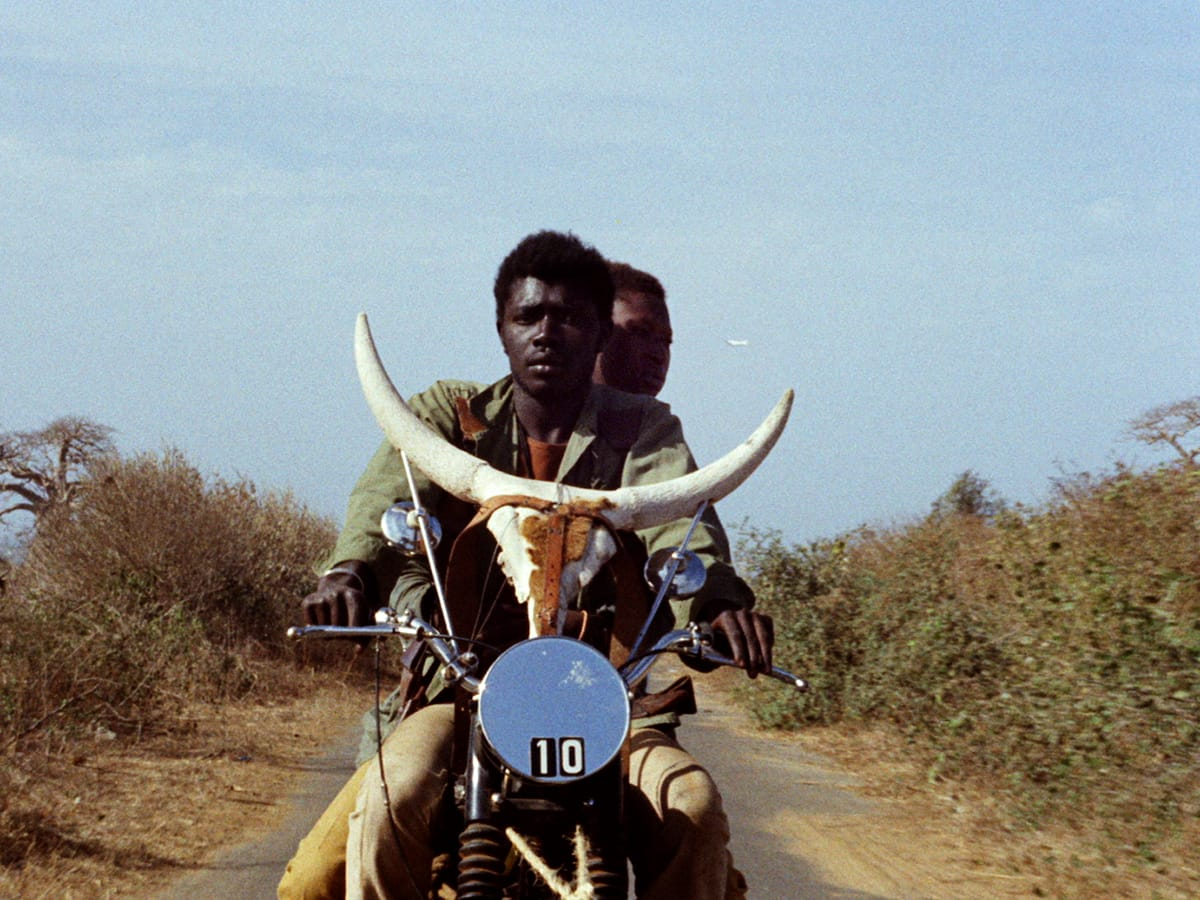
Mory’s horned motorcycle— beautiful and corrupted, glorious and absurd — embodies the film’s contradictions most directly. It is at once a gesture of defiance and a caricature of their imported vision of modernity, suggesting that his desire to assert his freedom is already compromised. The lovers’ freedom, such as it is, is serrated and unable to coalesce into a clear narrative, and the film hangs on whether the idiom of escape that enlivens so many French narratives, self-critical though they were, is even available to two vagabond lovers. Paris is never shown. It exists only as a projection, a seductive but ultimately hollow and absent signifier of life, futurity, and sophistication. Conversely, Dakar is rendered in vivid, chaotic, complex immediacy, a proliferation of motorcycles, markets, and bodies that vibrate with documentary vitality. Yet its presence is shot-through with its own palimpsestic nature, its existence within and between the distortions of modernity. The film’s many jump cuts and sonic disjunctions are not merely stylistic flourishes. They function as a critique of the multiple cinematic languages Touki Bouki cannot uncomplicatedly endorse or embody. Mambéty appropriates and fractures these techniques, transforming them into tools of resistance rather than mere imitation.
The film’s unfitness with itself hangs over everything. One verse of Josephine Baker’s “Paris, Paris,” constantly looped and never completed, suffuses the text as a ghostly apparition of past visions of freedom imported from other countries. Even in its attempt to move beyond these apparitions, to exhaust their mythology, the film knows it must respond to them. These attempts to respond, the film implies, are limited by the tragedies of post-colonial malaise. Senegal feels like a phantom limb not yet culturally severed from the body. The protagonists’ efforts to exhume the colonial corpse, to desecrate the corpse, manifest in their aborted attempts to rob the money intended to fund a statue to Charles De Gaulle, ex-President of France, an attempt which quickly goes awry when they only take a skeleton in military attire. If the omnipresent Zebu skull on Mory’s motorcycle signifies the pull of tradition debating with the dream of modernity, this creative but unsuccessful vandalism of what may be a colonial official’s – or De Gaulle’s – skeleton clarifies but does not resolve the tension between heritage and modernity. In exhuming their past, they are only furrowing further into a neocolonial submission. The skeleton still lingers, and destroying it does not fix their present conundrum. If freedom isn’t found in a French past, what else is there? The only other option presented is the “American classic,” a red, white, and blue car practically begging to wear the Zebu skull, to utilize a romantic image of African essence for itself, to colonize a new “freedom dream.” When close-ups show Mory getting ready to lasso what we assume is another Zebu, he seems like just another American cowboy, adopting a new image of himself that could be on loan from a Ford Western. When the editing completes the sequence, he’s revealed to be lassoing his own motorcycle to a tree, a parodic variation of the modern-day cowboy myth that constrains him.
The film’s ending—ambiguous, unresolved—refuses catharsis, underscoring the impossibility of a simple resolution to the paradox of what Frantz Fanon called “the wretched of the earth.” Touki Bouki implies a stasis born of the inability to reconcile competing identities, the persistence of colonial structures in the imagination. Anta boards a boat, a cinematic freight ship meant for cargo, a dark echo of violent, commodifying historical journeys past. Mambéty teases us with visions of a cruise liner populated with tourists, but when Anta inhabits the frame, she glides across a ghost ship, herself a phantasm stretching her soul across the shimmering ocean she longs to cross. And, in a final moment, a miniscule personal boat skirts the sea in the distance as Mory looks on in the distance from the shoreline: the remnants of their shared hope, the violence of having no framework for liberation available to you that is truly ready for the complexity of the present. Earlier, when Anta seems almost to make love to Mory’s desecrated cycle, it is a violent consummation of an inescapable death drive, a perverse, melancholic love affair with a vision of hope that is what the theorist Lauren Berlant would call “cruel optimism.”
Score: 10/10
 The Long Take