
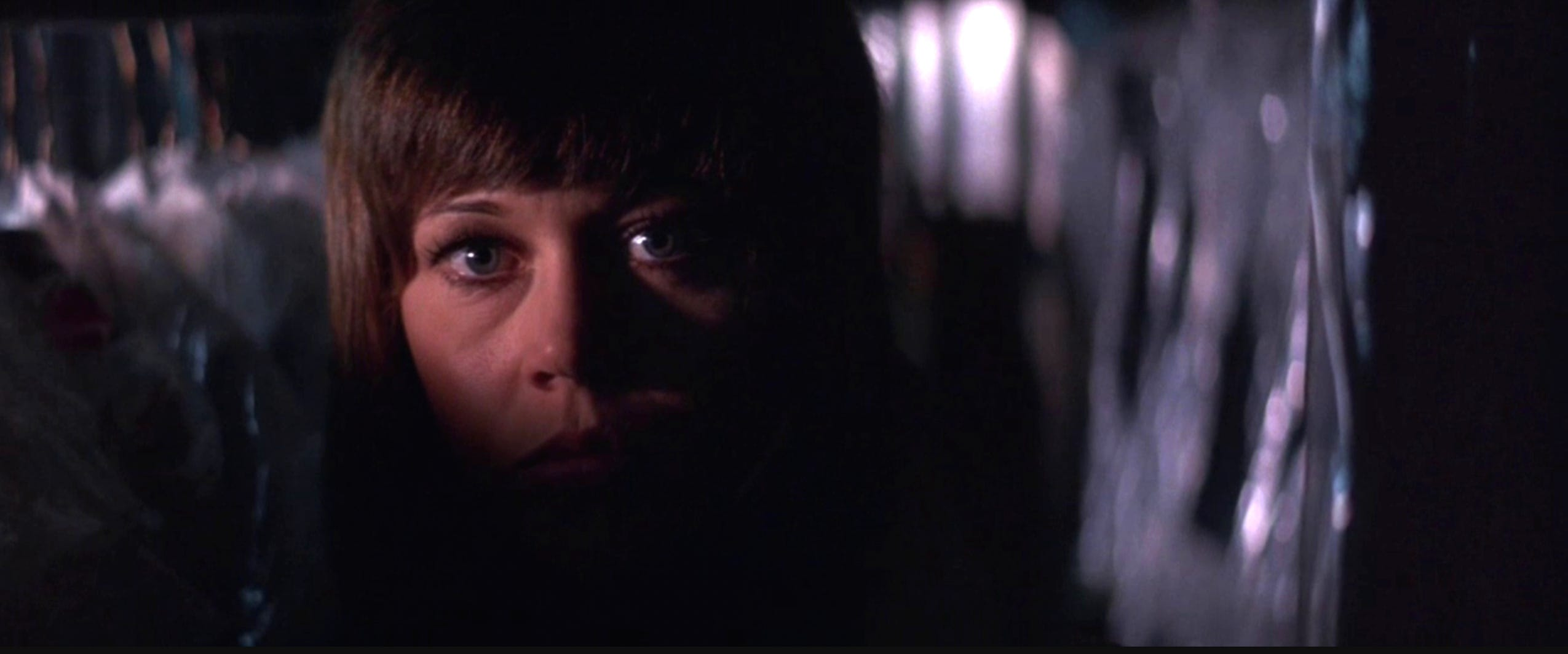
There’s a photo of JFK in Alan J. Pakula’s Klute that you can easily miss. It’s never mentioned in dialogue, nor bestowed with a glorifying or demonizing close-up. It’s a specter, a phantasm looming in the chiaroscuro of history. I couldn’t help thinking of Paul Schrader’s 1978 classic Blue Collar, where an old JFK campaign poster lingers like the vaguely comforting detritus of a dimly nostalgic history. It was just hopeless there, a half-forgotten remnant of the mid-century New Deal coalition that once signaled the hope of a connected, compassionate America. In Klute, seven years earlier, the demise of this vision is still fresh, and JFK looks like a malevolent specter, a doomed ghost from the past spying on everyone who appears in the frame, the angel of early ‘60s hope now perverted into a wraith dormant in the background. That one will likely miss the image is the point. It’s a model for the film’s moral universe, and its ethical question: are you – citizens, humans – paying attention?
Of course, the JFK image is also the first masterwork of cinematographer Gordon Willis, one of the few men who can be genuinely said to have redefined cinematography in the history of the medium. Achieving a kind of naturalistic symbolism, a fusion of old noir expressionism and ‘70s realism, Klute glowers with an aura of casual malevolence that is all Willis’s, asking us to see into the murky shadows of ambivalent morality without any crystalline lines of light and darkness to hide in, or hide from. This is an architectonic shift in cinematic style, framing immorality not as a question of brilliance and shadow but a morose, unforgiving brown. For Willis, everything can become potential background – everything in the world is waiting to be enshrouded by something else – and the film registers this entirely as a question of form. These are ambiguities that we won’t catch if we aren’t listening to how the film wants to be heard, if we aren’t attentive to the crimes the film is examining.
Perhaps that’s because the real questions Klute asks are not localizable to a single culprit. They are not concerns of personal complicity but ethical equivocation. Our subject is Bree Daniels (Jane Fonda), a call girl who has no real involvement in the world, until John Klute (Donald Sutherland), hired by fellow executive Peter Cable (Charles Cioffi), wanders into her life searching for the whereabouts of chemical company executive Tom Gruneman (Robert Milli), who sent Bree a series of letters months before. For Bree, her coldness to Klute is much like her connection to Tom is much like any warmth she might have displayed to her clients: a mode of self-protection, a form of distance through performing herself, mediating her relationship to the world through layers of detachment and artifice that may, if she isn’t careful, become her truest self. Bree’s identity – whether she can extirpate herself from this sense of self, and whether we have truer selves beneath all the masks – is the film’s mischievous question. The killer’s identity is irrelevant and, essentially, impossible to miss. She seems like a mannequin initially, and the mannequins she walks past in the climactic confrontation imply that she is figuring out what it means to not be one. In that moment, she is confronting not a quick, personalizable killer but a social structure that performs a much slower death.
When Klute opens, it’s on an abstract tableaux of recording – who is speaking, and for what end? We get a nod to giallo: a gloved hand that doesn’t need a knife but instead a cassette, a far more cunning and terrifying weapon for an era where corporeal violence was perhaps not the sternest punishment. A shot of Bree in an elevator, the camera looking through the metallic trellis on top, signals the manacles of a system she cannot name, an iron cage of gazes watching from above. Yet if the film anatomizes surveillance, it ultimately turns it inward. It is how we investigate ourselves – how we fade into the backgrounds of our lives – that matters here. The shadows are so thickly rendered that they seem to engulf the figures within, as though they are not framed or tested by the darkness but blurring into it. Even when they stand in the light, they appear exposed rather than revealed. There’s no shadow to hide in here: it’s difficult to see anything in the film, but never so dark that the characters might seek refuge from us. They are not swallowed by shadowy absence but trapped in half-visible enclosure. Terror, in Klute, is being seen and understood.
The film’s mood is miasmic. Pakula’s framing is quietly sinister, creeping up behind our necks. Even when the film feigns clarity, the dimming of the light clings to surfaces like a damp fog that refuses to lift. When our heroine returns to her old haunt, the film depicts her as a doomed specter in a space that once promised a facsimile of autonomy but now curdles into a gothic fringe, a puppet sitting on a throne as she takes what she assumes is her rightful place. But it’s an exsanguinating maneuver, and the film positions us as voyeurs ushered into a similar space of self-disavowal. When we pan across corpses as Klute looks for an identity, they’re all similarly flattened, drained of context or vitality. What separates them from the living? When we see a police line-up, is this a search for killers, or for victims? And what is the difference anyway?
In these equivocations, Klute exposes itself as one of the first shivers of a national thaw. Adrift from the moral certainties of earlier versions of order and justice, or the psychedelic fragmentation and fleeting idealism found in kaleidoscopic clarity of the mid-‘60s, we’re now in the sobering disquiet of the early ‘70s. The film becomes an omen of moral uncertainty in the twilight of a nation that had, at least on paper, assumed the century was its to lose. The film’s real object of investigation is the twilight of national hope, a dimming horizon fractured by the prodigal commotion of murder that may simply signal a final unraveling.
Score: 10/10
 The Long Take