Monthly Archives: March 2026

Film Favorites: Touki Bouki

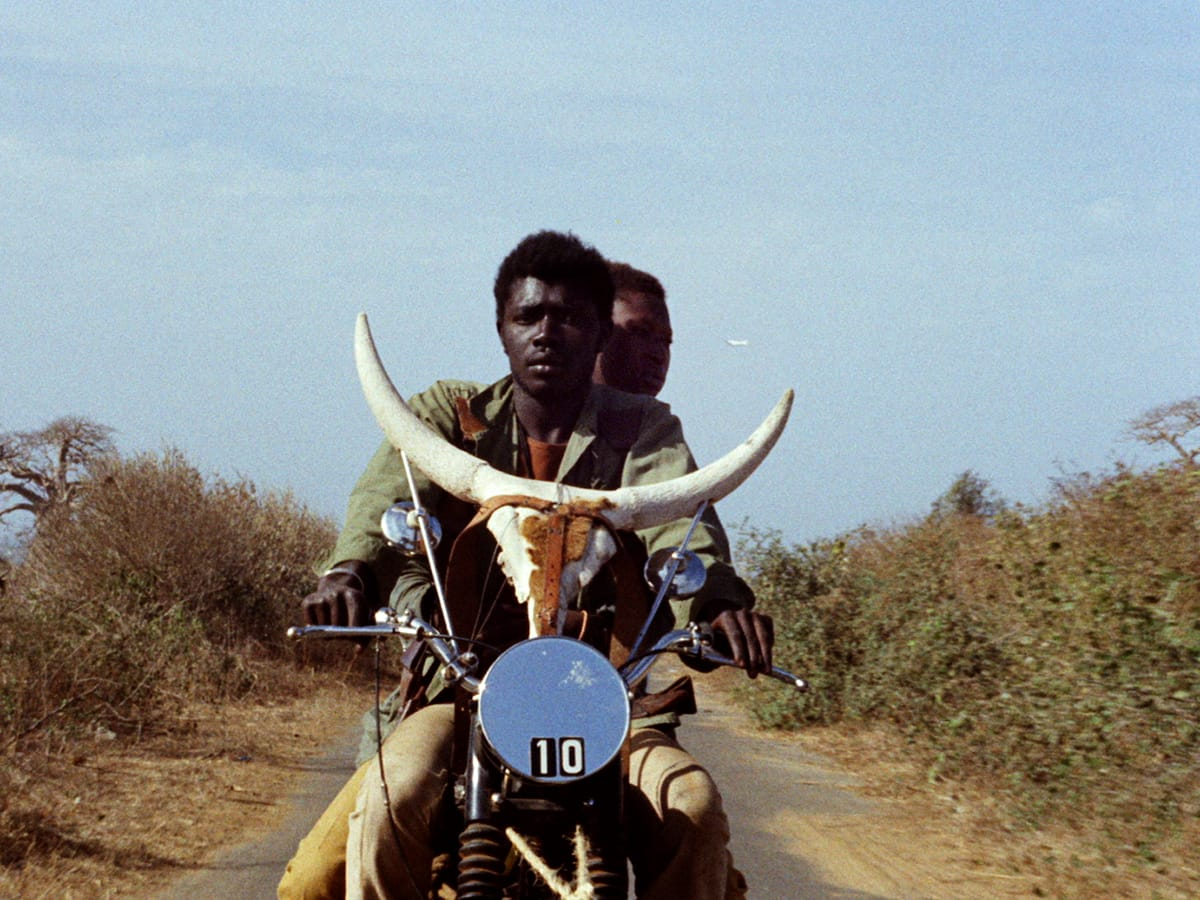
Djibril Diop Mambéty’s Touki Bouki is a vicious humanist of a film. It vandalizes its inherited cinematic styles, but it does so out of affection as much as frustration, care as much as critique. It trades classical cinematic storytelling for a French New Wave-inflected openness to disorientation and disarray, importing violent cuts, repeated imagery, and anachronistic sound cues from the French cinema of the 1960s. Stylistically, these techniques come from a Senegalese dream-time of integration with the metropole, embodying formally the inheritance of French thinking and culture on Senegal while meditating on the desire to smooth these connections, to render them natural rather than constructed through histories of violence and subjugation. These techniques destabilize the viewer, forcing us to confront the artificiality of both cinematic form – very much in the spirit of the New Wave’s critique of its own inherited and borrowed cinematic tropes – and the constructed nature of the colonial fantasies this cinema often sustains. If Touki Bouki utilizes its inspirations, it does so because it recognizes that it cannot escape them, and that engagement is the precondition for critique. While the techniques are in part borrowed from French New Wave cinema, Mambéty’s film makes them self-conscious of their own mimicry and, perhaps only in this capacity, able to escape it. There’s a self-conscious recognition of un-originality here, the brutal and curious intermixtures and impurities of colonial lineages, and an attentiveness to the fact that only in diving into these contradictions, rather than overlooking them, can African cinema become truly original. In the act of becoming itself through its interrogation of French cinematic norms, in appreciating those norms through its questioning of them, Touki Bouki may ultimately save them, and affirm itself.

The French New Wave was certainly self-conscious of its unoriginal originality in its own way. There was no long-term liberation in Godard’s image of French youth infatuated with American gangsters. Nonetheless, Breathless is infused with a romantic image of vagabond individualism as dissent, a rebellious rhythm in which youthful spontaneity could preserve a residuum of resistance, even if it took the form of a libertine death-drive, in spite of its limits as a form of collective challenge. The two lovers on the run in Godard’s first film were doomed, but there was poetry in the film’s exuberant vision of demise, a weak refusal of the status quo that retains the pure potency of its own energy. The protagonists were not long for this world, but their chosen idiom made their shortness amazing while it lasted.

Touki Bouki takes the same narrative structure – young people in search of a framework to hang their inchoate dreams on – but dislocates the joints beyond the point where it might read as even superficially libratory. Associative and allusive (courtesy of the elliptical editing from Siro Asteni and Emma Menneti), the film follows two young lovers, Mory (Magaye Niang) and Anta (Mareme Niang), as they dream of escaping Senegal’s capital of Dakar for a mythologized Paris they’ve imported from decades of colonial fantasia. They can’t, but Mambéty knows that he can’t get out of relation with that vision of escape. The film creatively dislocates this impossible aspiration, the violence of mental colonialism, through an act of formal disfigurement, ravaging itself in recognition of its own inability to conjure a genuine alternative. This isn’t a failure of imagination so much as a poetic acknowledgement of reality’s unfitness for itself, a formal gap in which our recognition of modernity’s wrongness – its control over the terms on which we might begin to imagine otherwise in the first place – demands to be recognized.

Continue reading
Film Favorites: Klute

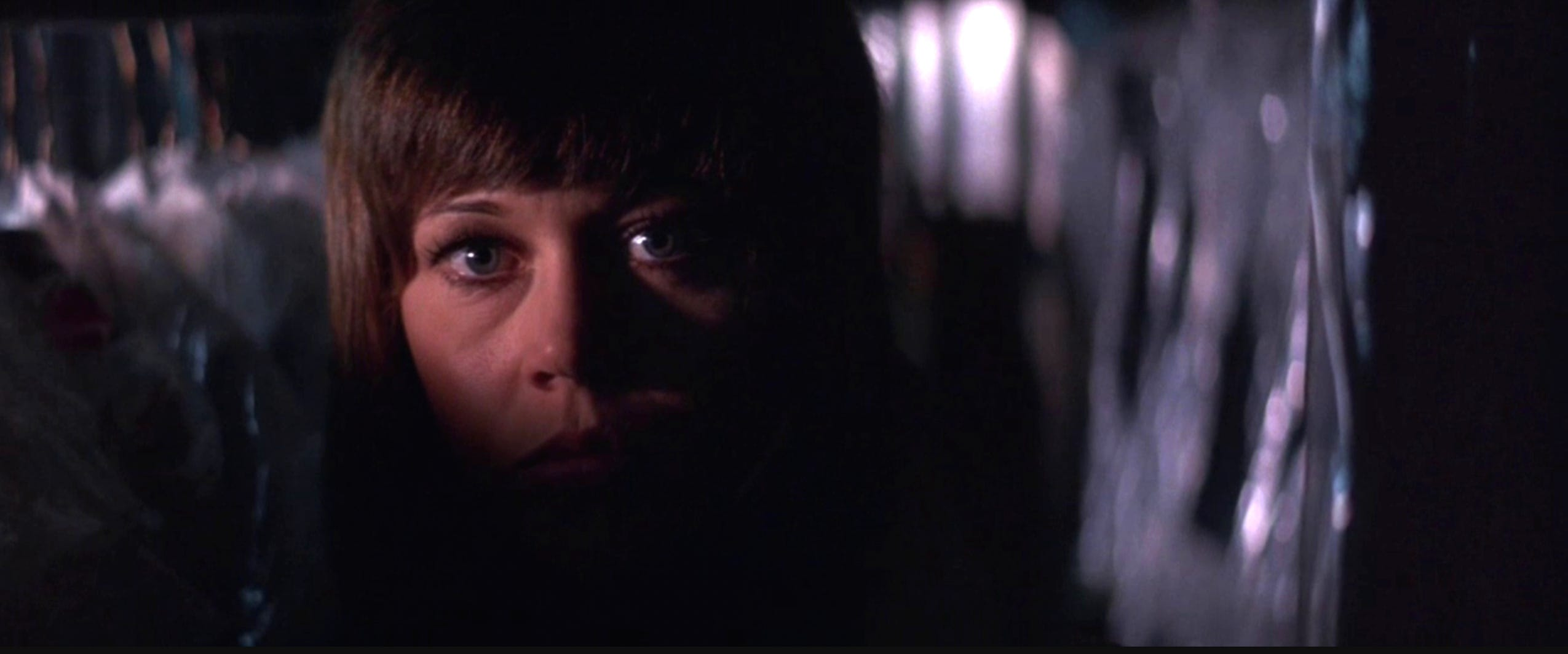
There’s a photo of JFK in Alan J. Pakula’s Klute that you can easily miss. It’s never mentioned in dialogue, nor bestowed with a glorifying or demonizing close-up. It’s a specter, a phantasm looming in the chiaroscuro of history. I couldn’t help thinking of Paul Schrader’s 1978 classic Blue Collar, where an old JFK campaign poster lingers like the vaguely comforting detritus of a dimly nostalgic history. It was just hopeless there, a half-forgotten remnant of the mid-century New Deal coalition that once signaled the hope of a connected, compassionate America. In Klute, seven years earlier, the demise of this vision is still fresh, and JFK looks like a malevolent specter, a doomed ghost from the past spying on everyone who appears in the frame, the angel of early ‘60s hope now perverted into a wraith dormant in the background. That one will likely miss the image is the point. It’s a model for the film’s moral universe, and its ethical question: are you – citizens, humans – paying attention?

Of course, the JFK image is also the first masterwork of cinematographer Gordon Willis, one of the few men who can be genuinely said to have redefined cinematography in the history of the medium. Achieving a kind of naturalistic symbolism, a fusion of old noir expressionism and ‘70s realism, Klute glowers with an aura of casual malevolence that is all Willis’s, asking us to see into the murky shadows of ambivalent morality without any crystalline lines of light and darkness to hide in, or hide from. This is an architectonic shift in cinematic style, framing immorality not as a question of brilliance and shadow but a morose, unforgiving brown. For Willis, everything can become potential background – everything in the world is waiting to be enshrouded by something else  – and the film registers this entirely as a question of form. These are ambiguities that we won’t catch if we aren’t listening to how the film wants to be heard, if we aren’t attentive to the crimes the film is examining.

Continue reading

Florida Fiends: River of Grass

Writer-director Kelly Reichardt’s River of Grass captures Florida’s weirdness by presenting it as entirely mundane. It’s not a Florida noir, nor a Southern Western, nor a film that fetishizes the state’s purportedly alien qualities. It presents America’s tail as a humanist limbo, a space where joining the circus and joining the service are two paths out that are actually just circles to nowhere. She captures a state in which people hoping to cross eons, to get as far away as possible, who seem hopelessly apart from the world, may find a kindred spirit just one town over.  In River of Grass, to be “not from around here” applies to all and none of us, embodying an exciting vertigo and a paralytic nothingness. Florida is a space that we can offshore the nation’s peculiar aloneness and strange camaraderie to, but that really is just America.  

And River of Grass is a quintessential American text. Wandering with wooly abandon, carrying an imperfect idea about itself in its holster, it feels like a characteristic apostle of the American independent movement, a loose and amorphous thing more interested in momentary minutiae than eternity-chasing symbolic abstractions or dogmatic formulations. It was released at roughly the same time as Tony Scott’s True Romance and Oliver Stone’s Natural Born Killers, both of which would trouble the cinematic water in a way that Reichardt’s film , which didn’t make waves at the time, initially didn’t, but it joins them in telling a characteristically national tale of forlorn lovers on the run, looking for a conception of capital-M meaning to frame the rougher edges of their existence.

Stylistically, though, the three films couldn’t be further apart. Stone’s film was more the unholy progeny of European (or at least continental) neurosis and morbidly glorious excess. True Romance is the more obvious comparison to River. Both are not-so-quietly cribbing from Terrence Malick’s Badlands (itself an American variation of a European remix of an older American Depression narrative), drawing from Malick’s Emersonian openness to flux and skepticism about formalized institutions. But True Romance accents Emerson’s energy. It’s an American dynamo, a kinetic machine constantly inching toward torqued, fluorescent, Whitmanesque zeal.

Reichardt’s text is another thing entirely, not a motor revving the American id (like True Romance) or a fire-and-brimstone preacher castigating America’s unthinking viciousness (a la Natural Born Killers). Instead, it’s a gentle shift that touches the nation to slowly cast it in a new light. Malick’s Emersonian tension between immediacy and distance, his play between transcendental and empirical truth, is never not here, but the closer analogue might be Jim Jarmusch’s Stranger than Paradise (to name another quintessential early text from a master of American ennui), with its deflationary wryness. Jarmusch and Malick aren’t one another, and Reichardt could be the hypotenuse of the two. She has Jarmusch’s wonderful appreciation for the absurd immanence of reality, his desire to luxuriate in everyday detritus, but she laminates it in Malick’s eye for the sublime aspiration toward rapturous grace that seems to animate so many American texts, framing themselves as dousing rods for something they might call the American soul.

Continue reading

Florida Fiends: The Nest of the Cuckoo Bird

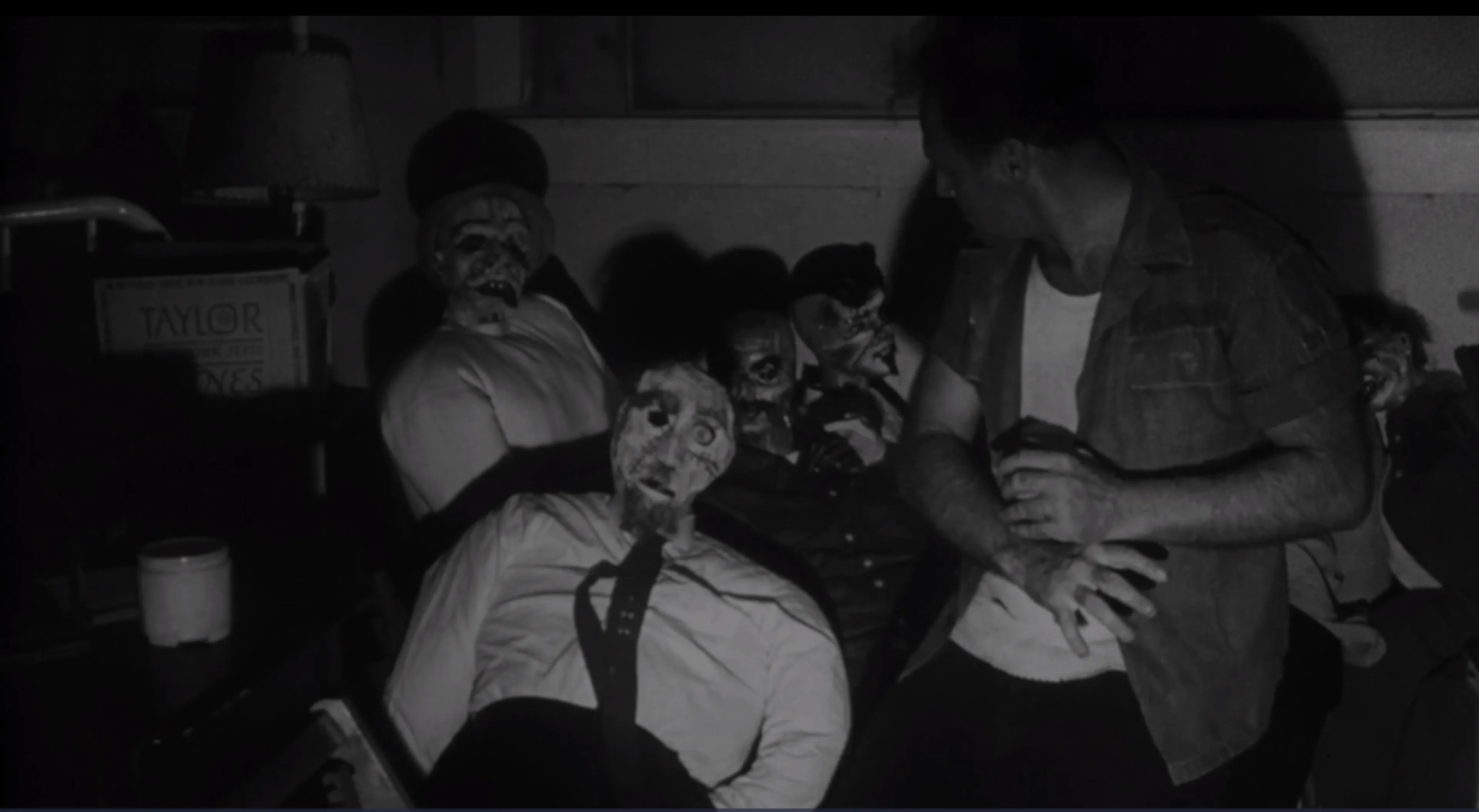
The unholy offspring of director/star Bert Williams, The Nest of the Cuckoo Bird is characteristic proof that a sufficiently minimal budget and a significantly disheveled orientation toward continuity can be indistinguishable from the avant-garde. The story of a government agent on the hunt for a serial killer in the Gothic swamps of Southern Florida, the film is about an inside man and a social outsider, a mainstream, corporate figure who is also, thoroughly, out on a limb. It is about that peculiar mid-century creature, the practical man of affairs, the kind of guy who is supposed to move ceaselessly between the center and the margins. And the film is such a creature as well. Released in that shady region of the art form known as the 1960s, after Old Hollywood had ceased to be but before New Hollywood had figure out what to do with the chaos, this is the kind of film that bears the imprint of so many definable cinematic types, yet feels like it can’t quite find a home in any of them. It feels like the wax drippings of several mannequins dressed in other film genres, or a strange, backwoods gathering ground where they each mingled and mangled and got lost in the swamp. In this miasmic post-noir, the ‘60s is a waterlogged mire that can’t quite remember what it could have been and can’t quite imagine what it could become.

Continue reading