History in Daughters is oral and haptic, textural and material. It floats and sinks, breaths and chokes. In the cyclical “muddy waters of history,” a character can proclaim wanting to unceasingly “move forward” while also reminiscing on their unquenched taste for a decidedly nostalgic, historical gumbo. This paradigmatically liminal phrase – “muddy waters of history” – frames cinema not as a reflective mirror reclaiming the past but a swampy transmission touching that past, a semisolid state where history is stilled before us and yet very much in motion. In Julie Dash’s 1991 masterpiece, art is a catalyst for the tornado of history that is always encroaching on the prism of the future. It is a space where we haunt the past and it trespasses on us. As Martinican poet-philosopher Edouard Glissant wrote, this time, you can step into the water twice.
Mary (Barbara-O) is perhaps the one character most overtly stepping back, the one who, along with devout Catholic Viola (Cheryl Lynn Bruce), who initially seems to approach the act of disowning her history with a missionary zeal, begins the film on a boat returning to Ibo Landing, her family’s century-long home. Her people are Gullah, a wayward tribe of African Americans who inhabit the off-shore site where a lost colony of slaves, at the dawn of the 18th century, once infamously chose to head back to Africa, or into another plane of existence, rather than remain entombed in a present that denied them a future. This infamous mass suicide, where several dozen slaves purportedly walked into the ocean in the direction of Africa, lingers as a source of inspiration and fear, a dream and a nightmare, for the Peazant family, who still daily traverse this land a century later, in 1902. While Mary returns by boat at the film’s beginning, everyone is really constantly arriving and departing, stopping and leaping. In Ibo Landing, past, present, and future weave into one another. What one character calls “the last of the old” and the “first of the new” are indispensably tethered.
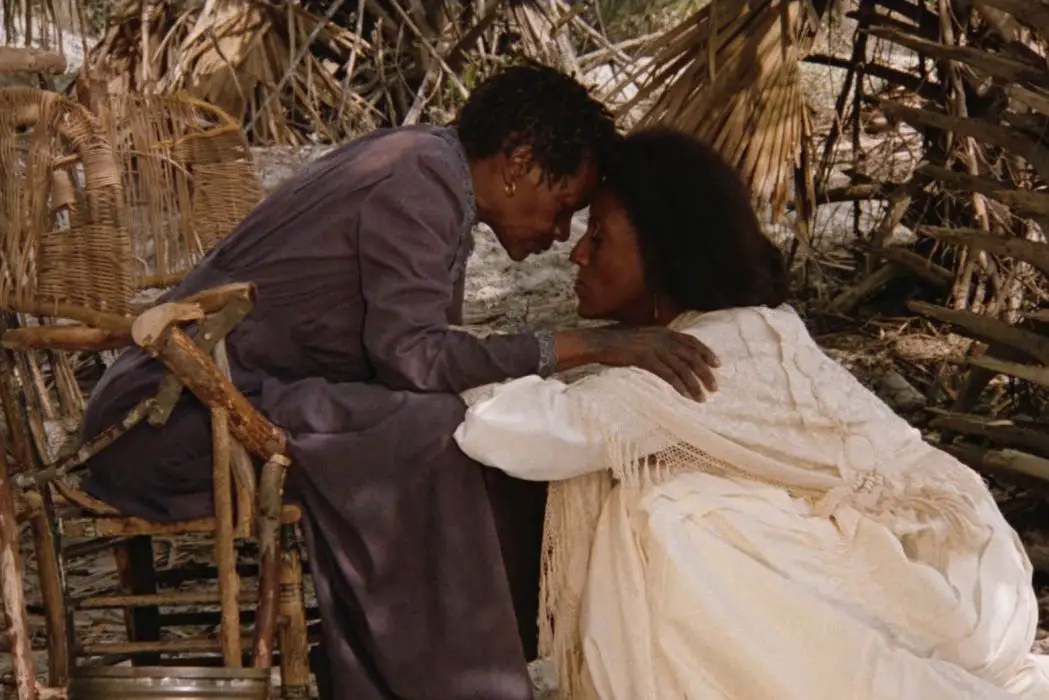
The voice speaking those lines is Nana Peazant (Cora Lee Day), a characteristic griot, a diasporic storyteller who recounts the past like the weave of the earth, the dust in the sand. She is the matriarch of the family that still lives on the island, a family that is presently at a moment of transit, each of them having to decide whether they will stay on the island or finally leave for the mainland like Mary and Viola before them. Nana seems unlikely to go. She disowns Christianity’s Manichean gods and retains the family’s old ways. But she also wraps their Bible in her own ritualistic totems, symbols of a syncretic religion, a melding and reforming of cultures, new and old world, an act of collective poesis that remains as potent as it is elusive and inconclusive. She herself may not leave, but she’ll always remain a resource for their future.
Nana is a gravitational voice around which many others circle, but they each also find their own paths. This is a village voice of characters exploring one another, holding onto a present but phantom past and conjuring images of a diffuse but pressing future. What of Haagar Peazant (Kaycee Moore), Nana’s daughter-in-law who desperately craves modernity? Or Haagar’s daughter Iona (Bahni Turpin), who is in love with Native American St. Julian (M. Cochise Anderson), who is clearly not going to leave? Some of the characters pondering their fate aren’t even born yet. Our narrator, an Unborn Child (Kay-Lynn Warren), the progeny of Eli (Adisa Anderson) and Eula (Alva Rogers), or perhaps Eula and an unnamed white man who, we learn, raped Eli, ruminates on a truth she doesn’t know, a history she can only feel for, never reconcile. That her father may be white is implied only in the fact that Mary begs Eula not to tell Eli of his identity (Eli only knows that it was some white man). Their family has enough complexity to deal with without worrying about Eli being “lynched.” These innuendos and insinuations are transmitted incipiently and picked up in fragmentary fashion. The characters can read each other; we are strangers. This history is thick and foggy, a bitter remedy for the atrocious Netflixication of art where memos are being sent out to companies for fear that people are not watching the screen, exsanguinated by the slow death of narrow efficiency. The Unborn Child will be part of this lineage, will be their child, will be their future, with all its violent suggestiveness and haunted mediation intact. The family lines are not linear but diagonal, not rooted but what Glissant would call rhizomatic, and her connection to them is a project of care and concern, not a fact of blood.
Thus, the future persists, through, with, and within, the violence. A camera always looks at the world like the “scene of the crime,” wrote German mystic Walter Benjamin. But what would it mean to cast a gaze on such a foundational crime as transatlantic slavery? In Daughters, the camera of Mr. Snead (Tommy Hicks), an urbane member of the African American “talented tenth” who self-amusedly comments on these “salt water negroes,” attempts to provide an answer to that question. With his investigative camera, his visual gaze attempts to press, as if in a microscopic slide, the film’s murky waters, to still its history. While he perhaps hopes to congeal a static image of a bygone past, a crime acknowledged and, if not averted, at least overpassed by the benefits of the “civilized” Western world he represents and which slavery admitted Africans into, his camera congeals something more radical, a dissident image of an alternative future. The Unborn Child materializes in the frame, haunting it from a future that refuses to recede before the horrors of the past and present. The camera, we find, encounters a history that is both excessive to its gaze and intolerably subterranean, that is both a past dreamt and a future recollected.
In this film, the crime in question is the whole structure of modernity, something beyond any localizable visualization, something that has often been understood as “sublime,” so horrible as to be beyond representation. The film repeatedly confronts that sublimity with a suggestive and oneiric style. Editors Amy Carey and Joseph Burton knead an elliptical and allusive editing structure, watery but also fragmented enough to reveal particles of stray historical alluvium. Cinematographer Arthur Jafa washes the film in a briny texture, kind of romantic but diaphanous and miasmic enough to imply a corrosive force beneath it all. Theirs is a poetic style that implicitly rebukes and expands the limitations of Snead’s sociological camera, his acceptance of a modernity that cannot excuse a violence he may initially want his technology to redeem. The Child represents, and Snead seems to slowly recognize, a vision of survival that does not disavow the cruelty of history but, instead, folds it into a possibility Black Americans made themselves. Travelling, as Christina Sharpe might say, “in the wake” of violence, we’re in what Glissant calls a “womb” and an “abyss,” a violence that must be tended to, reckoned with via a polyphonic form, that cannot be limited to a straightforward document of history. The individual child, the Unborn narrator, resonates with a realization, more attended to by the women than the men, that this is not anyone’s private creation, that the next generation is the progeny of a collective history that all the past and present ones make day by day.
“Making,” in turn, is thus also an act of remembering, the characters perusing even those aspects of their own history that might complicate their dreams of purity and aspirations of solidity. Consider Mary, who may be a working girl and who may be a lover to Trula (Trula Hoosier), who joins her on the trip to Ibo Landing, something that is only intimated and that the other women judge her for. Eula is careful to remind them that this perceived impurity taints them all, that their history as Africans in American history was to be used, that they cannot hold to romantic images of an uncontaminated, Edenic paradise recoverable as an exalted future. Instead, and following Eula’s vision, the film treats the family as an undisciplined menagerie of human complexities, refugees from whatever doctored history might camouflage the full gamut of their liveliness. The Unborn Child is not an Adamic figure prophecizing a new future unburdened by history, but a crucible, a reminder that their capacity for love and mutuality will continue on in spite of everything.
Eli, despite his frustrations with his wife’s perceived tarnished quality, seems to heed Eula’s call late in the film. When he pensively caresses and washes the icon figure of a slave ship that long ago brought men and women to this island, he sets it adrift, both out of and back into the mud of history, a letting go that is also an acknowledgement that is also a kind of baptism. He seems to be trying to cleanse this horrible history, bestowing upon it an ambiguous weight, gifting it a strange, alluring beauty in the chiaroscuro of time, a figurative embodiment of what Ralph Ellison would call “fingering” history’s “jagged grain.” Nana Peazant does something similar with her indigo-stained hands, a violence that remains. And yet she wears an indigo dress, a beautiful adornment fashioned from a history far different from the pure white that most of the characters wear. These are the strange refractions that writhe in the waters of history, in the alembic of cinema that, like the icon figure, is a strange voyager in the waters of time. Daughters sings a penitential blues in a frequency that reflects and represents nothing, makes and, to use Zora Hurston’s word, “ornaments” everything. It’s a plea for attention to history that is also a eulogy for the weird beauty of places, even about oneself, that one doesn’t want to look.
Score: 10/10
 The Long Take