
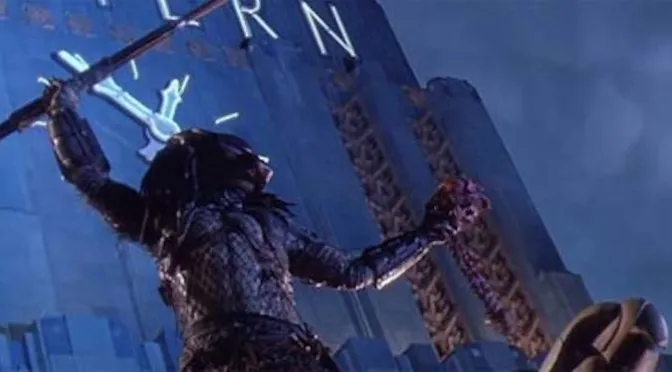
If only director Stephen Hopkins’s Predator 2 was quite as awful and empty as its reputation suggests. Turning from post-Vietnam parable to a vision of the U.S. as a police state, Predator 2 is at once too inadequate and ham-fisted to take home and too canny and cunning in its critiques of American society to write-off. If the first Predator was, at base, an imperialist fantasia of an action movie cracked in half, turned into a vicious thriller about an interracial group of American men united in working as puppets for American corporate and governmental hubris, Predator 2 figures all races, groups, clans, and organizations as one more front in a violent war of unceasing viciousness that reaches from the streets to the penthouses to the institutions of power. If Predator concluded with a set-piece that systematically reduced Arnold Schwarzenegger, paradigmatic icon figure of ‘80s American masculinity, into a sort of visual negative space reduced and stripped barren, Predator 2 lets the titular Predator loose in a high-tech, dystopian Los Angeles to reveal how empty the whole edifice of Western progress might be. The film is basically empty, but it also suggests, here and there, in moments and fragments, that we are too.
Fighting the Predator this time around are a group of police detectives played by Bill Paxton, Maria Conchita Alonso, Ruben Blades, and, as our protagonist, Danny Glover (along with an intelligence agency squad headed by Gary Busey). They are another interracial task force of a penal American modernity that is basically a way to launder the film’s cruel, vindictive vision of modern justice in a patina of liberal multiculturalism. Glover’s character is a classical Hollywood potboiler archetype, a by-his-own-rules cop who can converse with the designated social underbelly and who, somewhat remarkably, wears the same loose-fitting ‘50s suit he wore in the same year’s To Sleep With Anger. In that wonderfully sly Charles Burnett film, he plays a self-amused, pestering id, a devilish reminder of history’s pull. Here, the same look and feel positions him as a slippery operator barely surviving an internecine conflict called humanity. This is a gross vision of modern life, a fascist view of the world, and Predator 2 shows remarkably little compunction about hiding it from us.
That suit feels like the film’s pass at a noirish atmosphere compared to the original film’s unbridled action-movie machismo. Predator 2 delves more fully into the urban Gothic architecture of an L.A. it depicts as a rotting scab, a case of the American imperial violence the prior film fetishizes and critiques returning home to roost. This, like the titular Predator, cuts both ways. It feels like a grotesque vision of the world and a satirical extension of that very paranoia in which the social world can be nothing but a festering wound, as in an absurdist joke where every passenger on a train has a weapon, a nasty, satiric beat that both validates and mocks this film’s unapologetically horrid view of the universe. In this, Predator 2 is as confused and as incoherent and as texturally interesting as Hopkins’ later The Ghost and the Darkness, another diagnosis of modern violence that simultaneously weaponizes, exoticizes, and fetishizes that violence.
The film’s vision of modern violence as an inexorable, ever-expanding debasement is theoretically meant to suggest that little really separates the sub-units of a species united in its capacity for cruelty. This is both a strength and a weakness of the film, which is both less specific than the first Predator in its political critique of American governmental hegemony – this sequel tends to generalize the conflicts depicted as human failings rather than specific sets of assumptions about and policies governing the world – and more evocatively nihilistic, since it does, at root, paint a more damaged, inescapable vision of late-capitalist life as an all-consuming free-for-all.
Before we get there, Hopkins, a journeyman director if ever there was one, fashions an above-par action film, doing a more-than-workmanlike job adding the hurtling kineticism and addled, torqued expressionism, at a lower register, that James Cameron and Kathryn Bigelow were bringing to much better films at around the same time. We also get a lot of nasty-minded racial essentialism along the way, including a brazenly inaccurate vision of Jamaican culture (here rooted in the broadest approximation of voodoo, a Haitian practice in reality) that the dreadlocked Predator works its way through while cutting a warpath up the totem pole of LA life. It’s an ugly, nasty film, but also a curiously, perhaps accidentally, beautiful one. When the frankly phenomenal final set-piece (which takes up nearly the last third of the film) begins, we’re in a meat factory, the Predator hanging “lesser species” out to dry like the people themselves have already done.
Before that, a mid-film lull depicts the Predator deciding whether a child blissfully running around a cemetery with a toy gun is a “threat” or not. The child is basically non-disturbed about seeing an alien, but why would he be? Given that he already pays no heed to the cyclical irony of turning a cemetery into a playground of violence, what could possibly attune him to the strangeness of the world around him anymore? What could sensitize him to the inhuman, alienated world we’ve already created, a world in which the titular predator really is just the best at doing what we already take for granted. There is, in other words, something afoot here, not unlike other seemingly misbegotten 1990 Hollywood sequels such as Robocop 2 and Gremlins 2. Although Joe Dante’s Gremlins sequel, in its positively gleeful deconstruction of the capitalist cinematic machine from the inside out, is the only real secret masterpiece among these films, Predator 2 slouches its way to thoughtfulness more often than we might want to admit.
Score: 6/10
 The Long Take