
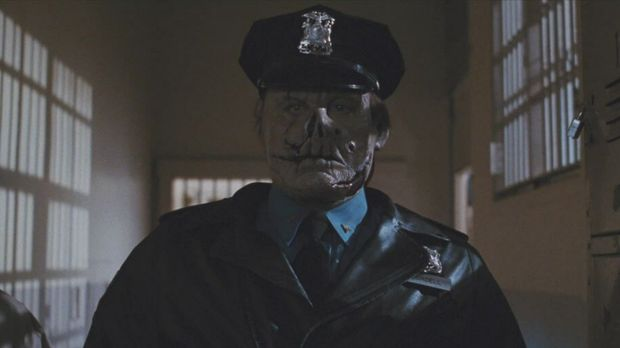
I’m only winking a little bit when I claim that Larry Cohen was one of the great New York artists, a bedraggled poet of a forlorn city. Evocatively directed by his compatriot William Lustig with an eye for spontaneous eruptions of brutality and an ear for the underlying violence beneath them, Maniac Cop II is curdled and vicious enough to leave a stench. It isn’t messing around. It’s also distinctly Cohen-esque, the work of a unique voice not because Cohen wanted to be an auteur or really cared about his personal vision but because he couldn’t but do it. This is evident in the near-fetishistic infatuation that a would-be criminal has with zombie police officer Matt Cordell (a Vorhees-esque Robert Z’Dar), which never plays out as straightforward attraction. Or the undercurrent of real melancholy that the lighting ropes around Cordell, who is presently on the war path for those who wronged him in his waking life, suffusing him in a melancholy menace despite the character seldom speaking and never expressing a vocal line. The suggestive relationship between cop and criminal keep the text remarkably ambivalent, transforming Cordell into an icon of entombed masculinity and silent devastation, a mutant man incapable of human expression anymore. That’s evident in more than just the titular character too. Robert Earl Jones, who shows up only briefly, nonetheless wears on him a century of racial violence, a much longer echo of a brutal world than Cordell does.
And Lustig, more than just a hired goon, is a true partner in crime. Some of the gruesome beauty he brings to the film is simply a matter of time passing. It looks better, of course, than 80% of any given year’s cinematography Oscar nominees, because it came out before Netflix turned everything into a homogeneous aesthetic paste. Whatever else Maniac Cop II is, you can tell it wasn’t made with the assumption that the people watching it are off doing their laundry or chopping vegetables. This is cinema, someone with a genuine eye exploring visual textures because he happens to be curious about them, no more and no less. Maniac Cop II evokes an entire sensibility with its style in a way that I can’t imagine another slasher from the dreaded early 1990s doing. This is expressive sleaze in the best sense, channeling – and frequently being confused about – the violence of an era it outlines in what we might, paradoxically, call ambiguous boldface.
How else to define the tension at the heart of the film’s “monster,” a brutal, Manichean killing machine outlined in an iridescent gloom? This is a slab of meat, a police officer as an almost literal pig, a monstrous perversion of police brutality and a melancholic survivor of abuse. He somehow manages to be both blunt, self-evident presence and spectral absence, much like a state that obviously brutalizes, that needs no screen, and yet still somehow manages to remain just out of reach of the forces that might restrain it. The film thematizes this in the presentation of the titular Maniac Cop: the kills themselves are rendered viscerally on-screen, but Cordell somehow manages to almost always hover right off camera.
Sam Raimi was involved in producing, and a couple of kills, for instance, a chainsaw grabbed from a dollar-store Santa, nail Raimi’s penchant for mixing minimalism and maximalism within the same scene, rather than sequestering tones into different silos. The brutally quick way the protagonist from the previous film is unempathetically knocked off here, or a slightly later kill where an officer is hoisted, without visible killer, onto a tow crane and solemnly dragged away, turn the titular monster from melancholic horror, a grotesquely malformed body, to comic terror, an unseen force perpetrating disturbing hijinks. Even the “action,” typically the addendum in a film like this, is far from rudimentary. A major car chase is more exciting than anything in the same year’s vastly more prominent Die Hard sequel and more authentically Verhoeven-esque than anything in the try-hard, viciously nihilistic Robocop sequel. It also has maybe the greatest fire stunt in the history of cinema, a literally incantatory “I’m walking here” from a guy closing the loop on his life before exploding back into the grave. That’s not nothing.
Score: 7/10
 The Long Take