
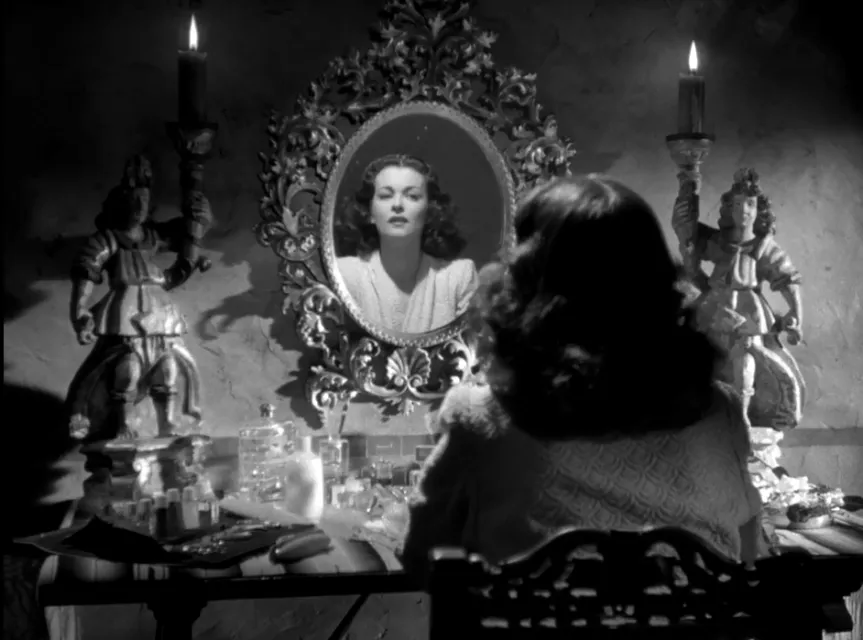
For a director most associated with expressive harshness, Fritz Lang was an abnormally varied, prismatic artist. Even his American sojourn, long considered a fall rather than a fault-line, an adventure of its own, reveals multiple distinct periods emerging out of one another. His despondent ‘30s texts, evocations of a Depression-beset nation submerged in restless ennui, are preludes to his flourishing film noir American missives in the ‘40s. Noir itself was a trend that Lang had, of course, precipitated in his German expressionist classics, but he would go on to break them down as well, essaying several coldly analytical later texts in the 1950s that abstract noir to nearly Kafkaesque levels of conceptualization, reflecting the return of European thought to a mid-century America wracked with anxiety about its Byzantine bureaucracies, corporate homogeneities, and ambivalent position in the global fight for a freedom that America had long claimed but also inhibited.
These final films were among his most despairing, anticipating the post-modern criticism of the ‘60s and suggesting that the soul-ravaging violence Lang worked through as a young man in Germany was an all-too-perfect waystation for his discovery of a more distinctly American violence. While Lang adapted to the particular anxieties of multiple time periods, from Depression-era miasma and social neglect to ’40s-era social consensus politics, he became a dark poet of life within the apocalypse at its most fatalistic.
His American films, specifically, condemned the seeming spirit of banal optimism in American life, essaying the violence of a nation that couched itself in possibility, the terror of a country that simmered at a much lower ebb than the catastrophes of Europe, but which, in the director’s final films, returned to roost. Few filmmakers understood so well that fascism was endemic to America as well, and that it did not require someone like Hitler to perpetrate. Lang remained, until the very end, an underground operative in the Hollywood machine, pulling its gears in self-critical directions and contorting its innocent facades in askew angles to expose its own malice and manipulation.
Through each period, Lang’s films were sinister and spellbound, tales of cloistered fates and expansive, almost impossibly labyrinthine realities incalculably complicating our paths to meaning in life. Lang could smuggle contraband critique into cinematic playthings as well as any other, and Secret Beyond the Door is a vision of mid-century human agency moldering in the grave. It’s a Gothic melodrama, a film about the testament to the pull of the past, to the latent layers of oppression within any apparent possibility, to determinism’s cruel designs on our capacity for escape. Complex transformations of meaning abound, signaling reincarnations of repressed truths by forsaken souls.
Two such souls are Celia (Joan Bennett), presently on the verge of marriage, and Mark Lamphere (Michael Redgrave), a charming sophisticate she spuriously meets on vacation. When he runs off suddenly, she tracks him down, only to find that he is a widower with a teenage son David (Mark Dennis), who seems unusually, violently cold to his father. Once he introduces a series of locked rooms that he has restaged with replicas of the bedrooms of famous historical wife-murders, it seems fairly obvious where his wife might be, and what might have befallen her. But Secret is unusually thoughtful in its morality and demanding in its methods of identification. Mark, it turns out, may be a modern-day bluebeard, a serial wife murderer presently grooming Celia as his next victim, but the screenplay (by Silvia Richard) is less invested in riveting us with the factual answer to this question (or, indeed, whether he did kill his previous wife), than in making us complicit in meditating on what this means, and what the cause of it would be. Increasingly, the film layers in suggestions to interrogate whether he is a self-conscious murderer or a dark and tragic constellation of unclarified social forces and decades of repressed meaning haunting his choices today. His sister Caroline (Anne Revere) and their family servant Miss Robey (Barbara O’Neil), meanwhile, have their own arcs in only a few scenes each, with O’Neill’s wounded recalcitrance as the vulnerable but fiercely self-protective Miss Robey, carrying a decade of uncertain feelings toward her situation, being particularly moving.
Lang is in a sometimes-sedate form here, but the film accrues an aura of pregnant suggestibility that lingers in even its more apparently pedestrian moments, implying that every image may be a key to a deeper truth, every mind a torrent of latent thorns, every hope a mode of fulfilling or collapsing the self. Celia’s own ambivalent affections for Mark feel rooted in her conflicted orientations toward the inner turmoil that social circumstances can bring up in a person. Lang evokes the deepest meanings in the subtlest maneuvers of the gaze, his camera moving in and out of spaces, gradating the nature of the conflict at an at-times infinitesimal level: whose perspective is relevant, and who is bothering to pay attention. His shadows suggest festering menace but also real affection, a humanistic negotiation of the confines that shape and frame our futures for us, both a late 19th-century gothic and a mid-20th-century awareness of structural determinism. It’s a materialist metaphysics, a vision not of supernatural or abstract ideas but psychological and sociological forces pressing down on unsuspecting persons who are worried about their own agency in a world that affords them no one.
The latent expressiveness of this most expressionistic of directors does, occasionally, come alive though, offering sudden reminders of the capacity for even the most apparently banal moments to erupt into plenitudes of darkness. The opening is an associative free-for-all with Wellesian signifiers playing out in an existential fugue state that casts a pall over the entire film, darkening the relatively light opening act and loosening up what seems like a potentially straightforward story. The film will only really return to this lyrical texture once, a mental trial in which not only a guilty conscience, but the ambiguity of definitions of guilt, laminate a mind in its own failures. In the film’s most phenomenal descent into the ambiguities of time, Lang stages Celia as a specter haunting Mark’s past, floating to a door that, on its own, signals nothing, but which, in this context, is pregnant with nefarious intent, a sign of almost funereal predestination. Is she her own person, the film asks, or simply one more echo of a cosmic recurrence? The film around these moments is not as bracingly critical nor as lacerating as Monsieur Verdoux, Charlie Chaplin’s same-year update of the Bluebeard myth, a film that takes us to task for the violence we assent to every day and claims that we need no expressive laminates to expose that violence if we really pay attention. Secret is a bit more local in its aspirations, but it exposes Lang in continually compelling form, a German expressionist mastermind adrift in, and in turning a chill on, his Hollywood thaw.
Score: 8.5/10
 The Long Take