In the opening minutes of Sidney Lumet’s 12 Angry Men, justice transforms from a towering obelisk of American might into an embattled and deeply fragile conundrum. In the opening shot, the courthouse pillars leer, imposing edifices that might suggest a beatific monument to a concept solidified for eternity or, conversely, corroded into a hollow stillness. But what makes the building matter? The lawyers, who we do not see in the film, get a uniformly bad wrap, and the judge we temporarily witness seems more interested in playing with his pencil than in the conceptual, ethical, or logistical questions he doesn’t recognize are on trial (or, perhaps, he has already resigned to their assumed guilt). This seems like an evacuated justice, distorted by an unnamed McCarthyism and the daily inertia of boredom and limitation, a vaporous principle without a sturdy enough form to channel it.
12 Angry Men wants to save democracy though, or at least to argue that it is worthy of being saved, but it presents no legal armor worth a salt. This is a film in the unenviable position of mounting a battle for a principle that, it admits up front, has no army to fight for it. No formal army, that is. It is not the building, 12 Angry Men suggests, or those employed in it or by it, that form the cornerstone of American morality, but that most humble arm of democratic reasoning, the titular figures who assume they know before learning to appreciate that things might be otherwise. This, the film claims, is the soul of America, a dozen lost soldiers of democracy heretofore unknown to one another: “the people.”
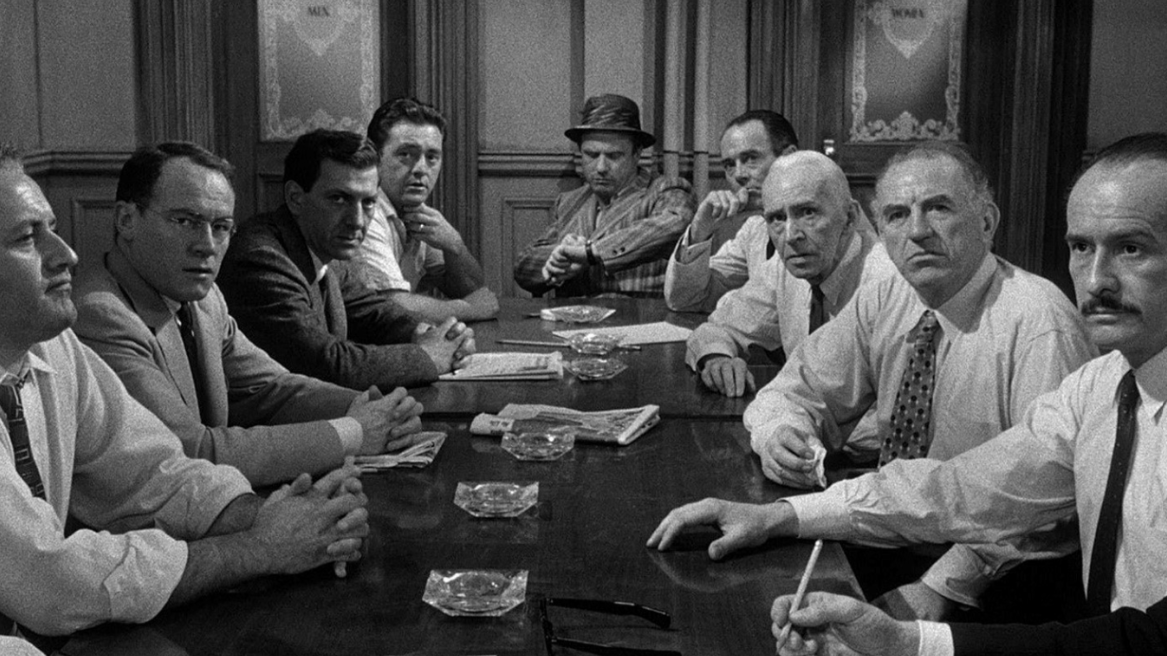
Indeed, they become “the people” throughout the film. The opening tracking shot glides us through the courthouse and into the jury room, a gathering ground of difference communicated and contested, a town hall meeting in miniature. Juror #8 (Henry Fonda) marks himself as a redoubtable icon of justice by staring out the window of the room, reflection upon the wider world while preserving his own individuality, not yet fully, or only, participating in this temporary local community. When everyone sits at the table, the film christens the creation of a space of democratic give-and-take and competitive collaboration where friction produces, in theory, a truth as ragged and unfinished as it is steadfast and eternal.
Those paradoxical pairs, “ragged/unfinished” and “steadfast/eternal,” constitute the American conjuring act. Democracy, our legal system perpetually implies, is incomplete and flexible and preordained and forever. It is rooted in nothing and expands to everything. It cannot be embodied in a building, only embraced in a debate. By the film’s end, the men at the center of the film will have performed a version of what Sacvan Bercovitch called the American “ritual of consensus,” in which they learn to assent to the American spirit, in which some guiding voice of doubt produces a new kind of democracy through a combination of vigor and uncertainty, between principle and, it must be said, contrition.
What works about 12 Angry Men is how self-aware the film is about contrition, about the many, often disgruntled, disagreements by which democracy comes into being, how its eternity is defined by, not against, its fragility. The script understands that this is, essentially, a magic act, creating something out of nothing. While the twelve titular arbiters of American fate who temporarily gather here leave the film having enacted something the film calls justice, not all of them have really become convinced of what they’ve done. Some have been beaten into submission. Some have simply given up. When we leave the courthouse, the building’s look is less celebratory than it seems, less like a leering leviathan and more like a man, foibles unreconstructed. Adapted by Reginald Rose from his own teleplay, the screenplay is a monument to democracy’s unmonumental nature, to the way in which “the people” are evanescent and hydra-like, perhaps coming into being despite being, perhaps, nothing real at all.
The film, then, is an act of faith, less an emphatic plea for democracy than a demonstration of its fundamental ambivalence. Our “hero,” Juror #8 (Henry Fonda), is an acolyte of doubt, a zealous believer in disbelief. He is a prophet of human frailty and finitude, the fallibility of flesh and the mercurial quality of mind meant to secure American salvation. It is less he than the space of principled doubt that he facilitates that becomes the living, breathing “spirit of liberty,” as Judge Learned Hand would say. It is thus that the apathetic baseball fan (Jack Warden) gets the harshest treatment, for his is a doubt of abdication, not passion. He doesn’t care about the result of the jury’s deliberation because he doubts belief, not because, like Fonda’s juror, he believes in doubt. For the film, Warden’s character is an acolyte of apathy and thus an apostate of justice.
In negotiating this tightrope, 12 Angry Men must walk the unenviable and contradictory fault lines of mid-century America, cracks whose directions easily circle back on themselves. To wit, when confronting Fonda in the bathroom, Warden says that Fonda’s principled doubt won’t change anything. The roll of paper towels breaks, a symbol of Warden’s uncaring, fragmented moral compass chilled into mid-century conformity. But what are we to take from the other towel roll, ceaselessly moving in cyclical endlessness, “working” in a way that churns repeatedly but may not really be moving anywhere. Warden’s character is an unchanging man who is, paradoxically, changing, willing to shift on a dime, which is to say, unchanging, much like Robert Webber’s passive ad exec, who hides his assaulted masculinity in capitalist cunning rather than Warden’s flustered irony. When the second towel roller smoothly circles, it is supposed to represent another kind of unchanging change, American democracy’s eternal belief that, whatever else is going on, these truths remain self-evident. The film hopes that this ineffable something of principled doubt will guide us, however itinerantly and uncertainly, in the right direction when it comes to the end. But it isn’t a guarantee.
12 Angry Men is an ur-text of mid-century liberalism, an intellectual-cultural milieu in which Jack Klugman’s well-meaning, slum-born nervous tic and George Voskovec’s noble European immigrant emerge as partners in democracy’s project of doubt as readily as John Fiedler’s bank teller, who, although he appears passive, evinces his own mixture of idealism and pugnacious cynicism. So too are Ed Begley’s sweaty avatar of embattled bigotry, and Cobb’s cool-tempered advocate of what he believes to be reason, two seemingly antithetical postures that find themselves on the same side of a losing project of certainty. This time, though, I was most interested in Martin Balsam’s apparently neutral middle-American coach when he reflects on the inextricable, impertinent force of rain (while decked out in a wonderful polo shirt and tie combination, so apposite for this type of guy), metaphorizing the replenishing of light via darkness, the rejuvenation of faith with apprehension and curiosity. The very game that Warden’s sports aficionado so desperately wanted to short-circuit democratic due diligence for is itself rendered moot via this rain, an emblem of a democracy that will hopefully wash away all problems in time. Democracy is a natural process, the film suggests, a cosmological movement that America, in its troubled, incomplete, but potent genius, can only hope to echo.
Democracy, the film hopes but cannot promise, is both inexhaustible and inevitable, a kind of kaleidoscopic immanence emerging from the polyphony of discussion. The problem, which it cannot resolve, is that it needs to see democracy as both foundational and fragile, always-already present and ever newly emergent in the space in which it is enacted. This is a power conducted under the aegis of the American Constitution but not guaranteed by it. The ethos behind the film’s tensions is honorable and, ultimately, pernicious. America, it comes close to implying, may be the best nation because it is the one most willing to account for its own failures. It is ideal because it is a misshapen, disreputable thing. But the failures it acknowledges are themselves limited, and accounting for them stops at the systems that already exist. The foundational principles of American justice need to be preserved, but nothing necessarily really needs to be changed in the film’s view. These men, and the beleaguered nation they inhabit, and the moment they are called on to affirm their often begrudging commitment to democratic process and empathetic deliberation, is the only hope America seems to need, a hope that things are impure, but that, probably, this is the best system available, or at least the only one we have. It’s perhaps the film to encapsulate, for better and worse, America’s tragic romance with itself.
Score: 10/10
 The Long Take