
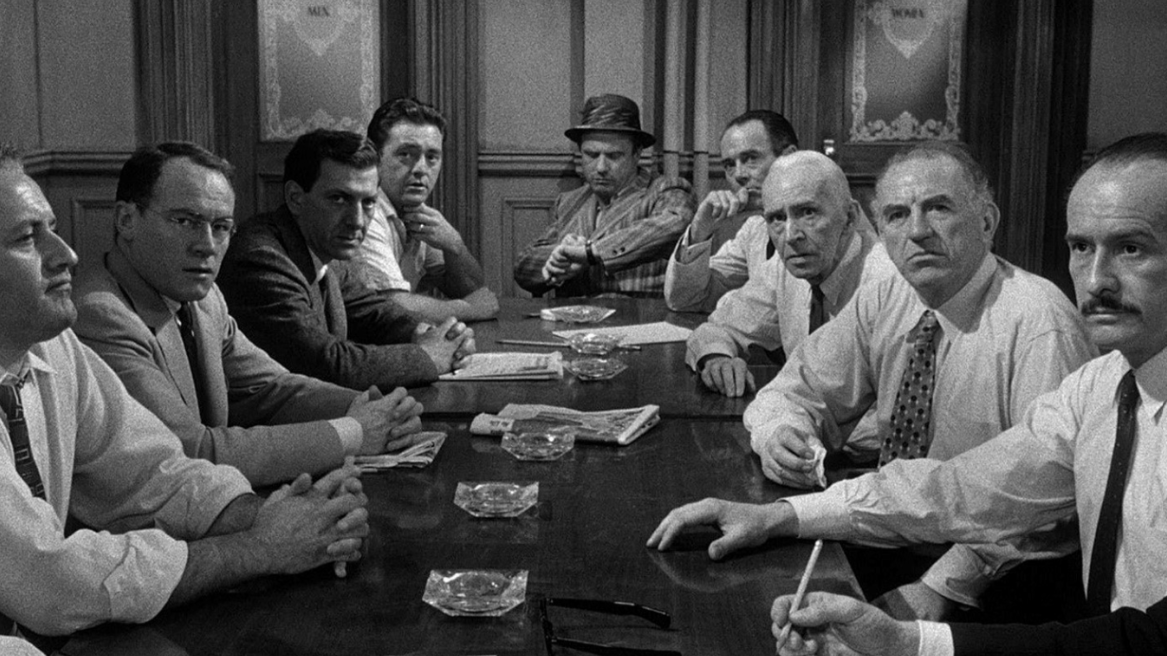
In the opening minutes of Sidney Lumet’s 12 Angry Men, justice transforms from a towering obelisk of American might into an embattled and deeply fragile conundrum. In the opening shot, the courthouse pillars leer, imposing edifices that might suggest a beatific monument to a concept solidified for eternity or, conversely, corroded into a hollow stillness. But what makes the building matter? The lawyers, who we do not see in the film, get a uniformly bad wrap, and the judge we temporarily witness seems more interested in playing with his pencil than in the conceptual, ethical, or logistical questions he doesn’t recognize are on trial (or, perhaps, he has already resigned to their assumed guilt). This seems like an evacuated justice, distorted by an unnamed McCarthyism and the daily inertia of boredom and limitation, a vaporous principle without a sturdy enough form to channel it.
12 Angry Men wants to save democracy though, or at least to argue that it is worthy of being saved, but it presents no legal armor worth a salt. This is a film in the unenviable position of mounting a battle for a principle that, it admits up front, has no army to fight for it. No formal army, that is. It is not the building, 12 Angry Men suggests, or those employed in it or by it, that form the cornerstone of American morality, but that most humble arm of democratic reasoning, the titular figures who assume they know before learning to appreciate that things might be otherwise. This, the film claims, is the soul of America, a dozen lost soldiers of democracy heretofore unknown to one another: “the people.”
Indeed, they become “the people” throughout the film. The opening tracking shot glides us through the courthouse and into the jury room, a gathering ground of difference communicated and contested, a town hall meeting in miniature. Juror #8 (Henry Fonda) marks himself as a redoubtable icon of justice by staring out the window of the room, reflection upon the wider world while preserving his own individuality, not yet fully, or only, participating in this temporary local community. When everyone sits at the table, the film christens the creation of a space of democratic give-and-take and competitive collaboration where friction produces, in theory, a truth as ragged and unfinished as it is steadfast and eternal.
Continue reading
 The Long Take