
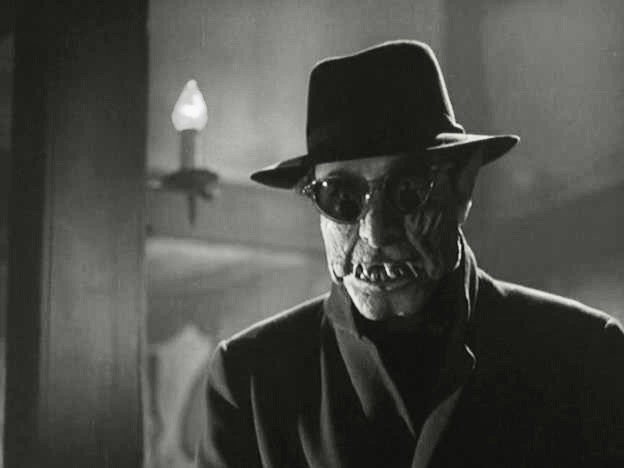
There’s a proto-Giallo mischievousness to The Vampire Moth’s overstuffed story, an ever-cascading sense that this amounts to more and less than is on display, that the limits of logic are beside themselves, hopelessly unable to explain what we’re confronted with. The narrative implodes and folds in on itself, hurtling by with a feverish, feral brutality that is disarming in its disinterest in narrative closure. Written along with Hideo Oguni, and Dai Nishijima, director Nobuo Nakagawa’s The Vampire Moth is mostly a tatters from the beginning. In relation to post-war Japan, it feels mutational, like a nation growing quickly and in ways it hadn’t anticipated, organically following lines of inquiry that were not expected of it, a proliferating madness that the tidy rules of narrative cinema cannot contain.
Roughly approximated, The Vampire Moth is the story of fashion designer Asaji (Asami Kuji) being tormented by a masked man who could be anyone from her ex partner Tetsuzo Ibuki (Ejiro Tono), who recently assaulted her in Europe (the film connecting bodily mutilation and Japan’s devastating, dormant European-entangled past) to former model winner Tazuko (Chieko Nakakita) to manager Murakoshi (Ichiro Arishima) to, most obviously, Tetsuzo’s twin Shunsaku Etho, a lepidopterist with an interest in curating and dissecting insect flesh no less sinister than the killer’s penchant for disfiguring human bodies. Or, for that matter, no less sinister than the fashion designers themselves, women and men that the film recognizes sculpt and organize bodies for appearance, emblems of a modernity that seems more interested in regulating bodies and preparing them for rigid aesthetic arrangements than inviting their curiosity and humanity.
A chaotic, ruthless, remorseless world, one in which everyone, even if they aren’t “guilty,” is complicit in the atmosphere that produces the crime. When reporter Kawase (Minoru Chiaki), model Yumiko (Kyoko Anzai), and detective Kindaichi (Ryo Ikebe) end up pursuing their own line of inquiry, they’re really just trying to keep pace and not drown in the morass of fluctuating suspects and social confusion. Actually finding anything seems thoroughly beyond hope.
With bitterly vulgar noirish poetry courtesy of cinematographer Jun Yasumoto and a theremin-haunted score by Masaru Sato, Nakagawa’s film is fascinated with Japan’s grim enmeshment with a violent European past, with the pandemonium of causality and identity, and with bodily malformation that may, ultimately, just be a metastasizing of the masks and mistaken identities that choreograph the malformations of modernity. The 20th century, in this view, is best embodied in a mannequin factory in which plastic bodies are strung up in fragmented, cadaverous rigor, reduced to component parts assembled in a grotesque, unforgiving machinery. Later, the curtain comes down to suggest that one burlesque dancer is simply a pair of severed legs, a facsimile of humanity still fully capable of confusing the passive onlookers. How would the other dancers not know that the limbs right next to them are severed? The more interesting question: what does it say about the 20th century that we, a species that ignores mass destruction and devastation all around us, wouldn’t notice something so close to us, that it could simply be accepted in our peripheral vision? In ignoring literal logic, the film expresses something far more disquieting, a view of the post-war world as a corrupted meatgrinder all-too-capable of dismembering bodies and preserving them, killing us without leaving a trace.
Score: 7.5/10
 The Long Take