
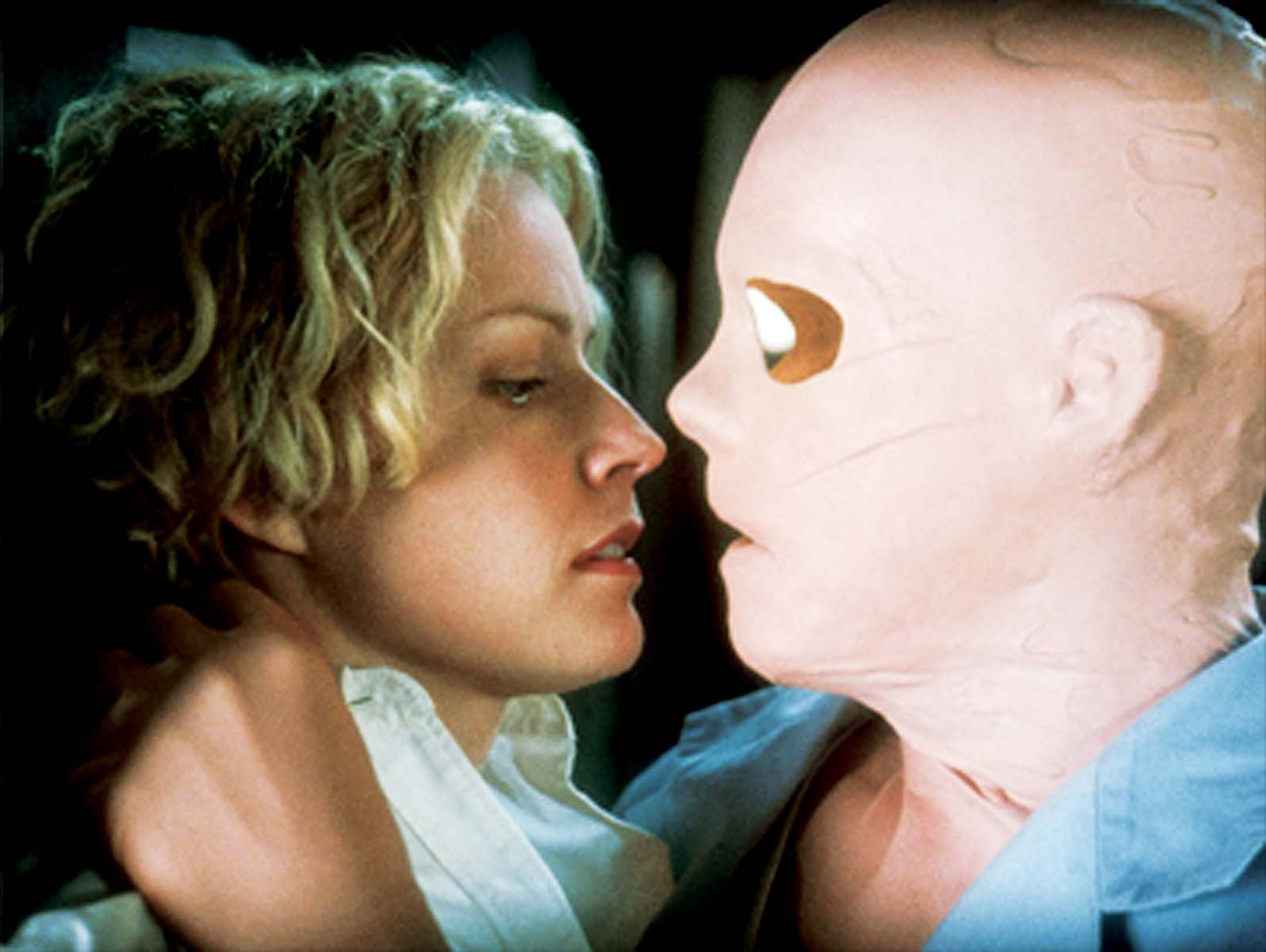
The thing about Hollow Man is how trivial it is. I’m not the first to make that point, and I won’t be the last. This is an irrepressibly small-scale film for a Hollywood A-list director. Admittedly, Paul Verhoeven had been shunned by Hollywood with Showgirls and forgotten with Starship Troopers, but one senses this was less because the machine grew hip to his viciousness than because audiences hadn’t. They confronted these texts as incompetent films rather than self-conscious visions of Hollywood’s grotesqueness. With Hollow Man, it’s hard to blame the public for being ungenerous. It’s initially difficult to detect any critique altogether. It feels like this infamous self-hating Hollywood conspirator has finally been brought to his knees, forced to play along, as though he had lost any appetite for drawing blood. The American violence(s) explored by Robocop and Starship Troopers are forms of national fascism couched in ideological projects and delusory visions of a better world. Hollow Man is entirely devoid of any such romanticism, any grandness of vision, any sense that any of this amounts to anything. How does a film critique visions of American efficiency and brutality couched in aspirational opulence and moral zealotry when the film, itself, is so openly limited, so business-like, so blandly functional? There’s just so astonishingly little here.
Yet Hollow Man is major vision because it occupies such a minor key. I would submit that its viciously un-visionary nature is core to its vision of mercenary corporate cinema. Paul Verhoeven’s final English language Hollywood film is not arbitrarily banal but self-consciously inconsequential, a mercenary shiv to Hollywood’s gut from a double-crossing hired goon. Its vehemently local texture is the point. The aspirations and delusions of scientist Sebastian Crane (Kevin Bacon) are distinctly post-modern. His desire is not to control the world but to inhabit it, to fulfill himself more efficiently, to unlock his own personal capacity. Once he allows himself to be injected with the invisibility serum he has been developing, he has no interest in marketing this to the American military-industrial complex as a weapon to expand American hegemony. He just wants to become a more efficient killing machine all his own, to get off on his own competence, his own ability to manipulate sheer matter, light and shadow, to his own effects.
Typically, this would be a cause for critique, a rote and reductive Hollywood depoliticizing, and individualizing, of thorny geopolitical issues. The film promises a critique of American military and banalizes itself, diminishing to a glorified special effects reel about a mad killer on the loose in an anonymous laboratory. Yet Hollow Man seems brutally self-aware of its failures, its complicity in an atomized culture of self-gratification and self-improvement. Its more of a cyberpunk text than anything, with organic amplification replacing mechanical augmentation. The film promises that invisibility will become a weapon for the U.S. military, weaponizing this technology for itself, but Crane, finally, has no ideology other than himself, other than immanence, to become a pure “technology of self.” He is a neoliberal demon, a figure for whom the capacity to tap into the forces of matter, the energy of technologies both scientific and cinematic, exists only to experience life more fully, to become more, to feel and experience in new ways. What the film understands is that technological capacity, the ability to free the body from its limits, does not change the limits of consciousness as structured at the dawn of the 21st century. It only provides more efficient ways to fulfill base impulses in a society that thrives on heightened forms of self-gratification and fetishizes continual and incessant self-improvement.
Crane’s distinctly non-visionary desires, in this sense, paradoxically, become entirely visionary: they reflect our modern vision of what society is supposed to be, and how technology is supposed to fulfill that vision. This is, simply put, the story of a man who gets off on, and self-actualizes via, being cinema. He’s a Hollywood movie star for whom science is simply one more path to libidinal emancipation, one more modern mechanism that harnesses illusion and manipulation. His is a decidedly cinematic monster, a man who wants to conquer space-and-time and become cinematic form embodied. The film’s main claim, then, is that science and cinema are both means of manipulating the world to your purposes, adventures in uncertainty that are all too easily modes of asserting control.
There’s a self-consciousness desolation to Hollow Man. It feels, to excuse the pun, hollow. Trying to read it feels futile, but perhaps that’s the point. The finale is transparently – again, I can’t help myself – an excuse for a directorial mad scientist to explore his fascination with new forms, rendering our titular figure through fire, water, wind, ash, and blood. Bodies become mere composites of molecules hiding, and being conscripted by, cinematic manipulation. Verhoeven is transparently figuring the director not only as a cruel manipulator of persons but an invisible forcefield exerting themselves on a pliant world. Hollow Man expands and intensifies these particles, but it also evacuates them, ultimately presenting them as fundamentally empty, the director – and, vicariously, the modern human being – as a malleable collection of atoms, molecules, impulses, frustrations, and desires that is all too willing to experiment simply to get ahead personally. This is, in a sense, an “end of history” blockbuster, a “capitalist realist” nightmare: all we have left, all we can imagine, is to fulfill ourselves, to tinker with ourselves in hopes of being better, of abusing others more efficiently.
It is perhaps because its critique hits so close to the bone, so enmeshes with our era, that this film hasn’t yet been recuperated. While Hollow Man shares Robocop’s and Starship Troopers’ fascination with the military-industrial complex’s wonton rigidification of the human into a machine, and Showgirls’ auto-erotic intrigue about the revising of the self into a surface-type, Hollow Man goes deeper, or, perhaps, shallower. Humans here enjoy being turned into a machine, and no formal institution needs to dominate us with a heavy hand to extract our willing complicity. And there are no surfaces here. We are not hiding our humanity beneath idealized images but trying to become image-less, to become a purely pliable force, to meld with the machinery of modernity which, in this case, has come to replicate a bastardized version of life itself through our desire for it.
This is, thus, the closest Verhoeven ever got to fully immersing himself in the machine, abandoning any sense of authorial touch or wink-and-nod personality. He embraces the anonymity and invisibility, creating what, in effect, feels like DTV Hollywood detritus. He renders himself figuratively hollow by dispersing himself in the code of the text, absolving himself of self and merging with the display of matter around him. This is a film that is both about and that is the story of a man become virtual. It is a film as slick and as self-evidently trivial as its antagonist, a mirthless mastermind of a text that clearly gets off on being able to stalk his prey and on us enjoying him doing so. This is the director unbound not as gaze but as omnipresent spectral entity, unbound from corporeal form, a Videodrome for the digital era.
But that’s Verhoeven for you, the resident cinematic conspirator at large, disguising self-critique in the body of a body-less thing, announcing his humanity in a film thoroughly without a human touch. How else to interpret the maliciously minor nature of Sebastian Crane’s madness? Or, for that matter, the transparent way in which the film only exists to excoriate itself, and to reflect on that fact. Everything looks phenomenally real, and undeniably fake, but that also says more about our imagination and its limits. Why are the Nazi gloves of Starship Troopers more scabrous and deserving of more critical purchase than the latex face mask and hands Crane wears here, looking so uncomfortably like human skin, and yet so disconcertingly alien? This is body horror without a body, a vision of ourselves emptied out and replaced with a facsimile by a world selling ourselves a “better” version of ourselves.
My favorite CG in the film, then, is its least purposeful, and thus its most intentional. When Crane drives into his office – indeed, when he drives anywhere – his car is clearly a computerized product. Why use CG for, say, cars that would not be especially taxing to shoot, say, driving not-particularly-fast down the road? This is certainly not a show-piece scene. It doesn’t “look” any better than a real car would, and it isn’t in any meaningful sense easier to shoot. Indeed, it was probably both more difficult and more listless, but that’s the point. The film’s own self-awareness about the limits of its imagination is striking, solipsistic, and deeply, wonderfully self-hating. Hollow Man presents not a conservative and nationalist monstrosity but a neoliberal abyss, a vision of Hollywood as a self-actualizing creature pursuing a raw efficiency of pleasure, one that presents no ideology to latch onto, no clear political program or initiative to critique. The monster, as it always is, is us. That’s an entirely hollow point, and the film knows it.
Score: 8/10
 The Long Take