
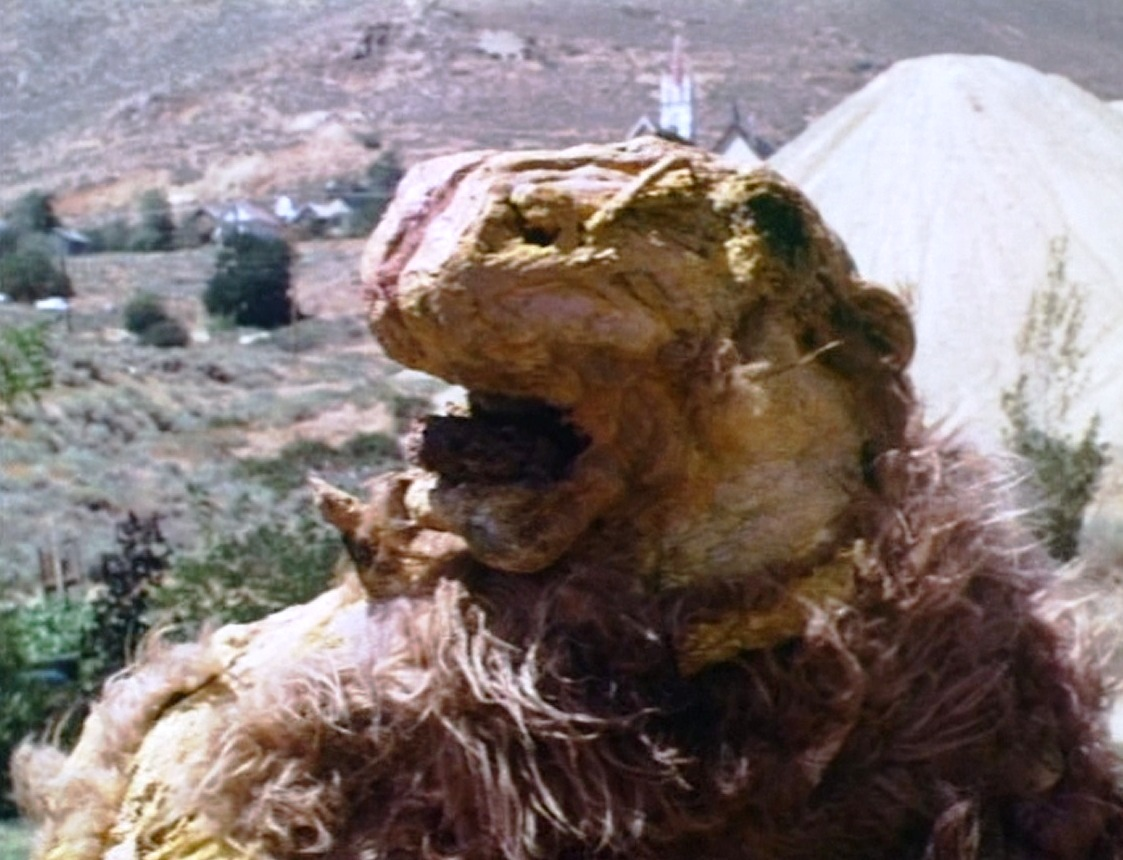
Godmonster of Indian Flats is like its titular creature in more ways than one. It shares its unruly, mercurial nature, its frustrated friction. It comes out of nowhere, from the abyss of an American id, or from some dim region of consciousness. And, above all, it has our souls on its conscience, the weight of the world impressing upon it. This is an alien being, a wonderful cinematic monstrosity that looks and sounds like nothing else, that feels like nothing else, and that was bequeathed to us, lost children in need of salvation, at the twilight of one period of American growth to teach us the error of our ways and offer, in the ugly, beautiful, grotesque, revolting fact of cinema, a shock that might help us see through the darkness, to see our darkness. In spite of it all, the film says, art, with all its misshapen curiosity and lumpy monstrosity, remains.
But saving us, the film posits, may mean destroying us. Godmonster of Indian Flats projects no beautiful harmony with the earth, no romantic image of art as a channel for grace. It is angry with us, a forgotten creature born unto this earth to witness our failings and prey that we might do better. It is an impossible creature of a film, a truly mad object, the prodigal creation of a nation and the scion of a mad scientist of an artist trying his hand at cinema. Writer-director Frederic Hobbs, was by day a wild bricoleur stitching solar energy and nomadic errantry and mid-century ideas about ecology and technology into something called Art Eco, one of those micro-artistic mid-century forms that resonated with a constellation of ‘60s modes, from the ever-curious, ever-deflationary termite art of Manny Farber to the more purely explosive tornadoes of internal energy produced by Jackson Pollock to the anti-technocratic romanticism of Frank Herbert’s Dune to the collective eulogy for a myopic world that was Buckminster Fuller’s Spaceship Earth. All of these frameworks, mechanisms of social critique and machine-work for a more humane world, invite us to rethink our relation to the rhythms of the cosmos, to expend less energy, or expend the right energy, to appreciate the irreducibly uncertain nature of reality and the horizontality of our diffuse formations and strange interconnections with one another.
Hobbs’s paintings celebrated this sensibility. His film, however, seems much less sure of our worthiness for salvation. We begin with a spirited journey to the margins of the nation, a group of youths on the path to adventure, “lighting out” to the territories, as they used to say. Cut to them pushing in on the camera, like a zombified parade of the damned, soon driving to nowhere, on the edge of an abyss. Perambulating into an uncertain future, this is the American road trip not as a long night of the soul but a night of the living dead. Promising a bounty of possibility, this Nevada-set film only offers a parched desert permafrost, a harbinger of a national thaw.
Arriving at our shared destination, we enter a bar and see a robotic Americana band, the alien world of Reno, Nevada, the most overt manifestation of a population that seems to only exist to perform semiotic functions, exhibiting no real humanity. We’ve entered a bizarro-world parody of American desolation, a desert science that taps into the region’s grip on American imagination and technology’s hope of extending the frontier into an endlessly hopeful future.
Eventually, there’s an attack on a farm. By what, and for what reason? Nothing happens to the person assaulted, and the assailant has no rhyme or reason, implying some fungible mystery, a pure force, an unmediated cosmological otherness. Something is percolating, mushrooming, impressing itself onto him, but before we can tell, we suddenly cut to kissing, jungle noises. We’re in the grips of a demonic whirlwind, a cinematic conversion from placid normality to unfathomable terror, or are we? What in the world is normal in this film? In Godmonster’s most mundane moments, even before what technically counts as a monster attack, characters speak as though hovering over the frame rather than emanating out from it, as though the world we are momentarily privy to is not a home for anyone.
Throughout the film, the edits are monstrous themselves, a Frankensteinian stitching of cinematic detritus from other, more “cohesive” films. In a signature moment of potential explanation, one where we’re supposed to be witnessing exposition, the camera suddenly pans way out to a man looking down at our two expositors, as though he is stalking them. This is an emblem of post-Watergate paranoia, a vision of a nation where people are always just beyond the frame, but before we can even register the suspicion, we cut to a parade. In their refusal to compose themselves, the images signal cinema’s making and unmaking. “Events have a certain logic,” we’re told, “rolling down the mountains like an avalanche.” But what logic governs this alien nation we have wandered into?
Or perhaps the logic is all too apparent. “Something strange about all this, doesn’t feel right, shooting guns everywhere,” someone remarks, but this is an America in which murder really isn’t strange at all, in which, seemingly, this is what Americans do, in which we recognize that the thing we fear is actually what we may have been all along. The monster, when unleashed, enters an already runaway, relentlessly entropic film, and yet, odd, uncomfortable resonances abound between the film’s world and our own. Indeed, the titular creature is the second foreign interloper to enter the film for uncertain purposes. The first is Barnstable, a Black agent (Christopher Brooks) for an opaque outside buyer, who, at one point, accidentally shoots a town dog out of nowhere. His gun is pointed nowhere near the animal. It’s as though the world had conspired to put him in that place, at that moment, to be in prison, as though it was the nation’s destiny for him.
Barnstable is corralled in jail, shirtless, overseen by a deputy in a wifebeater. Later, we hear of a “wild beast whose rampage has wreaked havoc on public property, threatening women and children.” Who, or what, precisely, is being spoken of here? When the creature is finally captured, it allows the town to “return to our everyday tasks,” which encompass what precisely? “I would have lynched him,” one man remarks about Barnstable. When the town attempts to do something just like that, in the film’s anti-climax, the moment is set in an industrial ruin, filmed like both a totem to an unacknowledged past and an arcane portal to an apocalyptic future.
This is a portrait of American abjection, a vision of abiding national disinterest, something that shouldn’t surprise us given the film’s near-subliminal efforts to expose its subterfuge to us. I’ve already discussed the atmosphere of paranoiac observation hovering in the film, the sense that someone might be watching, and I’ve suggested the film’s paradoxical attitude of deflationary refusal: frequently, right when we expect to get a sense of the violence, the film will just cut, limiting our access to what we assumed were its mysteries and thereby asking us to pursue other lines of inquiry, other questions that haven’t been openly asked yet. At one point, one of the town’s benefactors, and thus controllers, looks from his desert manse down on the town through his telescope, glancing, in an entirely unstressed beat, over an unnamed black person, speaking of strange travelers and transformations in the world. To be an “other” in this world is to be an object for perusal, a background presence to be passed over. When Barnstable dresses and acts like a sheriff, it seems that the universe corrects him by arresting him.
The real surprise is that the title is absolutely, finally, no joke. One stray presence refuses to be passed over. Barnstable isn’t lynched. He is saved by the monster’s intrusion into the frame, its eventual capture a bizarre act of sacrifice. None of these people are very worthwhile, but the monster seems ready to save them, if not to absolve them of their apathy and inhumanity. This creature is one of the most wonderfully other creations in cinematic history, emerging out of the monstrous gloom of the early ‘70s and exhibiting the only real curiosity in the entire film. When it is captured, the thing explodes, a kind of combustion designed to interrupt the status quo, to move the film’s population into a new way of being, but the film ponders whether this effort is ultimately pyrrhic. The people themselves explode into chaos, a diabolical dance of monstrous otherness.
In a stunning conflagration of a finale, the idling and diagonal movements of a perpetually inchoate narrative clarify into an omen of a disturbed world. In an act of divine cinematic transmutation, we began firmly in exploitation territory, only to stumble upon, of all things, an American Au Hasard Balthazar, a story in whichone of God’s creations is transformed into a most fertile, iridescent metaphor in the act of immolating itself, not in this case in an act of divine penitence but holy war, a kind of retribution aimed at a humanity that needs saving but doesn’t want to listen. As an incarnation of our worst impulses and our deepest hopes, the titular The Godmonster of Indian Flats bears witness to our confusion and ultimately seems to either abdicate, to leave us to ourselves, or to renew the earth by taking us with it, metastacizing our failures into an onslaught of reckless mayhem in what may ultimately be an act of messianic abandonment.
In exploding, the monster is both an ecstatic dispersal of diabolical sublimity and a surprisingly mundane thing, just one more happenstance in a wild, wooly world we don’t seem ready to look at. Certainly, the monster, much like the film, has an almost auratic force, cracking and breaking the film, sending it astray and enveloping it in the folds of another mode of thinking and being. But there’s no monstrous grandiosity here. The film insists on nothing. It remains as confused as the people in it. It’s just an insurgent force, an eco-parable of human devastation and experimental extraction from the earth, but it never quite congeals as anything so didactic. This is a madly unhinged film, a text that seems to twitch in and out of modes. As one character says, “something (is) jamming my network.” The monster offers a new frequency to tune in to, a transmission from a dark now that may be both a herald of our impending eruption and our accomplice in finding renewed purpose.
Score: 10/10
 The Long Take