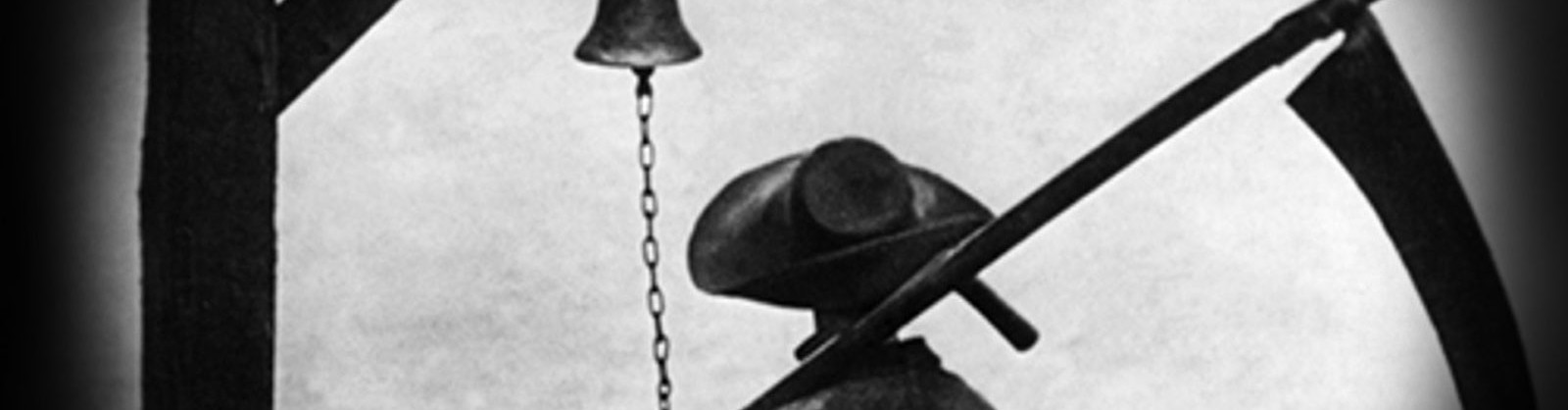

Writer-director Avery Crounse, who fittingly became lost between rustic New Hollywood authenticity and synthetic ‘80s artificiality, is not only a conjurer of darkness but a scion of America’s very liminality, an acolyte of the spaces between existing categories. His first major feature Eyes of Fire feels like it could as easily have come out in 1923 as 1983, like it could depict 1750 as easily as 2250. It’s a lost film, a cinematic netherworld where time stands still and folds in on itself, a text that seems to be going from somewhere to somewhere else but never to exist anywhere, or to arrive at anything. Visualizing America’s wilderness years, and produced within its own cinematic wilderness, Eyes of Fire is a road-weary, ramshackle merry-go-round of contraband people in search of opportunity and the underground operatives – the seemingly deceased but still very present histories – that turn this period of America not only into savage terrain but demonic ground.
Demonic, that is, to the characters who are apparently our protagonists, but not to those dormant but not domesticated pasts rumbling beneath them that have less interest in going gracefully into the good night. In Eyes of Fire, Crounse limns the crepuscular underbelly of a pre-revolutionary American landscape clearly on the verge of becoming something else, but not quite sure what yet, a non-nation that remains hesitant about what sets of ideas would shape and provide contours to its empirically unstable ground. These national values, the film suggests, would be binding fictions, ideas of togetherness that would attempt to overwrite an aching land with visions of harmony. This framework of national unity comes undone in Eyes of Fire, slowly unweaving and then, with frightening quickness, collapsing from relatively stately solidity to fractal, fissioning landscape.
A landscape traversed by Will Smythe (Dennis Lipscomb), presently evicted from his protestant community for engaging in a double affair with Eloise (Rebecca Stanley), whose husband Marion (Guy Boyd) is away, and Leah (Karlene Crockett), a touched woman who projects rapturous otherness. This leads to the removal of everyone involved, including Eloise’s daughter Fanny (Erin Buchanan), and later Marion, who finds them, as if fated to, while wearing his own death garb. These intrepid interrogators, apparent prophets of an undiscovered country, quickly discover that they also wade into a morass of undigested history waiting to make sense of them far more than they can make sense of it.
Crounse’s film is as surreal as it is speculative, a fog-shrouded, sinister canvas of dispersed forces slowly ensnaring our explorers as they shoot off in errant directions, leaving behind totems to keep the darkness at bay. A floating tracking shot over water recalls Werner Herzog’s own demented, baleful Aguirre but differs by framing the endpoint not as a doomed, delusional imperialism but a frail, febrile democracy, one that the film has hope for even amidst the violence and uncertainty of its origins. The dead man floating on the barge at the end of the shot is a poetic embodiment of an America in search of scattered dreams to weave without having yet fashioned a coherent national tapestry. But the film does imply that the people try, and that the nation might be something, even if it won’t get there easily. The impromptu group is dissonant and combative, yes, but they also embody a tradition of unruly Americans defiantly, if hesitantly, on paths to a new world, or maybe a new way of inhabiting the world. At stake in the film is whether they can appreciate this art of possibility while reckoning with the fact that they walk on wounded ground, that they must move into the future while moldering in the grave.
Throughout, Crounse implies that what they see as darkness, as a benighted past, might also be light, an incantatory frustration of the status quo. Ken Russell-esque flashes of negative imagery evoke revelations of another world, some sort of eldritch, other space, a monstrous ground of restless cinematic earth. In an early scene, where Will Smythe is being strung-up for his affairs, light creeps in through the boards of the building that serves as the center of town, invading their edifice of human domesticity and puritanical values with a vision of another way. Later, pages of a book splayed across the floor of an unfinished room imply the fragmenting of an organized and finalized national text, disfigured and strewn about the hollow body of yet another one. This white chaos on the ground is echoed again in a recurring motif of white feathers laid atop the earth, which we learn are Shawnee Native American warnings to stay away from certain paths, a different kind of text that suggests not an incomplete dream as yet unmade, like the white pages, but a half-forgotten one still present. These are mementos of a pagan knowledge that only Leah, singularly capable of listening to other ways of being, can wear in her hair, as accessories of a still breathing world rather than effigies of a lost one.
As a work of folk horror, Eyes of Fire is interesting because it is not precisely sure what, or who, “the folk” in question is. Indeed, if anything, the “folk” here is not the pagan undercurrent lying in wait, unmaking Christianity, but the early American Christianity that is actively unmaking itself: this is a Christianity torn between subservience to divine law, on one hand, and, on the other, individual grace and antinomian dissent, and the film is distinctly not, as we might expect, about one “older” world intervening in a stable “newer” one, but about a new world that hasn’t quite come into itself yet, that does not yet understand itself. It is about a nation, and it is very much a film, on the verge of a breakdown, a country destroyed and saved by the molten fires of the very visionary paganism that taunts it with death. The very thing that is positioned as the destroyer is also the redeemer, omens of a tremoring world perching the film between salvation and damnation. If Crounse is an apostle of darkness channeling cinema as a portal to a netherworld of horror, he also recognizes that the shadows in which we traverse may be the brightest things of all.
Score: 8.5/10
 The Long Take