
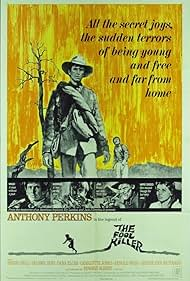
The titular not-quite protagonist of Servando Gonzalez’s The Fool Killer, played with curious intransigence by Anthony Perkins, embodies the American mantra of authenticity, a vision of self-reliance that is also self-delusion. His character wants to “eat when I’m hungry, talk to folks when I want to and not when I don’t, and see the world,” a mid-20th-century rebel without a cause in the garb of a mid-19th-century fugitive folk tale. He’s also a man “without history,” an aspiration to be pure momentary itinerancy, a paradoxical thing that is concept but also flesh and blood, a collection of bounded matter but also a free-floating spirit, something entirely unmoored from any kind of tangible relation with the world even as it floats all through it. He’s a dark Thoreauvian creature who resonates with that American prophet’s beautiful, redemptively spiritualized vision of matter and its unrestrained double, a self that is unaware of its debt to the world, that is all spirit and has no connection to the world’s matter at all. This is the self-isolation and feverish hunger for personal authenticity that would only turn the characteristic American craving for independence into a means of making men and women into appendages of the very mechanisms they nominally opposed.
This lode-bearing cinematic creature is also a mythological force, coalescing out of the very ether that marked 19th-century American dreams, galvanized here by the film camera. He doesn’t appear in the flesh for a long portion of the film, yet he seems to exercise real power over the text, asking the camera where it should position itself in relation to him, whether or not it can visualize him, and whether being visualized, taking on bodily form, separates him from himself, makes him become mere matter. Like art itself, he is menacingly passive, apart from the world but both reflecting and shaping that world, providing a vision of troubled American myths for us to reflect on. He is introduced with the camera taking his perspective, before a series of cuts inward onto his eyes, dominating the frame, suggest an invasive specter, a fragile phantom known as personal freedom that only occasionally corporealizes but exerts an inexorable pull on the nation’s conscience. He is a cinematic revenant, an illusory but impossibly-sticky harbinger of an America envisioned as a gathering darkness.
It is no surprise, then, that the moral core of the film’s screenplay, adapted by Morton Fine and David Friedkin from a novel by Helen Eustis, concerns his magnetic pull on a young boy lost amidst the American wilderness. When the boy looks at his reflection in the water at one point, he’s in search of some stable image of selfhood, a solid countenance that is also a fluid vision. When Perkins appears in the background of the reflection, a refracted, watery ghost, he’s claiming his American provenance as a warped refraction of childhood innocence and America’s violence, a brutal double of what the boy hopes to be and might become. This obsession with becoming oneself against the world is also a way of ensuring one can never connect with that world. Perkins’ character, then, is a marker of the foundational innocence that defines American dreams, a vision of eternal possibility that finally becomes a meditation on the inexorable transience of the very visions that animated the nation. The Fool Killer feels like America’s revenge.
I was reminded, among others, of Ambrose Bierce’s “Chickamauga,” an image of American innocence as a maelstrom of unacknowledged destruction. The Fool Killer also suggests that story’s feral melancholy, not to mention its brutal brevity. It’s peripatetic and episodic, splayed out like a series of folkloric concoctions, a rambling, rolling stone of a film as the boy and the titular man explore the wilderness. There’s a vision of national spirit here, but Gonzalez visualizes an America adrift in the penumbra of a violence it perpetuated, and that has come home to roost. His film depicts the 19th century U.S. as a hinterland confused about itself, forged in self-conflictual fires. No organized system can salvage it, as a backwoods, Jonathan Edwards-like preacher in a hurricane of a sequence promises to do. While this preacher tries to collect and stabilize the fragments of the nation’s story, to gather people together into a unified force, the film fractalizes them. When he makes his claim as a modern American prophet, the film hides him behind a piece of wood, having become one with the establishment, a false image of rebellion and change, a projection of difference that is really just more of the same.
Leaving the preacher’s camp, the boy remarks that he “don’t feel born again at all,” and, indeed, the film interrogates the limits of the idea that birth can salvage the nation, or exorcise its demons, when the very demon that haunts it is the notion of rebirth, of innocence, of having nothing haunting it. A fire-and-brimstone orator speaking with pugilistic vigilance, the preacher tries to warp space and time itself with a personal charisma, purportedly backed by natural grace, that the film only exposes as inadequate to the task of American becoming. What the film is really asking is whether Perkins’ Fool Killer, who seems to escape this fate with his exploratory ways, is really much different. He promises to channel freedom into an even more charged image of divine personal charisma, one that only intensifies and displaces the problem of reconciling individual grace and democratic pluralism.
Perkins himself was much like the titular character in this regard: an ex-hero turned tortured demon, a vagabond on the run from his good looks, wandering adrift in the dark penumbra of his own movie star image. He was a calculated product of mid-century youth culture who decided his flesh and blood went beyond the boundaries the United States had allotted to him. The ease with which he channels self-reliant energy into devilish magnetism troubles the very personal force that America so worshipfully celebrates. Before the film is over, he will mutate into a skirting shadow haunting bodies of water, a shout echoing around the film and dissolving the wilderness into a realm beyond space and time. He is a long way off from something America hasn’t set its mind to, coming from and toward nowhere. The portrayal, so conniving, so self-lacerating, so confused about himself, is an uncanny repetition of a century beforehand, a 1960s drifter looking back on the 1860s, a ghostly conversation between two different episodes of American history in which the nation attempted to find itself again through reinventing itself.
Whether the nation could recover its initial spirit of possibility and creativity is another story altogether. The 1860s was an attempt to move forward, but, for the South, it was also too easily an attempt to circle back, to find salvation in recrudescence. Ultimately, then, The Fool Killer rekindles another Bierce story, “An Occurrence at Owl Creek Bridge,” where the Confederacy’s necrotic belief in its own ability to survive across time, the romance of an Antebellum South worthy of existing in a modern, progressive nation, is exposed as an illusion, a faux-heroic quest that is actually an American ghost refusing to die. The Fool Killer’s America is a similarly haunted canvas, a vision of the nation as a body moldering in corrupted earth while mistakenly believing it walks on hallowed ground.
Score: 9/10
 The Long Take