
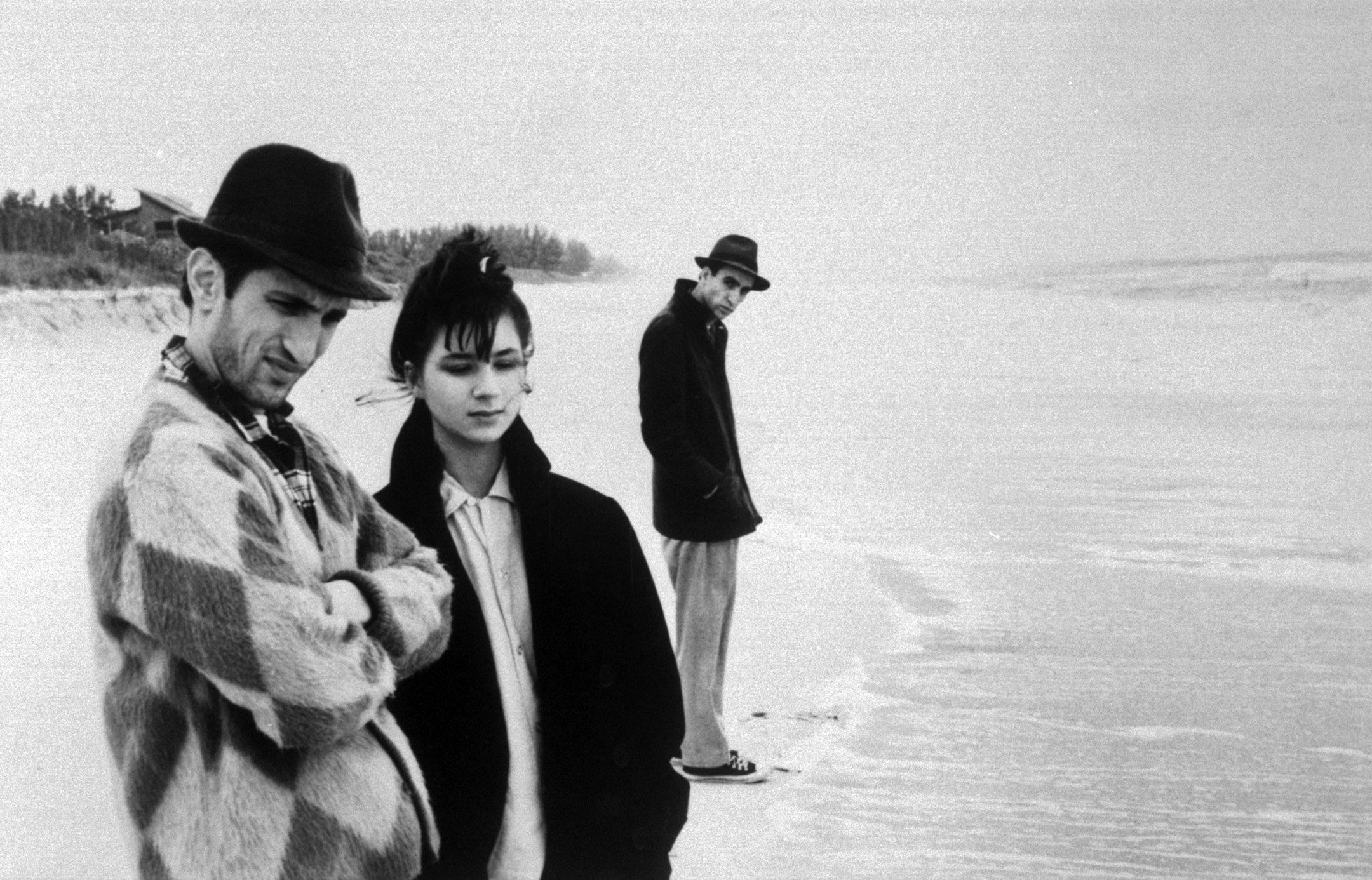
Writer-director Jim Jarmusch’s Stranger than Paradise feels revelatory in its banality. It exhibits a kind of dim-witted defiance that celebrates America by deflating it entirely, elevating it by turning it into nothing. The spaces are ratty and bare but wonderfully populated, the people are basically hollow and yet so teeming with phenomenal microbes of energy and uncertainty. It’s like a Bresson film if Bresson was a day-drinker interested in a way to pass the time instead of a monk in search of transcendence. Stranger than Paradise, like its title, finds salvation in the profane and the mundane. If it is in search of deliverance from destruction, it is nonetheless profane in a way, exhibiting ambling, quizzical assurance that things might not really be okay, but what matters is that they’ll certainly be interesting if we let it.
That’s an interesting thought, much like America is an interesting country, even if it’s nothing else. Jarmusch’s film is a lot like a particular vision of America: wonderfully inelegant, somehow both spare and excessive, spartan yet teeming with secret multitudes and plain-spoken eccentricities. It’s like America’s vision of itself when it cuts away all the stifling excess, when it reveals, termite-like, the multitudes that be contained in the seemingly minimal, the great depth in the apparently microscopic.
Consider protagonist Willie’s apartment. We gloss over it initially: how under-designed, how ill-equipped it is for a fulfilling life, for anything we would want to consider “humanity.” Thirty minutes in, though the cracks are our old friends, marks of a home that only remains alienated because we haven’t properly attuned to it. But they are also marks of our real alienation, of a society that doesn’t know what to do with us, or how to house its masses. Each corner of the apartment is a minor artistic masterpiece, secretly impressing itself in our brain with its everyday strangeness, and its reminder of our strangeness to ourselves, that which we overlook in the comings and goings of our existence. Forced to confront what filmmaker Jean Epstein would call the “horrible underbelly of things,” the film becomes oddly anarchic in its capacity to open the viewer to sheer existence.
Contrast this with the film’s vision of Lake Erie, framed by Jarmusch and cinematographer Tom DiCillo as a monotone monolith – a brutal slab of pure whiteness – brutally cut down with a deliciously deflationary, “Well, this is it, Lake Erie.” It’s a funny line, but it’s also an account of a quiet apocalypse looming in the background and around the margins of the frame, a vision of Reagan-era America as an abyssal absence, something so fully white, so pure, so pristine, so beautiful that it is, paradoxically, depleted, exhausted, lacking any particularity. Confronting us with its exalted terror head-on for the first time, it seems truly sublime, something both unrealizable and essentially pointless. Why show Lake Erie for real when we are already living in the Hell it represents? Why contain the beauty and the terror to the body we call Lake Erie? Insofar as it is spellbinding, it is only because it binds us to it and not to the rest of the world that it both expresses and fails to encapsulate. The film suggests that there is nothingness all around us, and that it can be a glorious nothingness. Sometimes all we can do is accept the violence all around us and go get a beer.
Which we do. Stranger than Paradise is an existential crisis played as a lazy Sunday afternoon hang-out. When Eva (Eszter Balint) shows up at Willie’s (John Lurie) New York apartment from Hungary, she is waylaid because the woman she is really there to see, Aunt Lottie (Cecillia Stark), who lives in Cleveland, is in the hospital and unable to let her in to her apartment. Eventually, she gets frustrated enough to leave anyway, only for Willie and his only apparent friend Eddie (Richard Edson) to follow her due to a lack of anything else to do. Then we’re being whisked away to the upper-midwest, Jarmusch’s native Ohio. When all three grow tired once again, as Jarmusch may or may not have done, they decide to abscond, like many mid-century Americans, to sunny Florida for something that looks, sounds, and smells like a vacation.
It’s a peripatetic text, moving between disappointments with an acerbic humanity worthy of Beckett, and it has three waylaid vagabonds worthy of America’s restless loneliness. John Lurie is wonderfully ramshackle as the brittle Willie who fits into his adorned Americana like he’s easing into an acid bath and who refuses his original European name because it reminds him of the pre-modern past, because he sees Europe as an identity that feels like an affectation rather than, like America, an affectation that feels like an identity. While he fortifies his existence with scraps of cultural detritus, Richard Edson’s Eddie is an appendage who actually appreciates the texture of his fringe existence, Edson imbuing him with an epicurean pulse. Eszter Balint’s Eva, meanwhile, appreciates the U.S. with an ironic honesty. She, somehow, wears the U.S. with more authenticity than Willie does, probably because she acknowledges up-front that it is only a home insofar as it is a transient zone, a corridor for crossing rather than a resting point.
Although Jarmusch’s film doesn’t truly move, so much as it acclimatizes us to a different kind of movement. Stranger than Paradise is a tripartite travelogue of America, as I’ve described it above, but it isn’t really a road-trip movie. It treats the trip not as an adventure in motion or becoming but as a series of variations on inertia. This is much like the scenes themselves, each of which encompasses one, and only one, shot. The rudiments of motion, as we usually experience them, don’t apply here. The film feels fixed in some key way, unable to let in the light of change, but it also coaxes us toward the penumbras skirting around that darkness. The entire film depicts a nation stuck in some animate void collapsing the previous several decades of U.S. history, like it could take place at any point in the forty years beforehand. It’s as though America got waylaid in its promise of progress, rerouted into a peculiar stasis mocking our hubristic expectations of growth and national improvement.
But Stranger than Paradise is less an oracle of a miasmic America than a herald of the fringes of humanity in all their vaporous grace. If it disfigures our temporal assumptions, it also tries to save America from our delusions of grandeur. By wandering into a swamp of lost time, the film asks us to sit with time, to notice time anew. Watching in 2025, I couldn’t help but think of Paul Thomas Anderson’s feral, fractal One Battle After Another, which similarly takes place in a vision of modern America as a nebula gathering and contracting several decades into a diffuse riot of time run amok. While that film forges an ongoing simultaneity, a distended, many-sided battle that begins before the film starts and continues long after it ends, Stranger celebrates a quieter battle, a search for small-scale joy that, in the context of this film, feels Herculean. Anderson’s film presents America as a thing lost in time, an inertial entity that is always moving but not necessarily going forward, but you still sense an affection for the nation’s feverish strangeness and ragged confusion. No one could essay American self-contradiction so thoroughly without exhibiting a genuine, if ambivalent and slantwise, affection for America’s askew multitudes.
Anderson’s obvious inspiration for that ambivalence is Robert Altman, but Jim Jarmusch, godfather of the modern independent film scene, is the waystation between them. Like his forebear and his successor, one always gets the sense that he finds America comforting in its curiosity. Not because he celebrates America but because he finds the wayward interests of people trapped in it, trying to fashion a living out of scraps of existence, intriguing. The film is a delirious abomination of a narrative because it wants to expose the problems with our narrative structures, with the rulebooks we have to tell American stories. Stranger than Paradise finds the idea of enjoying America interesting, and it is curious what it might mean to explore that sensibility for a moment. It’s a quietly defiant ramble of a film, a warrant for a different mode of existence, an appreciation for a nation forging ahead by getting lost. It’s a beautifully desolate object, something that feels lively and immediate but also arcane and elemental, a fable of passage for three individuals who manage, in their idling way, to be refugees from progress itself.
Score: 10/10
 The Long Take