
Whatever else can be said about Paul Schrader’s 1982 adaptation of Val Lewton and Jacques Tourneur’s 1943 shadow cat of the same name, it is a wonderfully interesting film of contradictory textures, a fiendish, feral text that is also a cold and mercurial thing. It feels like looking at fog condense on glass: a text of lustful energies clamped down on hard. Its director, Paul Schrader, so abstract and theoretical in his inclinations, is perhaps the worst man to take up the original’s suggestively cinematic mantle, but his discomfit benefits the material. He seems fundamentally alienated from this film. The camera floats around the humid streets of New Orleans like a disembodied spectre, or a trail of smoke. Ethereal and animalistic, the film feels like it could either diffuse into the atmosphere or lash out at our throats and splinter in our eyes at any moment, like it either wants to dissipate from this world or to seek revenge on us for bringing it into being. Much like its central protagonist, this Cat People seems unsure of its own ability to settle down in the world it depicts.
For a film so adrift and evanescent, to have a director so tortured by the limits of human freedom in the world, and perhaps so uncertain of his own capacity to exist in that world, ends up being an oddly perfect fit. Schrader’s points of ingress into the material are so esoteric. Here is a man who really never has anything to say about gender adapting a seminal text of feminist (or anti-feminist, depending on your analysis) horror. The screenplay by Alan Ormsby, the unsung, nefarious accomplice of horror director Bob Clark in the mid-‘70s, implies that the original was also a film about alienation more broadly (of obvious interest to Schrader), about one’s attempt to create oneself in the world and finding oneself occupying spaces with thick histories that one feels fundamentally disconnected from. Finally, the material becomes a folktale, an age-old fable about our un-fitness for a world we can’t refuse.
Cat People begins in America’s most exceptional – as in, abnormal – city, New Orleans, essayed here as a sort of old-world summoning, a place out-of-time and, thus, the only space in which protagonist Irena (Natassja Kinski) might feel home. Recently transplanted to the U.S. in search of her estranged brother Paul (Malcolm McDowall), she finds herself in a phantasmagoria of thoroughly uncoupled spaces. Schrader sees the city as America’s closest linkage to European sensibilities but frames the tension between America and Europe as a subterranean pressure fissuring the film apart at the seams. Geography seems to break again and again. Within a cut, we’ve moved from seemingly antediluvian scaffolding barely holding chthonic forces at bay to a confrontation with a grotesque caricature of Marilyn Monroe. Another cut, and we’re in a thoroughly unclarifiable building that looks like a gaudy, iridescent Emerald City castaway (marking this film as a darker cousin to Coppola’s One From the Heart and beating Lynch’s Wild at Heart absurdist Wizard of Oz by nearly a decade), before finding ourselves hovering over a candy-coated floorboard, as though we’re witnessing a polymorphous Americana’s dreams of itself. John Bailey’s cinematography is phenomenally suggestive: lurid giallo colors washed out into hazy afterimages, like the fire of hell dulled but expanded by the passage of time into a smoky effusion forever suspended between states of being, drifting between kinds of matter. One of the most sensual sequences occurs in an airport, perhaps the most liminal of spaces, but this is always a film travelling from station to station.
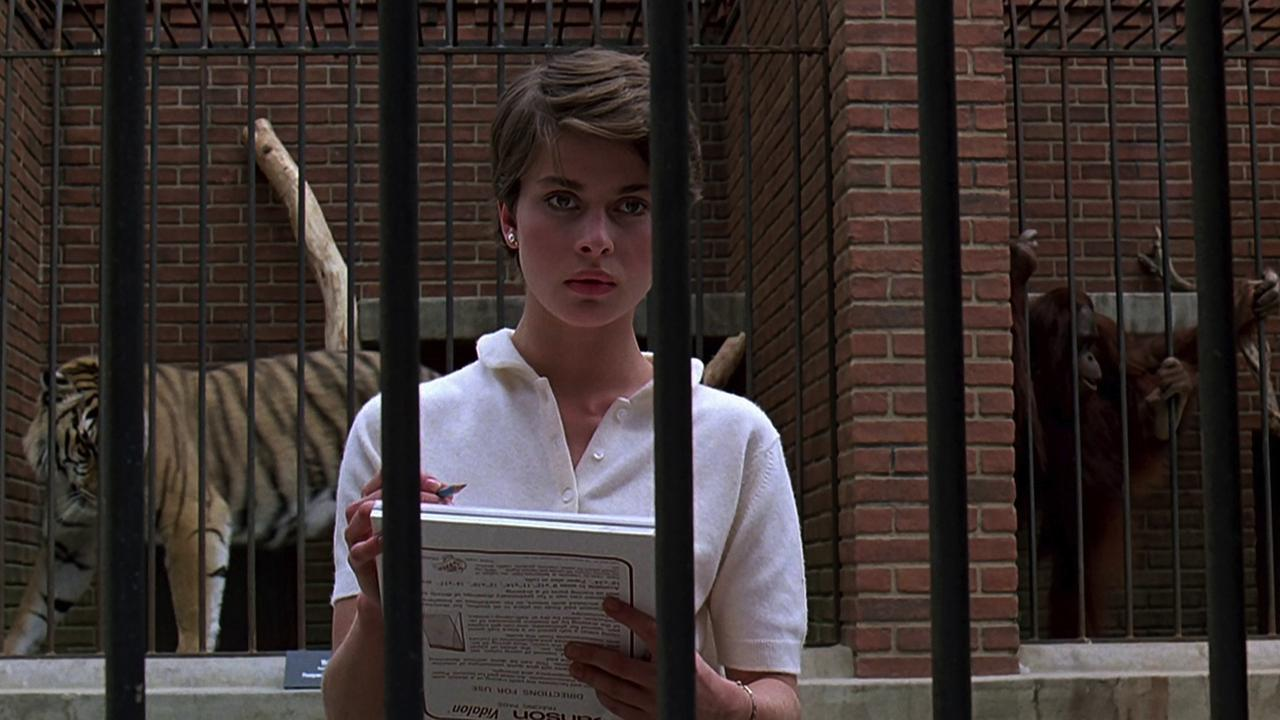
Why this isn’t listed as a werewolf film along with the previous year’s famous trifecta eludes me. It certainly has more to say about the mythological animality lying in wait within us than they do. And it essays out-of-body ennui with more disturbed beauty than An American Werewolf in London. Skulking around a zoo, the camera troubles which living beings are “inside” and “outside” the cages. The humans are as much entrapped as the animals. The staircase of a domestic home mutates into a prison imposed by their very domesticity, suggesting people trying to break out of ideological confines that they’ve also willingly assented to.
Perhaps, then, it is Schrader’s obvious distance from the text that saves it, that infuses it with an undying alienation from itself. Schrader is so self-aware of cinema’s potential, but also so attentive to – even tortured by – its limits. Schrader’s wide shots feel like travelers in a world detached from his camera, a gaze interested in sights in motion, lost in a sense of things passing it on, or recognizing the ease of missing something that really matters. At one point, the camera gracefully swoons around a tableau and only then, as if lost in the midst of its distraction, stumbles upon a body, as though its own capacity as cinema to register the impression of death was under threat. Just as the main character cannot fully commiserate with the world she has secreted into, the film seems to wander above and beyond its material, looking for a point of connection it cannot find. This Cat People becomes a cold-blooded sermon about the difficulties of connection, the threatened potential of art’s so tenuous capacity to engage the world, to support a humanity that only ever lies away from it.
Yet if this is a reckoning with art’s limit, it is also, occasionally, a plea for artistic redemption. In the airport, Schrader briefly catches sight of blood red luggage that attracts him as markers of an inexorable human contingency, containers of his own unclarifiable, spontaneous interest. This is true artistic freedom, the space to notice these objects, or to find them attractive, for no particular reason, other than that the combination of textures and feelings are of intrigue to him personally. These slivers of aleatory happenstance attempt to salvage humanity, and art, through sheer curiosity.
But achievement at what cost? When Irena’s brother dies, it’s a weird, open sexual moan, an ecstatic comeuppance for a character whose inner urges threaten and reveal humanity’s toiling tensions. He seems to implode the text even as he wants to save it, his vigorous, unmodulated spontaneity both a form of salvation and damnation. While Irena watches the world from outside, longing for a connection to something she can’t maintain, he savors his displacement as a form of ecstatic rapture, a carnal euphoria we are meant to fear and desire in equal measure. This is art’s Dionysian side, its molten, interruptive energy unleashed back upon the species in a fit of doomed, self-fetishizing revelry. For Schrader, art itself may be an incestuous race fated to lose its connection with humanity because it can only procreate with itself. Irena’s aspiration to become human is the Faustian bargain of art itself, the capacity to empathize with something that is never completely available to you and that, in the guise of saving, you may only be supervising, if not fully destroying.
Score: 8/10
 The Long Take