Monthly Archives: October 2025

Film Favorites: Stranger than Paradise

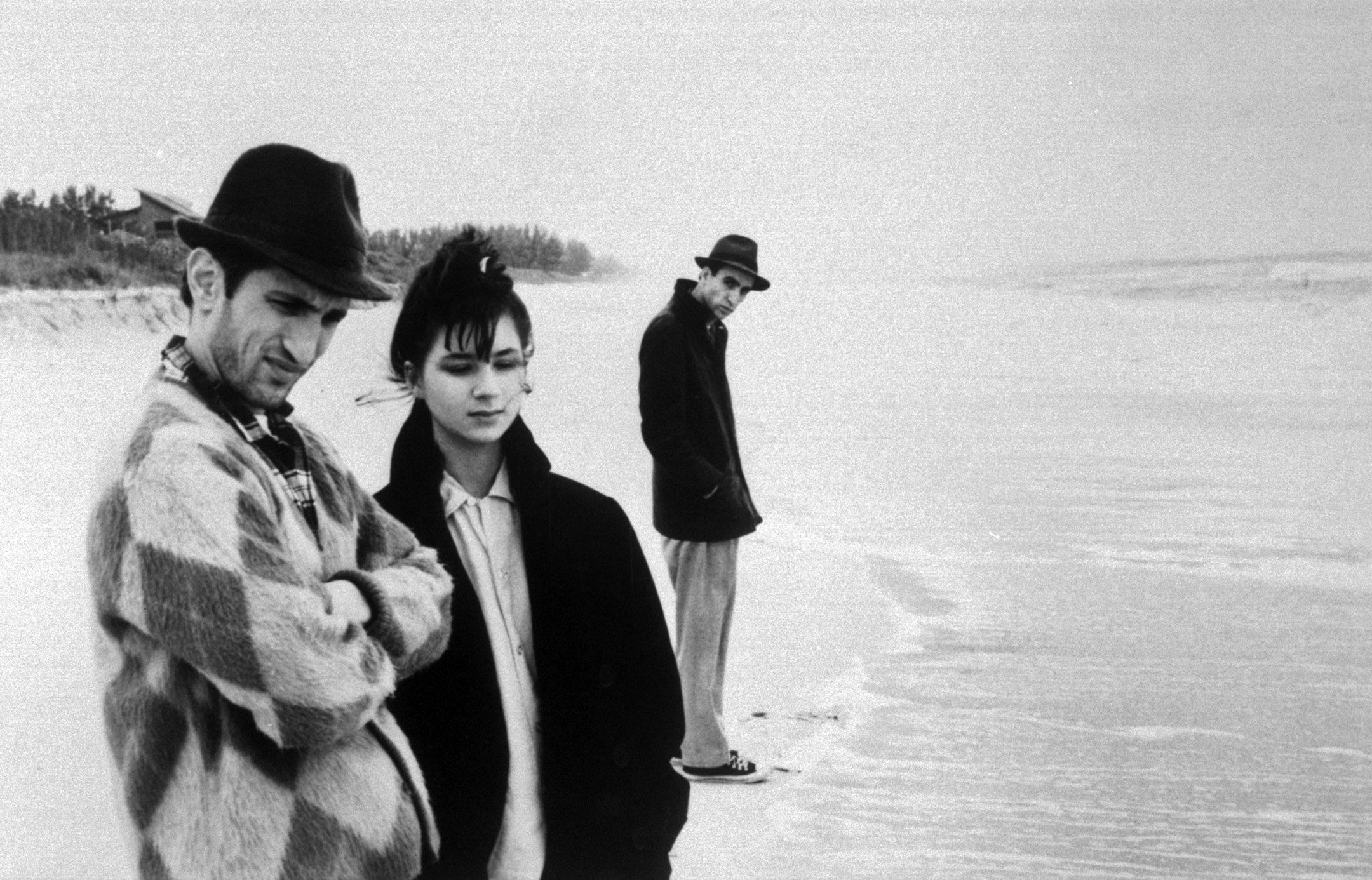
Writer-director Jim Jarmusch’s Stranger than Paradise feels revelatory in its banality. It exhibits a kind of dim-witted defiance that celebrates America by deflating it entirely, elevating it by turning it into nothing. The spaces are ratty and bare but wonderfully populated, the people are basically hollow and yet so teeming with phenomenal microbes of energy and uncertainty. It’s like a Bresson film if Bresson was a day-drinker interested in a way to pass the time instead of a monk in search of transcendence. Stranger than Paradise, like its title, finds salvation in the profane and the mundane. If it is in search of deliverance from destruction, it is nonetheless profane in a way, exhibiting ambling, quizzical assurance that things might not really be okay, but what matters is that they’ll certainly be interesting if we let it.

That’s an interesting thought, much like America is an interesting country, even if it’s nothing else. Jarmusch’s film is a lot like a particular vision of America: wonderfully inelegant, somehow both spare and excessive, spartan yet teeming with secret multitudes and plain-spoken eccentricities. It’s like America’s vision of itself when it cuts away all the stifling excess, when it reveals, termite-like, the multitudes that be contained in the seemingly minimal, the great depth in the apparently microscopic.

Consider protagonist Willie’s apartment. We gloss over it initially: how under-designed, how ill-equipped it is for a fulfilling life, for anything we would want to consider “humanity.” Thirty minutes in, though the cracks are our old friends, marks of a home that only remains alienated because we haven’t properly attuned to it. But they are also marks of our real alienation, of a society that doesn’t know what to do with us, or how to house its masses. Each corner of the apartment is a minor artistic masterpiece, secretly impressing itself in our brain with its everyday strangeness, and its reminder of our strangeness to ourselves, that which we overlook in the comings and goings of our existence. Forced to confront what filmmaker Jean Epstein would call the “horrible underbelly of things,” the film becomes oddly anarchic in its capacity to open the viewer to sheer existence.

Continue reading

Midnight Screenings: American Gigolo

American Gigolo is usually described as a key neo-noir text. It strikes me as a kind of anti-noir, not a text that skirts the shadows of a seemingly bright modernity but a film that has accepted how the shadows themselves aren’t as threatening when the light is so obviously hollow. American Gigolo treats noir as banal, unequipped for the violence of the modern world. This is a world that has made peace with its shadows and lacquered them in a façade of beauty.

The key moment, to me, is an encounter where protagonist Julian Kaye (Richard Gere) accosts a threatening conspirator in front of a movie theater, dwarfed by a poster of The Warriors. If that film was the apotheosis of the New York of Schrader’s most famous script, Taxi Driver, murder as a spontaneous, bodily, nocturnal emission, this film is L.A. warfare: cold, calculated, and all-too-mechanical. That 1979 film cavorts with denizens of a social netherworld, caged creatures of a modern void looking to escape it in ways they haven’t fully fathomed. They lived by the images they paint on, the masks they wear, second skins as authentic selves. They form entire sub-cultures, leaping into jeans and leather pants and each other’s personal spaces with the ramshackle, reaching energy of unbridled youth. The Warriors pounces on everything. American Gigolo is always knowingly keeping a distance from itself, aware that it lives in a world that is completely alienated from itself. It can only live in that gap, slowly stalking prey that gets trapped in the space between truth and fiction.

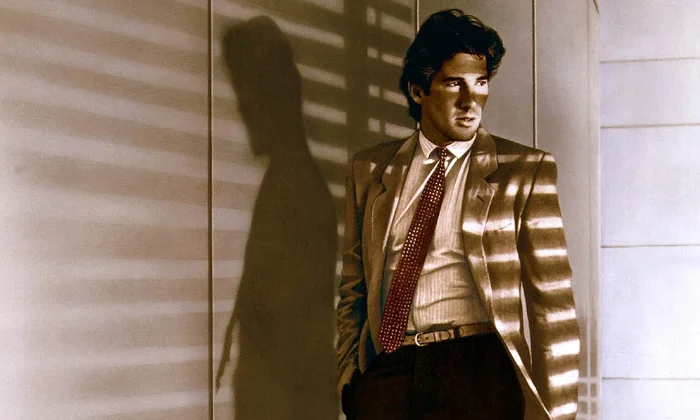
Kaye, too, is being stalked by this film. He is rendered background, wallpaper, a hastily-put-together man of disposable, posable parts sitting with leering torso images behind him. “You were frameable,” Bill Duke brutally intones near the end of the film, something the text wisely never underscores as double entendre, but it’s clearly the governing motif of the film’s mise-en-scene. A key image of him looking at himself in the reflection of a chic print writes his fate in an image. Gere’s Kaye is a walking specter of a person here, a mannequin violently controlling his self-image, manicuring every moment until he finds himself lost in an honest-to-God narrative outside his control. The trouble is that, while the narrative he steps into has its sights set on him, it is also very much the world he wants to inhabit.

Surfaces shape this narrative. They both bind it and unravel it. Kaye is a high-priced male escort for upper-class older women whose life funds and determines his lifestyle, a mode of being that he protects with a devotional fervor that borders on divine ardor. Yet he seems essentially opaque, a blank space whose zealotry is unthinking. It’s hard even to call it blind belief. He doesn’t seem to believe anything, and his reaction to being framed for a murder entangled in his work is less anger than robotic curiosity, as though saving his name is simply his automatic response to the machinery of his world being interrupted. Kaye is little more than a cog of the machine working to set itself right.

In a sense, it’s not much of a narrative then. There’s little contingency or chance. It’s a mood pretending to be a narrative, mocking us with how little is really going on in the story we’re being told to watch out for, and how much is being slipped in between the frames. The camera looms from above, something Schrader would metastasize in his next film, 1982’s Cat People. But here it evokes less a negligible line barely covering a nebulous depth – a thin strand holding a black hole at bay – than a flat, planar surface with no depth at all. It seems to watch, from above, as the world empties itself out of possible meaning. Light tries to peek in, but shutters, also from above, break up the illumination into violent black and white lines, silently fractalizing Kaye into light and shadow, deconstructing him into his component parts. The light through the blinds seems to be breaking the facade apart, fissioning the image of the man into pieces, and he either doesn’t know how to respond or can only cope with it by doubling-down on his alienated sangfroid.

The film is, in this respect, not unlike The Warriors after all. Walter Hill and Paul Schrader were two of the bastard children of the New Hollywood movement, birthed within it but in search of their other forebears, namely the chilly art-house ennui of European avant-garde cinema. The dominant texture of the ‘70s New Hollywood was spontaneous, cobbled-together, and live-wire, a vision of brutal and ragged reality tearing through the façade papering it over. Men like Hill and Schrader fold in a cryptic and impressionistic gaze that seems unsure of what breaking through the images that consume them might really mean. These directors engage modernity’s conundrums not with the ravenous, mischievous human vivacity of the ‘70s directors but with a near-apocalyptic loss of self. Where earlier films unleashed something vital and rotten underneath the surface of an apparently accepting, compassionate society, American Gigolo is all surface.

Thus, the film is all tone and texture, a collective act of stylistic theft in which the depth of the text, the possibility of a world with layers, is stolen by a cabal of conspirators insisting on the emptiness beneath their efforts. Giorgio Armani’s costumes are stark and warmly forbidding, inviting but entrapping like a Lycra straight-jacket. Ferdinado Scarfiotti’s cannily controlling production design is an open-air prison. Most devious of all is Giorgio Morodor, a man who would help redefine a decade of cinema music by turning to smooth, brittle sounds lost between analog pasts and digital futures. Here, they mark the film as a febrile commentary on modernity itself. Even the exquisite Greek Chorus of Blondie’s “Call Me” feels like an ambivalent, absolutely iridescent refrain: how much can the film do with so little, and is this a manifesto of artistic imagination or a statement of creative death?

Gigolo is too good a film to not make the case for imagination, but it requires serious moral rectitude, one that, Schrader suggests, isn’t going to come easy.  In the film’s final scene, one woman sacrifices everything that her life has been building to, her entire social and public image, for a moment of personal grace. Whether or not Julian has come to understand the value of this sacrifice, after all he’s been through, remains a question mark. Putting their hands on a glass protrusion between them, one surface that finally, explicitly literalizes their separation from one another, they try to transform a canvas of alienation into a forge of redemption, a zephyr of personal authenticity to cut through the surfaces that is nonetheless formed by those very surfaces. In a deliciously ambivalent frisson, Schrader asks whether the image itself can become a weapon of something that looks quite a lot like absolution, at least on the surface.

Score: 9/10

Film Favorites: Chungking Express

In Chungking Express, even the shadowiest corridor of the modern condition feels like a vast expanse of possibility. Writer-director Wong Kar-wai’s unfathomably effervescent romanticism knows no boundaries other than the limits of his audience’s perception, which he also takes to be his film’s primary concern: how we see the world, and whether we can see it all at once. His film’s vigorous curiosity, a measure of our poise and flexibility, our readiness to open ourselves to uncertainty, is also a testament to a world wonderfully and unmanageably beyond our complete grasp.

With Chungking Express, Kar-wai fashioned the masterpiece of his early style, an exquisite fable of modern human friction that adopts the exploratory texture of magical realism but not its sometimes abstracting gaze. His text is not lacquered in the same kind of candy-coated wax that would go on to petrify something like Jean-Pierre Jeunet’s Amélie, so obviously indebted to this film in other ways. While I’ve always found that film to feel like a penitentiary, a cinematic prison-house designed with directorial despotism, Chungking Express is feverishly alive, attentive to momentary shifts in rhythm and tempo, feeling like it could explode into something new at any moment. Its closest predecessor may be Fellini’s mid-period, still alive to the observational particularities of his neorealist era but beginning to breathe, to newly expand and contract, into fantastical realms of a world more wonderful.

An amorous fairy-tale of frisky humanity that is also an arduous trek through the swampy terrain of maintaining, and failing to maintain, moment-to-moment human connection, Chungking Express tethers two stories with a phantom thread. It links them through a form of chance and circumstance that feels both molecule-thin and like the latchkey for some secret of the universe. This is not “hyperlink” cinema. They have no narrative connection, nor do they even occupy the same emotional temperature, but they do embody a shared hope, a vision of the world in which the everyday is a kind of delirium, a carefully controlled entropy as a kind of bliss. Their linkages are atmospheric, each second of the film implying a nebula of bubbly energy that happens to have coalesced at this very moment.

Continue reading

Midnight Screamings: Cat People (1982)

Whatever else can be said about Paul Schrader’s 1982 adaptation of Val Lewton and Jacques Tourneur’s 1943 shadow cat of the same name, it is a wonderfully interesting film of contradictory textures, a fiendish, feral text that is also a cold and mercurial thing. It feels like looking at fog condense on glass: a text of lustful energies clamped down on hard. Its director, Paul Schrader, so abstract and theoretical in his inclinations, is perhaps the worst man to take up the original’s suggestively cinematic mantle, but his discomfit benefits the material. He seems fundamentally alienated from this film. The camera floats around the humid streets of New Orleans like a disembodied spectre, or a trail of smoke. Ethereal and animalistic, the film feels like it could either diffuse into the atmosphere or lash out at our throats and splinter in our eyes at any moment, like it either wants to dissipate from this world or to seek revenge on us for bringing it into being. Much like its central protagonist, this Cat People seems unsure of its own ability to settle down in the world it depicts.

For a film so adrift and evanescent, to have a director so tortured by the limits of human freedom in the world, and perhaps so uncertain of his own capacity to exist in that world, ends up being an oddly perfect fit. Schrader’s points of ingress into the material are so esoteric. Here is a man who really never has anything to say about gender adapting a seminal text of feminist (or anti-feminist, depending on your analysis) horror. The screenplay by Alan Ormsby, the unsung, nefarious accomplice of horror director Bob Clark in the mid-‘70s, implies that the original was also a film about alienation more broadly (of obvious interest to Schrader), about one’s attempt to create oneself in the world and finding oneself occupying spaces with thick histories that one feels fundamentally disconnected from. Finally, the material becomes a folktale, an age-old fable about our un-fitness for a world we can’t refuse.

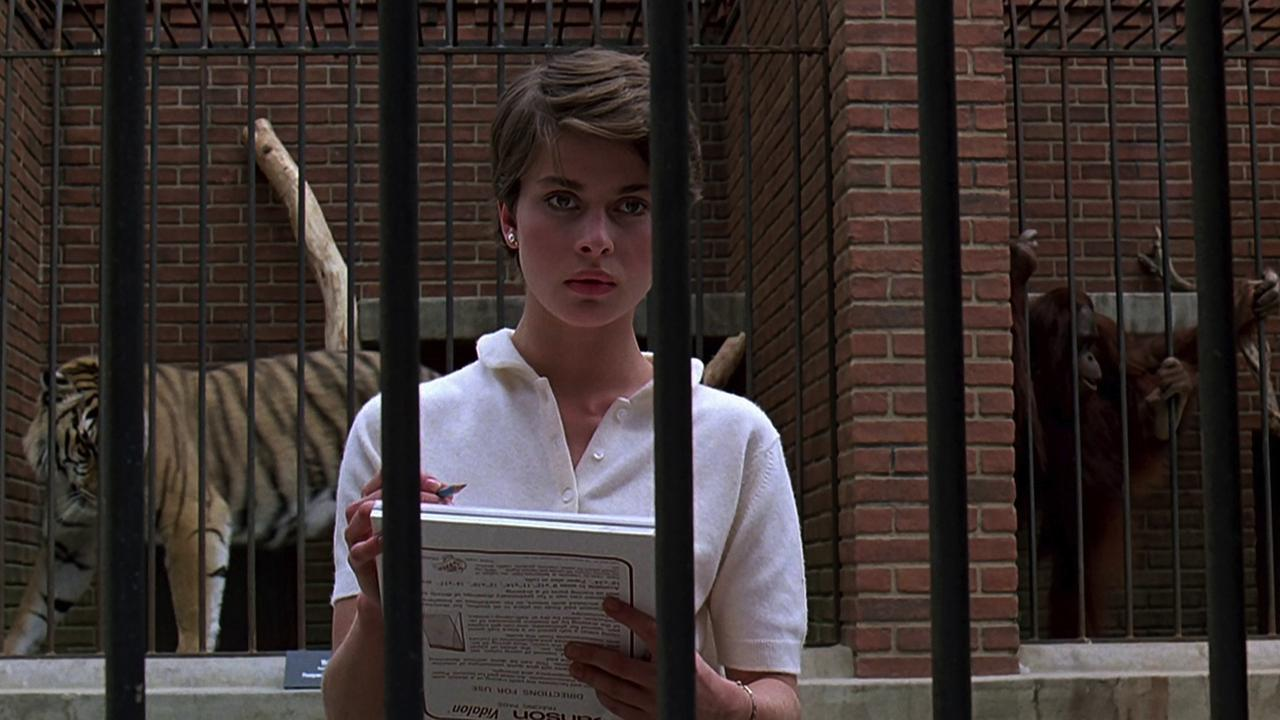
Cat People begins in America’s most exceptional – as in, abnormal –  city, New Orleans, essayed here as a sort of old-world summoning, a place out-of-time and, thus, the only space in which protagonist Irena (Natassja Kinski) might feel home. Recently transplanted to the U.S. in search of her estranged brother Paul (Malcolm McDowall), she finds herself in a phantasmagoria of thoroughly uncoupled spaces. Schrader sees the city as America’s closest linkage to European sensibilities but frames the tension between America and Europe as a subterranean pressure fissuring the film apart at the seams. Geography seems to break again and again. Within a cut, we’ve moved from seemingly antediluvian scaffolding barely holding chthonic forces at bay to a confrontation with a grotesque caricature of Marilyn Monroe. Another cut, and we’re in a thoroughly unclarifiable building that looks like a gaudy, iridescent Emerald City castaway (marking this film as a darker cousin to Coppola’s One From the Heart and beating Lynch’s Wild at Heart absurdist Wizard of Oz by nearly a decade), before finding ourselves hovering over a candy-coated floorboard, as though we’re witnessing a polymorphous Americana’s dreams of itself. John Bailey’s cinematography is phenomenally suggestive: lurid giallo colors washed out into hazy afterimages, like the fire of hell dulled but expanded by the passage of time into a smoky effusion forever suspended between states of being, drifting between kinds of matter. One of the most sensual sequences occurs in an airport, perhaps the most liminal of spaces, but this is always a film travelling from station to station.

Continue reading