1968 was a year on the edge of eternity, a transformational vortex of social revolution and political stress. Hammer Horror was, to put it kindly, not a company fit to weather the storm. Their moral universe was mostly conservative (in the small “c” sense). Their films, skulking with fiendishly recalcitrant minor currents though they could be, were fundamentally about staving off the forces of darkness, typically equated with dissent. While their films drew new blood from old horror chestnuts, they were very much playing the classics. In the late 1940s and throughout the 1950s, horror cinema became very much contemporary. Anxiety about nuclear catastrophe and new technologies of mass destruction produced modern-set horror films with distinctly present-tense fears. The late ‘60s, meanwhile, would thrash horror into the future: influenced by the post-modern fragments of shattered reality coming from Europe and the acid baths of ‘60s psychedelia, they erupted the social canvas rather than creeping in the background. Hammer Horror’s heyday was in between these channels, the late 1950s and early 1960s, racing against a tide of history that would wash the company into oblivion.
The company’s most adept conduit of that fear was director Terrence Fisher. One of his final films with the company, The Devil Rides Out, is perhaps the paradigmatic ideal of a mainstream British horror film negotiating the Apollonian pull of order and the Dionysian energies teeming underneath society. The film exhibits a brutal, stone-faced rigidity, the product of obvious fear about the world coming undone around it and its own attempts to straight-jacket those tremblings. In its fear, perhaps without intending to, it also gives voice to that uncertainty, becoming a herald of an unquiet society. That it can’t fully appreciate its own tensions, can’t quite admit to its own inner restlessness, is all the more potent a suggestion that it knows the complexities of the world around it, and needs to deny them to survive.
Although The Devil Rides Out is a perfect emblem for an aging company reckoning with the fact that it no longer occupies pole position in a restless world, it is set, appropriately enough, in the 1920s, a time when Aleister Crowley’s influence on a Britain wounded by war catalyzed new energies percolating in that society’s cracks. Ravaged by an industrial war that was very much modernity’s own, the fissures of empire, the fractures in Britain’s gigantism, also facilitated cross-currents of international thought traversing the science-spirituality gap. These were liminal energies that engaged social longings and frustrated uncertainties. They were force fields that could metastasize into either Nazism or surrealism, different responses to the perceived failures of a rationalized modernity.
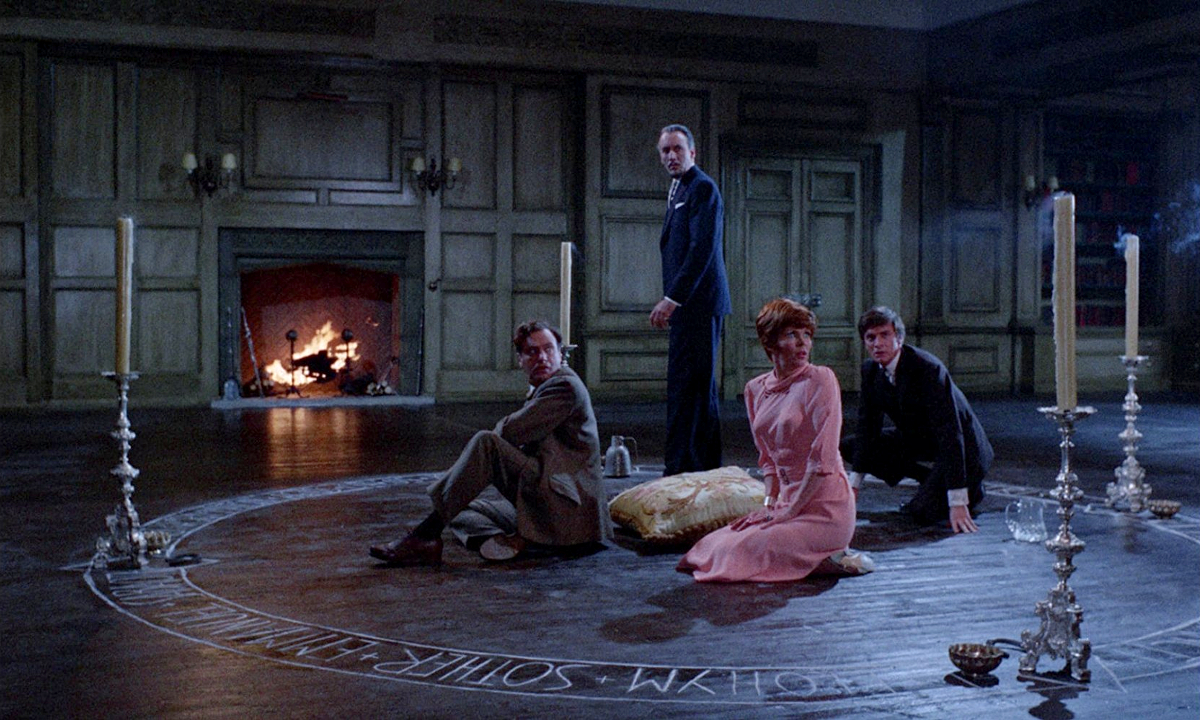
These were, truthfully, amoral forces that could be channeled in multiple directions and that troubled the Manichean worldview The Devil Rides Out obviously wants to maintain. In this film, these forces channel into and through the menacing, self-amusedly malevolent Mocata (Charles Gray), leading a cabal of satanists that have charmed the wealthy young Simon (Patrick Mower) into their grips, much to the dismay of aristocrat and Biblical warrior Christopher Lee, a patron of the untempered rightness of Britain. While Mocata’s sinister meditation on the “science of causing change to happen according to one’s will” and “mind over matter” anticipate fascist occultism, they also return to a thirty-year period of cross-cultural European contact with religious energies that were not strictly Christian but explored the outer valences of Christian mysticism, Buddhism, and Hinduism. These were men and women in search of something that industrialism and rationalism were not affording them.
Hammer’s film is an old institution’s attempt to wrangle these dispersed forces, to bring them fearfully to light. Fisher was a consummate professional, although he mostly chose to color within the lines, and to direct up or down to the screenplay he was given. In this case, first-rate science fiction and horror author Richard Matheson gifts him a classically-mounted screenplay, one that speaks to generational differences in a newly globalizing world that challenged Christianity’s traditional hold over England. Fisher anoints it exquisitely, if mostly expectedly. The phantasmic conclusion, though, relies on a number of almost primordial cinematic tricks, recalling the inchoate underbelly of early cinema, when the medium itself danced on the line of science and religion, charisma and authority, embodying a healthy suspicion of rationalism, drawing on a shadowy magic that promised, with all its might, to bring the dead back to life, to reenchant the world. When Mocata says “I shall not be back, but something will,” he speaks in the language of resurrectional forces, new forms materializing long dormant forces. In doing so, he is tapping into the energies of early horror cinema itself, a technological generator that, at least in its early years, seemed to some to be summoning a pre-modern force in a phantasmic body, a Moloch of the cinematic sublime.
The Devil Rides Out can’t explore the nebulous underworld of early cinema quite like the nocturnal playthings from that era. Those films seem genuinely otherworldly, like they emerged from a cauldron more than a camera. The sober classicism of Hammer, conversely, summons a doom and gloom that the nation can only temporarily acknowledge before trying to put back in the closet. The film recognizes as much every time that Lee is asked to exert a hold over others in a very similar display of mind over matter, spirit over substance. Fisher stages some diabolical close-ups on eyes that feel deliciously unsettling, that seem to contain the world while severing themselves from it. Tellingly, he does so with Lee’s eyes as well as Gray’s. While opposed in the war that the company stages before our eyes, the camera can’t lie: these two men channel the same forces, even as the narrative insists otherwise. What precisely, really, marks the discrepancy between the forces of patriarchal Christianity and Pagan shamanism, what morality precisely lies beneath the pure force of charisma, remains a question the film can’t acknowledge, but which haunts every frame. The forces at work in the world, the film realizes, are ultimately more unwieldy, and more difficult to differentiate, than Hammer wishes to admit.
Score: 7.5/10
 The Long Take