
Woman in the Dunes is the story of matter’s murmur, how it promises and then profanes. An unnamed entomologist (Eji Okada) opens the film wandering the coastal desert dunes of a seemingly out-of-the-way corner of Japan, far from his daily life in the doldrums of Tokyo’s burgeoning modernity. For the entomologist, the dunes promise relief from the workaday banality of modern city life, promising challenges to pursue, forces to explore, submit to, and command. He hopes they will unsettle him, that the romantic pull of the sublime otherness of these forbidding desert dunes will sink into his soul, that they will bring him outside himself and thereby return him to himself after communing with the world. But the film slowly impresses on us that his quest is a dangerously abstract escapade, one that takes him away from modernity’s tensions rather than into their conundrums. The titular dunes, with their eerie, eons-long omnipresence, their mixture of grace and gloom, lay his solipsism bare, drowning his ego in forces he wants to both dwarf and that he wants to dwarf him. The titular dunes are iridescence embodied, warping any meaning imposed on them. Alternately confessional stall, open-air penitentiary, and vast abundance, they can stand for seemingly anything and thus, perhaps, afford nothing other than a cosmic trick. The dunes offer this man his soul renewed before holding a mirror up to his inner cravings that he would rather not see. Woman in the Dunes understands that the line between spiritual purgative – hope for cosmic salvation – and menacing infinity – adriftness in a void of your own making – is gossamer thin.
Soon enough, the unnamed man rests in the house of a widow (Kyoko Kishida), whose husband and child were taken by the dunes, and who worships the landscape’s shifting unfathomability with a combination of devotional zeal and melancholy passivity. Their relationship is charged with the same internal instability that galvanized and unsettled the central couple in Hiroshima mon amour. She, he learns, is a willing prisoner of the town around the dunes, forced to extract precious sand from the dunes to melt down into illegal cement. She is inviting and exotic, but the sculptural way the film contours her body in key scenes marks her as a sort of congealed sand sculpture, a prisoner of the place that carries her trauma, that she cannot escape lest she begin to grapple with the liminal nature of a past she can’t not hold onto.
In “exploiting the lure of the dunes” and “my fascination with the sand,” Woman casts itself in the romantic tradition, a cosmic togetherness debased by the entomologist and the “postcard salesman” who have come before, and who aspire to curate, demarcate, and displace a nature that is as mercurial and it is effervescent, teeming with an exploratory curiosity that numbers cannot contain. Teshigahara understands that these particles are also waves, from sand dunes to hair to fabric to the amorphous mysteries of the heart and head. The sand dunes look uncannily like human skin when projected in close-up, rendering the flesh a genuinely alien landscape and the sand an unexpected home. Clothing hangs down like weeds, part of an omnipresent but often ephemeral ecology that the townsfolk both respect and debase by trying to sell it to factories for cement. They too attempt to engage an all-encompassing, incomprehensible immensity that feels thoroughly uncircumscribed in its boundless violence. They too try to penetrate that which can seep into anything. The widow, conversely, aspires to an occult forum with the earth, a communion with the atmosphere around her that renders her family still alive, in whatever imagined measure, in the sand itself.
It would be easy to schematize the two central humans in Woman in the Dunes, to see her as a backward marker of pre-modern pastoralism and him as an indication of repressed modernity. From the beginning, though, writer Kobo Abe (adapting from his own novel) and director Hiroshi Teshigahara understand every person not only as an individual but as a series of folds playing out, as energies extending themselves and replaying themselves on multiple scales. The woman certainly displays an excess of affective, mystical attachment to the area, an obsessive pull for home that admittedly could be coded as anti-modern and backward. Yet the entomologist’s curatorial zeal itself treads so close, and blurs with, its ostensible opposite, a desire to be cracked open by this place. The film understands this as a consequence of modernity’s aimlessness and of a mid-century ennui that provides little escape from a death drive that only seems like a calling. This misidentification of his needs, one that intimates that all this questing might just be a longing for a sense of meaning that the desacralization of modernity has evacuated, suggests that neither figure is more prone to the pull of the dunes, nor that their bodies, when all is said and done, can easily be separated at all.
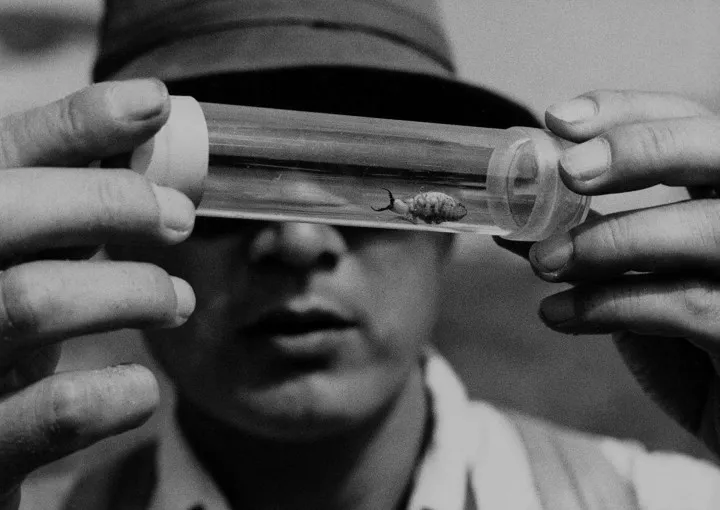
Throughout, Teshigahara so thoroughly problematizes any distinctions between viewer and viewed, knower and known, that the idea of “power,” of agentively engaging the world to change it, of separating the actor from the acted upon, becomes a fool’s errand. When our entomologist holds a glass containing a captured beetle, it is positioned in the frame as an object obscuring his own eyes, obfuscating that this science is his perspective, not a neutral, objective truth. His desire for it controls him as much as he manages it, something Teshigahara implies in another, later image of a village onlooker’s eyes covered by sunglasses, viewing the entomologist, now in his own transparent prison. In both positions, as looker and looked-at, he is a trapped specimen, a vision that is masked by the object of its view (he looks at the townsfolk as well), each blocking and revealing one another. Is there any difference at all between him and the other characters in the film, between city and country? His friends will come to save him, he remarks at one point, but the image is of townsfolk carrying him back to his hole, giving him a renewed, awful purpose that saves him, but not in the way he expected.
What the film understands so well is that this desire for a romantic attachment to place is itself a product of modernity, a need that finds solutions for itself in the “tourist resort” attitude the entomologist approaches the place with, his drive to simultaneously surpass borders and boundaries and to further circumscribe them. The entomologist wants both to control and to be controlled, to be dissolved into the shifting sands that he also wants to collect and bottle. In peering into the secret life of insects, our entomologist is also searching in the sand for the soul of existence itself, and humanity proves bitterly disappointing. As, maybe, does he. From above, the townsfolk look down on him like a specimen too, one more lost thing from a (city) colony looking for a release, a new ecology to play in, a new existence he thinks he understands. When he looks up at them, he is all too easily rendered a shadow on the sand trying to escape it, scorched and blinded by a force more powerful than he. When he is lifted up at a pivotal moment, hoping for escape, he seems to raise up into the shadow, a genuine void far away from his everyday life, but that only turns him back to the ambiguity of his own mind, the folds and networks of his inner ocean. Like many wayward romantics beforehand, his desire for something beyond his comprehension, for a secret that he can venture into and extend without fully concluding, is entangled with his own craving for mastery, for something he can study and claim for himself.
Certainly, Woman in the Dunes resonates with the country-city post-war dialectics of many other contemporary Japanese films. But Woman raises these questions to metaphysical heights and newly material critiques of that metaphysics. It recognizes that, to many people, the desert really was more than just a retreat from modernity. It was within their way of life, a mode of survival and understanding with genuinely spiritual connotations. It understands that this feeling isn’t simply about preserving an apparently antiquated vision but about surviving and thereby being complicit in that which you might oppose, that circle around you in webs and tangles of confusion. It knows that the need to suffuse into amorphousness and the drive to regulate and solidify coexist and aren’t always the clean opposites they present as. You have to “make the sand work for you, not against you,” they tell us, but the film exploits the ambiguity between matter as living force and as layered material inscription whose relations expand vastly outward beyond the frame. Woman in the Dunes frames the search for ultimate truth as a Faustian folly, not necessarily because the quest to know is an intrinsically doomed project but because the quester often isn’t honest about their own investments, trying to lose themself in a sublime matter and know themself in a calculable one at once. The entomologist is, in this sense, on a continuum with, say, Lawrence of Arabia, to name another classic film that weaponizes the shifting currents of the sand lodging into the cracks of an ego that masks as a form of humility, a way of giving to others that is, maybe, just another form of taking for oneself.
Score: 10/10
 The Long Take