
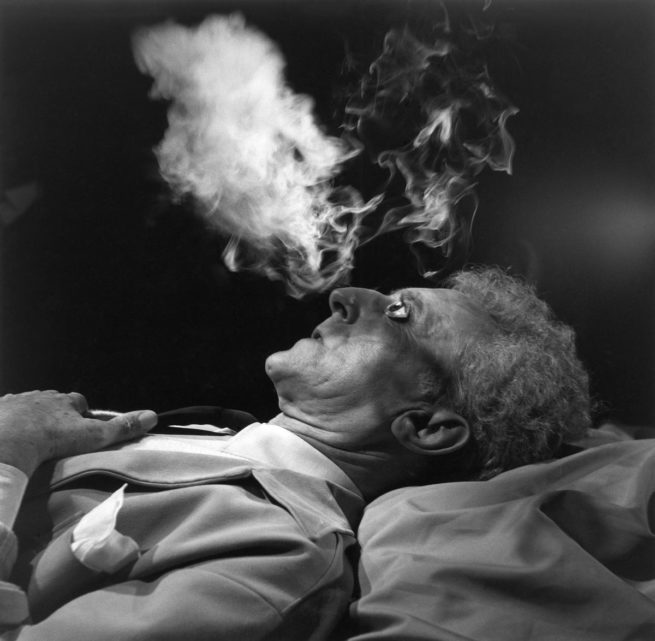
Few questions received such a pressing and recurrent tribunal in mid-century European intellectual culture as Theodor Adorno’s inquiry about whether there could be “poetry after Auschwitz.” For essayist, poet, and filmmaker Jean Cocteau, poetry may be all we have. The problem, both Adorno and Cocteau understand, is that poetry is complicit in cruelty, that feats of human imagination are entangled with the abstracting violence of mass destruction and the failure to acknowledge human reality. Art, Testament of Orpheus proposes, has a “a very poor memory for the future,” and it can be complicit in its own metastasizing as weapon and mechanism of power. Its dreams of a better world, the film well knows, all too easily become fantasies of control and justifications for destruction, means by which the poet’s will creates a new world prey to their sovereignty. In “repeatedly attempting to trespass to another world,” the poet is “besieged by crimes (they) have not committed,” by the potential violence of escaping the world, by the horrors done via technology attempting, like cinema, to conquer time itself. Art, the film posits, is an “innocence” that is nonetheless “capable … of all crimes.” Cocteau’s film begins as an inquiry into art and morphs into a testament to the necessity, in spite of everything, perhaps because of art’s very ability to do evil, to artistic transformation.
I’m quoting from the dialogue so much because Testament is a poet’s movie, the kind of robust and self-referential text a film theorist (as Cocteau was) would produce, particularly a theorist so eager to tinker around in a world where the “living are not alive, and the dead and not dead.” It can be a little self-serving, and Cocteau’s smirk – both his directorial elan and the knowing grin he dons on camera, as “the poet,” an iconographic variation on himself – tells us all we need to know about how aware of that self-service he is. The artist, try as they might, “always paints his own portrait.” But Testament of Orpheus turns egocentrism into ecology, the inward gaze into the relational soul. Cocteau is keen to invite us to participate in cinema’s own liminality, to join hand in hand with its own navel-gazing. Its vision of art is a “petrifying fountain of thought,” and if it petrifies like Medusa’s gaze, it also reminds us that witnessing that petrification via art is the only path we have to confront the world in all its complexity and emerge galvanized for further inquiry. One would be hard-pressed to find a more petrifying vision than Testament, so completely does it stop and restart the rhythms of the mind via a cinema of perpetual free-fall.
No doubt, though, does Orpheus realize that this perpetual motion is its own violence, the fount of possibility that can all too easily convert art into mass destruction. Orpheus puts the same sentiment in the hands of the poet and an inventor of time-warping weaponry: “I can’t be responsible for what happens now.” Something, beautiful, horrible, wonderful, and violent has been set in motion in the past few hundred years, something unmanageably complex and contradictory. The film responds playfully, wryly, a little violently and anxiously: this contradiction is an “occupational risk” of the artist’s freedom. The inventor in the film has created a bullet that can travel into the future, but the film itself admits that art is a poor predictor. While the “illusion of progress” is so central to our meta-narratives of modernity, Testament understands the mutual passage between explosions of cinematic sublimity and an inventor’s “bullet faster than light,” two industrial, mass-produced conglomerates of technological form eminently adaptable to evil.
By the mid-20th century, a weapon that could shatter any human’s faith in the species had been tested to disastrous results, and intellectuals like Martin Heidegger had lamented cinema’s complicity with what he called the “world picture”: a vision of the world as manageable, knowable, categorizable, totalizable. And not without reason: one survivor in John Hershey’s expose of the Hiroshima bombings describes the bomb itself as like a giant flash photograph from a camera, a malevolent technological gaze capturing an image of the Japanese and, in doing so, both destroying their material bodies and denying their opacity, their resistance to knowability. In the midst of geopolitical confusion, many social critics put their minds to the task of figuring out how to keep the faith, or if any faith was worth maintaining. One of the questions, in turn, was the question of mind itself. The American literary critic Lionel Trilling wrote that American art perpetually figures a party of “the imagination” and a party of “reality” and assumes that the learned artist must “enlist” under the sign of “reality.” Artists and intellectuals looked on imagination with slanted eyes because they felt that uncoupling from reality, with all its tragic conflicts and irreconcilable apprehensions, would lead to fantasies of control and delusions of domination.
In Fritz Lang’s The Testament of Dr. Mabuse, looking forward to this destruction rather than back,the artist is a conniving manipulator, the apotheosis of the enterprising conspirator as domineering mastermind who sees into modernity’s soul to pull its strings. Cocteau, aware of the way the poet can lapse into the autocrat of an imagined world, fights in the name of art as a critical commentator, celebrating the perennial disobedience of the divine mind. For Lang, this aspiration to master contingency and command time is modernity’s waterfall breaking through the dam. For Cocteau, the same is true, but with a crucial difference. The poet is “condemned to live,” and thus die, even though they wish, perhaps, to thrive in timelessness. They must be subject to reality by imagining beyond it. Their dances with eternity must bring them back to death, and thus to lived reality.
Orpheus thus dooms itself to live, which Cocteau understands as a moral injunction and a technological imperative. He forces his film to live by demanding that it investigate itself, that it play with its own rhythms, that it extrapolate from its own impulses. Footage moves back and forth. Characters warp in from nowhere and then disappear. The world crumbles and is remade within a single edit. By always warping his film, turning it ever back to reminders of its own undoing, Cocteau turns cinema against itself, producing a terrifying amalgam of science and poetry gone horribly awry in self-inquisitive entropy and finally, hopefully, saving it from itself via reckoning with its ability to unmake and remake the world. Look at this chaos, the film seems to say, look at what hell you can create as a poet of technology, and look at its limits. Turning the footage back brings the dead to life. Stopping the frame stills it in eternity. But eventually the footage must go forward, or the image must move to a new one, or the film must end. The eternity doesn’t last, and death remains eternal. Each new experiment must give way to the next, a claim that is as life-affirming as it is humbling. You must keep playing, but your playthings too shall pass.
Play, the film does, in the “shadows of some strange universe,” as it searches to “find a new ghost.” Its experiments are as appealingly crude as they are undeniably effective. Its reverse photography, a whimsically childlike and beautifully obvious gimmick, treats the cinema as a sandbox of temporal mischief. So simple a cinematic gesture also cuts right to the basis of the medium, framing cinema’s bare ontology as a search for life and eternity, a tension between keeping things in motion and reclaiming, in still, the dead that can never be resolved. Testament lays this tension bare, a playful experiment that endorses “humanity’s spirit of contradiction,” that queries the desire for eternity and resurrection and confronts what it means to keep something alive in the heart and mind.
In its self-exploration, Testament may only see Cocteau pushing his art to its limit, fulfilling the death drive it admits that all great art exhibits. His much earlier, magisterial Blood of the Poet (1932) famously turned water into a vision of cinema as a metamorphic abyss in which you stare into your soul and emerge transformed through confronting your bodily limits. Its belated sequel Orpheus (1950), semi-literalized his interest in artistic self-becoming through death by treating art as a kind of nether realm where reality’s underside is exposed. Testament, the finale of Cocteau’s cinematic trilogy,answers the former film by framing self-inquiry and artistic critique as a kind of underworld, a space beneath expectation and apparent truth where uncertainty revels in its own endless capacity for vitality at the risk of death. Questioning ones art, here, flirts with destroying and killing the art, but also with bringing it really to life.
In the Orpheus myth, the doomed venturer journeys into hell to save his lover Eurydice, ascending with her back to the living, only to look at her face at the last possible minute, thereby dooming her to eternal existence in the underworld. Critics have often treated the story as an allegory of the poet’s drive to commune with and conquer death and their fate to never achieve that communing. The artist deigns to bring the past back to life but must return with a truth that they cannot look at completely, for art can only refract and comment on the past, not truly recreate it. Art’s quest to infringe on the laws of existence receives a manifold critique in Testament of Orpheus, predominantly by the Princess of Death (Maria Casares), here (contra her characterization in Orpheus) unwilling to sacrifice herself so that the poet, and art, can live on. Instead, she doubles down, interrogating the violence done in the name of the quest for eternity. But critique breeds redemption in Testament. If the poet in bodily form, Cocteau himself, sometimes looks on, bemused, unable to account for his answer even though he knows she has asked a good question, it is only the art informing us that it recognizes that this is modernity’s paradox, that there is no answer to this conundrum, and that feeling out that paradox is art’s crucible. The garden of irrepressible creativity is also a menagerie of agonized humanity.
This is lamentable, but it is also, finally, irrepressible, the blooming disruption, for good or ill, that art wrecks on the world. Although Testament is more classical and philosophical in form than, say, Godard’s or Antonioni’s concurrent films, texts so distinctly cinematic that they are unimaginable in another medium, Cocteau’s film is no less exploratory. Its rhythms are architectonic, all the more so because it is the rare text simultaneously committed to creating new pathways in the earth and to acknowledging the cracks it both documents and opens in its wake.
Score: 10/10
 The Long Take