
Early on in Roadgames, Patrick Quid (Stacey Keach), a lonesome truck driver presently cutting a path across Australia’s perilous and forbidding Nullarbor, is wasting away. The unmoving, apocalyptic expanse of pitiless landscape refracts the fatalistic hopelessness of his unceasing existence. The night before, he nearly missed an opportunity to pick up a nameless hitchhiker (Angie La Bozzetta) on the road and to preempt the man (Grant Page) who did. In the meantime, we’ve witnessed that man, face still unseen, emerge from a steamy shower and slowly creep up on the hitchhiker from behind as she plays a guitar, the camera cutting just at the moment he seems primed to strangle her with piano wire. Soon enough, Patrick will pass the hitchhiker on the road, mysteriously burying something in trash bags in the outback. Because we haven’t seen him, and because Quid only sort of wants to see what the man is up to via his binoculars, and because writer-director Richard Franklin was a protégé of the late Alfred Hitchcock, we can’t miss that we’re suddenly being strangled by a Rear Window riff.
Strangled, I wrote, and technically Roadgames concerns whether this strange other man did in fact kill the woman. But Roadgames is also Hitch liberated, set out on parole, adrift in the cosmic reflecting pool that is the open frontier of the Outback. Indeed, quicker than you can say “The Trouble with Harry,”or “Frenzy,” Roadgames reveals itself as a murderously ironic deflation of Hitch’s own icy brutality, a film that isn’t really interested in tightening around us but in suspending us over a void. While Brian De Palma was twisting Hitchcock’s voyeurism and autoerotic exploration of mastery and impotence into increasingly perverted, masochistic spaces in the early ‘80s, director Richard Franklin (who would next direct a sequel to Hitchcock’s seminally serpentine Psycho) unravels Hitch. Instead of tightening the vise, Roadgames fills the parched purgatory of the Outback with a mordant, off-kilter mischievousness, moving us from episode to episode as it proposes a kind of wry question: can a hang-out road movie, with its vague digressions and ambling waywardness, become the template for a claustrophobic thriller?
Latching onto Hitch’s self-amused self-mockery, Roadgames turns Hitch’s sardonic undercurrent of wry malevolence into a bone-dry comedy of missed communication, not so much between the people in the film but between the film and us. To that extent, Roadgames refers more to the game the film is playing with us than the game the characters play with each other. We aren’t privy to some conspiratorial match between one malevolent force and an unsuspecting everyman, one in which the character’s lack of knowledge exposes the void around us. In this case, the force is the film, and we are the everymen, unprepared for how disinterested this film is in thrilling us, how little it seems to want to use and abuse us and how comfortable it is drifting about. It seems to be doing everything in its path to not transform into the horror film it has generally been advertised as. It is paradoxically not by treating us as Hitchcockian playthings, puppets of a camera impresario, that the film is really having its way with us. Franklin twists the knife in by taking it out, letting the wound breathe and the entrails flail all over the ground.
Quid himself is a decidedly disinterested movie protagonist, a man who remarks “so what if he is a murderer… who gives a shit?”. His is not an obsessive life, a portrait of impotent masculinity demanding control, but a disaffected life. He is not a cinematic conjurer, producing a film out of thin air, out of piecemeal frames and incomplete information, Rear Window style. He did not ask to be the center of this story, and he’d probably rather leave it on the side of the road, a bundle of frames unreconstructed into a narrative of murder and manipulation. Throughout, we encounter other strange figures, like a man with a boat who just does not want the plot of the film to continue on or a woman, Frita (Marion Edward), who seems at once to want the film to pass her by and to pay attention to her, that speak to the film’s promiscuous attentiveness to the story we’ve been primed to pay attention to.
All the while, Quid is doing a colossally poor job of not making everyone think he is a killer, as though he is simply too bored to try harder, too dispassionate about life to either get involved in finding the real culprit or to save his own skin. His self-repeated phrase “just because I drive a truck doesn’t mean I’m a truck driver,” initially an indication of his acknowledgement of self beyond his career, eventually morphs into a refusal to accept any sort of responsibility for his own life. The climax becomes not one man’s attempt to overcome a brutal interloper on his normality but one man’s duel with his own listlessness, an attempt to fashion some kind of narrative for himself, if only because people need them to survive.
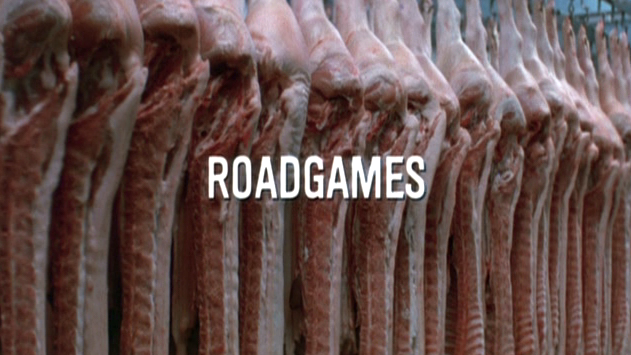
All the while, Franklin’s film is alive with tiny filigrees of suggestive instability, tremors of visual detail silently shuddering the film apart, playing with it in ways that deepen the sense of subliminal violence via leavening it, coaxing a murderous atmosphere out of apparent nothingness. Fred Flintstone silently smirks at us from a wall. A pig image cleaves into a man’s head in the background. A key scene where the protagonist searches for the unseen culprit on foot, which mimics Steven Spielberg’s Duel, takes place in front of a backdrop of a mural that exposes, without explicitly revealing a colonialist murder behind them, an intimation of a violence far more unfathomable, far more gravitational, than anything within the film’s diegetic narrative. The “suspense” of this violent narrative, the film seems to suggest, pales in comparison to the violence latent in this environment, lingering in the margins of the story for the inattentive yet suffocating it dry. Roadgames is a film of populated vacancies, but also productive congestions, spaces where more meaning skulks up on us than we were expecting, slitting our throat because we’ve been told which kind of violence we’re supposed to care about, and which we’re supposed to relegate to the outskirts of our perception.
Franklin’s coconspirator here is screenwriter Everett De Roche, a journeyman writer and American expatriate to Australia with an outstanding feel for the rhythms of the loneliness of a space that is essentially otherworldly but that can’t quite refuse being just mundane enough to keep you simultaneously sane and make you a little madder. With Franklin’s bleak canvas opening up enough space for De Roche’s words to crawl and writhe around, their shared vision of postcolonial ennui is of a frustrated playground, a space dancing with foreign desires: escape valve, untouched land, amorphous matter for sculpting, a new Wild West. That the two central characters are both American expatriates either on the run from something or not knowing what they are running towards, marks Roadgames as a cinema of exile that is also uniquely aware of the way in which Australia, as tangible space and imaginative construction, has served as a means for dreams of exile to mask realities of brutality. Yet like Hitchcock’s films before, Roadgames treats the sheer unfathomability of the world’s violence with a wry smirk, one that cuts right to the bone.
Score: 8/10
 The Long Take