
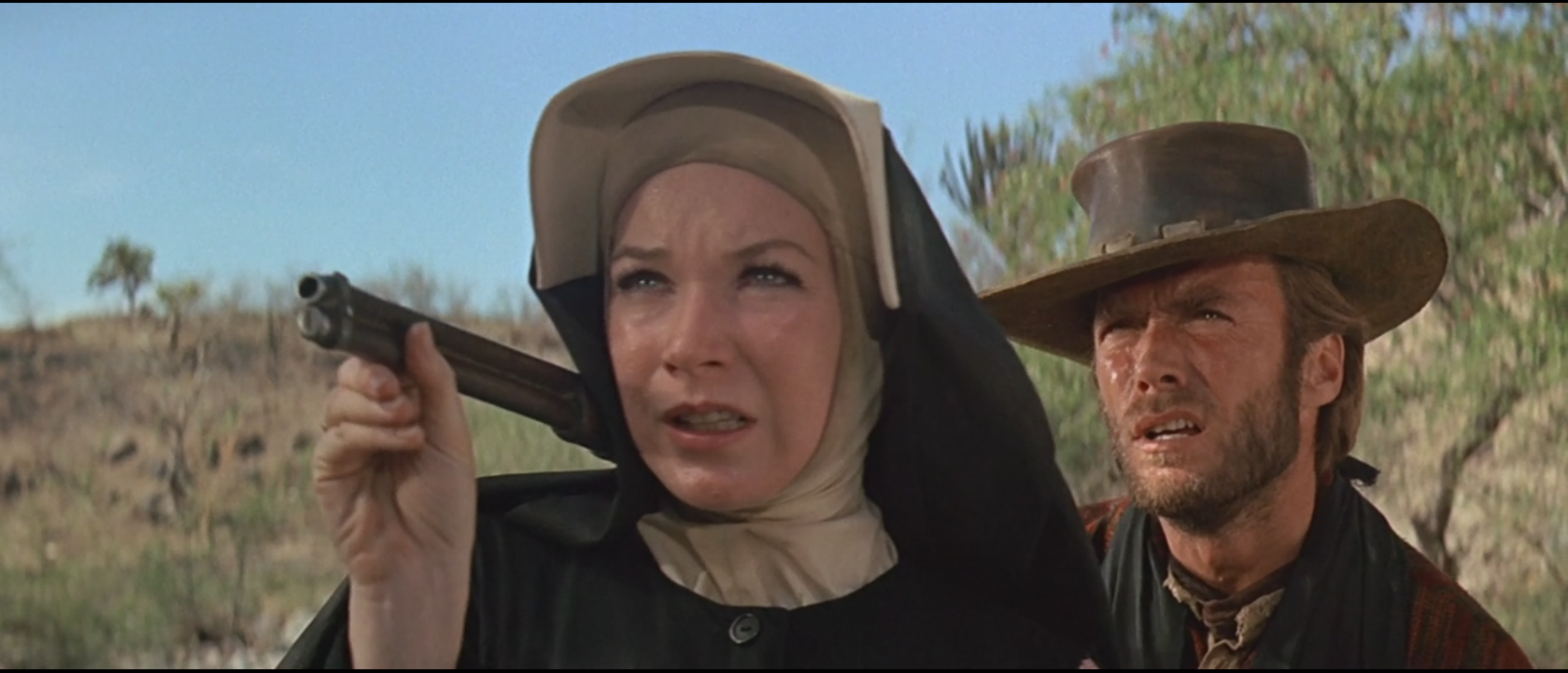
It is no secret that Clint Eastwood’s Hogan is very much the second “mule” in Two Mules for Sister Sara. For the most part, he’s a brute muscle whose soul is barely more tortured than a paper bag’s. If his taciturn efficiency and adaptable, survivable ethical relativism are treated with a tip of the hat by director Don Siegel, it is clearly Sister Sara’s unwavering moral vigilance that actually inspires the film. Without faith in a fundamental rightness, Hogan – and, implicitly, the archetypal wayward American with their hard, unmoving practicality – seems ready to drift in perpetuity, to suffer the fate of blind chance and mere circumstance that it mistakenly calls personal acumen. If Eastwood offers any contrapuntal critique of Sara’s spirited commitment and absolute belief in the first half of this film, a mid-film revelation that rounds out her character significantly implies that Sara is, finally, all that a human needs to be, and that Eastwood is just along for the ride. If, say, Robert Bresson sacralized the figure of the donkey in Au hasard Balthazar, creating an exalted mute witness lamenting humanity’s capacity for brutality, Siegel does the opposite. He profanes the human hero as little more than an ass.
This is an unusual thing for the signature Don Siegel-Clint-Eastwood pairing. Dirty Harry looms largest in their shared canon, and that film’s curdled vision of a thoroughly amoral world offers a backdrop for the film’s queasy call for a deregulated masculinity, unencumbered by government oversight, to personify that world’s awfulness, and, in doing so, hope to pacify it. But the men’s work together is far more slippery, and far more varied, than that epochal, and often grotesque, film suggests. The Beguiled, released between Dirty Harry and Two Mules, is a scorched-earth vision of American restlessness, implying that its rugged, creatively duplicitous loner protagonist is actually a cruel, conniving force, and that its coterie of Confederate women are really a menagerie of heated desires and malnourished souls in search of a pulse beneath their tenuous patina of harmony and ideology. And that’s not even mentioning Siegel’s earlier, non-Eastwood explorations like The Killers, which inverts the detective genre as two ruthless, reptilian assassins spend the entire film in search of an explanation for why their target was so willing to enter the wrong end of their gun.
Critical texts, certainly, but Siegel’s films are hairline fractures, not fissures. Little about his work announces itself as a critique of their zeitgeist, but in cutting into the world around him at odd angles, he can’t but fray its edges. Several of his key films take place in the modern-day West, and the most famous ones generally seem to affirm the Wild West’s mythology of ragged souls and recalcitrant spirits cleansing a tormented, unfinished land. The titular Dirty Harry, especially, clearly weaponizes anti-authoritarian dissidence and anarchic overflow as paradoxical tools of the state and harbingers of order, much like the Western cowboy beforehand. Yet Siegel and Eastwood’s actual Western is essentially a forgotten object, a self-consciously inconsequential text from a director and star working in a genre that, by any reasonable account, should have invited nothing less than a magnum opus. And, superficially at least, Two Mules leans fully into the signifiers of the baggage it carries, carting out Eastwood in his de rigueur poncho, scruff, cigar, and breathy husk, calling on the spirit of a man who had sacrificed his humanity to become an avatar of a set of ideas. How could this walking Western icon, working with his most important collaborator, not produce a masterpiece?
That’s the wrong question. A better one: why did they not seem to want to make a masterpiece? Siegel, in fact, was a journeyman by calling. He took his works as they came, and finishing one was an invitation to try on another, not an opening for an existential crisis. His vision of the West had little use for Sergio Leone’s abstract, metaphysical sense of bearing the weight of the genre’s accumulated trappings on his shoulders like an act of supreme penance. Two Mules for Sister Sara, comparatively, only initially seems like a brutal broadside of a Western, a film with a big idea about the genre that houses it. Within fifteen minutes, though, it seems like little more than a lark. An hour in, it has emerged as a wily, ornery, very ground-level thing, a merging of critique and nonsense, a film so seemingly superficial, and so obviously pretending to be serious, that we threaten to miss how serious it really is. It’s a veritable wolf in sheep’s clothing in wolf’s clothing.
While Eastwood’s Hogan is as archetypal as they come, he’s played here less as a cosmic force searching through the world than as a comic straight man ironically mocking it. He’s not channeling the world’s energies; he’s often frustrated by them, sometimes amused by them, and finally called into service by them when he can no longer accept them as they are. His tentative connection with Sister Sara (Shirley MacLaine) doubles as a test for the limits of his calculated neutrality, for a world he works within but not with. In the specific context of the film, he finds himself aligned with the Mexican independence movement and arrayed against the weight of French and European imperialism. His reasons, though, as befitting his type, are entirely self-serving, and he remains for the most part doomed to his own acceptance that these larger entities are essentially interchangeable cogs in a celestial machine of resistance and oppression. He cannot really change the world because he can’t allow himself to really be affected by it.
What, then, is his fate? And, what, vicariously, is the fate of the stoic, stubborn, ironic, flexible, solid-liquid amalgam this film understands to be the American soul? The film feigns to adopt the anti-ideological brute pragmatism of its coarsened mule. Like many heroes before, this poncho-wearing drifter signifies a pan-American celebration of New World intransigence and recalcitrance, a figure who can serve as an icon of generalized rebellion more than specific political critique. In this link, Hogan’s history must remain opaque. Competing insinuations, for instance, imply his participation in both sides of the Civil War. The film does, in this vein, reserve the right to mean whatever you want it to mean (c.f. Siegel’s own Invasion of the Body Snatchers), and, worse, to equate the Confederate army with the renegade Mexican anti-colonials as interchangeable avatars of dissent. A critical reading of the film would suggest that it lacks any real sense of contingency and contextuality. A more generous reading might suggest that this is precisely the film’s point. In its inability to shade itself in, to concretize itself, the film exposes the vague abyss hovering at the center of its very genre, the abstract vision of morality that uncouples resistance from particularly, from history itself. The film may be honing its sights on a nation that had forgotten what it fought for, or why, that had lost interest in remembering what actually separated the two sides of its most horrible conflict. The politics of the film are uneasy, yes, but they’re not unthinking, and it may be un-thinking-ness that concerns it most of all. If so, the film’s theoretical failure to live up to the conundrum it presents itself with signifies an embodiment of its very point, not a failure of imagination but a strategic act of self-immolation.
It is, finally, this self-skepticism which salvages the film’s otherwise mischievous meditations on death and deceit from flatlining into mere sacrilegious free-play uncoupled from any ethical drive or moral charge. The film is replete with indicators of subterfuge. Pinatas stow-away bombs. A nun exposes herself as a prostitute, a comically literal riff on the “whore with the heart of gold” archetype. A scene where gunpower and the butt of a gun push an arrow through Eastwood’s body transmutes modern technologies of death into “healing” salves, a gesture that also doubles as an erotically charged, deceptively intimate encounter with the body within an apparently chaste relationship. Siegel and Eastwood are obviously attracted to this impish openness to the multiple, to the unexpected revelation of the hidden within the apparent. Yet the director and the star also seem to recognize that Eastwood’s Hogan, and the Eastwood archetype writ large, could simply become charismatic, amoral forces of pure, personal pragmatism, reduced to acolytes of American relativism in which an endless play of objects becoming other objects serve no goal other than filling their place in a poem of sheer personal necessity.
The film, in other words, recognizes the limits of its own imagination, turning its own skepticism onto its own skepticism. Sara, the film knows, has been singing a ballad of righteous indignation for change all along, and Eastwood’s practical cunning meets its match in a woman who channels it into political change, not personal gain. Sara, ultimately, marries camouflage and certainty in a force of blazing righteousness. The pragmatic and the ideal, the heretic and the prophet, apparent strangers in American lore, become friends and co-conspirators.
The meeting of apparent opposites is a hopeful one, and it may be that it is neither Eastwood’s nor MacLaine’s nor Siegel’s but the itinerant faith of the writer: Albert Maltz, one of the unsung heroes of mid-century Hollywood leftism and a travelling partner of the Communist Party. One of the famous Hollywood Ten, blacklisted by the House Un-American Activities Committee, he, like those other martyrs of a better, freer world had to turn to subterfuge in order to get any political content smuggled into his films. Maltz’s film reads like the antithesis of Elia Kazan’s On the Waterfront. Rather than a lone prophet of personal authenticity arrayed against the social and institutional forces of bureaucracy and society, Two Mules is a vision of resistance as a fusion and friction of opposites, a dialectical tension in which tactics must be flexible, but morality must be cherished, in which ideology is primordial and essential but alliances with ambivalent and ambidextrous beings must be made. Two Mules was a late period work, a battle-scarred essay on revolutionary doubt and truth scorched by decades of personal fugitivity. It becomes a political allegory about desperate life in the belly of the beast, about using your oppressor’s tools – Hollywood’s narrative horizons, or American idioms of mythological individual capacity – against them.
Along the way, the film asks hard questions about the redemptive force of violence that so often galvanizes American energies. When Hogan is shot with an arrow and Sara and Hogan have to use his gunpowder and gun-butt to charge the arrow out the other side, Siegel and Maltz tease us with provocations that he is being saved and reborn through corporeal suffering. Yet they do not consummate the suggestion. Rather, they draw us to the libidinal pulsations of the film’s central relation, to the erotic complexities of a moment where Sara has power, working, gun in hand, to “penetrate” Hogan with an arrow, to entangle their relationship in a molten, fire and brimstone poetry. The scene vibrates with American lore, but it also bends it in odd directions, drawing us to the ambiguities of a power dynamic in which the woman is, throughout the film, deeply capable of confusing the man and the man must come to terms with the fact that she can deceive him while holding true to a holy vision of fundamental truth, that she doesn’t see deceit and divinity as opposites.
But the violence can’t merely wed the two figurations of possibility the main characters signify. The film concludes with a thoroughly volatile eruption of unfettered forces, an apocalyptic cleansing that promises salvation, if not absolution, and that threatens to decimate everything. Even still, the film zigs when we expect it to zag. Hogan’s gunslinging is played-down as a matter of fact rather than played-up as an object of worship. Rather than showcase his casual mastery of his weapon brandished as a machine of redemptive precision, the film has him nonchalantly throw sticks of dynamite like a self-amused, Bugs Bunny-like trickster. The gun “saved” him, the film suggests, but he would rather screw around with excess force for the fun of it. He has been molded into a tool for good, for the moment, the film implies, but his is a fundamentally vagabond ethical posture, a sudden clarification that seems to be held only doubtfully and tenuously, a crystalline resolve that may dissolve if the forces pressure it the right way. Violence, in this film, for better or worse, is the American way. It seems essentially unbeatable, and you simply have to hope that it is tilted away from you – that it can be turned against itself – in the moment when it matters most.
Score: 8.5/10
 The Long Take