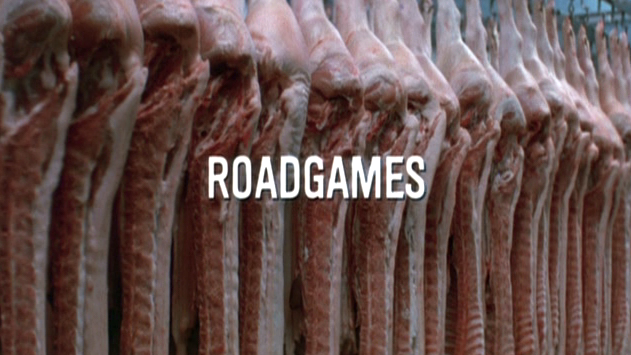
Early on in Roadgames, Patrick Quid (Stacey Keach), a lonesome truck driver presently cutting a path across Australia’s perilous and forbidding Nullarbor, is wasting away. The unmoving, apocalyptic expanse of pitiless landscape refracts the fatalistic hopelessness of his unceasing existence. The night before, he nearly missed an opportunity to pick up a nameless hitchhiker (Angie La Bozzetta) on the road and to preempt the man (Grant Page) who did. In the meantime, we’ve witnessed that man, face still unseen, emerge from a steamy shower and slowly creep up on the hitchhiker from behind as she plays a guitar, the camera cutting just at the moment he seems primed to strangle her with piano wire. Soon enough, Patrick will pass the hitchhiker on the road, mysteriously burying something in trash bags in the outback. Because we haven’t seen him, and because Quid only sort of wants to see what the man is up to via his binoculars, and because writer-director Richard Franklin was a protégé of the late Alfred Hitchcock, we can’t miss that we’re suddenly being strangled by a Rear Window riff.
Strangled, I wrote, and technically Roadgames concerns whether this strange other man did in fact kill the woman. But Roadgames is also Hitch liberated, set out on parole, adrift in the cosmic reflecting pool that is the open frontier of the Outback. Indeed, quicker than you can say “The Trouble with Harry,”or “Frenzy,” Roadgames reveals itself as a murderously ironic deflation of Hitch’s own icy brutality, a film that isn’t really interested in tightening around us but in suspending us over a void. While Brian De Palma was twisting Hitchcock’s voyeurism and autoerotic exploration of mastery and impotence into increasingly perverted, masochistic spaces in the early ‘80s, director Richard Franklin (who would next direct a sequel to Hitchcock’s seminally serpentine Psycho) unravels Hitch. Instead of tightening the vise, Roadgames fills the parched purgatory of the Outback with a mordant, off-kilter mischievousness, moving us from episode to episode as it proposes a kind of wry question: can a hang-out road movie, with its vague digressions and ambling waywardness, become the template for a claustrophobic thriller?
Latching onto Hitch’s self-amused self-mockery, Roadgames turns Hitch’s sardonic undercurrent of wry malevolence into a bone-dry comedy of missed communication, not so much between the people in the film but between the film and us. To that extent, Roadgames refers more to the game the film is playing with us than the game the characters play with each other. We aren’t privy to some conspiratorial match between one malevolent force and an unsuspecting everyman, one in which the character’s lack of knowledge exposes the void around us. In this case, the force is the film, and we are the everymen, unprepared for how disinterested this film is in thrilling us, how little it seems to want to use and abuse us and how comfortable it is drifting about. It seems to be doing everything in its path to not transform into the horror film it has generally been advertised as. It is paradoxically not by treating us as Hitchcockian playthings, puppets of a camera impresario, that the film is really having its way with us. Franklin twists the knife in by taking it out, letting the wound breathe and the entrails flail all over the ground.
Rosewood’s most salient character is a figure who seems to recognize that he has walked into Rosewood out of an entirely different film and that he wears a century of American cinematic lore on his back. He is a cowboy, a disciple of the wandering lifestyle that has its roots in the nebulous core of American life. He is an opaque drifter as archetypal as Shane or The Man with no Name or McCabe. Indeed, he isn’t even a man with no name. He is named Mann (Ving Rhames), a self-consciously iconographic masculine drifter who wears his self-composure and cultivated distance from history on his sleeve. His icy competence, ably displayed throughout the film, is tethered to his dispassionate reserve, his displacement from the forces of history that have shaped him and his aspiration to act as though he is beyond those forces even as he fully embodies an icon that itself constellates and coagulates the forces of American lore. He can help save the town of Rosewood, an African American oasis in the middle of Jim Crow Florida that he wanders into, for the same reason that he doesn’t want to. He has seen history weighted against his, and their, Blackness, and he has decided to abscond from history. Rosewood is the story of that man recognizing his own complicity with those historical forces. It is his attempt to redirect them in an insurgent, counter-historical assault.
This film’s obvious interest in Mann’s predicament, and its concern about that interest, is felt in every frame, not only because it is the film’s story but because it is its ontology, which is to say, its own being. That’s because Mann is also a cipher for writer-director John Singleton’s own combative, conflictual relationship to the Hollywood machine, to a force he both wants to claim as his and a fear that it neither wants him nor he it. In hoping to wrangle forces of history and structures around him like an itinerant, independent maverick, a man who is inside and outside the world, he weaponizes the forces of his oppression against them. Just as Mann tries to embody the American cowboy figure against itself and emerges unsure about its final value, Singleton plunders the American picture-book both to invest in the cultural markers of resistant Americanism and to imply that they may not actually be worth saving.
Singleton’s neo-Western style, reinterpreted and strip-mined for a radical poetics, finds a cipher in Mann, an ex-soldier who, like many other African Americans after the Great War, aspired to “close ranks” with white Americans, a showcase of American piety that quickly became a reckoning with the limits of sacrifice. For many returning African Americans, an aspirational hope of national togetherness quickly exposed feelings that their faith had been misplaced. Displays of support for the American spirit, they realized, had severe limits as a basis for a progressive politics or the facilitation of a joint racial venture of national development.
The war, then, was also a frontier of a kind, a space in which many African Americans reported experiencing the loosening of social structures and the inherited assumptions from their life in the U.S., seeing equal treatment for people of multiple races for the first time not in the U.S. armed forces, which were segregated, but in European society. W.E.B. Du Bois wrote that African Americans “returned from fighting” and they “returned fighting,” and the renewed vigor to fight oppression felt by many African Americans reflected a sensibility girded against forces of oppression at home and abroad.
Mann begins the film reflecting this ambivalence. He is certainly unqualified in his agency. He has no qualms about displaying his frustration with racism. But his solution is a retreat into a decidedly individual life, a turn to a world apart, one within the confines of himself. His frontier horizon is not to change the system, but to escape it. Yet Rosewood, the town he discovers, is also a frontier in another sense. Rather than easing us into the acceptable pathways of liberal American multiculturalism, as most Hollywood history films of its vintage did (and still do), Rosewood makes a claim on a region of Black history outside the harmonies of what Gunnar Myrdal called the “American creed.” The African American town of Rosewood is one in which the Black residents have fashioned a collective rejection of America. They’ve accepted the Faustian bargain of segregation as a slantwise path to possibility, if not progress.
Indeed, Rosewood travels in one of history’s forgotten trenches here, an unexpected, seemingly oxymoronic frontier not in the Wild West but in the Deep South, where the seeming fixity and entrenchment of history can belie odd occurrences and improbable freedoms born out of the trickster god that is history, a space in which people do not act according to code. It was in the backwoods of Florida that the first independent Black town in what would be the U.S. was founded near St. Augustine, when the area was still controlled by the Spanish. It was in Florida where Mary McLeod Bethune led an African American school for girls. Authors like Zora Neale Hurston would go on to parlay their life within modern independent Black communities in the South (Florida, in her case, as well) into inspired cultural commentary on the beauty and complexity of communal Blackness uncoupled from any claims on white society. The independent African American town of Rosewood, much like Mann’s recalcitrant refusal, suggests a renewed commitment not to invest all of one’s faith in the gradual evolution of American civic-national opportunity. Instead, the people of Rosewood look to make freedom and progress on their own terms, not by kindling with America’s hopes but by tracing America’s shadows. Focusing on their own space, the people of Rosewood suggest, might actually attack discrimination from a different front, wielding the admittedly back-stabbing weapon of segregation in a way that carves out some opportunity, however dubious, within it.
As with Mann’s masculine individualism and Singleton’s Hollywood filmmaking, this path is also an attempt to wield structures of inequality as best they could, to survive and work with the devil, to hold one’s own in the belly of the beast. History has been ambivalent about these paths, as, importantly, have Black radicals, many of whom, even in the 1920s and 1930s, felt that interracial class-based solidarity was the only viable way to pursue real, lasting change in a world of increasingly interconnected capital. A Black town would never escape the structures of racial inequality. It could only, much like Mann’s projected vision of cowboy charisma, hold them at bay.
Rosewood recognizes this problem. While it is distinctly a film about a Black community’s hard-won, albeit incomplete, security, Singleton’s text is also unusually attentive to the dynamics of white attitudes toward Jim Crow, attitudes that inevitably limit the possibilities afforded the Black characters when a lie stokes the simmering racial tensions into a full-blown holocaust. When the white residents of a nearby town run riot over the residents of Rosewood, raising it to the ground, they show little remorse for their actions. Those who did, Rosewood suggests, may be no better. In a grave, gravitational shot, one that seems at once to center the film, to hold it close to the ground, and to force it to confront its demons, Sheriff Walker (Michael Rooker), who has been nominally trying to hold the white mob at bay, raises up in the foreground, center-frame, suddenly blocking the massacre’s first black body being hung directly behind him. This isn’t the film’s plea to empathize with this white man, a wounded expression of the white man’s soul asserting moral and epistemic precedence over the Black man’s body. The film will not shy away from raw confrontation with the desecration of Black flesh throughout, but, in this image, the point is precisely that this white man’s feelings of guilt are taking up time and literal screen space over the actual story of the dead Black person. Walker constantly adopts a masquerade of unearned beneficence in the interest of making the story about him rather than acknowledging the grotesque brutality he has condoned and legitimized. He looks forward in the frame, apparently certain yet actually lost amidst the contradictions of history he wants to have move forward and stand still, whereas someone like Mann effaces himself and relies on reticence and ambivalence to radiate a quiet dignity and, when need be, a brutal charisma. It is Walker who cannot see the myopia of his missionary self-image, and the limits of his self-aggrandizing brand of brittle liberalism, not Singleton. He is, as it were, an allegory for a white Hollywood happy to array itself against white racism when it is played with a country accent and knotted into a rope but not when it is wielded by apparently more enlightened forces.
Singleton’s investment in and ambivalence about Hollywood cinema is apparent in nearly every frame of Rosewood, a film that sees him shun the position of a fervent acolyte of cultural inclusion to become, instead, an armored interpreter of America’s worth. He adopts the position of a volatile vagabond moving through Hollywood’s trenches, a renegade man wrestling with his own inner frustration, perhaps his own inner complicity, and turning those aspects of himself against the system that condones them. His film doesn’t fully escape this system. But that’s the point. This is tenuous stuff for a provisional history. Rosewood imagines no inexorable march of progress. It doesn’t lead us, Moses-like, into a better world. It submerges us into a conflictual netherworld in which the forces at play in the world are never stabilized, in which the niceties of civilizational advance are always potentially surface level masquerades for churning material tensions that have to be constantly maintained by implicit threats and by the possibility of more overt forms of violence.
Ever attentive to these knots of history, Singleton does exquisite compositional work throughout. His multi-sided, prismatic frames situate humans with and against each other, their surroundings, and the wider world. Unexpected truths are clarified to our eyes that are only dimly apparent to the characters themselves. Late in the film, for instance, John Wright (Jon Voight), a liberal white store owners and one of the few white residents of Rosewood, walks back home to his house, perhaps the only building left standing in town, when the camera attunes us, but not him, to the body of his Nlack employee in the foreground. She lies dead in the road because she couldn’t bear the thought of being harbored by the man who, although seemingly caring, nonetheless showed little compunction about asserting himself onto her sexually earlier.
The shot inverts the image of the sheriff rising above the dying black man. Here, an ambivalent, if finally more heroic, white man recedes into the distance, perhaps to a renewed conviction or perhaps to an unchanged moral compass, as the camera moves us to the position of displacing him with the body of a dead Black women who he has, metaphorically, turned his back on. This is a vastly more frustrated, frustrating, hesitant portrait of white liberalism than another Hollywood film, with its self-serving, artificially redemptive aura, would have managed. Wright is an essentially permissive man, open to the structures of liberal modernity, but he is also a capitalist who obviously feels good about himself for exhibiting a more enlightened disposition to the Black residents of the town. He is a vision of Janus-faced white American modernity, embodied most clearly in the film’s final climax, where he boards a confiscated train, a symbol of modernity, to Jacksonville, while the two Black men who are the film’s other heroes ride off together on horses, unable to participate in this story of modern progress and unwilling to forget the violence it was built on.
When Mann and Wright salute at the end of Rosewood, having worked together to save the Black children of the town, the film doesn’t necessarily understand this as a moment of commiserative honor. Their ex-military camaraderie, consummated in a shared salute, is as much a display of their confusion about their own commitment to any cause other than their own survival throughout the film. These are the two most liminal men in the film, neither with or apart from the Black town. Mann, for his part, has finally decided where he stands. Wright, conversely, seems to want to sit on the fence. He is a man who is theoretically likely to go back to his own ways, who disowns abject violence but is also accepting of structures of oppression insofar as it suits him. Rosewood is fully aware that his participation in the heroism of the climax may be pyrrhic, that Wright may go back to his old life, whereas Mann and Rosewood resident Sylvester (Don Cheadle) seem to be riding through a nation that has no safe place prepared for them.
It is Sylvester, then, who exhibits the film’s other revealing arc, the one which forces him neither to recognize his participation in a hopeful community nor to reckon with his complicity with an oppressive one but to acknowledge the decimation of his community and apprehend its continuance, albeit in a new form. A member of Rosewood, Sylvester is an embodiment of the educated Black landowning class who is emboldened and hesitant, who knows how to wield a veiled threat and stand up for his rights and to demur and mask his indiscretion without fully denying it. He is, with a piano or a gun, good with his hands. Yet he can only survive the film by hiding in his mother’s casket at a pivotal moment. He is nearly buried with the remains of the woman who reared him, played by Esther Rolle, whose most famous role, matriarch of a compassionate, fragile Black family for the modern urban world, reared many youths on intra-relationships in the Black community and the liminality of freedom even in the “progressive” North.That character, of course, was named Florida, an echo of the Black Southern past still alive in the North. Sylvester’s return at the end of the film is a metaphorical rebirth born out of a closeness to death, a near-demise that hammers a new man out of the currents of historical oppression and human agency. His is a life through which Singleton weighs the competing urges of staying and going, resisting and demurring, holding onto the possibilities etched out of an oppressive past and locating a new future.
With a fire and brimstone cinematic charge, Singleton creates a historical double-sided sword that exhumes the hellish currents of Jim Crow segregation as a lamentable, damned land that nonetheless radiates collective humane warmth and possibility forged in spite of the structures around it. While Mann has to relearn what it means to connect to a history and a community, Sylvester transmutes his inheritance into a new creation, not as something to myopically hold onto and curate but as material out of which something living might be created. This is perhaps Singleton’s vision for himself, as an interpreter of classic Hollywood luster and a griot harnessing cinema’s potential for coaxing out the collective, compositional relations tying humans and structures. He weaponizes the history of people in place, living and dying in a horrible world, bearing witness to an imperfect existence as they act with the feel for a better one insurgently pushing its way into the grime of the now.
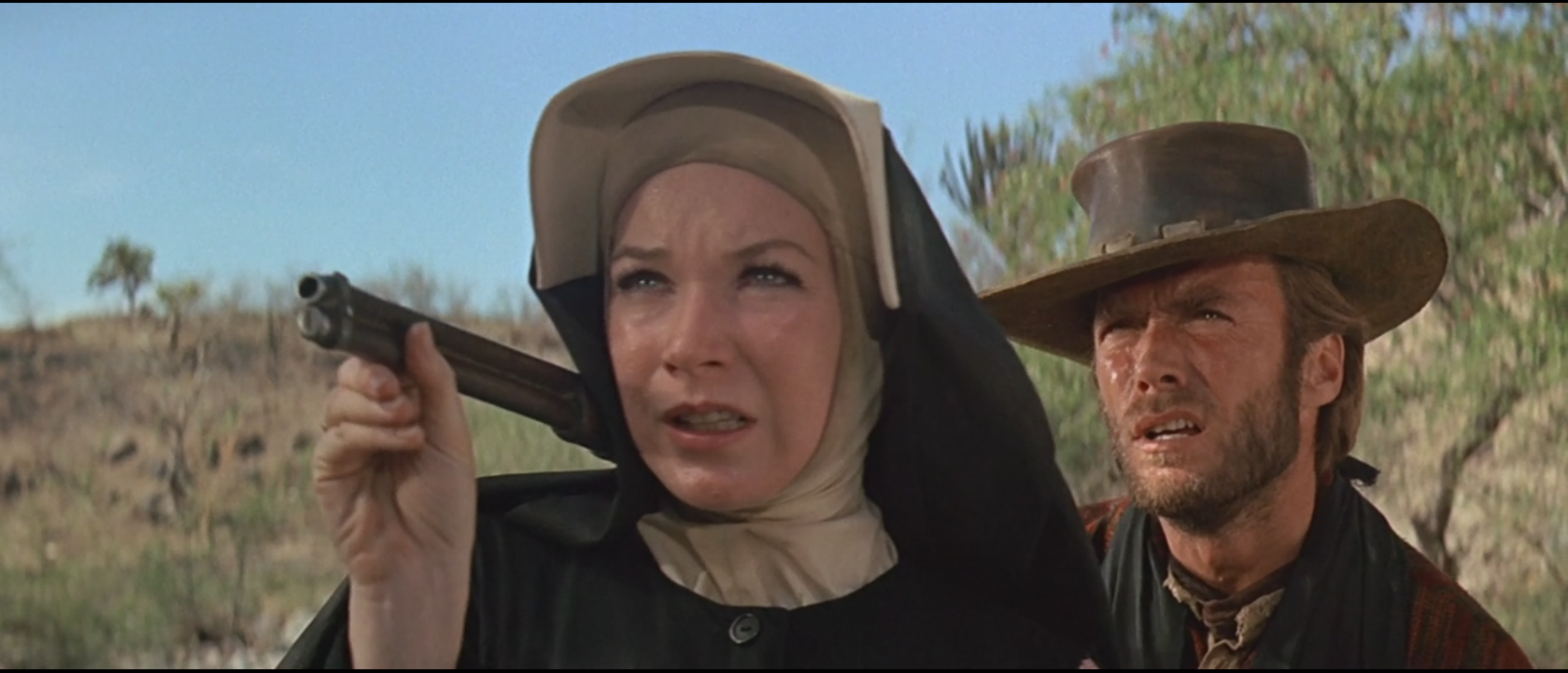
It is no secret that Clint Eastwood’s Hogan is very much the second “mule” in Two Mules for Sister Sara. For the most part, he’s a brute muscle whose soul is barely more tortured than a paper bag’s. If his taciturn efficiency and adaptable, survivable ethical relativism are treated with a tip of the hat by director Don Siegel, it is clearly Sister Sara’s unwavering moral vigilance that actually inspires the film. Without faith in a fundamental rightness, Hogan – and, implicitly, the archetypal wayward American with their hard, unmoving practicality – seems ready to drift in perpetuity, to suffer the fate of blind chance and mere circumstance that it mistakenly calls personal acumen. If Eastwood offers any contrapuntal critique of Sara’s spirited commitment and absolute belief in the first half of this film, a mid-film revelation that rounds out her character significantly implies that Sara is, finally, all that a human needs to be, and that Eastwood is just along for the ride. If, say, Robert Bresson sacralized the figure of the donkey in Au hasard Balthazar, creating an exalted mute witness lamenting humanity’s capacity for brutality, Siegel does the opposite. He profanes the human hero as little more than an ass.
This is an unusual thing for the signature Don Siegel-Clint-Eastwood pairing. Dirty Harry looms largest in their shared canon, and that film’s curdled vision of a thoroughly amoral world offers a backdrop for the film’s queasy call for a deregulated masculinity, unencumbered by government oversight, to personify that world’s awfulness, and, in doing so, hope to pacify it. But the men’s work together is far more slippery, and far more varied, than that epochal, and often grotesque, film suggests. The Beguiled, released between Dirty Harry and Two Mules, is a scorched-earth vision of American restlessness, implying that its rugged, creatively duplicitous loner protagonist is actually a cruel, conniving force, and that its coterie of Confederate women are really a menagerie of heated desires and malnourished souls in search of a pulse beneath their tenuous patina of harmony and ideology. And that’s not even mentioning Siegel’s earlier, non-Eastwood explorations like The Killers, which inverts the detective genre as two ruthless, reptilian assassins spend the entire film in search of an explanation for why their target was so willing to enter the wrong end of their gun.
Critical texts, certainly, but Siegel’s films are hairline fractures, not fissures. Little about his work announces itself as a critique of their zeitgeist, but in cutting into the world around him at odd angles, he can’t but fray its edges. Several of his key films take place in the modern-day West, and the most famous ones generally seem to affirm the Wild West’s mythology of ragged souls and recalcitrant spirits cleansing a tormented, unfinished land. The titular Dirty Harry, especially, clearly weaponizes anti-authoritarian dissidence and anarchic overflow as paradoxical tools of the state and harbingers of order, much like the Western cowboy beforehand. Yet Siegel and Eastwood’s actual Western is essentially a forgotten object, a self-consciously inconsequential text from a director and star working in a genre that, by any reasonable account, should have invited nothing less than a magnum opus. And, superficially at least, Two Mules leans fully into the signifiers of the baggage it carries, carting out Eastwood in his de rigueur poncho, scruff, cigar, and breathy husk, calling on the spirit of a man who had sacrificed his humanity to become an avatar of a set of ideas. How could this walking Western icon, working with his most important collaborator, not produce a masterpiece?
That’s the wrong question. A better one: why did they not seem to want to make a masterpiece? Siegel, in fact, was a journeyman by calling. He took his works as they came, and finishing one was an invitation to try on another, not an opening for an existential crisis. His vision of the West had little use for Sergio Leone’s abstract, metaphysical sense of bearing the weight of the genre’s accumulated trappings on his shoulders like an act of supreme penance. Two Mules for Sister Sara, comparatively, only initially seems like a brutal broadside of a Western, a film with a big idea about the genre that houses it. Within fifteen minutes, though, it seems like little more than a lark. An hour in, it has emerged as a wily, ornery, very ground-level thing, a merging of critique and nonsense, a film so seemingly superficial, and so obviously pretending to be serious, that we threaten to miss how serious it really is. It’s a veritable wolf in sheep’s clothing in wolf’s clothing.
The opening half-hour of Charley Varrick is a distillation of American ennui, a portrait of domestic pacification as percolating explosion. The first minute essays a romantic pastoralism, a post-Great Society Americana that could be the fruit of FDR’s Four Freedoms, a Norman Rockwell painting given motion and flesh. This is a Southwestern town that has adapted happily to mid-century modernity’s housekeeping. When a couple on the wrong side of middle age drive up to a bank, discussing an impending deposit, the West has been thoroughly commodified and expectedly tamed.
Until, that is, suddenly, within a swivel, two phantasms etherealize out of nowhere, joining the middle-aged man in a vitriolic bank robbery. The bucolic vision of America has been punctured, and we’ve been moved into an entirely different film, an imminently thunderous eruption of savage brutality that also reveals a brittle, banged-up America in search of an exit from itself.
A different film, I wrote, but Charley Varrick is also uniquely attentive to the continuum of the two worlds. The incendiary eruption will soon frost over into a slow, laconic crawl of an escape that raises the stakes by playing it cool. Varrick is a film about men whose capacity for violence has been formalized into the structure of a quotidian society, a remarkable film about the unremarkable. In three separate, interlocking stories that meticulously and suggestively interweave, director Don Siegel and co-writers Dean Riesner and Howard Rodman (adapting John H. Reese’s The Looters) craft three versions of post-‘60s masculinity that are circumstantially at odds with one another, but essentially overlapping in their mutual adriftness.
Walter Matthau’s titular Charley Varrick, ostensibly the subject of the film, is a casual criminal, a seemingly milquetoast crop-duster turned former stuntman turned criminal. In the passage from mid-century agrarian authenticity and sincerity to curious risk-taker in a world governed by confusion and subterfuge to outsider criminality weaponizing that chance-y chicanery, the film marks Varrick as a casualty of deindustrialization who is also a prophet of reinvention, able to mobilize his skills for illicit purposes to inhabit the cracks of a failing modernity. In a fallen world, he is a profane survivor.
Joe Don Baker’s Molly is a modern-day cowboy turned hitman, a laconic and self-amused individualist who wields the surface-features of Wild West authenticity like a corrupt and opaque moral code. He’s an old-school mercenary who fancies himself a mercenary whose only recourse to maintaining that vision of self is as an parasitic underling for the underbelly of legitimate business.
Most interesting of all, though, is John Vernon’s Maynard Boyle, a bank higher-up who uses his position to launder money for the mob, and who sicks Molly on Varrick when the bank they rob turns out to have an excess of mafia money lying in wait, undocumented, within it. In the film’s most inspired scene, a wonderful conversation near a cow field radiating with post-‘60s anxiety, both men doing the talking are speaking genuinely not about the waywardness of their souls but about the forces they find themselves prey to and their surprising comfort with their predators. Each man, in their way, seems essentially content with their place in the world, but they also recognize that this acceptance requires a myopia they have made peace with.
The inner-workings of these men, their capacity for violence and care, is genuine, and it only coexists in America with the placid doldrums of an only apparently comfortable existence because we’ve learned to accept this comfort in ours. Or to expect only the wrong kind of volcanic interruption. In an earlier moment, Vernon is making an inquiry with potentially deadly consequences while conversing with a young girl about her cat’s name. In another film, the girl’s presence would infuse the film with a superficial aura of suspense and dissonance. But there’s no guile here. It would be reducing the film to worry about this girl’s fate. Vernon’s managerial passivity has no interest in harming her. That’s not his style.
Nor is it late capitalism’s. While the frame seemingly binarizes the tranquil foreground with the girl and the dormant violence of the parents who know more of the man’s intentions in the background, the shot ultimately suggests a horrifying harmony. She will be fine, because the force of violence doesn’t suddenly interrupt anymore, but none of them will, because modernity’s bargain that allows her to be fine is an amicable agreement between domesticity and cruelty to suffuse the violence around them, at a much lower temperature, in the bones of the film itself. When startling violence does erupt, it is simply part of the tapestry of a world that relegates it to the margins, something the film evokes in one shot that depicts a suicide in a frame within a frame. A door closes on one man in a story that has moved beyond him, and which he doesn’t feel like continuing on in.
A not-so-different modernity, then, but it is, perhaps, a different Don Siegel. Most famous for Invasion of the Body Snatchers, apolitically political in a way that arguably evaporates its critique of conformity into a display of it, and, Dirty Harry, his quasi-fascist celebration of insular American individualism threatened by the forces of modernity, Charley Varrick is a vision of a different caliber. Rather than embattled, complacent suburbia pitifully susceptible to (potentially its own) insurgent bodies, or a modern-day resurgence of Wild West raggedness as a battleground for the fate of the American soul against nihilistic forces of social disintegration, Varrick exists in a post-apocalyptic West, an irradiated fallout zone of the late ‘60s in which the New Mexico landscape is a bleak backdrop for a narrative of social ennui. Like Dirty Harry, this film suggests a critique of progress’s potential arrogance, but unlike Harry, it doesn’t lionize untempered individualism as the privileged arbiter to put it back in its place.
If, like Dirty Harry, this is essentially a modern-day Western, it’s also a kind of film noir in that it depicts people getting involved in more than they wanted to bite off, entangling themselves and burrowing deeper and deeper into systems that extend beyond their mental horizons, and hoping that the most negligible of objects doesn’t act as a front for a more threatening one. Guns hide in purses, seemingly peering through objects, revealing a hidden world of pragmatic malevolence beneath the veneer of Americana. What interests Siegel is the minutiae of how this apparent subterfuge interacts with the everyday world, how the two are often one in the same. When Molly accepts his contract in the backrooms of a Chinese restaurant, Siegel takes note of the cans of food lined up like either day players in a more generous story of human survival or the bars of a prison, markers of the restaurant’s usual functioning not ready to be forgotten in the conflict that centers this film’s “narrative.” When Varrick has to evacuate his trailer-house suddenly, the tell-tale sign of his absconding is his dairy products laid out on his landlords doorstep in a similar array, not wanting it to go to waste because his act of sheer survival has gotten in the way of them being eaten, which is to say, of him surviving.
A simple, seemingly meaningless reference, unlocks so much about the fifteen year gulf between Varrick and the cool-cucumber ‘50s films it calls back to. When Varrick’s lover, apparently trying to have sex facing in every direction, says “you still owe me south by southwest,” Siegel’s film registers the amused itch of Hitch’s North by Northwest, a joke corroborated given Varrick’s previous life as a stunt pilot in a crop-dusting plane. This previous job of course nods to one of the classic cinematic suspense sequences in Hitch’s wry, deflationary study of mid-century masculinity and American cynicism. In that film, the advertising man is exposed as little more than a legitimized spy, a modern-day magician of shifting identity navigating tenuous surfaces above an empty center. The crop duster scene is magnificent, but the sequence’s sharpest moment involves the joke that a random person one meets in the middle of nowhere, on the side of the road, in the essentialized heartland of Americana, really could be a threatening revelation or a lackey of a secret conspiracy, that a stranger with no interest in you could be a missed connection to a more beautiful life or a vulture zeroing in on your throat. That film suggests that the only appropriate response to this quintessentially modernist situation is a kind of amoral ironism, a necessary distance held from the world that allows you to wear it lightly, and laugh it with gusto. Fifteen years later, in this more cynical film, one that wears the demise of “the American Century” on its sleeves, Varrick is the pilot, or rather, the ex-pilot, having gone straight by, paradoxically, turning to crime, by bending himself to the world of jagged edges and twisted irons to the point where the only way to maintain a space apart, a realm of private authenticity amidst fluctuating and devious surfaces, is not to glide with it but to sever oneself from it completely. This is a fallen world, and the only way to survive in this America is to seek transcendence through complete refutation of the social, to wander the drifter’s path of Emersonian self-exploration. This is an America in which a collective redemption has been deemed impossible.
This is, then, a work in which becoming something new is both as simple, and as impossible, as just getting by. The film’s finale affirms the American West’s historical promise of self-reinvention, as others have commented, but it is a decidedly melancholic reconsideration of selfhood, a deeply thin version of liberation. As Varrick leaves his old persona behind, his vehicle burns with a pathos as evocative as the lost childhood sled of Charles Foster Kane. Unlike Kane, though, Varrick is not deluding himself. He’s a post-modern ironist who knows that his survival is predicated on little more than recognizing how insignificant he is, or how insignificant he can appear. His final plan involves one last act of deceit that returns him to his stunt pilot days. He wins not by succeeding as a lone wolf but by pretending to be a failure, and pretending to be a friend, all from a distance.
The point is that he really is both of these things, a friend to capitalism because he is a failure at overcoming it, but he knows how to manipulate this status to his own gain. While Molly acts the part of an acolyte of old-school Hollywood renegades bucking the system and playing by their own rules, Varrick intuits that he is really in cahoots with the men who oppose him, that the only thing he can do is manipulate their rules, their perception, to his momentary benefit. He understands that they’re all basically fronts in the death drive of American capitalism. Tellingly, the film’s conclusion stages his resurgence by cashing in on his apparent nothingness, adding several more wrecks carted out from his past to a junkyard of American detritus. His cunning is appreciated, but it does not signal a moral victory. Rather, it unsettles the archetypes Siegel is more typically thought to celebrate. What sort of heroism is Varrick’s, and why does it both demand the resurrection of his former self and necessitate its immolation? Could heroism survive in a world where the difference between a fast and slow demise is knowing when to turn being upside down in a crashed plane into a means of self-effacement rather than self-delusion? In Varrick’s phenomenal, scorched-earth finale, the myth of the American bootstrapper-reinventor is turned, literally, upside down and saved, temporarily and tenuously, only because it recognizes how much figurative, and literal, weight is pressing down upon it.



 The Long Take