
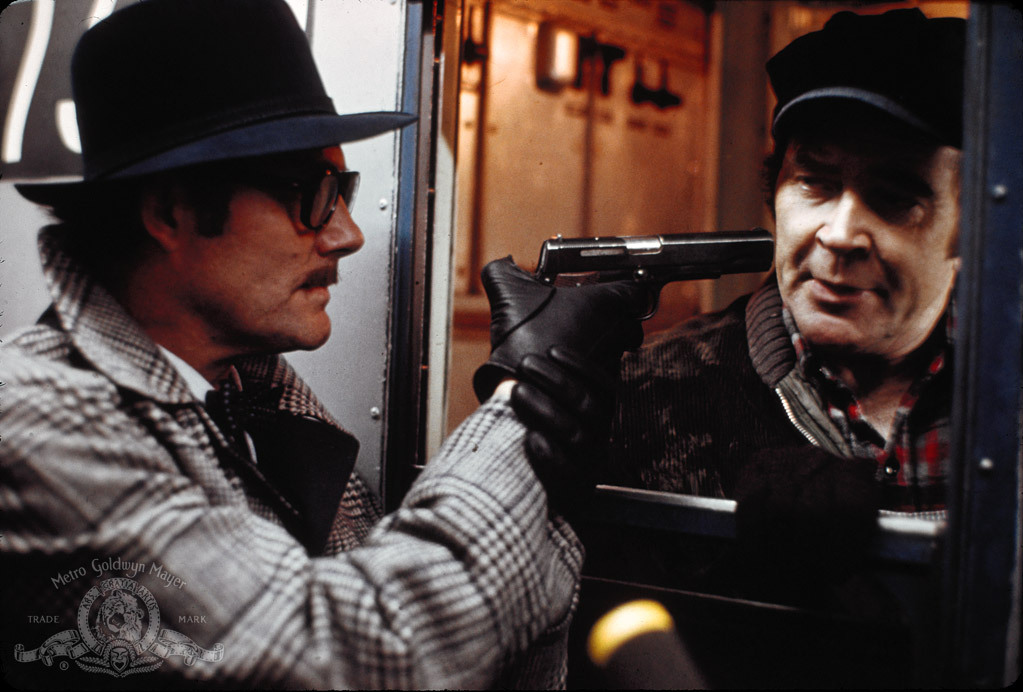
We begin in motion, a man in a self-consciously unconscious suit running into a subway station, as though late for work. He is late for work. He’s about to hold a subway car hostage, but he walks like a recently divorced dentist. He seems less like a man worried he will get caught for robbing several million than a guy concerned about whether his coworker will waste fifteen minutes of his time at the watercooler. The Taking of Pelham 123 is a remarkably workaday vision of New York City, a schlub’s paradise. It feels trapped in a post-‘60s hangover, but what it sees isn’t a nihilistic failure but a run-of-the-mill existence. New York City, here, is a machine that hasn’t defaulted on a foregone promise but that was too busy to even recognize it when it was there. When the conductor first recognizes that his train is being stolen, he can only respond “you’re taking my train?,” and it’s more like he’s confused why anyone would want to bother with such a thing, or how it could be an interesting plot for a movie. When the police get involved, you half expect the hostage takers to respond “hey, I’m stealing here!”
Yet this is a hell of a movie, mostly because it doesn’t really treat any of this as a hell of thing. Nothing in Taking of Pelham 123 insists on its self-importance. It treats commandeering a subway train as another feature of the day, an incident roughly as interesting or as improbable as the nonchalant tour that Walter Mattheau’s Lt. Zachary Garber gives for Japanese businessmen at the beginning of the film. Everyone is a worker, and the film poeticizes what it means to be workmanlike. Director Joseph Sargent was avowedly not a great director, but his journeyman sensibility is amazingly appropriate in this context, a banal, quotidian vision for a monotonous world.
Sargent’s somewhat flat style thoroughly, elegantly deflates the entire film. He brings the kind of vulgar poetry that Don Siegel or Robert Aldrich would have brought to the proceedings, etching a semi-naturalist vision of crude, ragged world but distinctly not an expressionistic one. This is the city not as a crestfallen hellscape or a byzantine labyrinth of bureaucratic overreach or a carnivalesque playhouse but a simple fact, one that keeps you moving through it so expediently that you don’t bother to notice how it is limiting your consciousness. This is not a camera that accesses an inner life beneath the surface but one that observes how depleted inner life has become. When the pivotal moment comes and the strains of the story come together, Sargent frames the crisis not as an interruption but a continuum. In an exquisite panorama of a weathered transit station, Mattheau is giving his tour, mockingly bullshitting his temporary hostage audience, before he learns about the other, more severe hostage crisis perpetrated by the other, equally disgruntled, disaffected men. What, the film quietly posits, does it mean that these two things are less different than we want them to be, or that we no longer want them to be that different in the first place?
For this reason, the initiation of the robbery doesn’t tense the film. It may even slacken it. One subway employee, recently taken hostage, has time to laconically remark “I didn’t know these things went backwards” when the train is put in reverse, to which the head conspirator remarks “now you know.” After uncoupling the head car, the conductor is asked to walk back into the subway tunnel to tell all the other passengers to head back to the nearest subway entrance. He can only bemusedly remind the conspirator that they will likely be annoyed. People usually don’t like to be bothered, and the conductor didn’t sign up for this, at least not in this economy. That’s certainly true of the mayor, who can’t wait to get back to his shows when he hears about the events occurring underground. This one, the life-or-death hostage situation, feels like a lesser theater, or just a commercial for a city too busy to notice, or too blasé to care.
Interestingly, the film doesn’t understand the obviously selfish mayor as uniquely non-committal, nor does it really judge anyone for it. Even the main hostage taker, Mr. Blue (Robert Shaw), spends his time filling out crosswords as though he’s taking a lunch break form his day job. This is almost an amoral movie, one in which the director of the subway system remarks “I’m trying to run a city not a goddamn democracy” and “what do they expect for 35 cents? To live forever.” The film is less interested in disagreeing with him than in observing the way of life that facilitates that line of inquiry. The question of whether the mayor will approve the ransom doesn’t particularly register in the film as an existential conundrum. He’ll do it, because it helps his bottom-line to not have a boatload of dead train passengers on his watch. A more silently disturbing gesture than Amity Island in Jaws one year later – where the mayor is a man who does the wrong thing for the wrong reason – New York seems to function in this story because the mayor, and everyone, does the right thing for the wrong reason. They want the crisis to be resolved because its existence makes them have to work harder.
In lieu of a moral universe, what the film instead explores is the minutiae of what it means to get the ransom money across the city, to count it, to wrap it, to account for it. With the minutiae of a Frederick Wiseman documentary or an early silent city symphony film, albeit without the current of Romantic spiritual energy and interpersonal sublimity implicitly being channeled by the filmmaking, Taking asks how the city functions, and what essential nature facilitates that functioning. “How many times you gotta wet your thumb to count a million bucks?,” one character asks. How much pressure can the machine take before it buckles? What is human effort? What is machine? Why is this machine even worth preserving? This ransom demand is a blip in this city’s life, but the city has to work to conclude it, and it depends on hands and feet complying and acting in motion. What, as the old saying goes, will fascists do if the trains can’t be kept on time?
Throughout, the script by Peter Stone (adapted from a novel by Morton Freedgood, which I have not read), is pungently attentive to the dynamics of interest and boredom, of watching and acting. When the hostage takers speculate on who they might kill first if their demands aren’t met, one asks “Have you decided which one it’s going to be?,” and the leader responds “Does that make any difference?” These criminals have invested in the same material economy as everyone else around them, working not as a grotesque aberration of modernity but as an advance guard of modernity’s fundamental crime of turning everyone into statistical regularities, essentially irrelevant and entirely interchangeable as individuals. Even the passengers don’t display much fear, and one of the most invested displays of intrigue comes from a passenger who is curious how much money the culprits are getting, simply because it’s interesting to know how much their lives are worth at that moment. The number might very well be higher than in their entire lives, at least according to the macrological scales and societal metrics that determine value, and that apparently arbitrate at least some of the internal self-evaluation of its victims.
Watching can also take on a theatrical veneer in the film, not only a political calculus but an aesthetic economy in which he desire to break from one’s routine, or the confusion about what one’s routine is, facilitates both feelings of beauty and anxiety. In a pivotal moment, one cop points his finger at the men on the train, pantomiming a gun when, suddenly, a sniper bullet erupts from behind. We didn’t even know that these other guns were pointed at the conspirators, nor do we learn why someone fired, or who did. They’re also interchangeable cogs, and they’re probably just bored, tired of observing the drama from afar, struggling to figure out what it means to be participants in an enervating city-wide theater. Some of them probably treat it like a playful escapade, as do the two cops, who act like Abbott and Costello, or Rosencrantz and Guildenstern, while delivering the money, who feel like they’re “walking into the fucking OK Corral,” summoning the specter of history, or a film they saw of it. They’re suffering from a generic mismatch, finding themselves drawn to slapstick nervousness even when they recognize that they’re suddenly knee-deep in a modern Western stand-off. They are asked to play a very particular part, just like everyone else, and not to fuck up their allocated potential. The real problem with the most troublesome of the four armed assailants, Mr. Grey (Hector Elizonda), is that he treats all this as an event rather than a routine within a structure. For him, it’s something to be excited about, something that allows him to act out, or to improvise, to go off-script.
His boss doesn’t like that, but, in his way Mr. Grey is playing out, in miniature, the very disturbance at the heart of the film, the means by which a smooth system becomes a frayed rope. What the film understands is that the real problem with the robbery for the people in power – indeed for almost everyone involved – is that it is a kind of interruption, a bump in their ritualistic road. Subways are the vascular system of modernity, a flexible scaffold that, to prove modernity’s worth, must feel effortless. To hijack a train is to render the apparently untroubled flow of modernity into a breakable object, a negotiable construction. Readers, this film may be the New York movie to end all New York movies, a film that understands the machinery of modernity as a vicious inheritance, a brutal womb, and casually indifferent mold. Compare to the following year’s more esteemed (and justifiably wonderful) Dog Day Afternoon, in which a bank robbery becomes the obsession of a city’s populace, summoning a theater-going audience for a momentary movie of decidedly epic proportions. There, society’s frustration is laid bare, and people worship the robbers as ciphers for their frustration, momentary prophets of an undying irritation temporarily channeling social unrest into living aesthetic iconography. Pelham isn’t even sure if people would bother to recognize that their frustration could be so channeled, that there is any other way of doing things. The robbery signifies nothing. It isn’t a catastrophic failure, an unholy revelation of the city’s necrotic inner core. It’s just business as usual.
The film even has a little fun with the potential that this is all a metaphor. One clever graphic match connects the money being counted for the men to the tissues on the sick mayor’s floor. Green money might be the city’s phlegm spewed out, excreted to exorcise a demon without really reckoning with its causes. While we might make nothing of it, it’s a sneeze that eventually does in Mr. Green (Martin Balsam), the lone conspirator to initially escape the conflict. When Garber investigates Mr. Green’s apartment, having noted that one of the men must have been a recently fired train operator, he recognizes Green just as he is leaving by the tell-tale sign of his sneeze. Throughout the day, Garber had been unthinkingly responding “gesundheit” to one of the sneezing hostage takers on the phone, and he catches himself in the act of repeating the gesundheit to this now unmasked culprit. Mr. Green has tried as hard as he can to avoid detection, but the tell-tale sign of the body doesn’t lie. The sickness inside exposes the façade outside.
Or does it? Garber also has to catch himself in the act of failing to recognize that he’s just said “gesundheit” to this apparently unrelated man in his apartment. That is, Garber bothered to notice the sneeze in the first place, and cared enough to say gesundheit to someone on the other end of a phone, even though they were robbing a train. This is, arguably, the one generous act committed in the entire film, and his generosity, and his attentiveness to that generosity, allows him to catch the proverbial bad guy. Garber, and only Garber, has a bit more interest in how this is functioning, rather than that it is functioning. In this universe, a moral core is simply being a bit more curious, hesitating to question one’s surroundings.
Indeed, it is actually Green’s un-hesitance, his failure to maintain his humility, that does him in. Throughout the film, in a gesture the film never has to make explicit, Green is Garber’s negative mirror image, the only culprit who seems to worry they might actually kill any of the hostages, who seems to hesitate within the position he adopts, to find some wiggle room within his type. It is only when he loses this questioning curiosity, and erupts self-confidently at Garber in his final minutes – when he acts like a stereotype of an affronted New Yorker – that he delays Garber’s leave enough to make space for his evidentiary sneeze.
But the film seems to suggest that such curiosity is in short supply in the machine-work of city life. Garber doesn’t ever actually seem to “think” about saying gesundheit. He says it to Green in person the same way he’d said it on the phone, as a formality programmed into him, a kind of automatic courtesy granted to ease the flow of the day. When the final man is felled by a sneeze, Garber’s face, a truly stunning, acerbic, lacerating, final freeze frame for the film, exposes just how empty this has always been. This is an image of a man who isn’t really thrilled he’s done the city a duty. He’s just glad that he finally gets to go home, another gear who can go get some rest before doing the same thing the next day.
Score: 10/10
 The Long Take