Despite its sterling pedigree, Intruder is an unjustly forgotten late ‘80s slasher, the unfortunate victim of a genre in the process of cannibalizing itself to death, even if the entrails produced something as deliciously necrotic as this. A kill crazy picture that is both too straightforward to qualify as experimental and too grimy, strange, and exploratory to qualify as pure trash, it’s the Skid Row of slashers, a terrific product that is mostly content to color within the lines but does so with too much elan and energy to write off easily. Despite the slippery, nervy direction and sinister, potent script by Scott Spiegel, who co-wrote Evil Dead II and clearly learned a thing from Sam Raimi (who appears here in a small role), and the co-production by Spiegel and Laurence Bender, who would soon translate this film’s playfully macabre spirit into producing Reservoir Dogs and then several later Tarantino films, Intruder has not lingered in society’s imaginary at all.
That’s the world’s loss, but it also makes the film all the more conniving and conspiratorial, a cinematic wolf in sheep’s clothing. Despite lacking the obviously labored-over dialogue and post-modern narrative chicanery of Bender’s future productions, Intruder nails the nervous exhilaration of Tarantino’s first film. While it lacks anything like a gimmick or a concept worth a damn, indeed while it may seem to lack even a film on paper, Intruder radiates euphorically disreputable, gloriously low-concept energy. It’s sloppy and basically empty on the surface, and while that diagnosis is technically correct, the film knows how to sneak up on you while you’re overlooking it. It’s a shiv of a movie pretending to be a meat cleaver.
And shiv it does, even before the cleaving starts. Even before the nominal killer enters the late-night supermarket that serves as the film’s combination morgue and display case, this is phenomenal stuff. Spiegel introduces us to the supermarket on a trolley of the damned, the camera being carted beyond its control into an open-air consumerist prison. The camera then cuts to the outside world, presented as a void that sequesters the supermarket off as a penitentiary that these workers must also make into a home. Or, at least, into a refuge that becomes a family, one presented with a surprisingly humanistic and empathetic eye by a script whose early scenes ease into an unexpectedly naturalistic mode. This is a script that exhibits real compassion for this impromptu community, and a camera that displays real compassion for the lonely surrealism of the night shift as it splits the difference between a groggy dream and a wayward, late-capitalist nightmare.
It’s kind of exquisite, and despite all the viscera, the word that comes to mind is exquisite. Intruder is an exceptional formal object. Off-kilter angles abound, revealing and obscuring, not simply because they unsettle the film’s rhythms but because they seem to genuinely want to explore a place they can’t get a hold on. Intruder never insists on itself – it never demands that we notice that it has anything on its mind – but the cumulative effect of the unexpected images is a mood of workaday torpor and managerial surveillance. In an early moment, the protagonist’s vaguely disreputable ex-boyfriend Craig (David Byrnes) breaks into the supermarket to threaten her. But the film understands him to be part of a violent scenery, not the invasive species. A later shot of the whole supermarket, with someone looking on from the outside before disappearing into the night like so many fish in an unforgiving aquarium, suggests that the characters are trapped by the very system that employs them.
When Craig returns again, he stares longingly, brutally from the outside window, a specter of masculine malcontent. But the camera seems to be more interested in a magazine of Sting looking exceedingly demonic just behind our protagonist Jennifer (Elizabeth Cox). Rather than obsessing over and cowering before the lone killer, the film attends to and exposes a whole socio-cultural assemblage watching, stalking, leering around the characters, listening for every breath the workers might take. It is the infrastructure around them that contains them and circumscribes their freedom, that threatens at every moment to turn an object of desire or lust into a beacon of punishment. An early camera angle, looking up through the innards of a telephone out of a circular hole at the worker making a call, suggests a camera or a gun, a weapon capable of objectifying or killing, a violent force from which no one is exempt. Soon after, a similar shot from within a trashcan quietly underscores the sadness of the supermarket’s owner vaguely wrestling with the detritus of a friendship/partnership he can no longer maintain, one more casualty of the cruel economics of his business practice and the system that circumscribes it.
What does one do in a situation like this? When Sam Raimi’s character, an especially aloof worker who exists in an ironic stupor, tells his friend, played by real-life brother Ted, that he’s “lost your job Joe” – the film begins with the workers being informed that they are to be let go soon enough – the latter doesn’t even hear it. There’s a droll undercurrent of working-class anomie throughout, as when a police officer offers his card to the workers and then hands them the wrong one, before being woefully unable to open a door that doesn’t seem to want these doldrums to communicate. After the first kill, which is suggestively glimpsed in a knife’s reflection, we cut back to Ted, always none-the-wiser, slicing a watermelon in half. Capitalism, it seems, already considers these people dead, and they are too tired, or too pulverized into their everyday rhythms, to pay attention.
Intruder balances on the knife’s edge, maintaining an exceptionally biting critique of capitalist malignancy with a compassionate, knowing awareness of everyday working-class existence, all smeared with a wry, mischievous undercurrent of vicious comedy. Even the seemingly inert opening, nominally devoid of event, becomes a beautifully staged aria of rhythms and movements, a sheer ballet of editing as characters go about their night, wandering the aisles, observing each other, trying to pass the time, thinking (or not thinking) about what they’re going to do next, not dying tonight but living nothing more than what Giorgio Agamben called a bare life. Portions of this film genuinely evoke the rhythms of a neorealist tone poem, an improvisatory aggregation of moments, an assortment of glances, as the characters go about a slow death that is about to be rapidly sped up.
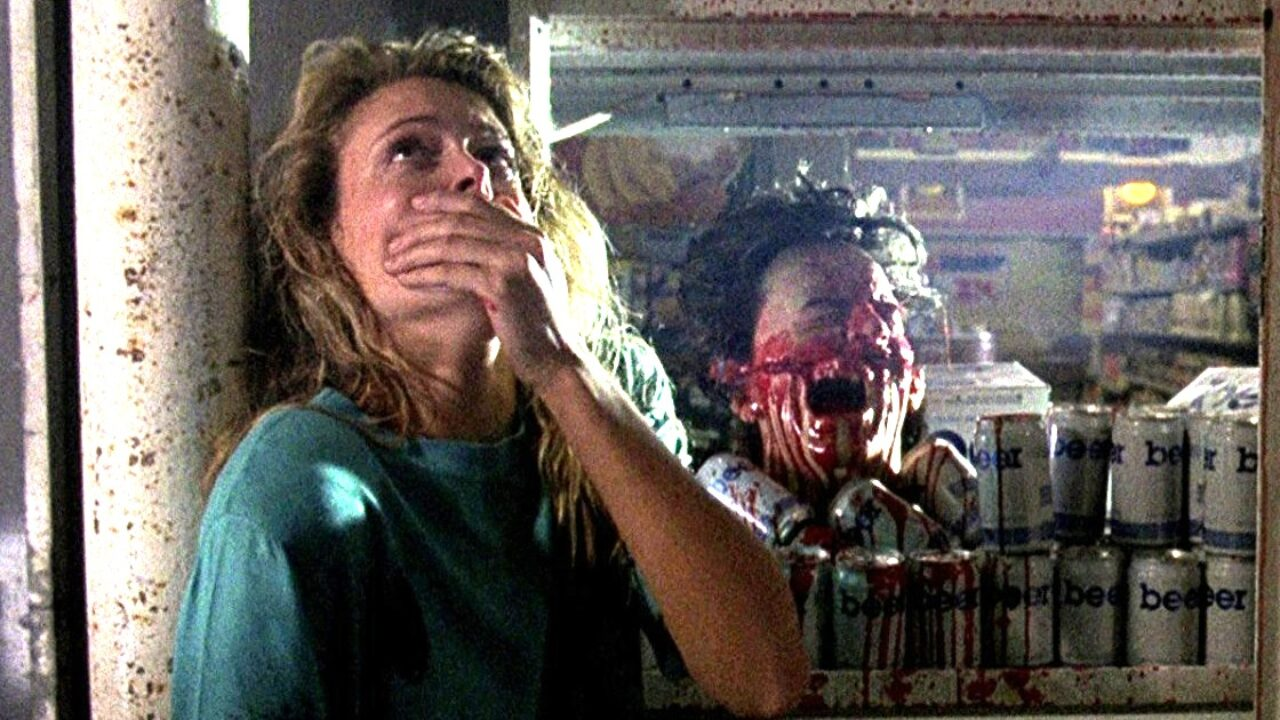
As they go about their business, the film tacitly undercuts the extremity of the deaths by figuring them as just part of the job. In a deliriously playful moment, we follow a knife back and forth as one character chops down on some vegetables before, without even knowing it, we’ve switched knives into one entering his head. By following the knife’s arc with such workaday ease, the film indicates the slippery slope between the everyday, condoned, repetitive violence of life itself and the more “extreme” violence we theoretically consider singularly reprehensible. In an earlier death, one man’s finger slides onto the adding machine he’s spent his life abstracting flesh and blood into so many numbers, devitalizing people with a far crueler disinterest than the actual killer seems to do. Another scene stages a character who thinks he’s talking to his friend, who we see looking much like he always does, stoned and depleted, full of dehumanizing but not debilitating ennui, without the talker knowing that just below frame a knife protrudes from his silent friend’s stomach. One character is hung on a hook like so much meat, blending all too easily into the background, and he himself nearly misses picking out a severed eyeball from his olive jar. In a runner, a bloody hand increasingly turns a lobster tank into the crimson waiting room it always was. Death and the death in life of capitalism exist on a murderously razor-thin edge here.
Nor do the workers necessarily have it in them to bond together to resist this death, or this life. When we later see one of them peeking at two lovers while the apparent killer stares at him in the same shot, Spiegel weaponizes his camera’s lens and some phenomenally suggestive depth-of-field modulation to alter who is doing the searching, and what their target is. But in making these characters so expendable, Intruder is fighting against a system that has already rendered them inessential. So much of Intruder is so feverishly attuned to the everyday violence we ignore or relegate to our periphery, the normalized destruction that takes on new resonance given the film’s defamiliarizing gestures, the facade of pleasant minutiae suddenly undone. In a gesture literalized near the end, the film chops these characters to pieces only to expose how their world was always-already a violent patchwork quilt of assembled pieces ready to be torn apart at the seams.
Score: 8/10
 The Long Take