
You can feel Day of the Outlaw grappling with itself from the first, forlorn shot of a snow-struck limbo as two men silently wander from left to right. Unlike many classic oaters, they don’t seem to order the screen at their command as virile archetypes of stoic masculine reticence. Rather, they seem like they seem to ride less above the land, superior to it, as atop it, at odds with it. The snowbound setting can’t but bring to mind McCabe & Ms. Miller, Robert Altman’s amazing, soul-shattering cosmic moan where the West is a demonic ground and a tragic, aching slow-motion catastrophe. In the intervening years, the self-critical version of the genre has increasingly felt like a parody of itself, an arbitrarily nihilistic approximation of depth rather than a genuinely exploratory attempt to inhabit the genre generously, from within its terms, to critique it.
While many of these subsequent Westerns self-consciously explore the genre’s violent origins out of a kind of kind of half-hearted expectation, Day of the Outlaw is a legitimate, forgotten premonition of McCabe:a Western that felt like it was earnestly exploring the American frontier not out of a forced expectation or a conscious desire to interrogate established rules but through the violent indecision of inhabiting the genre so thoroughly that it can’t but grapple with its contradictions and feel out the limits it may not actually want to trespass on. There’s no mission statement with Day of the Outlaw other than a general desire to give us more than we bargained for, to take a set of themes we expect the film to ease into and instead to malform them by recognizing their own potential for disruptive complexity. Day of the Outlaw is a film continually in the process of discovering a radical otherness within itself.
Rather than a harmonious synthesis as a microcosm of the American spirit, Day of the Outlaw is a deceptively tangled network of nervous tissue, shifting between several morally perplexing narratives compounded by their sheer refusal to stay separately cordoned off into their own films. Our protagonist, insofar as that term is useful in a film like this, is Blaise Starrett (Robert Ryan), a rancher who acts like a forbidding lawman and who is presently in conflict with homesteader Hal Crane (Alan Marshal), who is introduced as a potentially domineering antagonist, a man so frightening he can only be spoken about and never seen. Except that, although he is married to Helen (Tina Louise), who obviously shares a love for Blaise that is very much requited, we finally meet Crane, and he seems much more humane than Starett. While we’ve been quietly building Starett up as our hero, the rancher, for all intents and purposes, increasingly comes off like the film’s heel, a belligerent and somewhat narcissistic egotist played by Ryan not as a bundle of contradictions or a good man in an unfortunate situation but as a genuinely cruel settler coarsened by the harsh power dynamics of frontier living who, by this point, takes a kind of self-amused delight in being indifferent to other people.
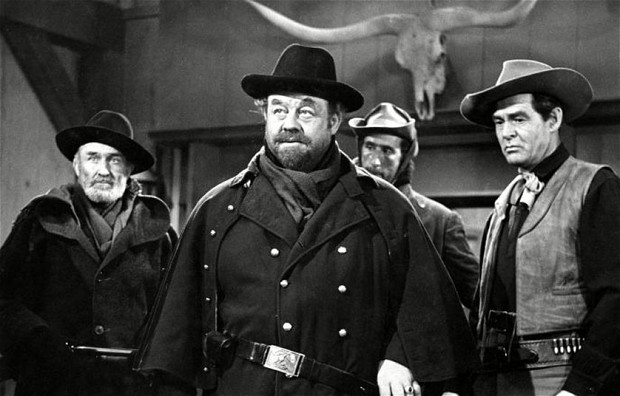
This is already a particularly thorny and pregnant variation on a classical Western standoff, but the screenplay by Philip Yordan simply refuses to console us by allowing us to understand its rhythms. The film sets up an exquisitely simmering conflict between two not especially likable archetypes and gives itself the perfect excuse to finally boil over: a showy lateral tracking shot of a battle rolling across a bar-top, as though the fate of the moral universe as we know it suddenly rests on this unsuspecting, arbitrary bottle. Nor, indeed, are we expecting it when the bottle and the camera are literally stopped in their tracks with the introduction of Burl Ives’ Jack Bruhn, an ex-Union general presently on the run from a bank robbery he instigated with his gang of runaway soldiers.
The sudden, premature conclusion of the tracking shot not only refashions the film’s energy but reframes the entire moral universe of the film, shifting the contours from a conflict between two struggling settlers to a tentative amalgam of people brought together by necessity teetering on the edge of a menacing, elemental loneliness. And even then, Bruhn is less an imposition of authoritarian obsessiveness threatening a precariously functioning organic entity with a top-down vision of savage American dominion than a reminder that these towns – seemingly beacons of a workaday democracy figuring itself out – were already prey to and constituted by wider forces which were, themselves, on the run from forces even wider and more implacable than they.
The robbers aren’t an external force weighing down on the town, in other words, but another version of the town’s self showing up when it wasn’t expecting to. It’s not an imposition by a malicious, sovereign government, but another band of troubled stragglers who constitute their own entity, and one that itself seems about to implode: Bruhn, who has already been shot before he appears in the film, spends the film slowly dying while maintaining a vestige of authority, desperately attempting to hold on to his version of a civilization he has already rejected. Day of the Outlaw soon becomes a genuinely slippery and deeply contingent nebula of forces and particles, presenting several stories each interrupted by an all-too-sudden closeness to a different narrative that wasn’t supposed to show up in this film and yet, like an unwelcome guest, wouldn’t stay in its place.
Cinematographer Russell Harlan, who was one of Howard Hawks’ favorites (and worked with Billy Wilder and Joseph H. Lewis as well) bestows the film with the kind of ragged glory that can only come from a cash-strapped location shoot at the end of Classical Hollywood’s Golden Age. The wide-screen images that suffuse Day of the Outlaw would signal the idealistic hollowness of the 1960s Widescreen Westerns, but here they evoke a genuinely apprehensive town dwarfed by a world much bigger than it and all-too-aware of how their community is in no way separate from the external world. Shorn of color, it’s a grayscale amplification of an increasingly restless, pervasively exploratory morality. The film gives off the aura of a neorealist fable, extracting the everyday complexities and moral conundrums of an un-given universe and channeling them into a microcosm wrestling with itself, itchily untethering under our nose. It’s a film that shares the edgy, shaky awareness of the genre’s precarious hold on American myth, a hard-won, tough-edged, calloused hand slowly reaching toward a loaded gun that just can’t wait to explode in your face.
Score: 8.5/10
 The Long Take