
Blue Collar boasts one of the great, self-implicating opening credits in cinema history. As workers at a car factory in Detroit negotiate the everyday mundaneness of life under late capitalism, the film repeatedly freeze-frames their tasks, chopping into their rhythms as the names of the filmmakers themselves seem to terminate their motion, to lock them into a cinematic-industrial prison. These men are busy minting and assembling the very apparatus that controls them, as not only the machinery of capitalism but the hardware of cinema atomizes and exsanguinates these men. The music, a swirl of blues lamentation and industrial punishment, seems at once to keep them alive and to keep them in place, to pulverize them in frames that stop and pause every time you think they’re going to get going. A mordant metaphor for the perils of the modern world, the credits prefigure and anticipate the violence that the world, and the film, will later do to these men as they go about their lives. Pressed in between machines and tools, they no longer even need to be swallowed by the anthropomorphized machine, a la Chaplin’s Modern Times, which at least took on a corporeal form that we could see and name. Here, the style of the film itself is against them. It melds with the very machinery of manufacturing, the two fulcrums of the ambivalent and often abyssal modernity that Michigan-born writer-director Paul Schrader cut his teeth on. It is only when the corrupt union representative struts through the frame that the film is able to smoothly compose itself, to run in full motion, to visualize a supple art in a stable world designed for him, not for them.
Watching (and listening to) this intro, I could not help but think of William Attaway’s classic 1941 proletarian novel Blood on the Forge, the story of three Southern African American brothers who travel to Pittsburgh to work in the steel mills in the early 1900s. Throughout the novel, the protagonist Melody emerges as a chronicler of the soul who inhabits the world openly and evocatively. His endless capacity for music transmutes the sensuous currents of existence into a vagabond poetics of protean presences, channeling the world itself into human energy. At the novel’s end, however, Melody hears a sound “too heavy a load to be carried on the wind,” described as “like a big drum.” He must imagine an instrument of culture, the very thing that has protected him, to avoid the implications of the forces capital has brought to bear on a vast landscape that seems beyond engagement. Music, here, no longer marks his creativity but his delusion, the failure of sound to offer a mode of escape from a system that can produce a far more booming, far more penetrating music than he, alone, ever could. His playful, peripatetic consciousness finally becomes not a redemptive enlivener of stray energies but a wayward monument to capitalism’s ability to render the environment, and the capacity to sense it, into a tool for its own purposes. The blues of his soul finally merges with the very oppressive industry that produces it. He becomes not an enlivened poet of the American laboratory, but, rather, a husk evacuated of his own self.
For Paul Schrader, the film scholar turned writer-director whose most famous academic text is an analysis of cinematic transcendence, Blue Collar is, much like Blood on the Forge, a defiantly un-transcendental work. In this world, everything is arrayed against your perseverance, and even your mechanisms of inhabiting the world creatively and aspirationally are accomplices in your own subjection. The coca cola machines steal your money. In a bar scene, pinball machines in the background echo jackhammers, a momentary reprieve turned into one more background jostler of the brain. One of Schrader’s heroes was Robert Bresson, a filmmaker who turned individualized action into an art of ethereal serenity, an exalted realm of allegiance with the cosmos where individual commitment becomes a devotional act. In many ways, Blue Collar is a vision of a world where that spiritual singularity is not only monumentally threatened but channeled into new methods of control, the protestant ethic metastasized into, as Max Weber wrote, the spirit of capitalism. The rambunctious vibe of their interpersonal camaraderie illuminates a space of potential resistance and momentary disruption, but in no way of real purpose. Compare Blue Collar to Michael Mann’s deeply Bressonian Thief, with its opening depicting bank robbery and safe welding as poetic abstractions of austere masculine determination, of arraying your energies against the world’s forces. Conversely, in Schrader’s film, a cinematic poem of pyrrhic victories, perseverance is not a temporary communication and battle with the cosmos but an inert illusion of escaping from a labyrinth in which the characters are fatally enmeshed.
Throughout, Schrader’s film accumulates tiny molecules of human friction, exploring the ways in which men bootstrap aspirations of an untroubled existence out of the nuts and bolts of American machinery. One man reads Catch-22. A poster in a bar behind the protagonists sinisterly declares “Take your chance with lottery tickets.” Richard Pryor’s character Ezekiel “Zeke” Brown, one of the three line-workers who center (and decenter) the movie, falls prey to the cult of the gamble. After remarking that the automobile “plant” is short for “plantation,” he notes that he demands “represent-ation.” Accenting the final “ation,” and thus recognizing a will to fight, he finally holds onto the possibility of risk as a modality of opportunity: “I’ll a catch them dice,” he remarks, a weapon of the weak that signals his humanity – his will to fight given little opportunity – and America’s ability to weaponize that striving aspiration to the tune of what Lauren Berlant has called “cruel optimism.” He can take the chances America offers him, Blue Collar well knows, but it reminds us to ask who is throwing the dice, and what are the terms of the game?
Looming – leering – in the background of this early union meeting is a banalized pas de deux between J.F.K. and Martin Luther King Jr. posters, images that serve here both as ghostly reminders of stubbornly clung-to possibility and arbiters of the way America negotiates and curtails the terms of that possibility. This quintessentially late ‘70s film already signals that it labors under the weight of the specter of an opportunity for real working-class transformation now foreclosed. The civil rights movement of the ‘50s and ‘60s won real victories for African Americans, but as historians have spent twenty years examining, this came at the cost of a wider and more transformative image of the nation as a shared community dedicated to reducing income inequality and securing equal social rights for everyone. The mindset that legitimizes these posters as the telos of American opportunity is the mind that can delegitimize the very real working-class connection between the protagonists of this film, men who, unlike the commodified and neutralized image of the civil rights movement as the success story of one president and one lion of black integration, aspire to no wider image of national redemption. The main characters of this film have no interest in defending the American spirit, or fulfilling an experiment in a “more perfect union.” Theirs is a mere survival, and their communion has no purpose other than itself. One of the few films from its era to display black-white friendships as a simple fact of life, not a narrative to be mined or a symbol to be anointed, Blue Collar both upends American race films, which usually treat black-white relationships as a means to an end, and honors a “lower register” of proletarian connection.
And a lower register of proletarian strife. In depicting the struggles of three men to outwit the mechanisms that bind them together, Blue Collar is a neorealist etching of the ambivalence of aspiration, a sorrowful howl for people who, in the act of reclaiming their humanity, turn themselves into tools for powers far beyond their control. Schrader’s script is awash with the limits of our humanity under capitalism, a limit that is felt existentially but also born bodily. Zeke, unable to fix the hinge on his locker, nearly turns his finger into a claw. Tying someone up, a character remarks “who can afford handcuffs, I had to use clothesline.” Harvey Keitel’s Jerry Bartowski, one of Zeke’s best friends, “tried to make braces out of a piece of wire” for a daughter he cannot afford. Even the less potent scenes hum with an impish mischief limning the precarious nature of our bodies and souls. While bowling, Pryor jokes that he rolls with a “new technique, it’s called radar.” In another film, and with another actor, this would be a throwaway boast of personal competency. In a film about the limits of personal agency for momentary gain, and spoken by a comedian who turned the razor edge between vulnerability and volatility into an art form, they’re acid. These are men who try to master capitalism’s machinery in the act of becoming machines themselves, and insofar as Schrader limns the tatters of their souls, he wounds ours. The central hope of the three men rests on weaponizing the “closed circuit tv cameras” of their union hall to steal from one of the many systems that disregards their humanity. By the finale, in a great moment where Harvey Keitel waits for an ostensible student revealed as a government plant, the camera panoramically surveils the street like a weapon of the culture industry, a dark mirror of the transcendental cinematic eye that Schrader once analyzed and celebrated.
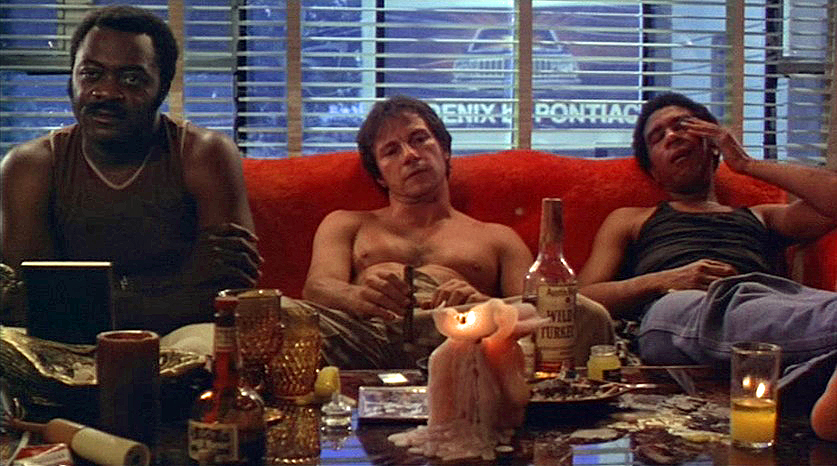
In its way, then, Blue Collar becomes an existential horror film, one that plunges into the miasma of deindustrialization and explores how the genuine fringes of possibility glimpsed in the penumbra of the blinding American Dream blur with the violence that asks workers to compete against one another for limited slots in a system that weaponizes aspiration to produce stasis. Some of the horrors are more corporeal in nature. The fate of Smokey (Yaphet Kotto), the third and most world-weary of the three conspirators, anticipates the blue-collar science fiction of the following year’s Alien, and when the three men unwind at his house earlier, an automobile ad stalks behind them like Christine peering through the blinds into the house, a reminder of the limits of domestication and the public-private divide, an indication of a world in which machines are animated and human de-animated. But the most terrifying implications are those that have less to do with death than with the modes of life that we are forced to choose between. Zeke is a character who has had held fast throughout the film to an orienting vision of personal integrity as a compass to weather the storm of forces around him. “I was my own man when I came to work here and I’m gonna be my own man when I leave,” he notes early on. But when he discovers an opportunity for himself and lambasts Jerry for trying to stay the course with their plan, he ripostes him: “I got one chance, and I’m gonna take it … If I gotta kiss ass, I’m pick the ass I’m gonna kiss.” Chance has become a bleakly ineffable narcotic that collapses creativity into acquiescence and purges it of vision. It has bound them in the fires of proletarian warfare and then shown them the particular relation of interdependence and estrangement called capitalist modernity. Chance has promised them an opportunity to reclaim their lives from the system and has finally offered them the pliability of their own selves.
The characters ultimately wrestle with a system that can only be survived by negotiating its severe and frigid number economy, an immoral calculus in which bodies become quotas, and survival is simply, and perhaps only, the capacity to become a kind of friction within capitalism’s calculations. When Pryor’s Zeke engages in a complex game in an attempt to turn his children into tax write-offs, the gesture seems like an act of unthinking instrumentalization by a parent, but it actually extends the cruel violence of a society which has debased people into numbers and turned possibility into the art of creating, or recognizing, one’s status as a potential “discrepancy” in the account book. That’s what Zeke calls his kids on his tax form, and it’s what he’s trying to find in the notebook he and his friends Jerry and Smokey steal from their union. If systems want to keep them “in their place,” Zeke responds that “this book is the place keeper” as he enacts an elaborate gambit in which the very manner afforded them to help themselves is also a mode of hurting themselves. They hope they can hustle their way toward aspiration in a world where betterment implies immorality, in which playing the numbers and hoping you can stay one step ahead is just a way to facilitate the machine’s access to you. Late in the film, when Schrader zooms in on a modular “number of cars made” counter looming over the horizon, it plays less like a blossoming of modern industry than an unceasing counter to oblivion.
An oblivion in which Pryor’s character Zeke finally, for the moment, makes a temporary, Faustian home, as do all the characters. In an early riff, he laconically remarks to an un-compassionate interviewer that their jobs at the plants are just for fun: “in the winter we work on Wall Street.” When pouring over the company account book a bit later, Pryor jokes about George Jefferson, who is strutting across the television screen in front of him. While he mocks that quintessentially ‘70s marker of black self-improvement and the rise of an interracial bourgeoise in America, Zeke’s wife mocks him: “if you hate it so much why don’t you just turn it off?”, to which he responds “turn it off, are you kidding me it took me three years to pay for it, we gonna watch everything they show on there, even the snow when it turns off.” Schrader metaphorically figures television as a distraction from this man’s life of meaningful contemplation, from questioning and critiqueing ledgers, an intellectual gambit which finally becomes an existential and material act of tragic complicity in the film’s end. When it concludes, he has gamed the system for a slightly better position (for the moment) and an illusion of potential change. He has become part of the open circuit TV camera of American opportunity, the vision of personal rather than collective betterment we present to the working class. Now wearing a suit on the plant floor, he struts through the frame like George Jefferson on his way up to the big leagues, cruising through chaos dressed in the vestment he once mocked as unrealistic. Network television, the film suggests, provides opportunity to assimilate into capitalist narratives rather than strive for solidarity, false linearity rather than collective possibility. In his own way, he has found his position on Wall Street.
Score: 10/10
 The Long Take