
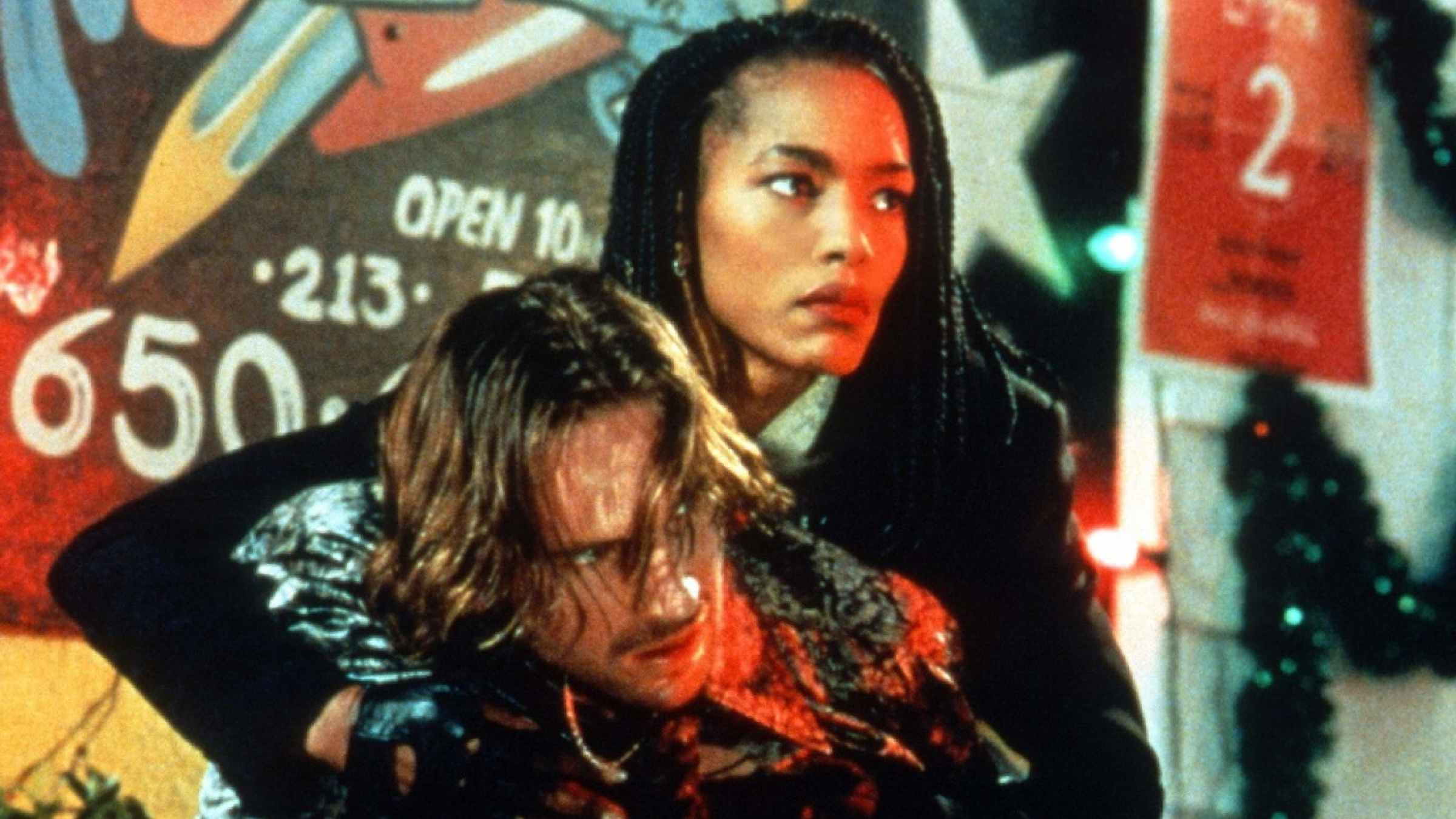
Strange Days opens with a remarkable moment of cinematic voyeurism, a morbid act of willful complicity disguised as sheer kinetic pleasure. In first person, we watch as a would-be robber is frantically chased out by the police, ultimately falling to his death. Soon enough, we’ll learn that we’ve been watching a virtual memory, one that can be felt and experienced through a proto-VR headset, and one that is sold by nebulous street urchin and creature of the night Lenny Nero (Ralph Fiennes). We will also learn that Nero is tormented by his own memories of ex-flame Faith Justin (Juliette Lewis), who now runs with bigger fish crime lord Philo Gant (Michael Wincott, so you know it’s a mid-‘90s film). He, like the film’s opening, is willing to run head-first into a violent world, and he is only held back from his darker impulses by a platonic but ambiguous relationship with extraordinarily competent bodyguard and driver Lornette “Mace” Mason (Angela Bassett). These relationships will expand and knot and inflame and fold in on themselves over almost 150 minutes of screen-time, but, for the first few minutes, we are in a blissfully neurotic and disturbingly ecstatic cinematic present-tense, a scene which impels us to look and to look away in equal measure, and during which we can think of nothing else.
Here, in the first minute, director Kathryn Bigelow updates her breathtakingly fluid-frenetic chase sequences from her prior apex Point Break, itself a story about how an audience-surrogate is tempted by the anti-social thrills the promise of escape offers, into a deliciously disturbing treatise on the uncanny thrill of cinema itself. Demanding that we participate in the act only to have the violence turned on us as we fall to our doom, the film opens with a self-implicating gesture that serves as Bigelow’s fullest statement of art not as a beautiful getaway but an elegant trap that invites and disfigures us in all its grueling and emotionally invigorating but disturbing and self-assaulting complications.
While this isn’t without its tensions and difficulties, even what we might call failures, and arguably the film’s overall interest in technological voyeurism is more notable for its vigorousness than its originality (given that the theme received such a consistent showcase in Hitchcock’s films, among many others), Strange Days is a pretty nervous, pulsing stylistic and conceptual workout that remains far more legitimately troubled about more serious topics than most films of its budget would even know what to do with. A pungent fulfillment of what her ex-husband James Cameron more than a decade before called “Tech Noir,” Strange Days explores themes of voyeuristic addiction and self-flagellation by playing around the boundary between filmmaking, fetishism, and observation in a way that borders on cinematic autoerotic asphyxia. It feels like the film is trying to destroy itself, dazzlingly so at times, but never loosely nor arbitrarily. This is throat-knot political popular cinema of the finest variety.
Lenny is a fascinatingly passive protagonist worthy of Gabriel Byrne in Miller’s Crossing. Like Jimmy Stewart’s anti-hero in Rear Window, he likes to watch, and to sell us on the fact that is willing to indulge our desire to watch as well. Able to move us through our fetishistic impulses, and always cut down by his, he is both a connective capacitor and a poorly closed wound. Lornette, although much more capable than he, is no less damaged despite choosing to medicate not on smarmy motormouth nervousness but pensive, steely-eyed, brittle resolve. Both are haunted by choices not made and lives not lived, and Lenny chooses to make a living off of his recognition that his plight is in no way only his. The central conceit of Strange Days is that viewers can pay for access to a memory, regardless of whether it was their own or not. Technically any memory can suffice, but given the anti-social texture of ‘90s cyberpunk cinema and Bigelow’s own fascinations with the ethical ambiguities of vicarious relation, it’s no surprise that most of the memories people pay for are of the knotty, grotty, and illicit variety. Be it a temporary inhabitation of another person’s moment of death or a fantasy of possessive rape, Strange Days fascinatingly limns the borderland between human consciousness and human desire, exposing a world in which no one’s desires are only, or entirely, their own, and in which the capacity for connection is always entangled with the potential for possessing someone else’s experiences, for monitoring, and for manipulating others’ memories and emotions in ways that in no way indicate real compassion.
Perhaps fittingly, Strange Days at timesfeels like a swirl of sensory impressions that test the film’s own self-composure, vitalizing it and threatening it in equal measure. It limns dozens of other texts, sometimes playing like a post-modern mind-meld of numerous cultural memories and premonitions, influences of films passed by and impressions of films to come. Bigelow’s Blue Steel and Point Break are never far from memory, but just as apparent are the Kenneth Anger fixations on loan from her 1981 debut The Loveless, which itself anticipates not only her own Near Dark (which itself anticipates David Lynch’s perverse plaything Wild at Heart). But you also detect elements of her ex-husband and co-writer James Cameron’s own investment in workaday blue-collar malaise, not to mention his deeply practical, pragmatic orientation toward science fiction as a way not of imagining far flung futures but contouring the likely failings of our own. The film’s tonal fissures and simultaneously meditative and muscular vibes don’t always coalesce into a self-same object, but the film still feels genuinely singular in the way it mimics and explores numerous other texts without ever feeling undeserving of any of the comparisons it evokes, even when it doesn’t equal them. All the more so, in fact, because it almost never demands or relies on the fact that we notice the films it’s drawing on.
In fusing these molten currents into cinematic iron, Strange Days both captures the proverbial mood of its time and wears it lightly, figuring other texts as canvases to work with rather than prisons within which to house oneself. Other films become passing sensations and clusters of feeling rather than canons to worship. Strange Days thus models the possibility that mutual relation, the self as a collection rather than a single being, might redeem us as well as the likelihood that it will only provide new avenues of securing our destruction. Far more than same-year works like Hackers (which has its amusements), Virtuosity (which has Denzel Washington saving hackwork) and Johnny Mnemonic (which barely even qualifies for room service), Strange Days is able to wring emotional paradoxes and ambivalences, rather than only baroque mise en scène, out of a century that seemed to be both crawling and leaping into its death throes. It manages to both present a plausibly 1999 future and an imaginative projection of 1995’s idea of that future, not entirely the same thing. It also takes its central conceit, with all the various desires and interests that might motivate people to treat the experiences of others as amplifications of their own desires and refuges from their own fears, as a canvas on which to map the ambivalence of the post-modern world rather than as a gimmick with which to sell that ambivalence to us or to mock us for our own interest in it.
In other words, while some of Bigelow’s films seem to suddenly fear their own attraction to the forces of self-transcendence that are in fact self-delusion, Strange Days seems uniquely haunted by them and aware of them throughout. Rather than exciting us and then cowering at the acts it has just committed, a la the finale of Zero Dark Thirty when the lights suddenly go up and the protagonist descends into the darkness of a machine she has let use her, Strange Days attends to the loneliness and the longing that facilitate these fantasies of technological overcoming even as it asks us to refuse their consequences. It isn’t a sudden come down but a torturous affection.
Bigelow’s films have always been invested in the exacting demands of obsession and charged with the nervous energy of fascination with the violence they dole out. Her films are clearly turned on by guns as much as they are concerned about them. Rather than accusations, her films take the form of temporary fixes and clammy withdrawals, shivers at their own interests. This is a filmmaker who, it seems, genuinely felt the pulse embodied in her films. While she is obviously aware of the violence inflicted in the name of passion and the forces arrayed to mobilize that passion for ill intent, Bigelow’s films often remain somewhat attracted to the very men they critique and, even more so, excited by the women who exert a kind of strength and composure in traditionally masculine battlegrounds. Sometimes, this is a kind of analytical limit her texts encroach on and sometimes cannot breach. But Strange Days uniquely asks us to feel entertained and disturbed at once. It slips into our desires for an adrenal narrative structure and swerves with our energies rather than only twisting a knife into us at the last minute. It treats Lenny not as a sleazebag or a hero but a forlorn and mostly hopeless loner not trying particularly hard to fight his worst impulses. Nearly invisibly, he recedes into the background as Mace, who never becomes an action star, picks up after his failures. Unlike the protagonists of Point Break or The Hurt Locker, she conscientiously refuses the energies the other characters indulge even as she obviously recognizes their appeal. She doesn’t need the desires that Bigelow often feels, but we can tell she understands them. In a film that quietly rearranges our affection for its characters without dismissing their humanity, her perspective is genuinely moral, suggesting the human capacity to weather the storm rather than seek out its winds.
Score: 8.5/10
 The Long Take