Monthly Archives: March 2025

Midnight Screamings: The Wizard of Gore

With The Wizard of Gore, cinematic raconteur Herschell Gordon Lewis created both his ideal interpreter and his own undertaker. The titular Wizard, Montag the Magnificent (Ray Sager), is both a carnival barker of cinematic proportions, a canvas for Lewis to voice his own frustrations, and a self-destructive, film-killing force. He embodies cinema’s life-force – the illusion of reality presented for us – and its death-drive – its interest in peering back beyond the illusion, exposing itself before us.

Early on, when Montag cuts a woman’s head off in what is apparently an illusion, her head falls off, and in a dissolve, we see the bloody stump, before the camera starts spinning around like a washing machine, which becomes Montag himself, joining with and celebrating his whirlwind of spectatorial dismemberment. He then conjures a flower that kind of looks like the bloody stump, just for kicks. Cinema, scholars have long noted, is a magic trick, an art form that works to convince us of its own holism and to hide the seams that render it a singular, internally-bonded object rather than a collection of disparate footage. The problem of a filmed magic trick, of course, is that the filmmaker can edit the trick together, making it all too easy to convince the audience and, thus, all the more difficult.

And yet! Lewis still cannot get the job done. When Montag performs the trick, the film’s editing is simply not up to the task of “convincing us” that what we’re seeing is anything like real magic. At every stage, the film’s cut from prop to person, object to another object, is so glaringly obvious that the film’s credibility crumbles before us. Lewis’s film is awful, essentially incompetent anti-cinema, a true travesty of the contract that cinema makes with its audience, its promise of an authentic, self-same, cohesive entity presented before us as an unquestioned reality. The Wizard of Gore completely fails itself within the first scene.  

But what if it also transcends itself? The Wizard of Gore musters the absolute bare minimum of effort – making the film “about” magic basically makes it obvious for the audience – that it seems to ask us whether the legitimacy of the magic-film comparison can survive on sheer charisma. This film has absolutely no game. It is an entirely guileless object, a work that presents its ideas with the cunning of a five-year-old. But what, the film wonders, are other movies really doing that this one isn’t?

Continue reading
Midnight Screamings: Intruder

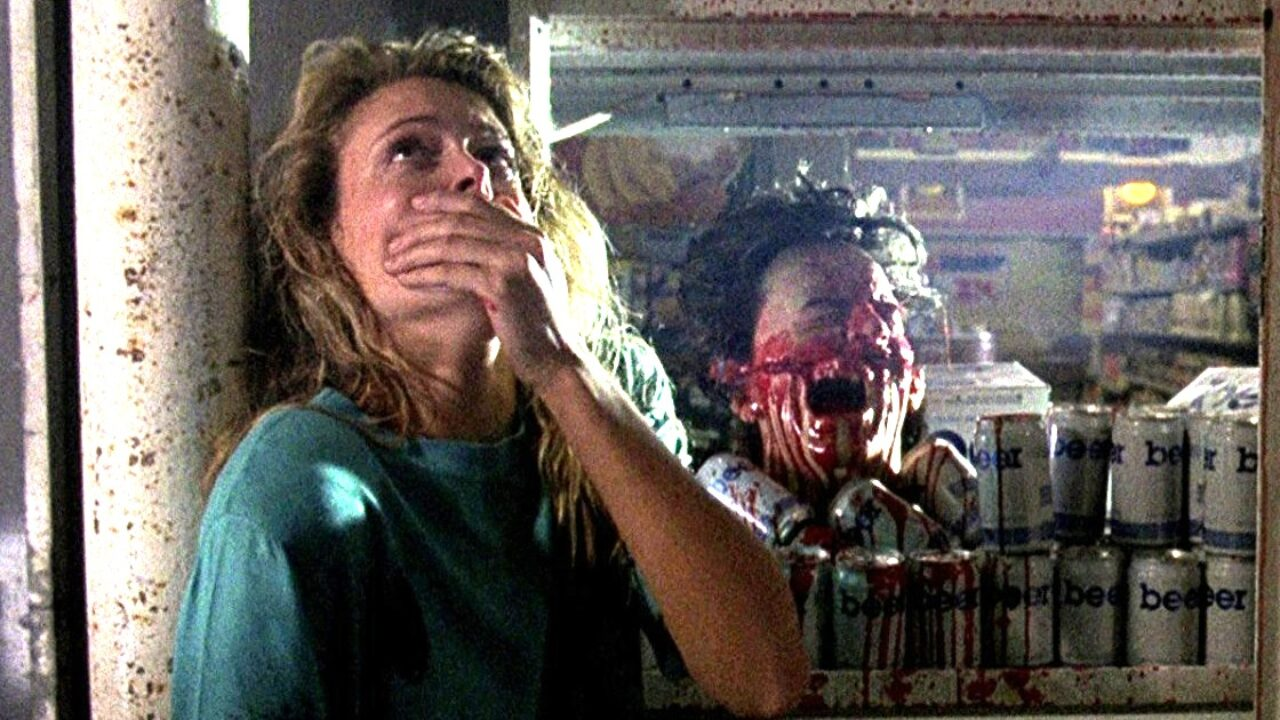
Despite its sterling pedigree, Intruder is an unjustly forgotten late ‘80s slasher, the unfortunate victim of a genre in the process of cannibalizing itself to death, even if the entrails produced something as deliciously necrotic as this. A kill crazy picture that is both too straightforward to qualify as experimental and too grimy, strange, and exploratory to qualify as pure trash, it’s the Skid Row of slashers, a terrific product that is mostly content to color within the lines but does so with too much elan and energy to write off easily. Despite the slippery, nervy direction and sinister, potent script by Scott Spiegel, who co-wrote Evil Dead II and clearly learned a thing from Sam Raimi (who appears here in a small role), and the co-production by Spiegel and Laurence Bender, who would soon translate this film’s playfully macabre spirit into producing Reservoir Dogs and then several later Tarantino films, Intruder has not lingered in society’s imaginary at all.

That’s the world’s loss, but it also makes the film all the more conniving and conspiratorial, a cinematic wolf in sheep’s clothing. Despite lacking the obviously labored-over dialogue and post-modern narrative chicanery of Bender’s future productions, Intruder nails the nervous exhilaration of Tarantino’s first film. While it lacks anything like a gimmick or a concept worth a damn, indeed while it may seem to lack even a film on paper, Intruder radiates euphorically disreputable, gloriously low-concept energy. It’s sloppy and basically empty on the surface, and while that diagnosis is technically correct, the film knows how to sneak up on you while you’re overlooking it. It’s a shiv of a movie pretending to be a meat cleaver.

And shiv it does, even before the cleaving starts. Even before the nominal killer enters the late-night supermarket that serves as the film’s combination morgue and display case, this is phenomenal stuff. Spiegel introduces us to the supermarket on a trolley of the damned, the camera being carted beyond its control into an open-air consumerist prison. The camera then cuts to the outside world, presented as a void that sequesters the supermarket off as a penitentiary that these workers must also make into a home. Or, at least, into a refuge that becomes a family, one presented with a surprisingly humanistic and empathetic eye by a script whose early scenes ease into an unexpectedly naturalistic mode. This is a script that exhibits real compassion for this impromptu community, and a camera that displays real compassion for the lonely surrealism of the night shift as it splits the difference between a groggy dream and a wayward, late-capitalist nightmare.

Continue reading

Fragile Frontiers: Forty Guns

There’s a scene in Forty Guns where the protagonist Griff (Barry Sullivan), finding himself in the middle of an impromptu high noon standoff, chooses not to draw his gun but instead to walk straight up to his antagonist and paralyze him in his tracks. As filmed by renegade writer-director Samuel Fuller, it’s not a beautifying celebration, a poetic coalition between gunslinger and camera-wielder, but a sudden invasion by a force that is too big, too insoluble, for the film screen to contain. He is assaulting the distance between camera and audience, and turning us to stone. This is a man who, with just his eyes, visualized so menacingly and brutally in pulverizing Cinemascope that he achieves a kind of Leone-esque abstract menace, not only commands the screen but exceeds it, cannot be contained in it, tries to rupture it with the sheer charisma of his uncontainability.

Fuller directs the way Griff walks. His style is both brazenly minimalist and bracingly direct, willing to state everything it needs to and never desiring to say more. At one point, a trial is initiated and concluded all within a single shot, a tacit admission of the limitations of the judicial system on the frontier conveyed, a visual travesty of justice that the film needs no other scenes to explain. Fuller gets right to the point here, while also arguing, with withering, savage grace, that the point has very much been avoided.

Continue reading

Fragile Frontiers: Day of the Outlaw

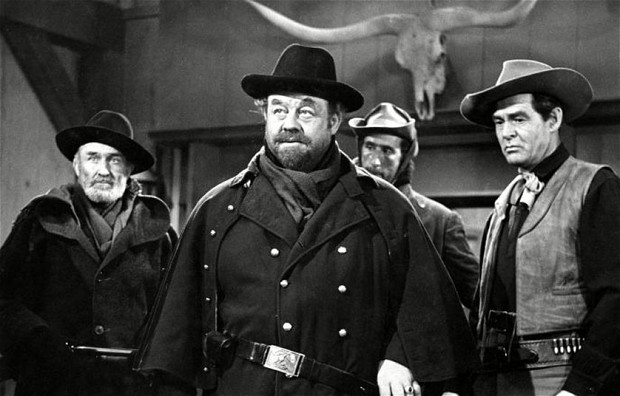
You can feel Day of the Outlaw grappling with itself from the first, forlorn shot of a snow-struck limbo as two men silently wander from left to right. Unlike many classic oaters, they don’t seem to order the screen at their command as virile archetypes of stoic masculine reticence. Rather, they seem like they seem to ride less above the land, superior to it, as atop it, at odds with it.   The snowbound setting can’t but bring to mind McCabe & Ms. Miller, Robert Altman’s amazing, soul-shattering cosmic moan where the West is a demonic ground and a tragic, aching slow-motion catastrophe. In the intervening years, the self-critical version of the genre has increasingly felt like a parody of itself, an arbitrarily nihilistic approximation of depth rather than a genuinely exploratory attempt to inhabit the genre generously, from within its terms, to critique it.

While many of these subsequent Westerns self-consciously explore the genre’s violent origins out of a kind of kind of half-hearted expectation, Day of the Outlaw is a legitimate, forgotten premonition of McCabe:a Western that felt like it was earnestly exploring the American frontier not out of a forced expectation or a conscious desire to interrogate established rules but through the violent indecision of inhabiting the genre so thoroughly that it can’t but grapple with its contradictions and feel out the limits it may not actually want to trespass on. There’s no mission statement with Day of the Outlaw other than a general desire to give us more than we bargained for, to take a set of themes we expect the film to ease into and instead to malform them by recognizing their own potential for disruptive complexity. Day of the Outlaw is a film continually in the process of discovering a radical otherness within itself.

Continue reading

Fragile Frontiers: Four of the Apocalypse

Aficionados of Lucio Fulci, perhaps the most savagely lurid of the most savagely lurid of the Italian horror giallo maestros and the least willing to sanctify his violence in a beatifying aura poetic abstraction, might be surprised to know that he did not fully commit to being a horror specialist until his sixth decade on this earth. His genre classics, which dare to descend into the darkness of the human soul at its most unvarnished, are cruel conduits for seemingly arcane, voracious forces that seem to congeal out of an unclaimed past. Yet even when he eschewed the formal trappings of the horror genre, Fulci seemed to tap into devious currents nonetheless. His was a cinema charting the existential breakdown of enlightenment ideals, an intrepid explorer of the darkness of the light. His greatest films merely use horror as a canvas on which to the frayed boundaries of reason and the murkiness of faith in progress avail themselves before us. His films, sloppy and with awkward edits that seem to come from some frayed corner of the mind, are dark impastos that stare at what we’d rather look at with downcast eyes, portraits of human abjection as vicious and primordial as cinema has ever produced.

Case in point: his downright malevolent travesty of an Italian Western, Four of the Apocalypse. While Italian filmmakers like Sergio Leone had exalted the genre as a hallucinatory canvas for piety and blasphemy to battle it out, and plenty of other Westerns essentially understood the genre as a boundlessly open space of anarchic creativity, Fulci’s Western is a shadowy vision of disgruntled sociality captured with Fulci’s primeval immediacy and narrative inexplicability. It begins with four characters in search of an exit, condemned souls who are, in a ruthlessly wicked gesture, only saved from a vicious massacre by their imprisonment. It ends with one interloper who found and lost a family set adrift in the desert sea to probably repeat this story time and time again. In the intervening span, Fulci turns the inviting landscape of the West into an unforgiving, unfathomable vortex that is also a cosmic abyss, a landscape that seems to extend for eons and to coagulate into a portrait of celestial nothingness.

Continue reading

Film Favorites: Blue Collar

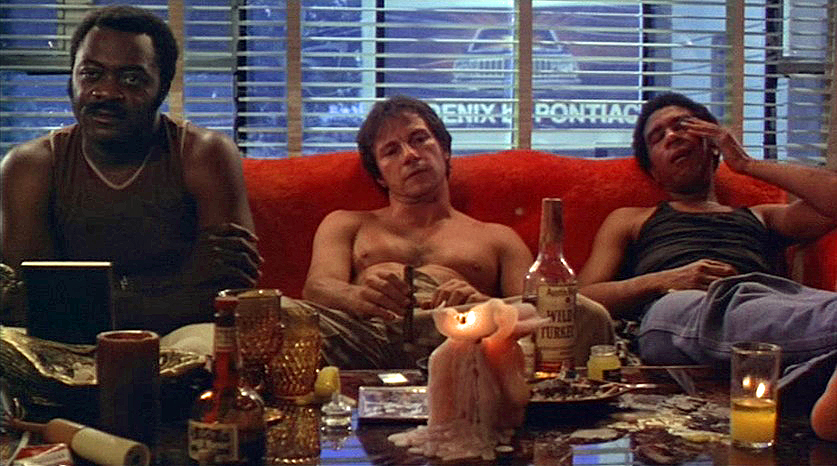
Blue Collar boasts one of the great, self-implicating opening credits in cinema history. As workers at a car factory in Detroit negotiate the everyday mundaneness of life under late capitalism, the film repeatedly freeze-frames their tasks, chopping into their rhythms as the names of the filmmakers themselves seem to terminate their motion, to lock them into a cinematic-industrial prison. These men are busy minting and assembling the very apparatus that controls them, as not only the machinery of capitalism but the hardware of cinema atomizes and exsanguinates these men. The music, a swirl of blues lamentation and industrial punishment, seems at once to keep them alive and to keep them in place, to pulverize them in frames that stop and pause every time you think they’re going to get going. A mordant metaphor for the perils of the modern world, the credits prefigure and anticipate the violence that the world, and the film, will later do to these men as they go about their lives. Pressed in between machines and tools, they no longer even need to be swallowed by the anthropomorphized machine, a la Chaplin’s Modern Times, which at least took on a corporeal form that we could see and name. Here, the style of the film itself is against them. It melds with the very machinery of manufacturing, the two fulcrums of the ambivalent and often abyssal modernity that Michigan-born writer-director Paul Schrader cut his teeth on. It is only when the corrupt union representative struts through the frame that the film is able to smoothly compose itself, to run in full motion, to visualize a supple art in a stable world designed for him, not for them.

Watching (and listening to) this intro, I could not help but think of William Attaway’s classic 1941 proletarian novel Blood on the Forge, the story of three Southern African American brothers who travel to Pittsburgh to work in the steel mills in the early 1900s. Throughout the novel, the protagonist Melody emerges as a chronicler of the soul who inhabits the world openly and evocatively. His endless capacity for music transmutes the sensuous currents of existence into a vagabond poetics of protean presences, channeling the world itself into human energy. At the novel’s end, however, Melody hears a sound “too heavy a load to be carried on the wind,” described as “like a big drum.” He must imagine an instrument of culture, the very thing that has protected him, to avoid the implications of the forces capital has brought to bear on a vast landscape that seems beyond engagement. Music, here, no longer marks his creativity but his delusion, the failure of sound to offer a mode of escape from a system that can produce a far more booming, far more penetrating music than he, alone, ever could. His playful, peripatetic consciousness finally becomes not a redemptive enlivener of stray energies but a wayward monument to capitalism’s ability to render the environment, and the capacity to sense it, into a tool for its own purposes. The blues of his soul finally merges with the very oppressive industry that produces it. He becomes not an enlivened poet of the American laboratory, but, rather, a husk evacuated of his own self.

For Paul Schrader, the film scholar turned writer-director whose most famous academic text is an analysis of cinematic transcendence, Blue Collar is, much like Blood on the Forge, a defiantly un-transcendental work. In this world, everything is arrayed against your perseverance, and even your mechanisms of inhabiting the world creatively and aspirationally are accomplices in your own subjection. The coca cola machines steal your money. In a bar scene, pinball machines in the background echo jackhammers, a momentary reprieve turned into one more background jostler of the brain. One of Schrader’s heroes was Robert Bresson, a filmmaker who turned individualized action into an art of ethereal serenity, an exalted realm of allegiance with the cosmos where individual commitment becomes a devotional act. In many ways, Blue Collar is a vision of a world where that spiritual singularity is not only monumentally threatened but channeled into new methods of control, the protestant ethic metastasized into, as Max Weber wrote, the spirit of capitalism. The rambunctious vibe of their interpersonal camaraderie illuminates a space of potential resistance and momentary disruption, but in no way of real purpose. Compare Blue Collar to Michael Mann’s deeply Bressonian Thief, with its opening depicting bank robbery and safe welding as poetic abstractions of austere masculine determination, of arraying your energies against the world’s forces. Conversely, in Schrader’s film, a cinematic poem of pyrrhic victories, perseverance is not a temporary communication and battle with the cosmos but an inert illusion of escaping from a labyrinth in which the characters are fatally enmeshed.

Continue reading

Midnight Screenings: Strange Days

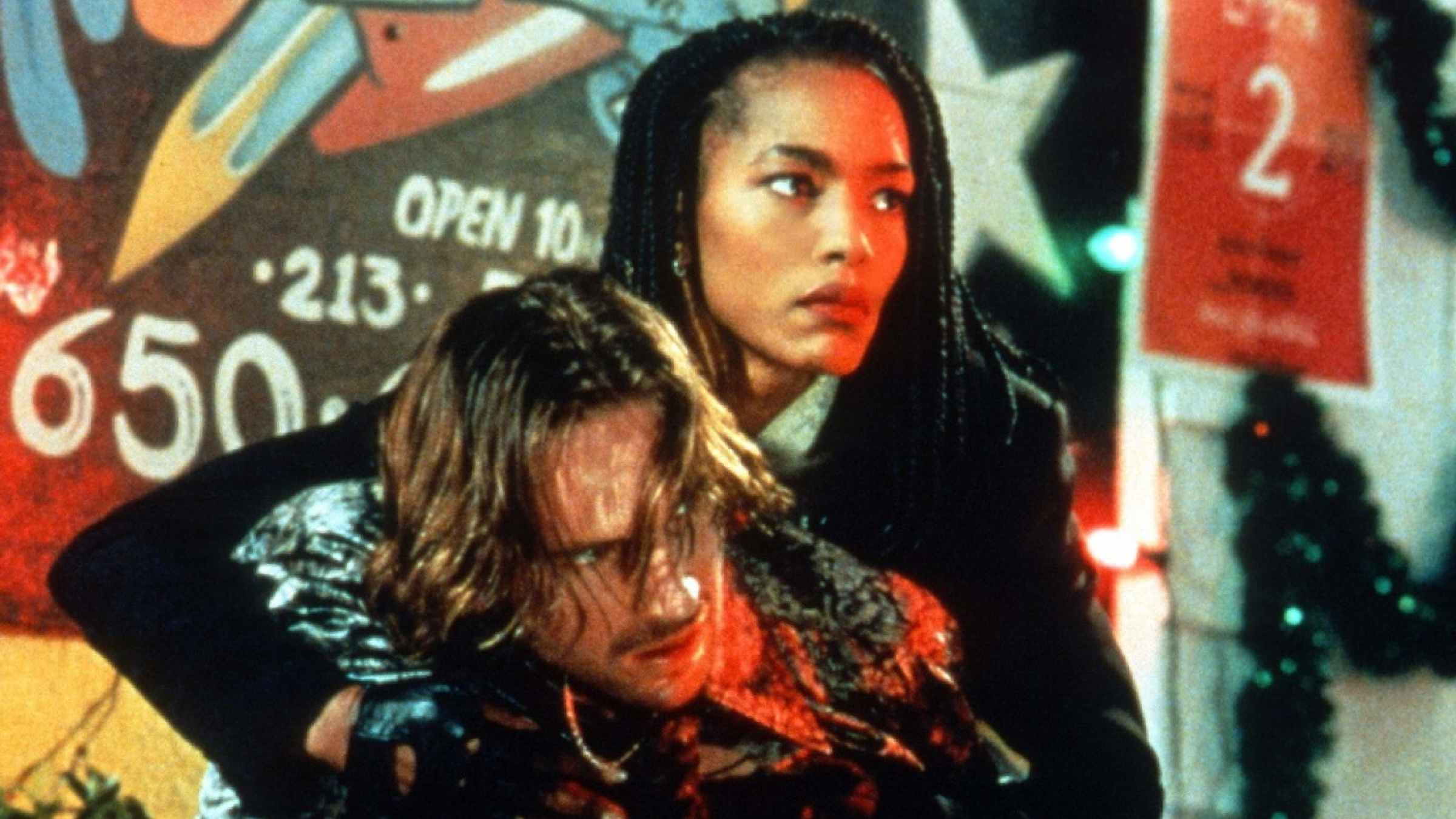
Strange Days opens with a remarkable moment of cinematic voyeurism, a morbid act of willful complicity disguised as sheer kinetic pleasure. In first person, we watch as a would-be robber is frantically chased out by the police, ultimately falling to his death. Soon enough, we’ll learn that we’ve been watching a virtual memory, one that can be felt and experienced through a proto-VR headset, and one that is sold by nebulous street urchin and creature of the night Lenny Nero (Ralph Fiennes). We will also learn that Nero is tormented by his own memories of ex-flame Faith Justin (Juliette Lewis), who now runs with bigger fish crime lord Philo Gant (Michael Wincott, so you know it’s a mid-‘90s film). He, like the film’s opening, is willing to run head-first into a violent world, and he is only held back from his darker impulses by a platonic but ambiguous relationship with extraordinarily competent bodyguard and driver Lornette “Mace” Mason (Angela Bassett). These relationships will expand and knot and inflame and fold in on themselves over almost 150 minutes of screen-time, but, for the first few minutes, we are in a blissfully neurotic and disturbingly ecstatic cinematic present-tense, a scene which impels us to look and to look away in equal measure, and during which we can think of nothing else.

Here, in the first minute, director Kathryn Bigelow updates her breathtakingly fluid-frenetic chase sequences from her prior apex Point Break, itself a story about how an audience-surrogate is tempted by the anti-social thrills the promise of escape offers, into a deliciously disturbing treatise on the uncanny thrill of cinema itself. Demanding that we participate in the act only to have the violence turned on us as we fall to our doom, the film opens with a self-implicating gesture that serves as Bigelow’s fullest statement of art not as a beautiful getaway but an elegant trap that invites and disfigures us in all its grueling and emotionally invigorating but disturbing and self-assaulting complications.

While this isn’t without its tensions and difficulties, even what we might call failures, and arguably the film’s overall interest in technological voyeurism is more notable for its vigorousness than its originality (given that the theme received such a consistent showcase in Hitchcock’s films, among many others), Strange Days is a pretty nervous, pulsing stylistic and conceptual workout that remains far more legitimately troubled about more serious topics than most films of its budget would even know what to do with. A pungent fulfillment of what her ex-husband James Cameron more than a decade before called “Tech Noir,” Strange Days explores themes of voyeuristic addiction and self-flagellation by playing around the boundary between filmmaking, fetishism, and observation in a way that borders on cinematic autoerotic asphyxia. It feels like the film is trying to destroy itself, dazzlingly so at times, but never loosely nor arbitrarily. This is throat-knot political popular cinema of the finest variety.

Continue reading

Film Favorites: Mirror

In Sculpting in Time, his exquisite paean to the soul-nourishing ineffability of artistic creation, Russian cinematic maestro Andrei Tarkovsky promises and then interrogates his art form’s relation to the world.Cinema, he informs us, moves beyond abstraction and engages the real in all its remarkable tangibility. Yet for all its adeptness and flexibility – indeed, because of it – film cannot really see the world as it is.It, like memory, is too distant from the thickness of reality, but also too close, a paradox that marks cinema as more and less than reality, a way of existing that is so touched by reality, so open to it, that it cannot ever distance itself enough to name reality as such. It is torn between feeling out reality in all its hyper-presence and holding back from it like a specter.

This tension, it seems, is cinema’s gift to us. In a world of unclarifiable external forces, acknowledging and reckoning with the complexity of the world around us often feels like an act of condemnation, dooming us to a fatal enmeshment in systems that limit and violate us. Threatened by the world, we produce either illusions of mastery over it or prophecies of surrender to it. This seems to be Tarkovsky’s critique, in his writing, of symbols: they abstract and attempt to master reality, and they posit control as the only alternative to evaporating the self into the world. In between diffusing into the pure immediacy of reality’s flux and, conversely, stopping it in a congealed concept, Mirror instead sees our lives as, to use one of its own metaphors, an impression on a pane of glass fading away. And it sees cinema as the form of our lives. Cinema is not really the mirror of reality, but the process of the ghostly touch leaving its mark and then letting go as it is displaced into the ether of an often ephemeral existence. And cinema, like life, is the act of watching itself come and go, engage with the world enough to stain it and color it anew and then acknowledge and grapple with the eventual invisibility of that interaction. Reckoning with the world not as a cosmic choreography we control but a lived encounter with an experiential symphony, Tarkovsky’s film invites us to see and feel the external in all its unmediated glory and ravishing awe rather than impress dogmatic meaning upon it. However, it also lets us know that symbolizing as an incomplete act of understanding and naming reality is part of this flow, not only a break from it. For this director, with significant spiritual acumen, nature is both a cavernous catalyst of possibility and a diaphanous fabric suffusing all existence. It surrounds us, legitimizing and potentializing our own efforts to exist, and to suffer its existence. Cinema’s capacity to renew our contract with the world, to see it in a new way or expose an alternative aspect of what we might otherwise pass by unthinkingly, bestows upon us a capacity to explore the world generously and expansively, to feel gossamer threads of relation across time and space. Cinema cannot see the world, truly, because it is with the world. While cinema, like all art, abstracts us from the world, it also returns us to it because that abstraction is our ability, as humans, to create with that world. If Siegfried Kracauer once called cinema the “redemption of physical reality,” Tarkovsky is one of physical reality’s most sensitive and receptive prophets. He treats film as the closest thing we have to genuine grace.

Continue reading