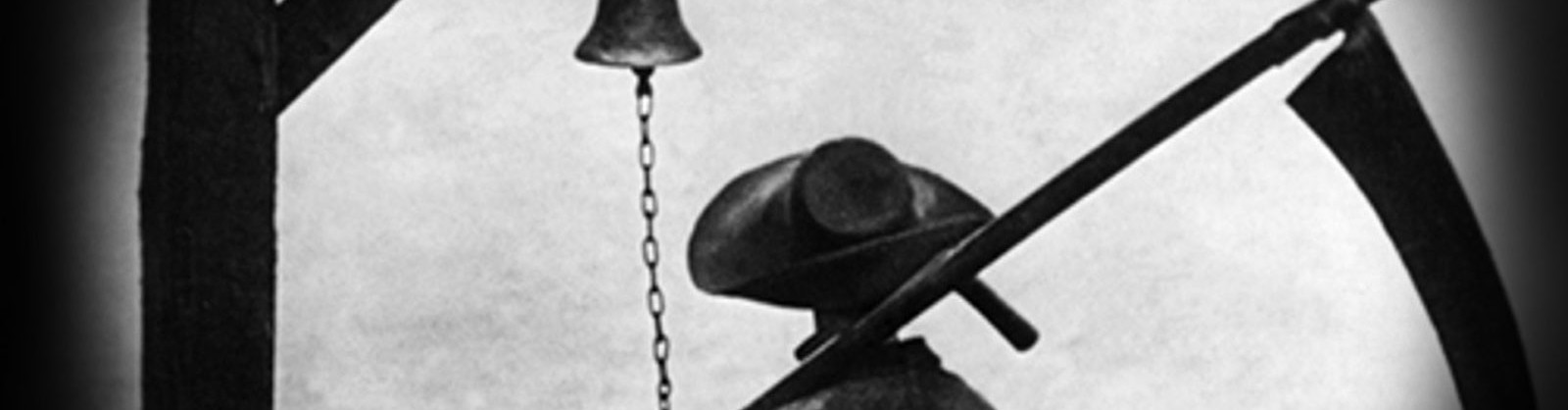
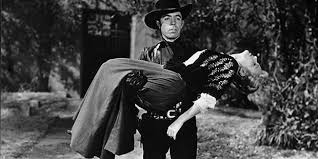
The Weird Western was born out of the very myth of the West itself. In American lore, the frontier of the Southwest was never not an invitation to mythologize and a call to speculate. Its material reality was both shot through with and held up by an imaginative topography that cast its expansive eye on to the nation’s iridescent understanding of itself. Already in the 1860s, Edward S. Ellis’s The Steam Man of the Prairies’ suggested the paradox of mystical machinery in the West: frontier living was a nominal revolt against civilizational order that was, finally, a harbinger of it. By the release of Curse of the Undead in 1959, nearly a century later, the Western frontier had thoroughly suffused the American mindscape, and the Weird Western understood the West as a mental canvas on which America’s vision of itself could be shot through a dark carnival mirror.
But the Weird Western signaled no default orientation. Its logic was a poetics of amplitude. The sacred frontier of untampered moral, spiritual, and economic progress could become a bastion of interstellar possibility in the Space Western. On the other hand, America’s history of genocide and material extraction could malevolently rematerialize as a cruel and unforgiving terrain wracked by violence and spectral presences of uncertain origin in the Gothic Western.
The latter, as a subset of the Weird Western, was still a rare breed in 1959 though, an uncommon wraith haunting the cinematic scenery, so much so that Universal Studios, near-monopolistic purveyor of horror cinema in the U.S. during the Old Hollywood era, nearly waited until their own demise to cast their shadowy eye on the American West. One ought not be surprised. While Westerns were perennial features of the Old Hollywood landscape, even the most sober, critically-minded work in the Old Hollywood genre seldom exposed the metaphysical terrors that doubled as the negative side of the desert’s eternal strangeness. If the Wild West promised an otherworldly poetics of dreamy becoming, it was also haunted by a netherworld of settler brutality.
Yet when horror did finally go to the Southwest in the 1950s, it typically refused the gothic arm of the past for maniacal creations of atomic science run amok and invaders from foreign locales. These were figurations of distinctly modern anxieties about the U.S.’s place in the world. These texts, sci-fi horrors like Them!, lament America’s warmongering and tampering in God’s domain, but they often frame the terror as a sudden, apocalyptic failure to extend a glorious national tradition, a jeremiad that leaves America’s history uninterrogated. Giant ants invited the nation to question its present actions, but not to investigate its soul.
Curse, however, directly casts a dark pall over America’s optimistic history by framing a hallowed ground of unchecked ambition as an unearthly landscape haunted by grim reminders of its own failure to escape a past that looms just beneath. Vampires, in Edward Dein’s film, are always ready to sink its fangs into the neck of a nation obsessed with its own future, unwilling to acknowledge its past, let alone atone for it. The film’s antagonist Drake Robey (Michael Pate), a centuries-old outlaw and bounty hunter who was killed centuries before, when the Southwest was still colonized by Spain. As a devastating moral referendum on frontier politics, he is a decidedly cruel killer who wields superhuman potency in a Nietzchean void where you have the “right to do anything you want if you can do it.” The film that unleashes him treats him as a dark reminder of the complicity of the renegade gunslinger and the bloodsucking vampire.
When he is hired by Dolores (Kathleen Crowly) to kill Buffer (Bruce Godon), who she believes to have offed her father Dr. John Carter (John Hoyt), in reality orchestrated by Robey, he ingratiates himself into the town around him all too easily. His withering “as if I’ve never left my own tomb. It’s good for a man to come home and hear words heard before,” spoken to the town’s moral center Preacher Dan (Eric Fleming), offers a damning portrait of the American West as little more than a cycle of perpetual stasis and ruinous destruction, something the film most potently evokes in a beautifully ghastly motif of a crypt doorway, turning John Ford’s famous images of liminal doorways, symbols of ambivalent possibility for Ford, into a haunted reminder of the pull of the past and the pretensions of progress. His “work” as a bounty hunter, whose career separates me from the rest of the world,” uncannily figures what the historian Richard Slotkin called American “regeneration through violence” in disturbingly literal terms.
While he stalks the land, Curse of the Undead also understands Robey not as a sudden shadow stalking a beautiful community but a revelation of that community’s own internal contradictions. The film’s lack of establishing shots, presumably the practical results of a parsimonious budget, suggest a world shattered by confusion and strung together out of bits of doubtful hopes and dreams. Robey’s intimations of cosmic violence – “this gun don’t care who it shoots” – suggest some inexplicable force over the landscape that simply happens to have channeled into him. Later, he remarks that “death is my life! It’s a force I can’t control!,” an exclamation many cowboys themselves might have uttered.. Thus is the critical purchase of the Weird Western. It doesn’t so much pervert the West as recognize how it was always a battleground of forces, and pretensions of forces, as they became excuses for untold violence. In defamiliarizing the genre, the film only lays it bare.
Score: 7.5/10
 The Long Take