
Monthly Archives: November 2024

Midnight Screamings: Curse of the Undead

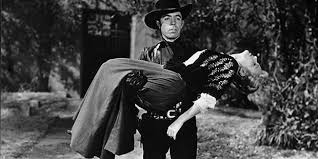
The Weird Western was born out of the very myth of the West itself. In American lore, the frontier of the Southwest was never not an invitation to mythologize and a call to speculate. Its material reality was both shot through with and held up by an imaginative topography that cast its expansive eye on to the nation’s iridescent understanding of itself. Already in the 1860s, Edward S. Ellis’s The Steam Man of the Prairies’ suggested the paradox of mystical machinery in the West: frontier living was a nominal revolt against civilizational order that was, finally, a harbinger of it. By the release of Curse of the Undead in 1959, nearly a century later, the Western frontier had thoroughly suffused the American mindscape, and the Weird Western understood the West as a mental canvas on which America’s vision of itself could be shot through a dark carnival mirror.

But the Weird Western signaled no default orientation. Its logic was a poetics of amplitude. The sacred frontier of untampered moral, spiritual, and economic progress could become a bastion of interstellar possibility in the Space Western. On the other hand, America’s history of genocide and material extraction could malevolently rematerialize as a cruel and unforgiving terrain wracked by violence and spectral presences of uncertain origin in the Gothic Western.

The latter, as a subset of the Weird Western, was still a rare breed in 1959 though, an  uncommon wraith haunting the cinematic scenery, so much so that Universal Studios, near-monopolistic purveyor of horror cinema in the U.S. during the Old Hollywood era, nearly waited until their own demise to cast their shadowy eye on the American West. One ought not be surprised. While Westerns were perennial features of the Old Hollywood landscape, even the most sober, critically-minded work in the Old Hollywood genre seldom exposed the metaphysical terrors that doubled as the negative side of the desert’s eternal strangeness. If the Wild West promised an otherworldly poetics of dreamy becoming, it was also haunted by a netherworld of settler brutality.

Continue reading

Midnight Screamings: Children of the Corn III: Urban Harvest

The original cinematic adaptation of Children of the Corn was one of the early casualties of the early Stephen King explosion. Like a good many of the man’s early texts, the story is a crazy-quilt of different fabrics and textures, an uncanny divorce from reality tethering together themes and questions without always trying to develop them. King’s story is a vision of corruptible children and generational trauma that also examines a wheezing, necrotic marriage and triples as an early exploration into a genuinely cosmic horror. In its short span, though, you mostly get the sense that King himself simply wasn’t sure about settling down into the pleasantly banal domestic sphere that, the story suggests, was at once a conduit for unholy forces and a way of denying them.

The presence of so many themes does not, as it would in another author, suggest a truly deliberate mind exploring the interweaving truths of many seemingly separate terrors. Rather, if they remind us that King could turn almost anything into horror, they also suggests that horror, somehow, wasn’t what he was most interested in after all. King was not a man tormented by suggestions of otherworldly forces, as say, H.P. Lovecraft was, or terrified by humanity’s capacity to channel them, as was, say, Mary Shelley. This was a man deeply bruised by alcohol and unsure of his relationship with the people who ostensibly loved him most. “Horror” could, for all the man’s reputation as a hell-raiser, often simply be window dressing for essentially sentimental stories that happened to channel emotions that slipped into the darker side of the world and didn’t pay too much attention to the reality principle. What, precisely, was horrifying is whatever happened to enter King’s mind that day. If parts of Children of the Corn could be filed next to Cujo as among King’s most quotidian horrors, its abutment of the inexplicable and the mundane are also indication enough that the author was willing to treat the genre more as a playground, or a toolkit, than a mission statement. His horror was, finally, an act of bare survival, not an existential vision.

Continue reading

Midnight Screenings: Incubus

“Alleged horror,” remarks a youtube description of the long-forgotten, once-lost Incubus. The poster seems to intend this as a criticism, but the film itself begs to differ. Incubus seems to delight in not being very upfront about the horror it wishes to unleash, including, quite literally, having to convince a Church that they were not making one in order to get the film made. It’s as though the film itself is afraid to call itself horror, or perhaps doesn’t want to be, all the more potent for a text feeling itself out in the moment, and that doesn’t want to stick around to let us figure it out. It’s a subterranean film, so much so that the actor playing the titular demon awakened late on, and who seems none too pleased about being back on this earth, would be back in the grave before the film’s release.

Incubus is a work that makes a virtue, or demon, out of necessity. It stalks our pretensions of perfect cinema. Written on the fly so that Leslie Stevens could keep up the momentum of the recently cancelled television masterpiece The Outer Limits, the brilliantly exploratory show that he unleashed upon the world and that, more importantly, conjured cinematographer Conrad Hall right out of nowhere and on a path to redefining color cinematography. To thin the membrane between cult American television and European art house cinema, it was filmed entirely in Esperanto, an entirely artificial language with no organic connection to any lived community, and it was framed as a folk horror film despite the “folk,” in this case, not existing. While other critics have pointed out this paradox as a simple curiosity, it’s really more of a thesis statement. While the “folk horror” genre purports to channel a group’s fears, Incubus almost – if you squint right – investigates the very idea of the genre: it implies an organic effusion of a single culture’s growth, but it, in fact, reminds us that “single culture” itself is entirely constructed object.

Continue reading

Midnight Screamings: The Bird with the Crystal Plumage

In announcing his status as a young director to be reckoned with, Dario Argento couldn’t have picked a more provocative opening gambit, one that unapologetically, if surreptitiously, seeds his future career into one scene. Witnessing a silent murder attempt in an art museum, protagonist Sam Dalmas (Tony Muante) runs to the aid of the wounded woman, only for the would-be murderer’s ghostly-gloved hand to push a button, trapping him in between the two glass panes in the museum entrance. Neither in the museum nor outside, all he can do is hopelessly watch an imminent demise he cannot even hear. Both of these people do leave the scene of the crime alive, but for the moment, Argento lets us linger in a liminal zone between reality and art, life and death, sound and silence, helpless and unwitting voyeurs to a killing that appears to be posed for him – and painted like an art object for us – but which he can only tenuously interfere in.

Positioned between Mario Bava’s earlier Hitchcock riffs and Lucio Fulci’s (and Argento’s own) later, lurid arias of psychedelic blood, The Bird with the Crystal Plumage also feels like a liminal realm for Italian horror in general. In 1970, Argento was clearly a director poised to move the genre from hell to purgatory, from brutally experimenting with society’s sins to exploring the very limits of narrative consciousness in a miasmic middle-ground. But Bird is not as demonic, nor as speculative, as his imminent, genre-transforming works. He’s still the lizard cleverly stalking his prey, not the shape-shifting chameleon daring us to join him in the abyss of cinematic solidity itself. The opening’s portrait of embroiled masculinity and helpless passivity obviously recalls Hitchcock’s Rear Window, and The Bird with the Crustal Plumage never quite escapes the Hitchcock obsession of the earliest giallos (and the likes of Brian De Palma), nor achieves the infectiously fractal vision of a completely broken world that Mario Bava unleashed with Bay of Blood one year later.

Yet Bird, like many great horror films, is already marvelously holding a knife to its own throat, achieving a kind of perverse self-awareness about its own debt to cinema history and the limits of its moral imagination. This is a film that knows how troubled it is, that senses its own participation in modernity’s foibles all too well. It opens with a man witnessing a helpless woman about to be murdered, framed as an art object worthy of the classics, and it closes with a reminder of just how blind he truly is. If the film, too, is myopic in many ways, it also exhibits the genre’s gleefully cruel ability to remind us that we, after all, are the ones who clicked play. The film, like most giallos, seems like a sledgehammer or a machete. We don’t notice it sneaking up on us with a scalpel, hellbent on disfiguring both its genre and our viewing habits, reminding us of the consequences of our inattention.

Continue reading