
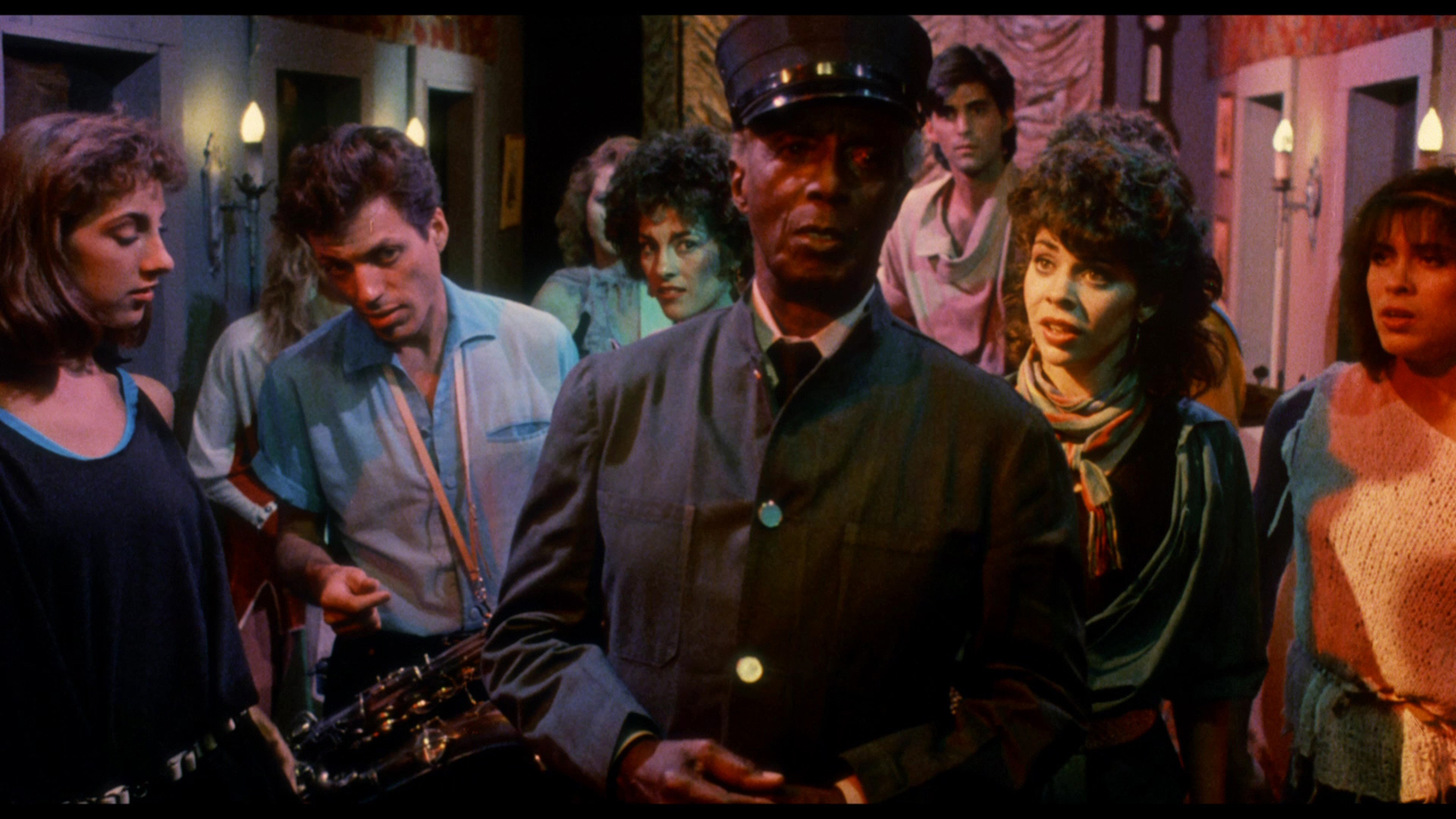
Night Train to Terror is undeniably trash, but its pleasures, paradoxically, are entirely intellectual. In its own unintentional, mercenary way, it severs the tension cord linking high and low art. It is, finally, only really valuable as a theoretical exercise, a strange cinematic mad science experiment (a connection that runs deep in cinematic history) in which several unfinished older films have been sliced and diced to pieces and reassembled into walking corpses of their ostensibly living selves. Born out of the forgotten remainders of unfinished horror pictures, this is an avowedly monstrous exercise in revivifying films that, as Frankenstein’s Monster himself once said, “belong dead.” That the film itself admits that this undertaking may itself be an immoral act – “bodies for money,” one character remarks in the first short film – is simply part of the fun. Night Train to Terror is a strange kind of cinematic meta-archive that salvages films while also working as proof for both the argument that this very salvaging is a heroic act and, conversely, that the films should have never been salvaged in the first place. It is, in the most literal possible sense, hack work.
All of this is to say: Night Train is probably an un-reviewable cinematic object. It feels like outsider art, so anything like a conventional standard of textual coherence or roundness seems essentially meaningless for parsing it or accessing its soul. Make no mistake, though: this is no labor of love. Its only investment is ensuring that scraps of lost and found footage might make a few dollars when unleashed on the unsuspecting, or on those who have deluded themselves into thinking this is a real movie, or on people like me who, apparently, hate themselves. For director Jay Schlossberg-Cohen, this is self-evidently an attempt to salvage a collection of films that couldn’t, or wouldn’t, cohere the first time around, footage that, as if by some demonic force, simply would not coagulate into a stable form.
On-screen, the discarded bits of these movies – here, titled “The Case of Harry Billings,” “The Case of Gretta Connors,” and “The Case of Claire Hansen” – have been distorted beyond narrative recognition into a grotesque simulacrum of whatever they might have been. As figured in Night Train to Terror, they are also cases for the prosecution, stories presented before God (Ferdy Mayne) and Satan (Tony Giorgio) to judge the souls of the recently deceased. God and Satan, incidentally, are presently dining in the film’s wraparound narrative on a cosmic train hurtling in outer space to oblivion. The train is also occupied by a rock band oblivious to their imminent demise and seemingly trapped in a perpetual loop of performance to an audience of no one. What God and Satan are doing on this train, and why they have the time to argue these three cases specifically, and why they are joined by a New Wave band pitilessly unaware of their own unoriginality, remain questions that are better not asked, the stray effusions of a film whose reality is so thin and nebulous that its mind paradoxically reaches the void. The two supernatural creatures, despite the purpleness of their prose, don’t even seem to be able to stitch two words together without changing tones between syllables, so conceptual and logical coherence isn’t exactly a fair expectation at that point.
Nor is coherence available within the segments themselves. It is almost certainly not the case that anyone involved in reupholstering these three films-within-a-film really lamented their premature demise. The individual pieces of this film have transparently been chopped and screwed for maximum pugnacity and punch, a kind of greatest-hits version of themselves with the narratives bathed in acid and burned away. Featured here, the stories have been purified to amusingly disturbing results that seem to question the whole premise of the film containing them. Case in point: the second story, originally titled Death Wish Club, presumably concerns a club with a death wish (you don’t say?) that organizes self-destructive games to test the limits of human experience. At one point, the nominal protagonist dramatically wishes one of the other members would be killed, summoning a decade’s worth of hatred in one sentence. As we watch it though, they boldly proclaim that they want the other person “out of my life, once and for all, out of my life for good” to a person we have literally not seen once thus far, and who we never see again. Their relationship stalks the film like a spectral presence, the phantom pain of the film’s cut-up, Burroughs-esque anti-poetry. By the end of this particular story, the woman whose death we are ostensibly witnessing, on the path to Satan and God debating the fate of her soul, simply goes off and lives happily ever after. A random woman dies instead, someone who neither God nor Satan seems to have much interest in, a marker of the film blissfully and uncaringly admitting to us that its frame narrative has collapsed before our very eyes and it doesn’t care in the slightest.
That kind of self-abnegation, a sort of film-length final gasp, is a thing to cherish. You could, after all, write much the same thing about, say, Avengers: Endgame, but you don’t see Disney stabbing itself in the gut in the middle of the film and reveling in the slow drip of its own anima. Night Train, meanwhile, has the courage to seemingly destroy itself in the very act of creation. It’s a bewilderingly strange concoction, the remains of three stillborn stories intercut with a wraparound narrative featuring a band who sing and dance like pre-mortem zombies or animated marionettes, puppets of some zeitgeist they cannot escape, figurations of some cultural demand imposed on them or some desire they do not understand and cannot quench. They brandish the phrase “dance with me” less like a genuine belief than a demonic emanation. They seem unable to recognize that they are about to die, and are even less aware that they seem to have never lived at all. It’s as though art itself – as though the possibility of an original, cohesive, self-same artistic vision, rather than the fragmented concoction born of tattered detritus and broken hopes this film offers – is on some kind of trial. A truly bizarre cinematic derangement, a work of prodigious and sublime nothingness.
Score: This would be a meaningless gesture.
 The Long Take