
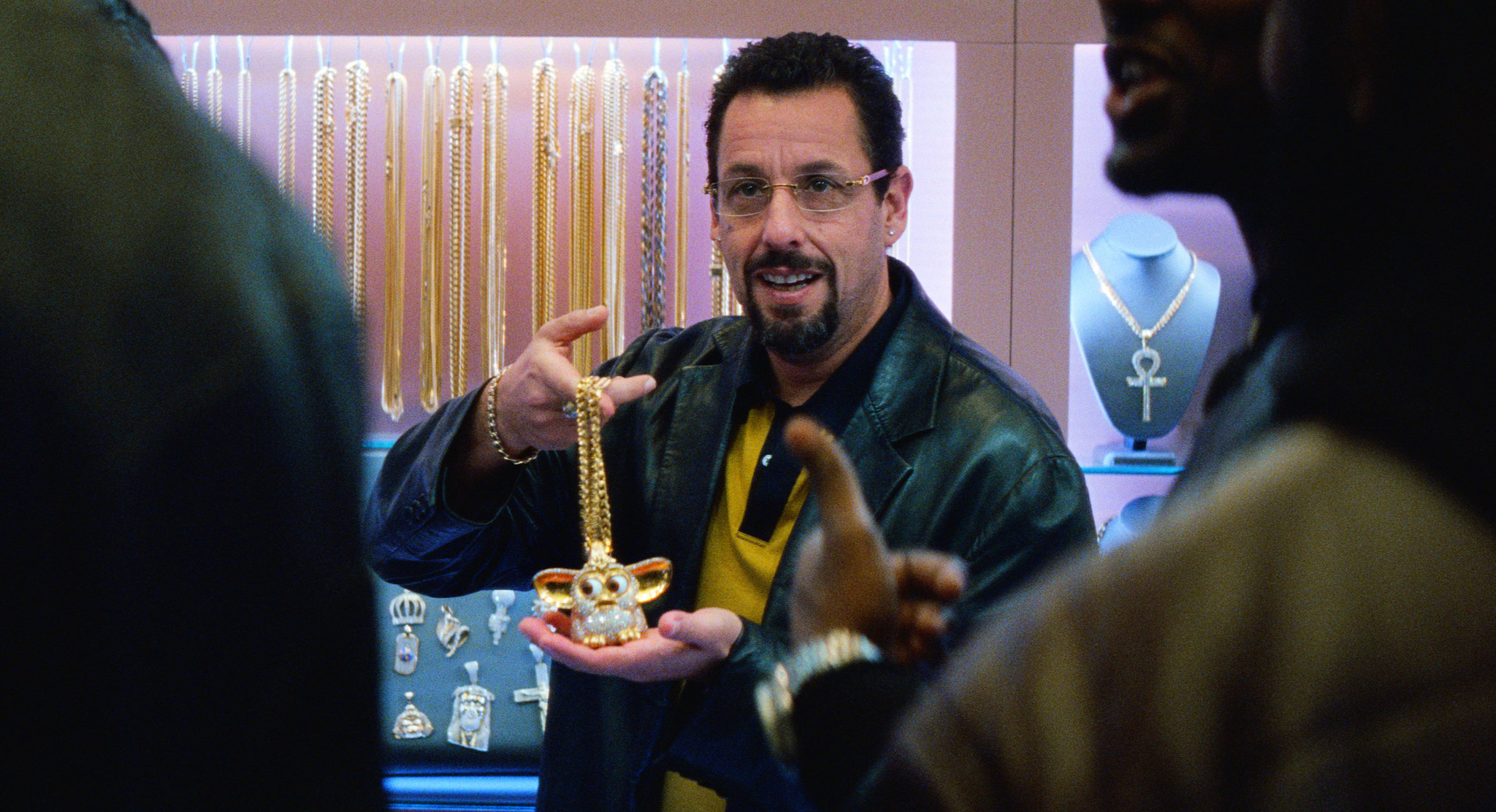
Early in Uncut Gems, writer-directors Josh and Benny Safdie (they co-wrote with Ronald Bronstein) gift us, and themselves, a visual metaphor that is simply too irresistible to pass up. After a prologue set in the blood-diamond mines of Ethiopia, a telephoto lens zooms deep into the crevices of an iridescent gem, as though excavating the soul of the diamond. The image becomes an increasingly amorphous, abstract canvas of raw colors and even rawer conundrums, an obliquely sublime carnival of sheer sensory overload. Before, that is, it finally mutates into the innards of a scan of protagonist Harold Ratner’s colon. A wonderfully grotesque metaphor for the film’s ability to find beauty in the detestable and atrociousness in the beautiful, it’s also a recognition of the ease with which the audience might overlook the violence that undergirds the artifacts of late capitalism. The cloacal excursion is a surprisingly pure encapsulation of the film itself, a sojourn into this man’s psychological innards that expose the webs of social entanglement that both construct him as himself and that invite him to believe that he can actually mobilize them for his gain before finally setting him adrift in a void of delusional egotism.
The film? It works pretty well. It’s a bit of a pity that it never develops beyond this initial, beautifully lurid metaphor, or finding variations on it. I can’t help but feel that something got lost, an intangible something missing somewhere between the anus and the mine, betwixt the film’s play of the absurd, the wonderful, and the violent. The Safdie Brothers’ Good Time was nearly my favorite film of 2017, a scintillating acid-bath of 21st century brutality and a frayed raw-nerve of psychological and architectural disarray. Uncut Gems is bigger, has more polish, and is at times more intoxicating, but it essentially repeats and in some ways reduces the formula, and like the gem at the center of the tale, it sometimes feels a bit more like the crystalline craftsmanship hides a black hole. It plays at larger thematic and geopolitical concerns, but these were already present in the earlier film, lodged between a dye pack and a hard place, and making the gestures explicit doesn’t necessarily make the film itself smarter. While it hits the ground running, it also has only, essentially, one tonal note to play from beginning to end. Despite the opening metaphor, Uncut Gems sometimes seems to work like its protagonist, so blinded by the rush of its own momentum and the thrill of its own formal beauty that it cannot quite see the full picture, let alone recognize how trapped in holding pattern it may be.
The rush is a rush, admittedly, and the thrill is, for the most part, honestly earned. This is a film that does everything in its power to evoke the choking atmosphere of sheer possibility, the way that the belief that we have an open field of play actually compresses us and squeezes the life out of us. It has a forbidding forcefield of a sonic palate that somehow manages to constrict us in the act of opening itself up, like a carnivorous plant releasing spores of sparkling metallic dust drawing any intrepid wanderer into its vise. Daniel Lopatin’s exquisite synthesizer score often seems like a demonic emanation from the gem itself, an alien artifact that is seldom seen but which organizes lines of human physical and mental energy in its name. The gem, like the score, weighs on us even when it remains invisible. When Howard cuts through the New York City streets at a pace between a strut and a shuffle, unable to stop or even look in another direction, the metallic glisten of the score takes on a gravitational quality, ever pulling him toward a forward that is actually just a spiral.
Add to that a sound mix that summons a swarm of voices and competing dialogues always threatening Howard’s supremacy in the frame, and the film starts to seem like an anti-Altman film that utilizes a dense, heterogeneous soundscape not to spread out and wander (as Altman does) but to narrow in on us and imply tightening forces that are only semi-visible but that sculpt and shrink its protagonists’ field of possibility nonetheless. The Darius Khondji cinematography is also pretty thorny, a harsh melding of vicious realism and garish ethereality, New York City greasiness and gossamer glow. For a film that traces unexpected lines of connection between all forms of matter and the entrails of one man’s belief that he can transcend them by riding the chaos of the international market to his betterment, this is stellar, pointed filmmaking. Each of these tools evokes the sense of raw potential in the air, some dormant energy all around us that invites us to search for it and weaponize it even as it is secretly using us, like a strange shimmer beckoning you that is secretly a shiv at your throat.
The shiv at the throat of Howard Ratner (Adam Sandler), a jewel seller who owns a small Manhattan shop that is mostly a cover for and means to his inveterate gambling habit, is two-fold. He is assaulted by both cosmic shrapnel, the minefield of the world he’s wandered into, and by a knife he’s fashioned all on his own, his inability to curb or question his addiction. Evidently living beyond his means with his suburban wife Dinah (Idina Menzel) and an apartment for his employee and mistress Julia (Julia Fox), he is heavily in debt to loan shark Arno (Eric Bogosian), who constantly sends an unnamed heavy muscle (Keith Williams Richards) to do something between pestering and brutalizing Howard. An opportunity arises when Kevin Garnett (playing himself) is introduced to Howard’s newest diamond by Howard’s liason Demany (Lakeith Stanfield). Garnett becomes obsessed with the diamond and increasingly wants it, by legal means, as his lucky charm for the finals of the Eastern Conference, which motivates Howard to sell it to Garnett so he, in turn, can bet on an absurdly unlikely series of events at his Boston Celtics game in hopes of paying off his debt and making it big.
At times, one feels the film, like the diamond, is giving us the run-around, a bit too busy wowing us with its look and feel (this is peak vibes cinema) to truly ruminate on the existential fate of these people with the meditative allure of, say, a Michael Mann. Sandler’s much-touted central performance meanwhile, isn’t as generative as his work in Paul Thomas Anderson’s Punch-Drunk Love, where he similarly turns the mirror onto his overgrown child persona and unleashes the violence of his inner emptiness. Ratner is all negative charisma, an over-confident neurotic whose explosions only reveal his incompetence, and Uncut Gems studies his fluctuating energy levels with Cassavetian force and Malickian spaciousness. But there’s increasingly less to him as the film goes along, and, to my taste, Sandler sometimes indulges his accent and physical posture at the expense of finding the emotional life of his character. Again, we get the sense of a wide-open film that is both strangling us and, perhaps, shrinking itself, becoming just another stylized suspense vehicle rather than a genuine character study.
Still, the film can be hard to shake, and there are more than a handful of exquisite conceptual and cinematic frissons. As Howard shows Kevin Garnett the jewel, the film implies a deeper bond between them on multiple levels. Howard mentions that the diamonds are mined by Ethiopian Jews, which, for him, we infer, connects automatically, too easily, to a history of Black-Jewish American relations. The film intimates that Howard is both secretly longing for this connection and using it, regardless of whether it is reciprocated, as a sales tactic, and that the film knows that most Black Africans are far more likely to work these diamonds than wear them. You get the sense that Howard and Garnett believe in a kind of cosmic continuity that binds them and that associates them with the continual high of success they can’t escape.
When Garnett first views the diamond, the combined weight of history and the desiring pull of these two middle-managers of modern capitalism is loaded with unresolved complexity and subliminal, internal conceptual tension. That is, before the introspective but delusional force of the gem’s gravity suddenly pulls Garnett into the glass which shatters beneath him, a gut punch that hits because it is only the force of these two men, and the pressure of their wishes, that pulls them down. They both hope to produce a future that is more available for them than they are for themselves now, but the film reminds us that they can only fall. Howard, the film suggests, is a truly wayward man who believes in the fallacy of individual confidence arrayed against systematic forces and ultimately becomes buried by those forces. In the final image, as the light of his many diamonds refract on his sunglasses, he has finally achieved a cruel parody of the cosmic success he so desperately and unerringly sought. He seems to be one with the rays they produce, even though it has come at the cost of his inner life. In becoming nothing, a pure husk for capitalist desires, forces, and flows to burrow in him and shoot off of him, he has exploded into the everything of his worst dreams. Hell’s Furbies are a nice touch as well.
Score: 7.5/10
 The Long Take