
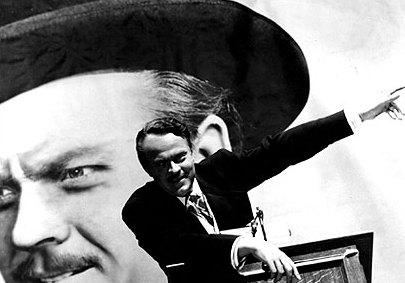
Citizen Kane opens with and then defiles a promise. The first shot is a “no trespassing” sign, and Citizen Kane immediately trespasses. The enigmatic and exceedingly wealthy Charles Foster Kane can wall himself off in a gothic manse that doubles as a prison-of-the-mind, but the camera – cinema – sees all.
Or does it? The shots that come right afterward move us inward toward the man, breaching the fragile barrier set up between him and the viewing public. But rather than clarifying, they confuse, exposing the impossible, unfinished space he has constructed, a monument to a tortured mind that prematurely closed itself to the world despite never truly figuring itself out. We move increasingly toward the lone light in an even lonelier room, a beacon that offers a hope of revelation, but the shots that seem to draw us inward toward a final truth actually scatter us all-around, toward a number of disconnected images that reveal much less than a portrait of a complete man. When we cut inside and finally encounter the titular Kane, we only see his hand, his lips, and finally, his ghostly silhouette. Instead of a procession toward closure, writer-director-star Orson Welles only offers a fragmented portrait of a man in search of a facsimile of wholeness.
It’s certainly a plentiful opening, and there’s certainly no need to add anything to the reputation of this most plentiful of films. But Kane’s odd, braying charisma endures, even as the film has endured many rounds of analytical licking and push-back. In truth, so few films are so self-important. So few films bite off so much more than they can chew. Yet this is only because so few promise the world to us like Citizen Kane. With its mixture of stylistic bravado and overworked symbolizing, of impenetrability and obviousness, of opacity and underlining, Citizen Kane is very much the film that Charles Foster Kane would have made about himself, a cinematic ego trip par excellence. This is a film that absolutely insists on itself, that demands that we pay attention with all the magnetism and mystique of Kane himself. And, like Kane himself, it ultimately dances right up to the edge of evacuating itself of nuance entirely.
In truth, then, it’s hard to miss what Kane is up to, and yet it still feels potent, a forceful, full-throated, somewhat fatiguing, and sometimes forbidding elegy for a forceful, full-throated, somewhat fatiguing, and often forbidding man who, the film admits, never really amounted to much to begin with. The problem for the film is what it can amount to beneath all the aesthetic show-boating. If Welles’s wunderkind of a film, like Charles Foster Kane’s prodigy of a newspaper, promises to disrupt the Old Hollywood facade and reveal the bristling truth beneath, it also drinks from the same well, and suffers the same conundrums, the peculiar entanglement of fantasy and reality, of films before and after. This is a paradoxical film, one that, like Kane himself, invites us in and keeps us at arm’s length, that studies the world but can be blind to itself, that welcomes us with open arms but can only offer much less that it pledges. It works because it is so patently a victim of its own ego, so unapologetically of the very Hollywood idiom it disdains, so much a product of the very style it seems to think is so soulless. Few films are as misguided as Citizen Kane, but fewer still, perhaps none other than this one, really earn these problems like Citizen Kane.
The film admits as much almost immediately. With pointed superficiality, we move from one highly inventive, showboating introduction (Kane’s death) to a second, equally showboating one: the News on the March segment that serves as a gloriously-mounted public presentation of Kane’s cloistered opulence, a hollow showcase of empty enormity that the film, with its overflowing beauty and self-aggrandizing demeanor, constantly presses up against. When we eventually learn of Kane’s origin, both his childhood and the film’s essence are laid bare in Welles’s and cinematographer Gregg Toland’s most pointed deep-focus image: a frame of young Kane playing outside in the snow in the far background of a wider image of his parents cutting a deal for his future. The frame-within-a-frame juxtaposes the weight of crushing historical forces and the innocent heart awaiting within. In many ways, both large and small, the story of a man searching for an ornamental refuge to hide his wayward soul isn’t that far off from the soul of the film, with its phenomenal but often cloistered style and its bragging technique. And it isn’t that far off from the soul of the man who made it. In a sense, Kane’s tragedy was Welles’s, and Welles’s inoperable charisma is the monstrous luster of Citizen Kane.
It’s hard to read anything else out of a scene of Charles Foster Kane running for office decked out like a Nazi propaganda meeting as he denounces New York machine politician James W. Gettys (Ray Collins), while shadowy yes-men and ghoulish on-lookers cheer. These are Welles’s fans: they worship the centerpiece text but are seemingly ready to turn on it, they maybe do not truly get it, and they perhaps, more than anything, really do actually realize how hollow it might be. Like Kane, Welles obviously fashioned himself as a populist renegade unencumbered by the formalities of political decorum and corporate submissiveness. His film recognizes that his rebellion was very much of the system he rebelled against, that he was a child of the very system he wanted to use, abuse, manipulate, and lay bare. He was the exception that proves the rule that we are all outsiders trying to lay claim to originality.
An originality that Citizen Kane both affirms and disturbs. As News on the March reporter Jerry Thompson (William Alland) tries to piece together the fragments of Kane’s life via the oblique void of his final, now-famous word, known to cinephiles everywhere, the film galvanizes Kane’s hypnotic pull – worships it, celebrates it, adores it, tries to unpack it – even as it shreds the man and his charisma to bits. Via interviews with Kane’s former best friend Jedediah Leland (Joseph Cotton), his second wife Susan (Dorothy Comingore), his butler Raymond (Paul Stewart), and his friend and assistant Mr. Bernstein (Everett Sloane), along with a trip to the archives of banker Walter Parks Thatcher (George Coulouris), Herman J. Mankiewicz’s glorious void of a screenplay tries to decode the man and then finally decomposes him, mutating classic Hollywood narrative into a travesty of classical Hollywood form. Rather than a climb to the summit of a single man, we trace and become tangled in a web of representations, haunted by the ghostly pull of a man who turned himself into a narcissistic nebula long ago.
Citizen Kane, in other words, recognizes how trapped in its own representational mesh it is, how unable it is to recover an authentic soul beneath all the facades even as it tries so desperately hard to do so. This is a film that knows that it is part of the problem. Like Kane himself, the whole film exudes an aura of over-compensating energy, like it is trying to pummel us with its virtuoso performance of cinematic mastery to avoid addressing its central tensions, the way its very form replicates the problem in the act of exposing it. Yet it is that very repetition, its willingness to submerge within Hollywood’s own faults rather than elevate itself above them, that makes the film so tragically beautiful, so finally frail beneath all the bravura, so wounded beneath the bluster. It’s the way the film aggrandizes its subject via low-angles that somehow suggest an empty carcass rather than a heroic lion as opposed to choosing the more obvious high-angles that would look down on Kane, and Hollywood, and us, with derision or pity. This is a film that knows the beauty of Hollywood well enough to destroy it from within, not from above or beyond. If the film itself is perhaps less than the sum of its world-class parts because it tries so hard to make us notice them, the very fact that it dares us not to recognize this fact makes it more than the limits of its own failure.
Perhaps the ease with which Welles grew up both too slow and too quickly made Kane both an albatross and a gift. After making the greatest film of all time, you’re never going to measure up again and, essentially, you have to find your way about the cinematic world on terms otherwise. Welles’ hammy, feverish performance of a man whose charisma blocked his lack of personality, whose own theatrics expose a lack of assurance, including willing to put up money donate to a fund to run himself out of business, isn’t exactly far from Welles’s own life story. In its precocious mixture of forthrightness and mystique, the broken snow-globe that opens the film is also an all-too-functional crystal ball, a film that in many ways peers into its own maker’s future.
If we are promised a vow of cinematic resistance from a truly original voice then, we end with an assurance of how unassured that promise, that director, really is. Kane takes the bull of the machine by the horns and, finally, gives us a blood covenant with the enemy, using its own grandiose style to unmake itself. It lurches between beauty and banality, perhaps rendering that binary obsolete not through analytical precision but through a sheer charismatic force that it reminds us, again and again, is not going to stand up under close scrutiny. From the future director of The Trial, a deliriously disturbed aria of cinematic confusion, and F for Fake, a wonderful magic trick of cinematic charm, this is both one of the great punishing cinematic labyrinths and the most spellbinding of cinematic conjuring acts, the star-crossed voyage of a lone wanderer and what they used to call the Hollywood Machine, a doomed marriage where neither leaves uncorrupted.
Score: 10/10
 The Long Take