
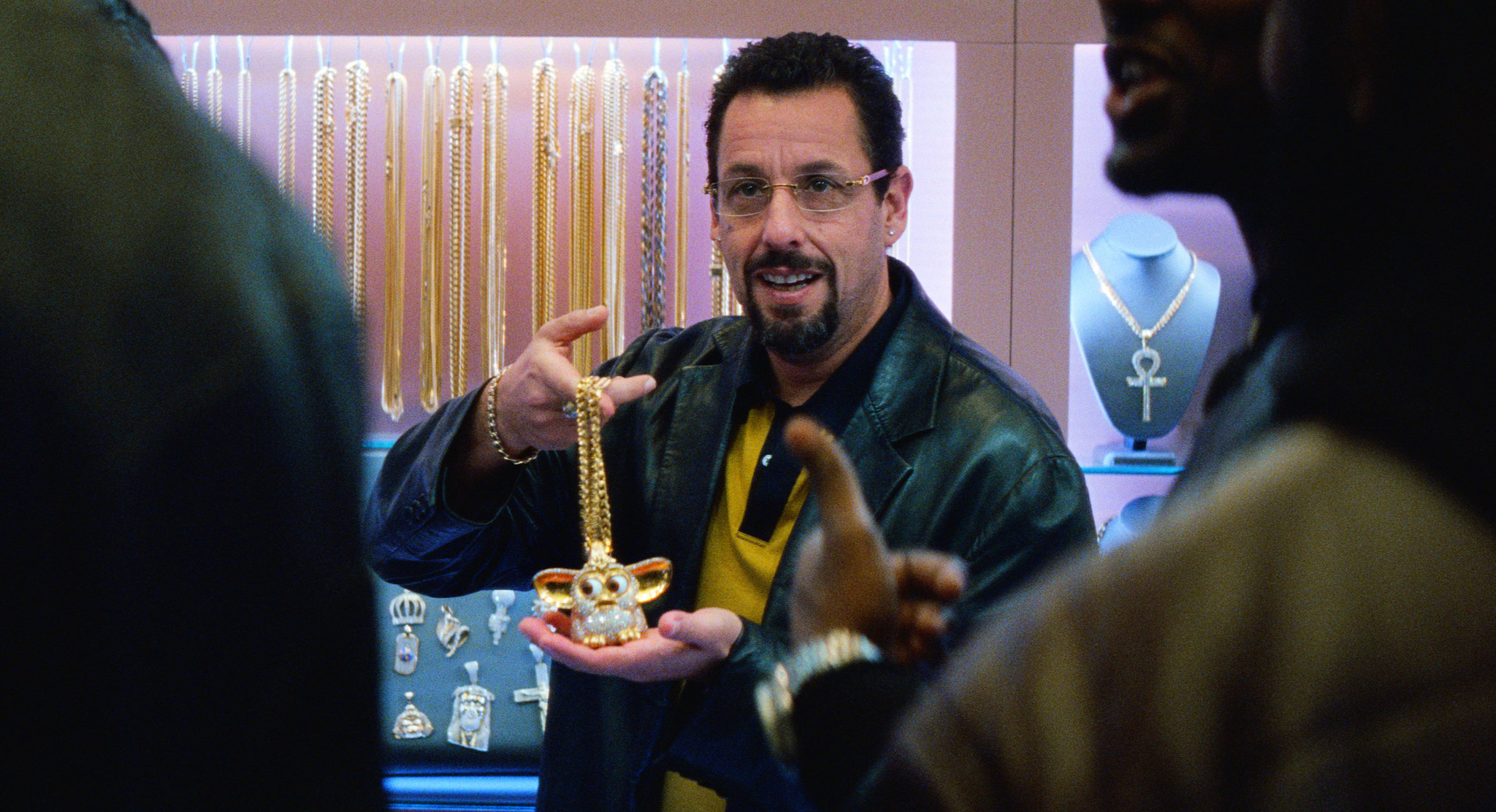
Early in Uncut Gems, writer-directors Josh and Benny Safdie (they co-wrote with Ronald Bronstein) gift us, and themselves, a visual metaphor that is simply too irresistible to pass up. After a prologue set in the blood-diamond mines of Ethiopia, a telephoto lens zooms deep into the crevices of an iridescent gem, as though excavating the soul of the diamond. The image becomes an increasingly amorphous, abstract canvas of raw colors and even rawer conundrums, an obliquely sublime carnival of sheer sensory overload. Before, that is, it finally mutates into the innards of a scan of protagonist Harold Ratner’s colon. A wonderfully grotesque metaphor for the film’s ability to find beauty in the detestable and atrociousness in the beautiful, it’s also a recognition of the ease with which the audience might overlook the violence that undergirds the artifacts of late capitalism. The cloacal excursion is a surprisingly pure encapsulation of the film itself, a sojourn into this man’s psychological innards that expose the webs of social entanglement that both construct him as himself and that invite him to believe that he can actually mobilize them for his gain before finally setting him adrift in a void of delusional egotism.
The film? It works pretty well. It’s a bit of a pity that it never develops beyond this initial, beautifully lurid metaphor, or finding variations on it. I can’t help but feel that something got lost, an intangible something missing somewhere between the anus and the mine, betwixt the film’s play of the absurd, the wonderful, and the violent. The Safdie Brothers’ Good Time was nearly my favorite film of 2017, a scintillating acid-bath of 21st century brutality and a frayed raw-nerve of psychological and architectural disarray. Uncut Gems is bigger, has more polish, and is at times more intoxicating, but it essentially repeats and in some ways reduces the formula, and like the gem at the center of the tale, it sometimes feels a bit more like the crystalline craftsmanship hides a black hole. It plays at larger thematic and geopolitical concerns, but these were already present in the earlier film, lodged between a dye pack and a hard place, and making the gestures explicit doesn’t necessarily make the film itself smarter. While it hits the ground running, it also has only, essentially, one tonal note to play from beginning to end. Despite the opening metaphor, Uncut Gems sometimes seems to work like its protagonist, so blinded by the rush of its own momentum and the thrill of its own formal beauty that it cannot quite see the full picture, let alone recognize how trapped in holding pattern it may be.
The rush is a rush, admittedly, and the thrill is, for the most part, honestly earned. This is a film that does everything in its power to evoke the choking atmosphere of sheer possibility, the way that the belief that we have an open field of play actually compresses us and squeezes the life out of us. It has a forbidding forcefield of a sonic palate that somehow manages to constrict us in the act of opening itself up, like a carnivorous plant releasing spores of sparkling metallic dust drawing any intrepid wanderer into its vise. Daniel Lopatin’s exquisite synthesizer score often seems like a demonic emanation from the gem itself, an alien artifact that is seldom seen but which organizes lines of human physical and mental energy in its name. The gem, like the score, weighs on us even when it remains invisible. When Howard cuts through the New York City streets at a pace between a strut and a shuffle, unable to stop or even look in another direction, the metallic glisten of the score takes on a gravitational quality, ever pulling him toward a forward that is actually just a spiral.
Add to that a sound mix that summons a swarm of voices and competing dialogues always threatening Howard’s supremacy in the frame, and the film starts to seem like an anti-Altman film that utilizes a dense, heterogeneous soundscape not to spread out and wander (as Altman does) but to narrow in on us and imply tightening forces that are only semi-visible but that sculpt and shrink its protagonists’ field of possibility nonetheless. The Darius Khondji cinematography is also pretty thorny, a harsh melding of vicious realism and garish ethereality, New York City greasiness and gossamer glow. For a film that traces unexpected lines of connection between all forms of matter and the entrails of one man’s belief that he can transcend them by riding the chaos of the international market to his betterment, this is stellar, pointed filmmaking. Each of these tools evokes the sense of raw potential in the air, some dormant energy all around us that invites us to search for it and weaponize it even as it is secretly using us, like a strange shimmer beckoning you that is secretly a shiv at your throat.
Continue reading

 The Long Take