
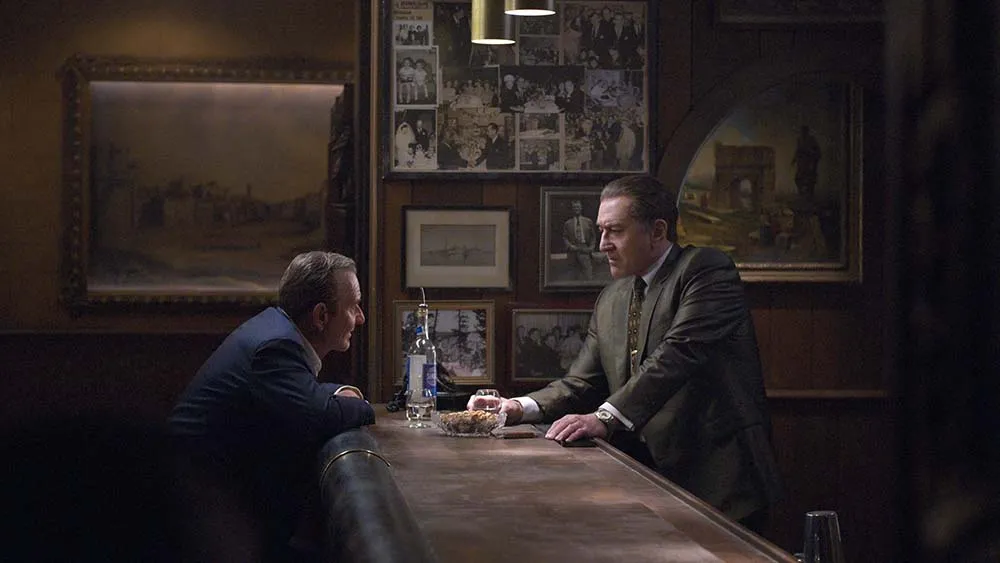
The Irishman is both a stern rebuke and a sober reckoning. After the breathtaking but ultimately tiring The Wolf of Wall Street, with its grotesquely flippant energy (grotesque in good ways as well), and the sublimely adventurous but sometimes hermetic Silence, The Irishman is a self-conscious homecoming. It announces itself as a return to the primordial breeding ground from which Scorsese’s career came. On one hand, it is a return to form promising a severe sense of finality. It tethers its director’s fifty years of cinematic releases together and ravages them, burning the director’s less critical supporters with righteous indignation. On the other hand, The Irishman is also one foggy four-hour anti-climax, a swamp of characters who seem unable to think or act creatively at all. It is a portrait of the mob as an American bureaucracy, not an American battleground. It is a homecoming as an act of slow, painful penance, a return to the most fertile ground of Scorsese’s career in order to scorch the earth.
Scorsese’s films often chase and desire dizzying heights of cinematic bliss, from the apocalyptic panic of Bringing Out the Dead to the slippery, Warner Bros. zeal of After Hours, a trend that reaches its apotheosis in the impossibly manic “Sunday, May 11, 1980” scene in Goodfellas. While these heaving highs of pure cinematic muscle are inevitably chased by brutal come-downs, the man’s films often court the very vitality and vivacity they ostensibly want to redress. Whatever comeuppance they insist on, you leave feeling satiated, even torqued. The Irishman, conversely, is pure holding pattern. There’s no up or down, no growth and decay, no cinematic evolution and destruction, just a tired old man who seems to have been out of sorts in his very body decades before his nominal decrepitude. In Steven Zaillian’s screenplay (adapting Charles Brandt’s nonfiction work I Heard You Paint Houses), Robert De Niro’s Frank Sheeran is not so much a broken man as a stillborn one, a guy whose slowly crumbling self belies the hollow husk he always was.
It is thus that the film’s on-screen title, “I Heard You Paint Houses,” captures its real essence: endlessly suggestive, vacantly poetic, but ultimately, pointedly, purposefully banal. This is Scorsese’s most businesslike film, a drearily quotidian story of gangland functionaries as office workers and pencil pushers. Sheeran, we learn, paints houses. With blood, for the mafia. Yet Scorsese films what we would like to think of as a “descent” into the depths of hell not so much as a tragic failure but as a simply natural or logical progression in American life. Not unlike his more recent Killers of the Flower Moon, where the ostensible protagonist’s most brutal and cruel actions are disarmingly presented as unthought, Sheeran seems to be defined by his Eichmann-like anonymity, his uncritical willingness to conscript himself to the position he finds him in. He simply does not seem to be able to consider another lot in life, let alone his capacity to act or think otherwise. Violence becomes an essentially foregone conclusion of structural forces far beyond the film’s eye, and the protagonists seem essentially incapable of, or unwilling to, imagine a position outside of it.
When we first meet him, Sheeran is a Pennsylvania truck driver who gets in with teamster lawyer Bill Bufalino (Ray Romano) and his cousin Russell Bufalino (Joe Pesci), an unassuming but deeply terrifying mob boss who slowly but surely grooms Sheeran into a mafia house painter. And the emphasis is on slow. This is a deeply ruminative film where anything that initially seems like an event eventually reveals itself as mere background tapestry, where becomings and potentials for change soon seem like nothing more than fate’s cruel weave. As Russell Bufalino grooms Sheeran, with quietly understated finitude, to murder the famous union leader Jimmy Hoffa (Al Pacino), who infamously disappeared, or was disappeared, in 1975 and whose body has never been found, The Irishman accumulates a sense of almost mythopoetic inevitability.
While this particular job obviously strains him, you wouldn’t know it from Sheeran’s unblinking demeanor and De Niro’s painfully ailing, brutally cloistered performance of a deeply incomplete person. The Irishman takes it as a matter of possibility that Sheeran did the job, yet it also takes for granted that Hoffa, who radiates charisma in this world of spartan simplicity, is his only real friend, perhaps the only real body to rise to the level of “person” in the whole film. Unlike Sheeran, he alone seems capable of a human politics, of acting to change the world, of being more than a functional constant, even if this means being horribly explosive and ultimately self-destructive. No one else appears to act with a sense of conscious purpose, let alone to enjoy any of this. They keep going, but they are incapable of growth.
Thus is it that the film’s most bravura, and most disturbing, formal conceit – its digital de-aging of De Niro, Pesci, and Pacino to play themselves across the decades – collapses the vivacity of youth into the decrepitude of age. In each case, one body seems to contain not multitudes of possibility but an eternal not-fit-ness, as though these were not living, breathing beings but robotic automata. In Scorsese’s hands, it’s as though cinema is reflecting on its own ghosts, itching to organize a temporality out of the fragments of a life masquerading as a linear narrative but actually hiding a decomposing, all-consuming nothingness.
This distressingly stilted sensibility entails an at-times self-lacerating orientation to the film’s own craft: Rodrigo Prieto’s cinematography seems so limp on the surface that it turns what we hope will be a morass of fascinatingly slippery, tricky relations into a flat simulacrum, a waxwork that suggests the forged memories of a counterfeit life, a mere imitation of the genuine drama playing out in Scorsese’s fan’s heads. This self-immolating sensibility extends every which way in the film, from the characters who are branded on-screen by their death dates when they first appear, to a dramatic conversation that begins with a lengthy debate about whether ten or fifteen minutes is long enough to wait for a meeting, to a hit that is immediately revealed as a comic-pathetic miscommunication. The cool cats that populate Scorsese’s other films with so much pizzaz, in this film, seem to be barely alive in the first place.
In this sense, it is understandable that the critiques of the film’s gender politics mischaracterize the depiction of Sheeran’s daughter Peggy (Anna Paquin) as Scorsese’s failure rather than Sheeran’s. She has so few words and such a limited personality because Sheeran seems plainly unable to understand her as a valuable part of his life, or to imagine a sense of human relation beyond the confines of his job and his own diligence to it. While these men plot and plan and can’t even imagine looking elsewhere, we might imagine her walking off screen into another film, one that might afford her a more humane existence. With the entire film framed as the emanation and foreclosure of Sheeran’s own mind, the narrative structure, much like the disorienting and all-important special effects, are recast not as the technological fabulations of a filmmaker but the semi-fraudulent, partially-fictive, ultimately-faded memories of a lost soul hanging onto the vestiges of a story he never really understood to begin with. While the film propositions us with a tragic tale of friendship offered and betrayed, Scorsese presents us with a deeply exhausted world that also seems to extend off-screen into an impersonal void from which his films, especially his masterpieces, can never escape.
Score: 9/10
 The Long Take