
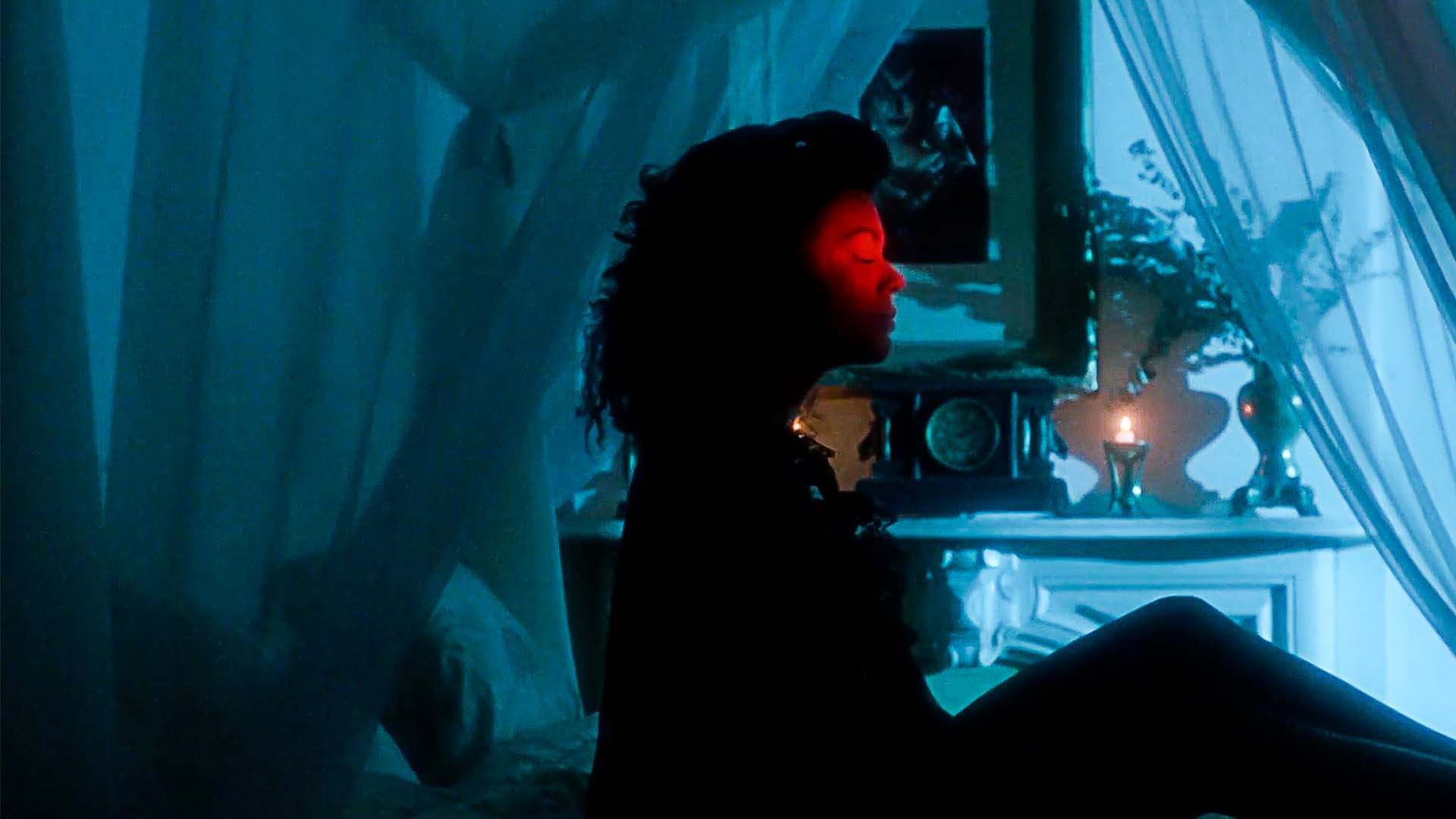
Def by Temptation is a self-evident labor of love, a film made by one man with no filmmaking experience and little money, a conspiracy between necessity and invention. The cinematic progeny of twenty-four-year-old James Bond III, who wrote, produced, directed, and starred in the film, Def by Temptation is an allegory of a young man dunked head-first into a world thoroughly alien to him. It could, with a squint, be Bond’s own tale, his fire-and-brimstone account of life on the other side of the cinematic veil. (Tellingly, while Bond plays Joel, an aspiring minister from North Carolina, his childhood best friend K is a film actor in New York). LikeBill Gunn’s masterful Ganja & Hess from seventeen years beforehand, another film by a lost voice of African American horror cinema unceremoniously ousted from the industry, Def by Temptation is a kind of poison pen love letter to the art form itself, a kind of baptism by fire in the cinematic world.
Def by Temptation, in other words, is a film that deeply appreciates the clarifying, messianic powers of the medium, the gift of viewing life darkly through a warped cinematic perspective, of using the weapon of art to transfigure life’s surfaces to reveal its true, awful self. Yet it is also a film that recognizes the dangers of playing with smoke and mirrors, that recoils at the cost to the soul of participating in, being tempted by the hope of success in, such a cruel and life-draining industry. Like Gunn’s film, it understands horror cinema as a hell and a home, asking us to seek sanctuary in the sacrilegious.
Indeed, Def nearly begins with a sermon of cinematic zeal, where young Joel’s father (Samuel L. Jackson, perfectly anticipating the righteous fury he would bring to Pulp Fiction) sees a vision of sheer horror behind his son before dying a brutal death on the run. And when Joel arrives to New York City as an adult, the bus-ride through the tunnel is framed as a passage through a portal of light into another plane of existence. A necessarily dangerous and destabilizing plane, at that, and Def by Temptation necessarily courts the horror genre’s conservative streak, its apprehension about the uncertain undercurrents of a chaotic and ever-changing reality mocking the confines of order.
At its heart, then, Def by Temptation is a moral parable, and a surprisingly old-fashioned one. It is impossible to miss the AIDS commentary at the core of this narrative of a succubus (played by Cynthia Bond, who isn’t related to the director) who frequents a bar every night and has recently set eyes on Joel and his childhood friend K (Kadeem Hardison). That commentary certainly carries with it an essentially conservative equation of promiscuity as corruption infesting divine faith with doubt, positioning Def by Temptation as an example of African American cultural piety in the spirit of Spencer Williams’s classic 1941 film The Blood of Jesus.
But Temptation is a tricky film. It initially presents as an exploitation film and reflects exploitation cinema’s paradigmatic paradox: investing in a moral parable about the dangers of inhibition that nonetheless preys on its audience’s love for that very inhibition. Yet Def is both a genuinely artistic horror film released in arguably the worst half-decade for the genre in film history and a work whose artistry is defined by how little it pays attention to the rules of the proverbial cinematic game. Like Spencer Williams in 1941, Bond had apparently no filmmaking career at the time, and he has managed even less of one in the ensuing thirty four years. He’s never directed another feature film. It may be that he leached out all of his talent in this one, but Def by Temptation is worthy of its cult classic status. The actual text is less an exploitation picture preying on social anxieties than the mesmeric incantation of a young spiritualist whose medium happens to be film. Temptation’s conservatism, if we want to call it that, is more pre-modern than anti-modern, a work that believes in fundamentally cosmic, rather than social, good and evil. Def by Temptation is less a view of conniving or injudicious women disarming men than a primordial battle of cosmic postures that can take up residence in any person at any time. The film’s final image clarifies the essentially hermaphroditic character of what it presents as an eternal evil able to take any form or shape.
Def by Temptation is also a pungent exploration of the texture of modernity in black, a story of agrarian religious currents encountering the perplexing chaos of city life, a story recounted in much African American fiction from the early 20th century. Def by Temptation follows in the long tradition of the African American migration story, in which the city can be a cauldron of discontent as well as a renewed vision of potential. Narratively, Bond finds possibility in a somewhat quiet undercurrent of male bonding that complicates anything that appears as simplistically retrograde. When K comments on Joel’s potential wooing of the succubus, who K had eyes for before, he remarks that he’ll “fuck him … mess him up,” the first missing “up” entirely changing the connotation. Later, K enforces a strict “one hug” rule as he schools him in a kind of parody of modern masculinity. At one point, K and fellow bar patron Dougie (Bill Nunn), hilariously revealed to be an FBI agent in a supernatural crimes division, which grants the film the texture of an old Kolchak episode, ask an African American spiritualist if they could just rip the succubus’s heart out and set it on fire to destroy her soul. K responds “we don’t have to do all that right? that’s some freaky shit” with a decidedly sexual undercurrent.
But it’s the cinematic expressivism of the film where Bond really reveals his thoroughly alien orientation to modern cinematic construction. He directs with a preacher’s sense for associative suggestions and dramatic filigrees whose subtler meanings creep up on you beneath, and after, the rhetorical flourish sidewinds you. Jackson’s sudden, aforementioned death, which happens out of nowhere and blindsides the film like a fount of demonic truth conjured out of the sheer force of the film, is the first clue. Cynthia Bond’s ethereal, abstract performance of the film’s central villain is another early key, granting the film an essentially allegorical texture even from the beginning.
Best of all, though, is the repeated trip to the obvious sound stage of a bar, where roughly half the film takes place, and which suggests a kind of waiting room of the damned lit by the phantasmagorical hues of cinematographer Ernest Dickerson’s camera, expanding on the heated, fluorescent textures he brought to the opening credits of the previous year’s Do the Right Thing. At one point, the camera seems to be in the bar observing a silhouetted jazz musician, only to pan out to Cynthia Bond and her most recent prey in her bedroom, framed as a thoroughly abstract, monochromatic space of love and terror. But this is only a literalization of what the film has already been up to. This is an entirely metaphorical film, an oneiric nightmare from another layer of existence. There’s no sense of a world outside these cloistered affective hothouses, never any connective tissue linking these incantatory enclosures and creating a “real” tangible world.
And why would there be? Could this cinema really visualize the kind of outside world that allows for the possibility of genuine human connection? While K briefly lectures Joel on the real cause of all the horror around them – Reaganomics – the moment seems didactic, a sudden infusion of the social realm into a film that steadfastly avoids such explicit commentary. Yet a ghoulishly lit but uncommented-upon Reagan puppet leering above the television in the background of K’s apartment mockingly informs us that the whole film has always-already been trapped in what Adorno and Horkheimer long ago called “the culture industry,” a world where even K’s potential challenge, his recognition of society’s ills, is merely conscripted to serve the cause of capitalism.
The Reagan puppet dwarfing the TV is like an unstated emanation of the political forces existing outside the film, but which it can’t fully comment on. It is also one man’s reminder of the limits of his ability to reject these forces, his tragic susceptibility to them. A tragedy clarified in the film’s best and most creative kill, when he is literally eaten by his television set, which is currently showing a vision of himself that embodies his aspiration to become part of the culture industry slowly eating him whole. Adorno, for his part, felt that genuine art could hold the liquefying fires of capital at bay with something like a human version of the divine. Perhaps Bond felt the same, and after this celestial howl of a horror film, he and the industry had no choice but to part ways. Def by Temptation, whose editing rhythms (credited to both Brian O’Hara and Li-Shin Yu) are so off-kilter and elliptical and drawn to gestalts rather than coverage, posits that the center not only will not hold but has already crumbled beneath us without us even noticing.
Score: 7.5/10
 The Long Take