
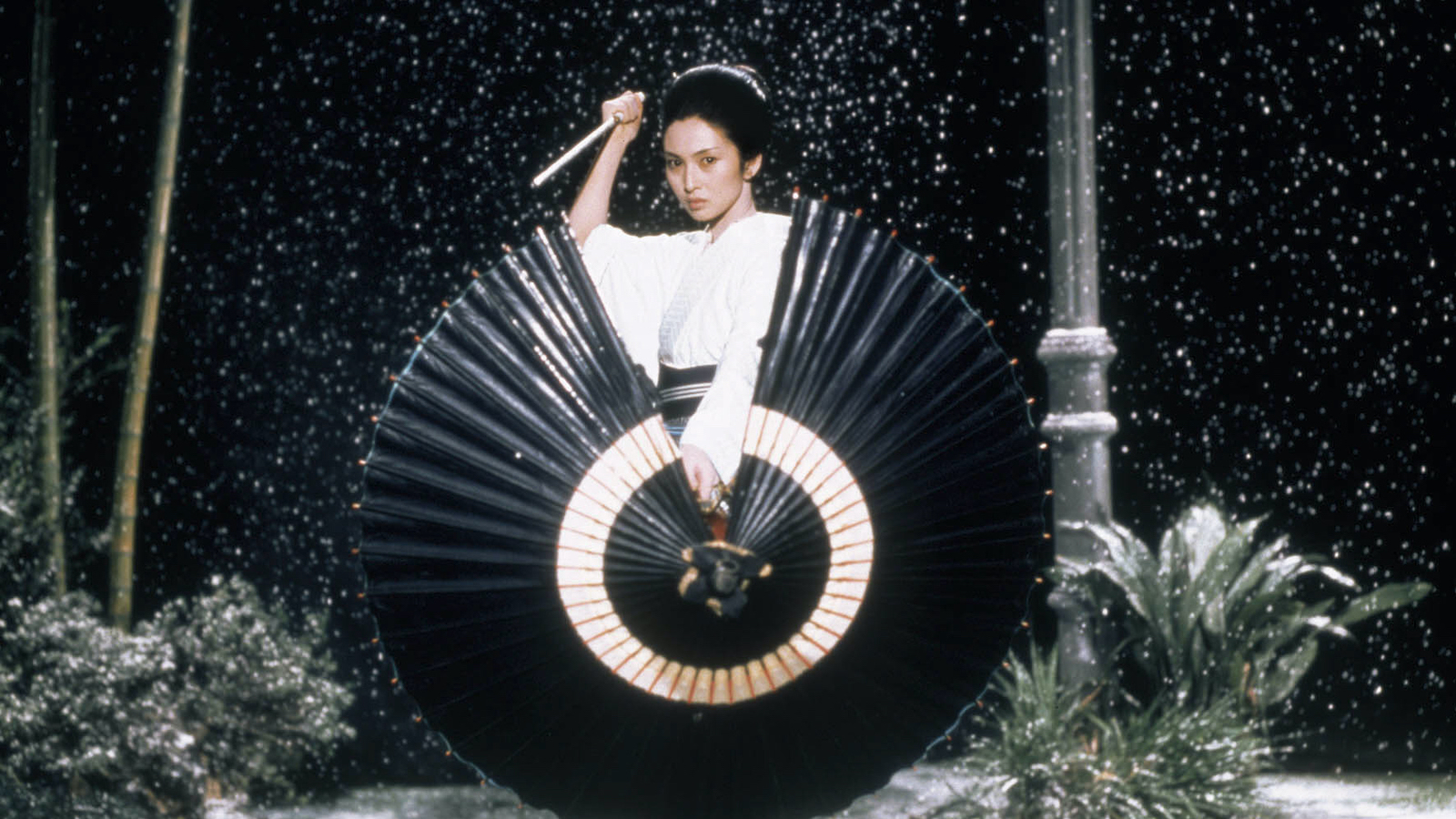
Lady Snowblood, the mirthless title of director Toshiya Fujita’s savagely beautiful film, suggests a woman with ice in her veins. In an opening, pre-title sequence of uncomfortable intimacy and grimy immediacy, Fujita clarifies the implications of this title for the life of a woman who is destined, pre-birth, to carry on a vendetta her mother did not complete. In a sober and ethereal pre-title sequence, we watch the mother give birth and hold her baby accountable to avenge the violence inflicted upon her. Obviously disturbed by the demand she is bestowing on her child, she shudders with fright at the life she is asking her to live through.
The film’s evocative epithet also implies a kind of cosmic cast, a person whose very soul is connected to – either kindled via or entrapped by – the very matter of the world around her. The film’s introduction occurs in a cloistered prison room with wooden slats offering a spectral view of the wintry outside world, which Fujita shoots as a forbidding, ghostly wave of snow falling to the ground. The snow doesn’t so much invade the frame, taking over the promise of a spring that will soon return, as bond with the frame itself, becoming the very canvas upon which the film takes place. This woman who takes the snow as her name will be an omnipresent specter gliding through life, a one-sided quest for vengeance as a perpetual winter haunting the men who destroyed her opportunity for another world. One oneiric image features her dying mother’s profile in front of a prison window, the snowy light shining through on her body suggesting her life force literally seeping out of her, both into her daughter and into the world. Despite technically growing up, we are meant to understand her as essentially stillborn, the replacement of a potentially agentive person with the corporeal puppet of a transhistorical, predetermined, unavoidable craving for revenge.
In the actual opening credits, the now-grown Yuki, aka Lady Snowblood (Meiko Kaji), makes good on her mother’s hope by cutting reeds of bamboo timed to the continuity-slashing pauses of the film. Depending upon your perspective, she is either, literally, a raw distillate of pure controlled force, able to “cut” the film itself with her single-minded determination, or simply prey to it, working, without question, according to the rhythms of forces that have mastered her since birth.
Yuki, we intuit immediately, was conceived by her mother in a woman’s prison for the express purpose of seeking revenge on the men who killed her husband and son. While her mother killed one of the men during the assault, three others survived. Each is introduced in their own freeze-frame as they murder someone, a brutal meeting that would be honored by Quentin Tarantino (for whose film Kill Bill this is clearly the primary inspiration). In matching her own film-stopping slices in the opening credits, Fujita suggests that she is not only avenging her mother’s honor but perpetuating a cycle of violence that causes her to become her assailants. Her helplessness is signaled in other ways – by her mother’s screams of childbirth ending right as the baby’s first cry is heard – but her complicity with the wider force that propelled the film’s villains, that is the flow of perpetual violence catalyzing the film’s energy itself, cuts deepest.
Written by Norio Osada, this adaptation of the manga of the same name by Kazuo Koike and Kazuo Kamimura, folds its more universalist perspective on cosmic violence into cycles of history that are less elemental and more political. In its brief notation that the killers are government-sanctioned thugs who oppress peasants in the name of securing a “modern” Japan capable of rivaling America and Europe – beating the nations at their own game – Osada and Fujita tackle another cycle of potential retribution becoming mere repetition, a bad echo of an imperial unchanging same.
Yet the texture of Lady Snowblood is like its title: terse but suggestive, brutally clipped but somehow ethereal, like a fable where the reticence of the words convey more than a denser, more explanatory script ever could. The screenplay mostly keeps the materialist analysis to a minimum, preferring an abstract texture that nonetheless smuggles in a commentary on abstraction. One character calls himself “curiosity personified,” and the voiceover frequently refers to herself as wrath and vengeance in human form. Her success also requires the perpetuation of her myth to smoke out one of her culprits. When this character kills himself to deny her the satisfaction, and she cuts him in half anyway. These characters are both ideas and people shaped by, and shaping, ideas. Ideas that sometimes fail the people.
Finally, though, it is Fujita and cinematographer Masaki Tamura’s camera that “tells” the story in Lady Snowblood. The light bathes Kaji as simultaneously diffuse and focused, as though her face is both dripping into the frame even as concentrated power from the frame coalesces within her. The camera movements are somehow paradoxically spectral and frazzled, like a ghost that’s lost its mind but can still haunt the characters with the limits of their own actions.
Lady Snowblood is a thoroughly unsentimental film, a poem of stone-cold stares and red-hot spurts of uncontained blood. While even the classical Japanese jidaigeki (period drama) films, like old-fashioned American Westerns, were never uncomplicated in their emotional investments or their vision of the lifecycle of death, Lady Snowblood limns an especially cruel tale. In this, it takes not only from jidaigeki but the fount of Japanese folk horror in the 1960s that rendered moral parables in an agonizingly cinematic canvas of primary colors shading into a moral void that the earth itself seems to sigh for.
Throughout the film, the camera frequently approximates some feral energy between human and cosmos, hurtling around in long takes that rush between Yuki’s POV and something more omniscient, just outside her, caught up in her moment in her undying momentum. Or perhaps the camera is the celestial force, the momentum of violence, and she is wrapped up in it. One revenge killing is preceded by a speech of righteous retribution backed by a tumultuous sea, before the fatal swipe calls forth a cut way-out to the vast, rock-covered beach in which both assailant and victim stand, a fuller picture in which the action occurs amidst cycles of destruction and regrowth. When the man falls and instantly infects all the water around him blood red, Fujita seems to be channeling the very forces of the earth into an aria for Yuki’s justifiable indignation, and an elegy for her own soul.
Score: 9/10
 The Long Take