
In a key mid-film moment in John Sayles’ beguiling neo-Western Lone Star, a flashback to the early 1970s begins on an image of a film screen at a drive-in showing Black Mama White Mama, a classic about an interracial pair on the run from the forces of law, categorization, and entrapment. The camera skulks down below to the car-bound audience watching the film, a pair of sheriff boots on the prowl to capture another pair of outlaws: two teenagers, the sheriff’s white son and his Mexican American girlfriend enjoying a night of relative freedom watching a movie. In this case, the authority figure hunting the two teens made his name – became a myth in the border town of Frontera, Texas – precisely by rejecting a horridly racist sheriff himself. He is both a frontiersman boldly resisting authority and a specter of his former enemy and the peculiar version of freedom – the freedom to control others, to resist order while sustaining it – that he once stood for, and that defines so much of American outlaw lore. Lone Star asks us to sit with that, with the paradoxes of power and rebellion, with the ambiguities and contradictions of American outlaw culture, with a past that is a multiplex of sensations and memories shot through with false truths and dim presences. It dwells on a history where identities are forged out of cinema-style myths of Americans escaping their pasts, a cinema of the frontier that looms large in the American imagination, a ghost in the machinery of much American violence.
In other words, Lone Star is a knot in a tangle in a labyrinth, a film whose irresolvable complexity is not the result of any unexpected occurrences in the narrative (although there are plenty of those) but of the intricacy and empathy of its interpersonal curiosity. Like any truly great film, it is defined by its mettlesome texture, upsetting any conclusions we draw on a scene-to-scene basis. Its moral imagination is its ability to delineate human relations and then unravel those delineations even in the act of drawing lines. The past will weigh heavily on the present throughout Lone Star, which continually moves across decades without even cutting, but the present is also loose to itself, containing many overlapping currents and frayed stories that circle around but also unravel its seemingly central mystery – whether one sheriff did, in fact, kill his authoritarian predecessor to take over the job, and what happened to the body – a mystery that is the film’s pretext but not its reason. This film continually implies that whatever resolution it can offer us to that story does little to resolve the pressing problems facing the town in many other tales only being briefly visited. Lone Star is a work of fascinating, beautiful, continual disappointment.
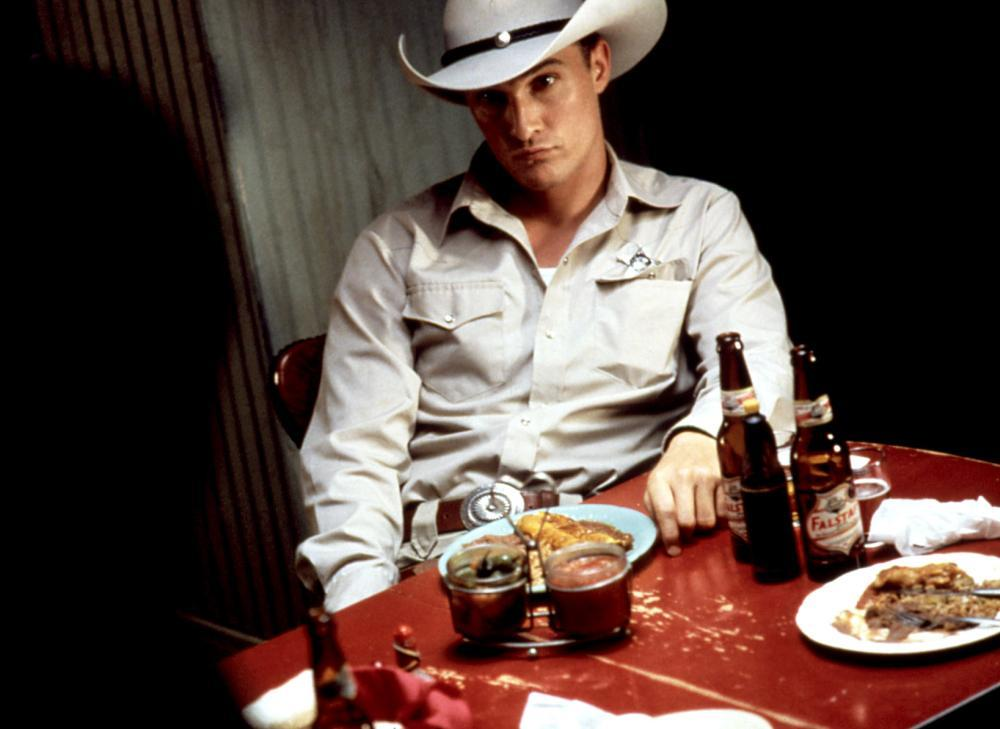
It all starts with the (circa 1996) unceremonious and accidental reveal of the bones of Charlie Wade (Kris Kristofferson), an infamously corrupt border-town sheriff who was, one time in the late 1950s, confronted by young officer Buddy Deeds (Matthew McConaughey). Deeds is now worshipped by the town, possibly on the back of having supposedly done-in (the never found) Wade in the first place. Buddy’s son Sam (Chris Cooper), who only moved back to town and became the new sheriff two years prior to the film’s present timeline, is skeptical of the legend. Yet he also has personal reasons for dethroning his father’s myth, and for demystifying the glory of a position that he seems more intrigued by in theory than in practice. All he really does, he remarks, is manage a “60 room hotel with bars on the windows,” and the contractors only seem to want to build an ever bigger one.
Technically, Lone Star is a murder mystery, but Sayles’ film is really an exploration of the limits of mystery, the narrowness of the abiding search for the dramatic solution. What it isn’t is a display of investigative rigor or deductive acumen. Most of Sam’s realizations about his father’s actions and the terror of Charlie Wade occur in between the shots, not within them. We never witness him piecing things together, and the “resolution,” so far as it is one, is ultimately, exquisitely straightforward. Whether or not this particular crime, the murder of an individual, is solved would miss the point in a town built on a bedrock of foundational myths and unspeakable violence that will not un-sediment themselves once Sam, or once we, know the “truth.” Sayles is skillful and humane enough to recognize that the world isn’t reducible to this mystery, that regardless of who killed Wade, or whether he really was killed that night, the world ticks one, and that for every character in the film, the resolution is wrapped up in but not reducible to the dozens of other activities and relations they undertake every day. Wade’s death haunts the town’s bones less because it forms the town’s skeleton than because it vibrates with dozens of other forgotten, or unacknowledged, pasts, serving as a central metaphor for what one character calls the dangers of “bringing up old business”in ways both grand and miniature.
It’s Sayles’ script, a refractive diamond of emotions and intuitions, that really crystallizes Lone Star as a modern American classic. Buddy is seldom physically present in the film, only appearing in the flesh in three scenes, but McConaughey’s wiry demeanor that manages to convey both “take it slow” and “quick draw” hangs over every moment. His elusive, mediated presence, the product of others’ memories and stories (and lies) about him, is indicative of the ambiguous texture of the film’s relations in general, in particular its racial ones. One white bar owner, witnessing an interracial couple, remarks that “Buddy’d be on them two” not, he defensively claims, out of racial animus but because he understood interracial relationships as a mark of potential danger and change. Yet Otis (Ron Canada), a black owner who runs a bar for mostly African American clientele, defends Buddy to the word, noting that “no one in town, Black, White, Mexican,” felt uncomfortable asking for Buddy’s help with a problem. Back in the day, Otis was among the victims of Wade’s most virulent racism and his most untempered violence. We suspect he was around the night whatever went down went down, even though he claims otherwise. But he also carries other histories that linger as large as the film’s not-quite-central who-done-it. While Otis defends Buddy for upkeeping the black bar, Otis’s son Delmore (Joe Morton) is skeptical that his dad is the mayor of what people call “Darktown.” The son sees this as a vestige of a segregated South, whereas the father feels that he provides a center of gravity for the black community in a town that doesn’t invest as much in abstract platitudes about integration.
As an adult, Delmore ran away from home – from his father – as quickly as possible. He is now the leader of a nearby military training academy, another beacon of American law, and much closer to his father’s ambivalent legacy than he ever wanted. He is also the double of Buddy’s son Sam. Both have little kind to say about their fathers, and both ended up back in town as adults for reasons not of their own choosing. When Delmore’s son Chet (Eddie Robinson) shows up to Otis’s bar, he says that Delmore enforces a “start from scratch” attitude, a need to remake oneself on one’s own terms and not pay heed to historical lineage. Otis tenuously underlines but doesn’t quite endorse the statement, whereas Delmore may be less willing to offer the same spirit of freedom to Chet, who he seems to want to join the military like his dad. Delmore is an understanding man, but also an ambiguous arbiter of state power and assimilation, a celebrant of personal choice who may also be an adherent of bootstrap-ism. “Why do you think they let us in on the deal?”, he remarks with knowing ambivalence to a younger African American cadet, referring to America’s willingness to let black Americans fight for national glory, to which she can only respond “cause they got people to fight.” She is more the realist, yet she too participates in the military industrial complex because she finds the outside world to be a kind of chaos.
Lone Star is an abiding irritation, one that continually frustrates cherished or expected principles of identification while tethering chords of unexpected relation between characters. Later, in a brief, one-scene appearance, a road-side Native American merchant claims that he can’t stand to live on a reservation because he “couldn’t take the politics” of Native American leadership communities. He, if anyone, is the film’s true memory of the “cowboy” archetype. The whole film is troublesome like that, a tricky and endlessly discursive project that doesn’t have much use for what the audience wants. When Sam’s one-time romantic partner Pilar, the one in the car with him that night, grows up, she is played by Elizabeth Peña, she is now a high school teacher, and she now has to manage the town’s fraught curricular debates. Several of the town’s white residents categorically resist and defame any attempt to reject the U.S.’s mythopoetic narrative of Manifest Destiny and white salvation. Yet while Pilar refuses to teach this narrative, insisting on an honest reckoning with histories of expropriation and white dominance, she also begins to lightly disagree with a Latino man who frames Anglo settlement as an entirely and uncomplicatedly imperial march. Lest we position her as the apologist, her own mother Mercedes Cruz (Míriam Colón), a Mexican American restaurant owner, has no problem demeaning current Mexican immigrants. She remarks that “the ones coming over are getting stupider every year,” and Pilar frustratedly responds with a mix of the personal and the political by arguing that she is simply getting more “impatient” with the world and its own complications. Whatever salvation Lone Star offers is found in reckoning with, rather than denying, the complexities of the beliefs people have about one another.
It also depends, Sayles implies, on engaging the uncanniness of our relation to the past. Recurrently throughout the film, Sayles’ faultlessly expressive camera movements frequently glide, sans cut, across decades, shifting, say, from a man on one side of a table to the two people he is interrogating on the other side about their pasts, back down to the table, to a glide up back to the interrogator’s side, except now he’s been replaced by the people and events of the 1950s they are recounting. The film not only smudges the linear trudge of history and frames life as a muddy haze of temporalities, but in an unusually deft compositional feat, it also reminds us that while cinema can momentarily dilate different historical moments into focus and connect those moments together – can necromance the past into the present – it is only by filtering it through layers of precarious memory and ambiguous deceit, both human and cinematic. If Jean-Luc Godard famously remarked that “film is truth 24 times a second, and every cut is a lie,” Sayles argues that a cinema that promises pure continuity across time, without cuts, a cinema that claims complete access, that promises only to recover the truth, may be the most difficult lie of all.
Score: 10/10
 The Long Take