Monthly Archives: August 2024

Review: Under the Silver Lake

With its spectral mood and sinister diagnosis of 21st century social restlessness, David Robert Mitchell’s It Follows was one of the early success stories of the A24 horror boon. Its atmospheric texture, evoking an oneiric gloss on reality, made it one of the patron saints of the so-called “elevated horror” explosion, which rode a crest of stylistic experimentalism to examine undercurrents of human trauma and dejection. A mere half-decade later, by 2019, elevated horror already felt bloated, no longer an exploratory rebellion against the corporate debasement of ‘00s horror but a codified set of rules and regulations, an examinable, even scientifically replicable, formula and a self-immolating object. Like much of late ‘10s culture, it increasingly felt like an attempt to solidify the status quo in the guise of intervening in it.

Within that context, let no one accuse Mitchell of resting on his laurels with Under the Silver Lake. Rather than extending the genre trappings of It Follows, Mitchell emphasizes its mood of extraordinary ennui and cyclical, ever-gestating confusion, figuring the modern world as a quiet, drawn-out apocalypse, a walking corpse. It recognizes the earlier film’s poetic evocation of suburban detritus set against a backdrop of industrial aimlessness as the real heart beneath the (too obvious) metaphors for sexual transmission. Like its predecessor, Under the Silver Lake is a deeply woozy film, a story about lives running in circles that can only lead to a puzzle never to be solved, and like its predecessor, it positively vibrates with both internal instability and the emptiness of that very energy.

Continue reading
Review: The Irishman

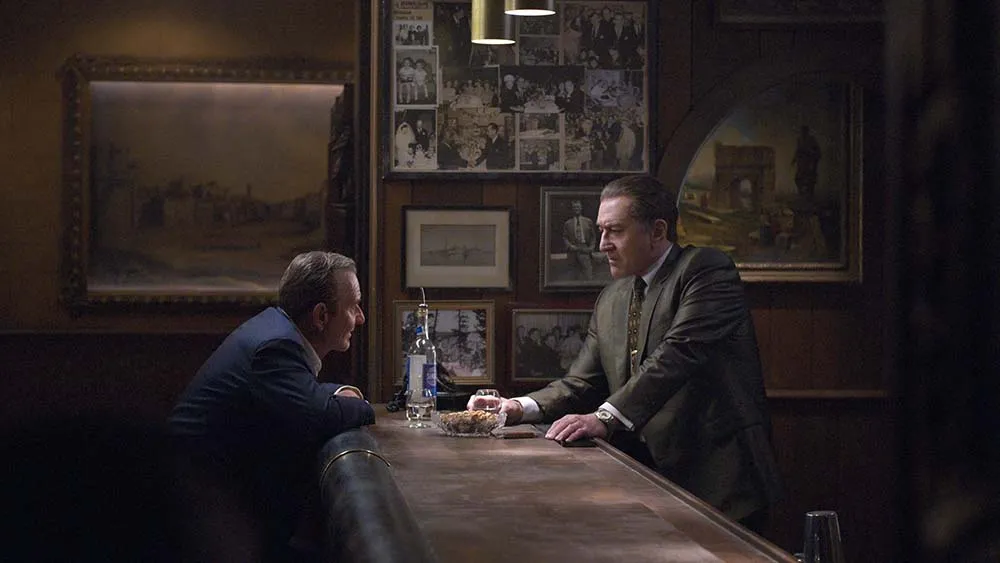
The Irishman is both a stern rebuke and a sober reckoning. After the breathtaking but ultimately tiring The Wolf of Wall Street, with its grotesquely flippant energy (grotesque in good ways as well), and the sublimely adventurous but sometimes hermetic Silence, The Irishman is a self-conscious homecoming. It announces itself as a return to the primordial breeding ground from which Scorsese’s career came. On one hand, it is a return to form promising a severe sense of finality. It tethers its director’s fifty years of cinematic releases together and ravages them, burning the director’s less critical supporters with righteous indignation. On the other hand, The Irishman is also one foggy four-hour anti-climax, a swamp of characters who seem unable to think or act creatively at all. It is a portrait of the mob as an American bureaucracy, not an American battleground. It is a homecoming as an act of slow, painful penance, a return to the most fertile ground of Scorsese’s career in order to scorch the earth.

Scorsese’s films often chase and desire dizzying heights of cinematic bliss, from the apocalyptic panic of Bringing Out the Dead to the slippery, Warner Bros. zeal of After Hours, a trend that reaches its apotheosis in the impossibly manic “Sunday, May 11, 1980” scene in Goodfellas. While these heaving highs of pure cinematic muscle are inevitably chased by brutal come-downs, the man’s films often court the very vitality and vivacity they ostensibly want to redress. Whatever comeuppance they insist on, you leave feeling satiated, even torqued. The Irishman, conversely, is pure holding pattern. There’s no up or down, no growth and decay, no cinematic evolution and destruction, just a tired old man who seems to have been out of sorts in his very body decades before his nominal decrepitude. In Steven Zaillian’s screenplay (adapting Charles Brandt’s nonfiction work I Heard You Paint Houses), Robert De Niro’s Frank Sheeran is not so much a broken man as a stillborn one, a guy whose slowly crumbling self belies the hollow husk he always was.

Continue reading

Midnight Screamings: Def by Temptation

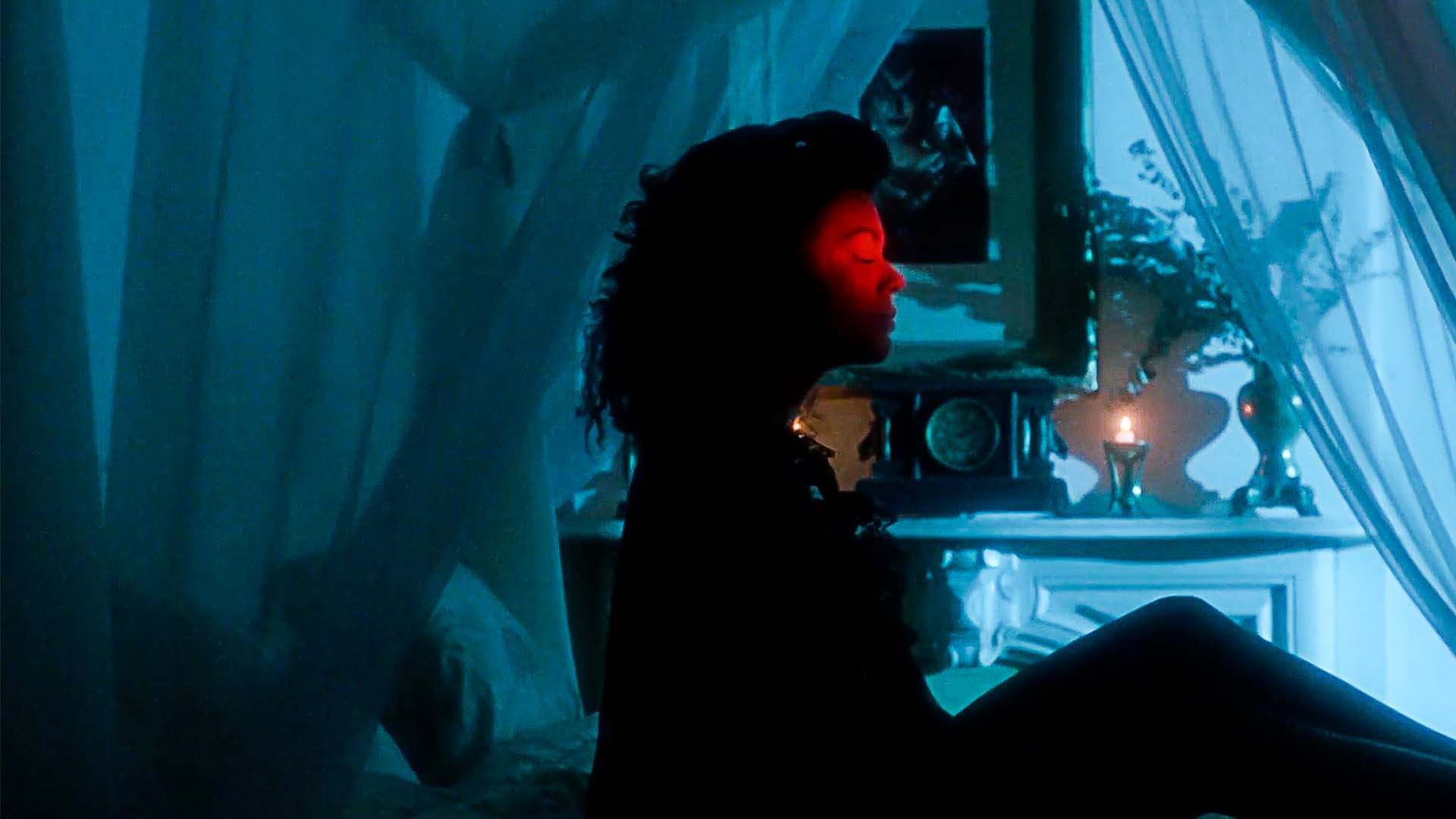
Def by Temptation is a self-evident labor of love, a film made by one man with no filmmaking experience and little money, a conspiracy between necessity and invention. The cinematic progeny of twenty-four-year-old James Bond III, who wrote, produced, directed, and starred in the film, Def by Temptation is an allegory of a young man dunked head-first into a world thoroughly alien to him. It could, with a squint, be Bond’s own tale, his fire-and-brimstone account of life on the other side of the cinematic veil. (Tellingly, while Bond plays Joel, an aspiring minister from North Carolina, his childhood best friend K is a film actor in New York). LikeBill Gunn’s masterful Ganja & Hess from seventeen years beforehand, another film by a lost voice of African American horror cinema unceremoniously ousted from the industry, Def by Temptation is a kind of poison pen love letter to the art form itself, a kind of baptism by fire in the cinematic world.

Def by Temptation, in other words, is a film that deeply appreciates the clarifying, messianic powers of the medium, the gift of viewing life darkly through a warped cinematic perspective, of using the weapon of art to transfigure life’s surfaces to reveal its true, awful self. Yet it is also a film that recognizes the dangers of playing with smoke and mirrors, that recoils at the cost to the soul of participating in, being tempted by the hope of success in, such a cruel and life-draining industry. Like Gunn’s film, it understands horror cinema as a hell and a home, asking us to seek sanctuary in the sacrilegious.

Continue reading

Review: Portrait of a Lady on Fire

Céline Sciamma’s Portrait of a Lady on Fire is a film about the melancholy of desolate spaces and the overpowering intimacy that can take up residence in them. A sensory romance to rival Wong Kar-wai’s aching, radiant exploration of unstated affection In the Mood for Love, or Alain Resnais’ oneiric portrait of fractured connection Hiroshima mon Amour, Portrait is the rare romance that explores the very nature of its genre. Portrait is really a meditation on the form of connection and love itself, on the way it breaks the self into many dispersed parts, the means by which it creeps up on you, how it takes over the soul and consumes the mind. Fundamentally, the film asks what it means to relate to another person. It is certainly, in this case, a “queer” film, but the relevant sense of that term is less that the two lovers are women than that the film troubles any stable or foundational understanding of what desire itself ought to look like. And I do mean look like. In addition to bewildering any conventional desire to label the film a specifically “lesbian film,” Portrait offers romance in a simultaneously expansive and fragile sense, as something that occurs in the gap between the mind and the eye. Portrait of a Lady on Fire is an uncommonly perceptive exploration of perception itself.

Nominally, the “looker” is Marianne (Noémie Merlant), commissioned by a Countess (Valeria Golino) to paint a portrait of her daughter Héloïse (Adèle Haenel), which we intuit is de rigeur  prior to an aristocrat’s impending marriage, in this case to a nobleman of Milan, who Héloïse has never met. Héloïse cannot know that she is being painted, which would indicate her agreement to the marriage, which she steadfastly refuses. She is only home from her chosen life in a convent because her older sister has recently committed suicide. Under the pretense of being a companion, which becomes the actuality of being a friend and lover, Marianne accompanies Héloïse on daily cliffside walks while she discreetly memorizes the contours of her face for a portrait she completes behind closed doors. However, when Marianne completes her portrait, she refuses to maintain the façade and tells Héloïse, who rejects the painting not, as we expect, out of a refusal of her impending husband’s desire but out of a desire to court and cultivate the beauty located in the artist’s desiring eye. The painting, Héloïse finds, doesn’t capture her fire, so to speak, nor the fire of Marianne’s attraction to her. Knowing that the painting reflects a desire of Marianne’s that remains untapped, both for observing Héloïse and for the possibility of creating with her, Héloïse decides, willfully and for the first time, to pose for Marianne.

Continue reading

Review: The Lighthouse

In the spirit of reviewing things other than obscure horror films from the ’80s, I’ll be spending the next few weeks dusting off some less eldritch cinematic creatures from the long-ago year of 2019, a uniquely intriguing year for the cinema and the final year before the industry took an extended hiatus for reasons I do not have to clarify.

In the beginning, there is only a boat clarifying its way out of the foggy sea, a speck of uncertainty coagulating its way out of the graininess of the film stock. The Lighthouse begins in the ether, in other words, with a material thing etching itself out of the two nebulous spaces we call the ocean and cinema. Over the subsequent 100 minutes, David Eggers’ film will stage and then vandalize the attempt to escape it. Finally, the belief in the distinctly human attempt to solidify stable things, to escape the all-consuming and finally formless world we come from and will return to, becomes a cruel trick of the gods. The Lighthouse is an otherworld, a confounding out-of-the-way that is also, in its overflowing sensory exertions and heaving presences, an all-around-us. It’s always there, an omnipresent sensorial experience. But it also feels like it is perpetually drifting into nothingness. It is both a force and a void of a film, a dimly visible but often sensible appreciation for the unclarifiable. As a film, it’s everywhere, on all sides of us, but you get the sense that you see it less than it can see you. The boat will deliver two men to a lighthouse off the coast of New England. It also delivers the strangest of dispatches to us.

The Lighthouse is a horror film of the mind and the body. It has as much in common with Tarkovsky as Cronenberg. It’s a spiritual lament, but also a corporeal act, a film in which places, machines, and bodies require upkeep, in which mending and releasing are acts of the flesh, the mind, and the spirit. The light of the lighthouse the two men operate is a terrible siren beckoning the soul to its furthest reaches, but it also needs oil to keep running. The cistern of drinkable water looks like celestial sludge, but it also needs to be churned. The film’s soundscape (by sound designer Damian Volpe and composer Mark Korven) is thoroughly otherworldly, but it also must make due with Willem Dafoe’s perennial farts. And a peek from above into a bedroom offers a writhing intimation of a body that might be engaging in some eldritch ritual of cosmic undoing, but it’s probably just the more everyday unknowable of masturbation behind a closed door. A seagull is an omen of ill intent and an unthinkable cosmos, but it’s also a blank thing that just doesn’t care about us that much, and doesn’t really want to bear the weight of our symbolic readings of it.

Continue reading

Midnight Screamings: Evil Dead Trap

A cruel dispatch from the less traversed regions of the burgeoning late ‘80s video industry, Evil Dead Trap anticipates the much more famous Japanese horror explosion of the late 1990s and early ‘00s that cast such a frigid, despairing shadow on the international horror scene. Following the likes of David Cronenberg’s Videodrome, Evil Dead Trap is a brutal and deeply disturbed portrait of modern urban ennui that turns a videotape – nominally a flourishing frontier of futuristic possibility – into a rumination of the darker side of technological democratization. In director Toshiharu Ikeda’s film, industrial modification and media transfiguration become conduits for a world on the edge of something fundamentally other than whatever it might have been before. In its disturbing force and multi-media experimentation, it sometimes plays like the grimy, unholy B-side to the Japanese sequences of Chris Marker’s Sans Soleil, framing modernity as something almost alien to itself.

Evil Dead Trap wastes no time winding and rewinding us. After a series of dismembered close-ups of bodies typing, watching, and bruising shot on video tape, the film cuts to a long cinematic shot of TV station employee Nami (Miyuki Ono) walking through the bowels of her office building to a backroom in search of a monitor and VCR to watch a recently arrived video cassette, to discover what alternative view of the world hides within its tape. The sudden shift – from a montage of cut-up incisions to a winding image of connective tissue – not only generates a frictive charge but directly engages the transition from one medium to another. By sheer force of its insatiable need to search for new technological life, to propel modernity, the cinematic detective slowly inevitably approaches the destructive monster of videotape which may doom it but which it simply cannot avoid.

Continue reading

Midnight Screenings: The Ghost and the Darkness

On the back of an ostensibly simple fable about two lions attacking a railroad camp in Kenya at the turn of the 20th century, The Ghost and the Darkness scaffolds so many half-baked ideas about the relationship between Hollywood filmmaking and Western colonialism that it is hard to tell whether it is more or less complex than it initially seems. Triangulating Western escapist fantasia, heart-of-darkness cynicism, and a malarial mood of colonial ennui, the film tries to cover all its bases, to be at once heartfelt and disaffected, hard-hitting and sentimental, critical and rip-snorting. It is, finally, the film’s failure to truly understand itself that makes it somewhat compelling, so far as it goes.

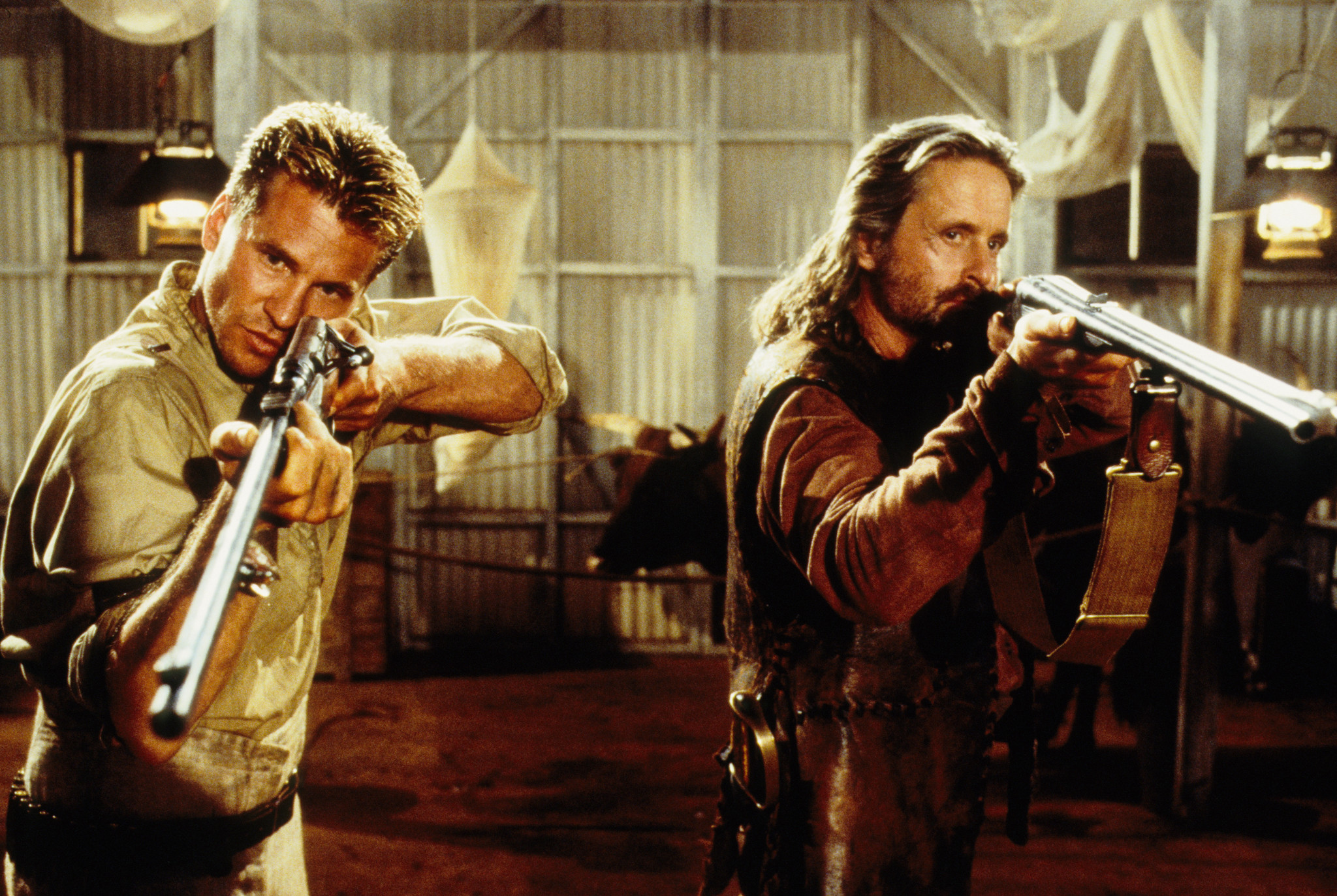
Writer William Goldman and director Stephen Hopkins heavily freight the film’s essentially B-movie plot (killer lions on the loose in Africa, two white men go on the hunt) with what alternately feel like poetic evocations and pretentious intimations of a screenplay trying too hard to impress us with its underdeveloped understanding of itself. Loosely, it tracks Val Kilmer’s John Henry Patterson, a military official tasked with getting the completion of a bridge in Kenya into shape, only to learn when he gets there that two abnormally aggressive, possibly supernatural, lions, popularly nicknamed The Ghost and The Darkness, are killing the workers in scores. After several thoroughly unsuccessful attempts to kill the lions, Patterson is joined by Michael Douglas’s American big game hunter Charles Remington, who has much to say about killing threatening animals and more to intimate to Patterson’s soul about the nature of man and modernity.

Or so the film thinks. Douglas’s mid-film presence substantially increases the film’s watchability, but it only exacerbates its lingering conceptual confusions. Remington suggests churlish American indiscretion, unsentimental humanism, disaffected irony, and cunning individualism in equal measure. He is the kind of figure who has no use for colonialism in theory, but who is entirely willing to use it when it suits his investment in killing animals. The film begs the question: what do we do with the fact that Douglass’s American warrior is self-evidently the most palpable presence in the film, and one the cameras are both ashamed of and fascinated by? Is this meant to signify the superiority of American forms of imperialism, favoring careless, violent insouciance, over British steadfastness and discipline, both of which, of course, are more myth than reality? Or does it suggest the dangers of American charisma as a promise of energy that only constrains further? Douglass, commenting on one of Patterson’s failed traps, notes that he once tried the same thing. It failed, but he remarks, it was still a “good idea,” suggesting quite a bit about the film’s vision of American style know-how and adaptiveness, including the potential necessity of killing oneself, and many others who don’t have a say in the matter, along the way. But one leaves the film less than entirely sure what it actually thinks about Remington, other than that Douglass is enjoyable with a vaguely Southern accent.  

Continue reading

Midnight Screenings: Lady Snowblood

Lady Snowblood, the mirthless title of director Toshiya Fujita’s savagely beautiful film, suggests a woman with ice in her veins. In an opening, pre-title sequence of uncomfortable intimacy and grimy immediacy, Fujita clarifies the implications of this title for the life of a woman who is destined, pre-birth, to carry on a vendetta her mother did not complete. In a sober and ethereal pre-title sequence, we watch the mother give birth and hold her baby accountable to avenge the violence inflicted upon her. Obviously disturbed by the demand she is bestowing on her child, she shudders with fright at the life she is asking her to live through.

The film’s evocative epithet also implies a kind of cosmic cast, a person whose very soul is connected to – either kindled via or entrapped by – the very matter of the world around her. The film’s introduction occurs in a cloistered prison room with wooden slats offering a spectral view of the wintry outside world, which Fujita shoots as a forbidding, ghostly wave of snow falling to the ground. The snow doesn’t so much invade the frame, taking over the promise of a spring that will soon return, as bond with the frame itself, becoming the very canvas upon which the film takes place. This woman who takes the snow as her name will be an omnipresent specter gliding through life, a one-sided quest for vengeance as a perpetual winter haunting the men who destroyed her opportunity for another world. One oneiric image features her dying mother’s profile in front of a prison window, the snowy light shining through on her body suggesting her life force literally seeping out of her, both into her daughter and into the world. Despite technically growing up, we are meant to understand her as essentially stillborn, the replacement of a potentially agentive person with the corporeal puppet of a transhistorical, predetermined, unavoidable craving for revenge.

Continue reading

Midnight Screenings: Pursued

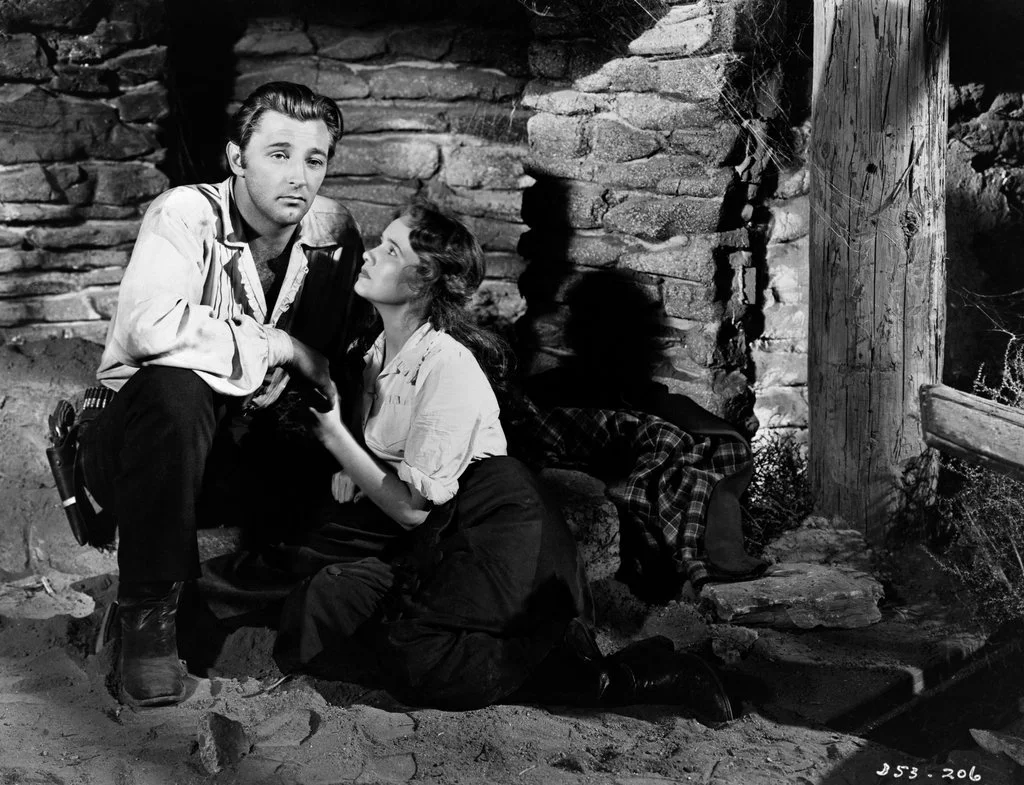
Pursued is a Western noir where panoramic prospects are limned by opaque shadows, where even the idea of a landscape being available for a person to fasten their own future gives way to the gaping maw of the past ready to seek vengeance upon your every attempt.  The preeminent Old Hollywood cinematographer James Wong Howe shoots the natural scenery of Gallup, New Mexico not with a hopeful Western’s sense of uncluttered expanse and possibility but, rather, a cloistered helplessness. A gloomy chiaroscuro contours the film’s moral perspective, figuring a shadowy backdrop for the story of a man beset from youth by histories far beyond his own abilities. Less overtly, the claustrophobic, closing-in-on-you texture of the visuals reveal a post-WWII nation whose abiding myths of natural possibility and individual capability were increasingly revealed to be lies. Pursued offers no blinding frontier of sublime possibility, only a dense effusion of subterfuge. Its characters are governed by forces they cannot even envision, subject to decades-long debts they cannot even name.

Continue reading

Film Favorites: Lone Star

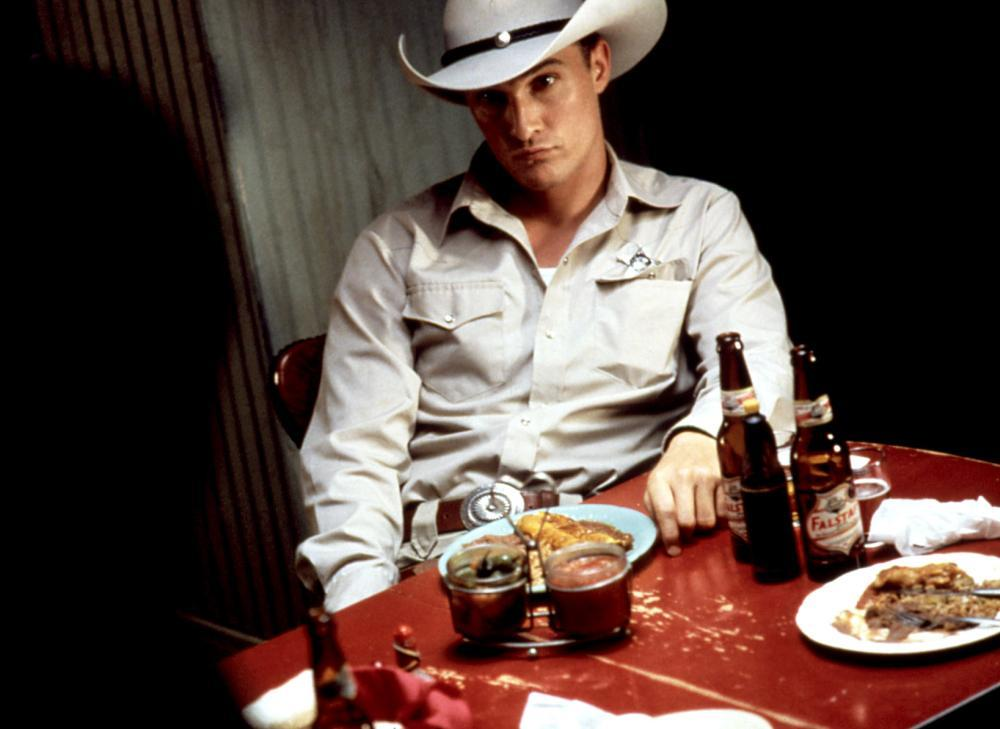
In a key mid-film moment in John Sayles’ beguiling neo-Western Lone Star, a flashback to the early 1970s begins on an image of a film screen at a drive-in showing Black Mama White Mama, a classic about an interracial pair on the run from the forces of law, categorization, and entrapment. The camera skulks down below to the car-bound audience watching the film, a pair of sheriff boots on the prowl to capture another pair of outlaws: two teenagers, the sheriff’s white son and his Mexican American girlfriend enjoying a night of relative freedom watching a movie. In this case, the authority figure hunting the two teens made his name – became a myth in the border town of Frontera, Texas – precisely by rejecting a horridly racist sheriff himself. He is both a frontiersman boldly resisting authority and a specter of his former enemy and the peculiar version of freedom – the freedom to control others, to resist order while sustaining it – that he once stood for, and that defines so much of American outlaw lore. Lone Star asks us to sit with that, with the paradoxes of power and rebellion, with the ambiguities and contradictions of American outlaw culture, with a past that is a multiplex of sensations and memories shot through with false truths and dim presences. It dwells on a history where identities are forged out of cinema-style myths of Americans escaping their pasts, a cinema of the frontier that looms large in the American imagination, a ghost in the machinery of much American violence.

In other words, Lone Star is a knot in a tangle in a labyrinth, a film whose irresolvable complexity is not the result of any unexpected occurrences in the narrative (although there are plenty of those) but of the intricacy and empathy of its interpersonal curiosity. Like any truly great film, it is defined by its mettlesome texture, upsetting any conclusions we draw on a scene-to-scene basis. Its moral imagination is its ability to delineate human relations and then unravel those delineations even in the act of drawing lines. The past will weigh heavily on the present throughout Lone Star, which continually moves across decades without even cutting, but the present is also loose to itself, containing many overlapping currents and frayed stories that circle around but also unravel its seemingly central mystery – whether one sheriff did, in fact, kill his authoritarian predecessor to take over the job, and what happened to the body – a mystery that is the film’s pretext but not its reason. This film continually implies that whatever resolution it can offer us to that story does little to resolve the pressing problems facing the town in many other tales only being briefly visited. Lone Star is a work of fascinating, beautiful, continual disappointment.

Continue reading