
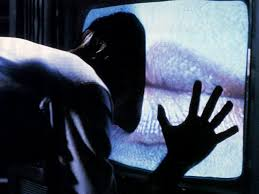
Videodrome wasn’t David Cronenberg’s first nocturnal cinematic emission, but even by the standards of the chilliest of Toronto-born filmmakers, this one orbits at a subzero frequency. The film is a dismal emissary from the nastier crevices of everyday life, presenting a psychosexual marsh as a cerebral mire. Cronenberg’s style here is an ice bath, one that chills a heated and tempestuous world of boiling, subcutaneous human desires and fleshy sensations into a frigid, monstrous exploration of modern uncertainty. If its story ultimately exposes the liminal space between humanity and technology, the film’s texture itself seems to literally turn flesh into a strangely vibrating machine, mutating neurotic, restless passions into fuzzed-out, spacey confusion. A dark dispatch from an otherworld lodged in between the channels, Videodrome feels like it is not so much presented to you as stumbled upon accidentally, a film whose truths are felt like slow chill of your own body while watching, whose reality is barely exposed between lines of static.
Barely. Much of Videodrome is about how little the film can really tell us, how subordinate to wider flows and forces it is, and we all may be. If David Cronenberg’s ostensibly more commercial film from the same year, the spectral and hallucinatory The Dead Zone, depicts a man whose sudden trauma morphs into a genuinely revelatory second sight, the capacity to see the future in however unstable a form, Videodrome is about a man whose perceptual awareness is cunning and calculated but finally insufficient to the vicious, slippery contours modernity he is a child of. Unlike Christopher Walken’s newly-awake Johnny Smith, the protagonist of The Dead Zone and an Emersonian romantic with a capacity to peer beyond the dim propsects of the present, James Woods’s Max Renn is a shadow able to hide in modernity’s cracks. Renn is deeply comfortable skulking through the dingy halls of a ghostly world with sinister intent. In an increasingly disembodied space, only a wraith is at home. But the film reminds us that the contours of a rapidly expanding world, separating and connecting people whose bodies seem increasingly tenuous, is always one step ahead of him.
Renn is the president of a local upstart Toronto television station that promises to serve a civic function and offer a public good in the form of feeding people the doses of lurid entertainment they need to let off steam around 3 AM, in the waking hours where one day slips into the next. “Videodrome,” a torture show that apparently consists of watching hour-long chunks of murder and punishment, is too enticing an opportunity for Renn to pass up. It happens to be from Pittsburgh, a city whose then-recent status as a decaying and abandoned post-industrial town metaphorically prefigures the new post-modern media economy of slippery signifiers and consumer service Videodrome visualizes as both a natural outgrowth and a deeply destabilizing transmission from what seems like a truly alien otherworld.
Cronenberg’s universe is knowingly critical, but he presents the film not with the hectoring superiority of a filmmaker that studies the material from afar but with a shock of genuine self-complicity. Videodrome clearly knows how much it is participating in what it depicts as an ethical quicksand of the soul, and perhaps how little it can do to save it except dimly raise the lights on the darkness humming in the static. In an early scene, Max debates Nicky Brand (Deborah Harry), a celebrity therapist who runs an on-air self-help show and who chastises Max for his garish self-amusement and cynical, soul-sick ennui, but who only turns out to feed off of sexualized pain even more than he. When she decides to audition for the show, and Renn vaguely induces that it may be for real, Renn goes to investigate. Whatever happened to her, both already seem prepped for the religious clinic called “Cathode Ray Mission,” run by the elusive Professor Brian O’Blivion (Jack Creley), which aspires to reconnect us to the mainframe of modern society, that, he informs us, is “part of the physical structure of the brain.”
That summary technically indexes the film’s situation, but it doesn’t explain the film’s soul. It evokes little of the movie’s mischief, and even less of its elliptical mood of dreadful dullness. In all of its forlorn uncertainty and its cryptic ruminations on the illusory nature of the image and the even more unstable manipulations of the body, this is both the curdled companion and anxious antithesis to Ridley Scott’s Blade Runner from the year before. While both films were, pardon the metaphor, deeply plugged-in to their moment, perversely aware of a society where reference and referent were becoming unmoored, Scott drowns us in it, whereas Cronenberg seems to tinker with it, even indulge the possibilities of worshipping it. The overwhelming sense of Scott’s film is the erection of a monolith, a film of fatalistic gloom designed to destroy us, whereas Cronenberg fashions a slippery and spry thing coiling around us. Scott’s film is spellbinding, sublime. Cronenberg’s is deviously, wretchedly polymorphous. Scott’s is an obelisk, Cronenberg’s is Medusa-like.
It also moves with modernity’s free-floating flux from backroom deals to on-air disagreements that are actually secret conspiracies, with television as the singular glue that connects scene to scene. Television can move us from hotel room to board room and soft-wire a vision of Toronto as a channel flip between post-modern malaise and hot-headed zeal. Cronenberg conjures a cloistered and desperately alienated modernity, but also dense and suggestive world of minutiae and manipulation. When the protagonist visits men selling torture porn to his network and the hallway is swamped with voices that are distractingly busy, as though each room is harboring a dark secret, Renn only cares because it allows him to cop a quick snack from a room service tray while the maid isn’t looking. Movement, hope, potential – all become merely the possibility to take.
Cronenberg’s compositions dissolve from organic to mechanical, and they find their coconspirator in Rick Baker’s phenomenal effects work, equally capable of pulsating a putrescent videocassette or mutating an engorged television set beckoning for human penetration. But some of the more insidious maneuvers are the most subtle, like the way that Woods’s granular, oily face vaguely resembles televisual fuzz or film grain, suffusing the film with the pock-marks of a world in which even the most mundane details signify a sense of a decaying world’s flesh that just doesn’t fit right anymore, a “machinery you’re wearing … too much for the shape of your face,” to quote character in the film. Later, when Woods penetrates his abdomen with a weapon, and when that weapon later penetrates his own hand, it all seems part of a natural give and take, a fraying and a blurring that spells neither transcendence nor doom but a holding-pattern, a circle of people inventing new ways to technologically transform themselves to obfuscate or evade an inability to confront the difficulties of an interconnected world.
Cronenberg doesn’t always posit such a desperate, moonless modernity, and what saves Videodrome from its obvious anxiety about the fate of the species is the sober recognition that we do live in an interconnected world regardless, and that the only real opening for human connection may be through the very technological mediation we haven’t yet figured out how to wield. Beneath Cronenberg’s swampy tangle of turbid wires and tissue lies no romantic quest to stop the flow of history, no desire to preserve a premodern individualism or escape into a sanctum sanctorum. Videodrome treats the promise of the transhuman-technological singularity, the aspiration of a world beyond the contours of the physical body, as a distraction from hopes and dreams of all kinds but also a necessary wellspring. The flesh, as they say, may be willing.
Whatever the future may hold, recent works like the demonic Late Night with the Devil affirm both the infernal expectations of Cronenberg’s film, and, perhaps, its deeper anticipations that the intersection of technology and humanity provide portals to other worlds for good or ill. That newer film, with its unceasing quest for ratings and its gradual creep into a full-bore nervous breakdown as the clock moves closer to midnight, suggests something Videodrome knew decades before: that modernity is both a viciously punctual, highly demanding, unceasing clockwork and a slow, phantasmagorical unwinding of time itself. In the opening of the 1983 film, when Cronenberg moves his camera out from a television screen to a man’s arm and a watch, he suggests that the man at the film’s center has mastered one side of the tension: he is composed enough to point his finger like a gunshot to the time of the show ending. Videodrome worries that the focus on temporal precision both creates the horrors of, and blinds us to the possibilities of, the other: that we live in the cosmic seepage of a slow oblivion, a mutual melding that is so loose and slippery we haven’t figured out how to grasp onto it, or if we should.
Score: 9/10
 The Long Take