
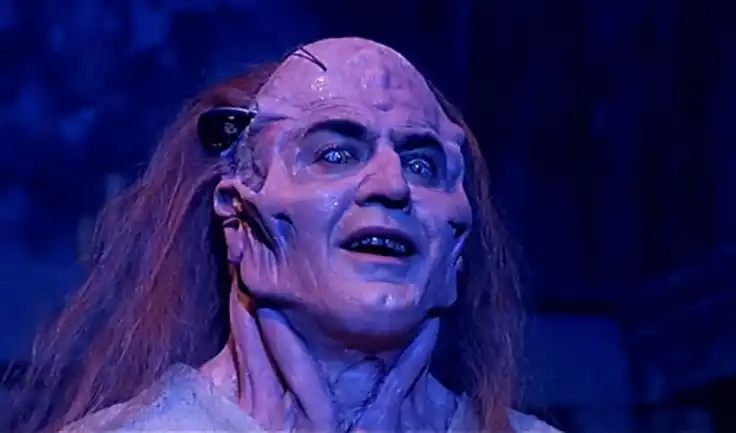
A bonus review of his final directorial effort in honor of the master’s life. RIP.
I for one cannot say what precisely motivated Roger Corman to take up the holy calling of the director’s chair after a 15-year sabbatical, following the phenomenally lurid Death Race 2000, nor to do it in the name of an adaptation of Brian Aldiss’s 1973 novel Frankenstein Unbound. But having seen it, I’m fairly comfortable being happy that he did. It’s as though Corman himself saw into a crystal ball that Universal Horror adaptations were about to become a momentary trend in Hollywood again and, unable to pass up an opportunity to steal the zeitgeist for his own purposes, he got in on the ground floor before the films even started being produced. That didn’t help him at the box-office, but thirty-five years later, we still have to reckon with this one-time cinematic mad scientist’s final rodeo.
And a mad scientist experiment it certainly is. While the obvious comparison would be Kenneth Branagh’s Mary Shelley’s Frankenstein from 1994, this is a much closer cousin of Francis Ford Coppola’s quasi-comeback Bram Stoker’s Dracula from 1992, to name a director whose career Corman helped vitalize decades beforehand. Like Coppola’s film, Corman’s has a certain diabolical lunacy in its mind, and you can detect the glimmer of the playfully egotistical in Corman’s eye in the thoroughly injudicious way he unleashes a ludicrously protoplasmic pink (that gestures to the Lovecraftian texture of Corman’s 1963 classic X: The Man with the X-ray Eyes) or when he closes with a distinctly putrescent green. They look thoroughly absurd on-screen, but can you blame the loopily boastful director for wanting to go a bit overboard, just because he could?
There are obvious differences: Coppola needed Bram Stoker’s Dracula, and he directed it like his life depends on it. Frankenstein Unbound feel more like a victory lap, a charming lark that Corman worked on because he wanted to, or because he was bored and needed something to do, or just to see if he could. If the fire of hell isn’t in it, that doesn’t mean it is just coasting, even if it obviously isn’t the work of a director who felt like he had something to prove. Cheerily idle, you might call it. Perhaps the somewhat lazy, “first thought, best thought” mentality of it all is what allows it to be so offhandedly pleasurable, so uncontaminated by any need to please or to perform to any expectations. So, well, unbound.
Perhaps, pace Coppola’s deviously ludicrous and distinctly labored-over Dracula, the somewhat anonymous quality of Corman’s filmmaking here is what makes it so distinctly personal. Corman wanted nothing else but to fit right in, to approach the mainstream from below, to offer a more subterranean perspective on the popular. His was a cinema of the mundane and the absurd, the straightforward and the peculiar, and the freakish texture of his films comes from how close they approximate the banal, how easy it is to not notice their slantwise riffs on the world around them, whatever that world happened to be interested in for that minute.
Case in point, somehow, despite all the strangeness afoot, Frankenstein Unbound is a strangely authentic adaptation of Mary Shelley’s novel, far more invested in the creature’s self-questioning laments and the scientist’s iridescent madness than most adaptations of the tale, and you never really get the sense that Corman wanted to add any idiosyncratic thematic texture or to twist the narrative into a diagonal direction to uncover some heretofore unworked corner of Shelley’s dark mind. For all his meddlesome interest in various trends and societal tempers, Corman was not exactly an interfering director, and he was, in the end, just interested in getting the movie out and back into his pockets.
Yet that isn’t something you would know from the plot description, which threatens by sheer force of exhaustion, to overtake and swamp any review. In this film, we begin with Dr. Joe Buchanan (John Hurt), a scientist in the far-flung year of 2031, who seems to have been conscripted by the U.S. military to produce a weapon capable of instantly vaporizing any target and has inadvertently produced a hole in the very fabric of space-time (as advanced scientific tests of the laws of physics are wont to do). Fair enough, two minutes in, and we’re good to go. The film has already bound us to one version of the potential meaning of “unbound”: this is a Frankenstein story for the 21st century, a new character taking up the mantle of a time-honored Romantic critique of scientific progress, the same themes replayed without any of the expected iconography or characters.
But no! Before you can say “set-up,” Buchanan travels back to 1819 in Geneva where he, in fact, does meet the real Dr. Victor Frankenstein (Raul Julia), who, surely enough, has created a Monster (Nick Brimble), presently hidden in the backwoods after having killed Victor’s child brother and currently threatening to kill again unless the good doctor creates for it a mate. Victor’s wife Elizabeth (Catherine Rabett) seems a likely candidate. We’ve been thrown for a loop, but, again, with precious little surprise, the tables are set for a hopelessly familiar theme: one, or both, of these men will realize that they can know vastly less than they aspire to, and that a little cosmic humility about the mysteries of the universe and the dangers of playing God may be their only path to recovering their humanity. Etc, etc.
We’re a little closer now, but no, that isn’t enough for Frankenstein Unbound either! Buchanan also meets Mary Shelley (Bridget Fonda), the real-life writer of the novel upon which this story is based, but who exists in this fictional world along with her fictional characters as an interested but noncommittal elite partisan who speculates on the series of murders being committed by the Creature, and who seems mostly uninterested in hanging out with her eventual-husband Percy Shelley (Michael Hutchence) and mutual acquaintance Lord Byron (Jason Patric). The three of them, in turn, serve as vague bohemians whose Dionysian indifference and interest in the world marks them as both ironic counterpoints to, but also curious doubles for, Dr. Frankenstein’s own malevolent rationalism, which similarly aspires to reflect on the world by distancing itself from it.
That doesn’t exactly explain a handful of strange visions Dr. Buchanan experiences throughout the film, including one of the three poets as a vaguely demonic conspiracy of hedonistic Satan worshippers, a dark and unmoored mirror of the fluid free love they seem to celebrate. But those expecting thematic coherence in a film with “unbound” in the title are playing by rules too earthen, for Corman, who, in his own way, was always willing to tamper a little bit with higher laws and in other domains.
Oh, and Dr. Buchanan also has a talking car (Terri Treas) that does things like print full paper copies of Shelley’s novel and, in the film’s only real moment of earned pathos, metaphorically transfer her electric life force into Elizabeth’s body so that she can be reborn, saying “goodbye” in the process. It’s just that kind of movie. Genuinely, if quietly, deranged, in other words, and everyone involved, Hurt and Julia especially, seem to have realized what they were getting into.
In the final analysis, Frankenstein Unbound has little to say, and it doesn’t really accomplish much. It lacks the splendid grotesqueness that defined Corman’s early ‘60s Poe cycle, which nearly redefined color cinematography, or the freewheeling insouciance of 1966’s The Wild Angels, with its pre-Easy Rider vision of malarial mid-century vehicle culture endlessly circling around itself, or the sheer brazenness of 1967’s The Trip, with its more genuinely psychotropic texture. I began by speculating that Corman’s sixth sense may have anticipated, and thus perhaps enacted, the very trend he only seems to be cashing in on. Yet, truthfully, Unbound doesn’t really seem to have the outside world on its mind at all. It is, in many ways, a decidedly bound film, limited by time, money, and probably, truthfully, interest. Yet somehow, in its own minor way, its very binding may be what unbinds it. Frankenstein Unbound feels untethered to, or cheerfully disinterested in, anything outside of itself, the one Corman film that has no aspirations to evoke the zeitgeist or to capture the proverbial but ever-elusive feel of the time. This one, which is both simplistically complex and complicatedly basic, floats free.
But it does, oddly, suggest, even without thinking it, the self-cannibalization of the Hollywood system, which may be Corman’s cruelest joke on all of us, one final cosmic smile from a certified huckster mocking the industry’s pretensions of invention and possibility. For Corman’s film did anticipate a subsequent Hollywood trend, even if it wasn’t intending to. Perhaps the film, in its peculiar mixture of effort and indifference, go-for-broke zealousness and haphazard laziness, recognized that Hollywood horror was out of ideas, and all it could do was return to the classics, endlessly repeating itself, doomed to a Nietzschean cycle of perpetual return. Perhaps in dialing in to his moment, Corman snatched a fragment of eternity. Certainly, Hollywood was bound to revisit this particular well at some point, right?
Maybe Corman was so cosmically in touch with the successes and failings of any given social moment that he speculated correctly. Or maybe not. In his own way, Corman was always just doing what Hollywood did: cashing in, with gusto. He just cut out the middleman, and any pretensions of saving our souls in the process. Rather than a prophet, he may have been an embodiment. Maybe he could foretell the near-future, to approximate Hollywood’s own failure to imagine anything new. Or maybe he was just failing with the rest of us. With Corman, it doesn’t really matter. That’s the strange, cynical sublimity – that mixture of beauty and terror, of perplexity with but also recognition of the fact that we may all just be trying to cash out – of the Corman touch. His dastardly genius may have simply been his recognition that, when the cards are down, we’re all Roger Corman in the end.
Score: 6/10
 The Long Take